

A Sacramento spinal cord injury can change daily life in an instant. One moment you are driving home on Interstate 80 or waiting at a light on a busy Sacramento street, and the next you are in an emergency room hearing words like vertebrae, nerve damage, and paralysis. Beyond the physical shock, you face questions about work, home care, and whether the at-fault driver’s insurance company will take your injury seriously. Understanding how California law treats a spinal cord injury claim gives you real control over what happens next.
At Schaar & Silva LLP, we help people in Sacramento who have suffered brain and spinal injuries in car accidents, truck accidents, and other serious crashes. This guide explains what a spinal cord injury claim actually involves, how to build one that reflects both your present and your future, and the mistakes that can quietly weaken a case, so you can move forward with confidence.
What a Sacramento Spinal Cord Injury Claim Actually Involves
A spinal cord injury claim is a personal injury claim, but it rarely looks like an ordinary car accident case. The injury can affect every part of a person’s life, and the evidence needed to prove its full effect is broader and more technical. Knowing the medical and legal basics helps you see why these claims need careful attention from the start.
How Spinal Cord Injuries Happen in Car Crashes
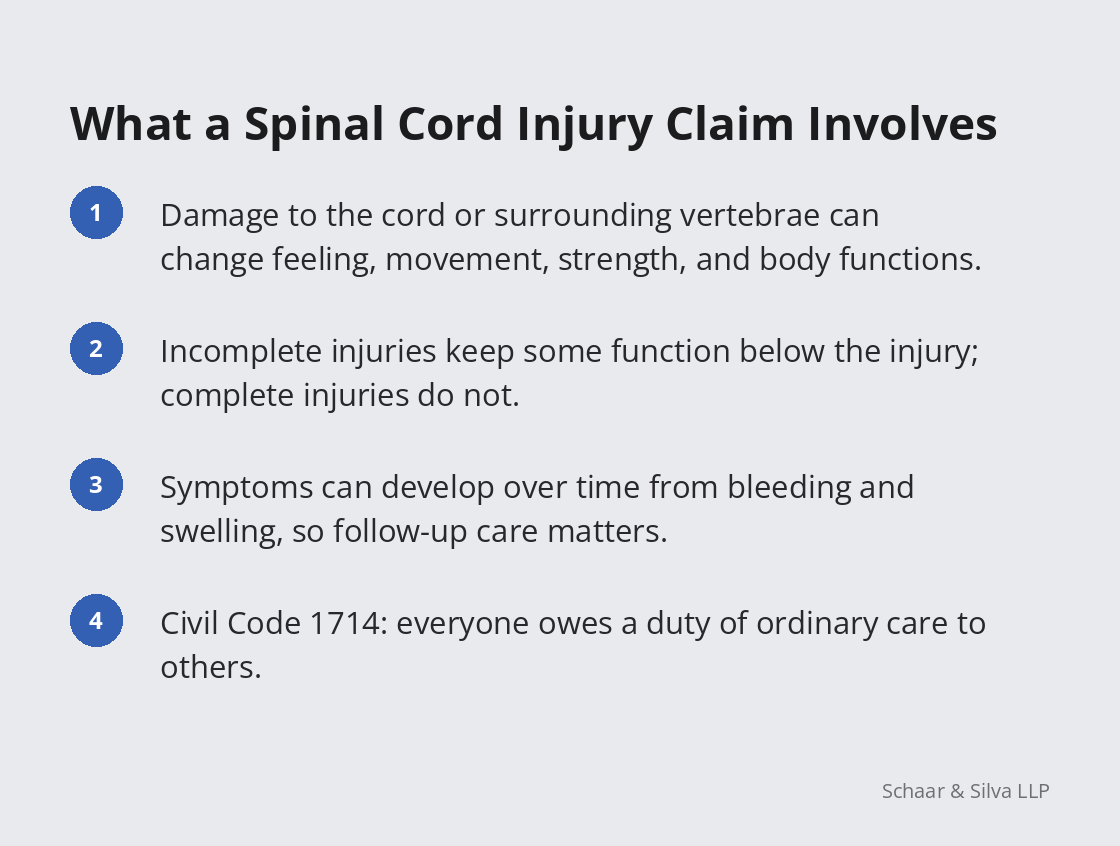
The National Institute of Neurological Disorders and Stroke describes a spinal cord injury as damage to the bundle of nerves and nerve fibers that sends and receives signals from the brain. That damage can come from a direct injury to the cord itself or from damage to the vertebrae and tissue around it. In a car crash, the violent forces of a rear-end impact, a side-impact collision at an intersection, or a rollover on a freeway can fracture or dislocate vertebrae and injure the cord. The damage can cause temporary or permanent changes in feeling, movement, strength, and body functions below the point of injury.
Complete and Incomplete Injuries
Doctors often classify a spinal cord injury as complete or incomplete. According to NINDS, an incomplete injury means the spinal cord can still send some messages to or from the brain, so the person keeps some feeling, function, and muscle control below the injury site. A complete injury means there is no nerve communication below the injury site. The location matters too, because injuries to upper parts of the cord affect more of the body than injuries lower down. These classifications shape treatment plans, and they also shape how a claim should be valued and presented.
Why Symptoms Can Change After the Crash
Not every spinal cord injury looks the same on the day of the crash. NINDS explains that paralysis can happen immediately or develop over time from bleeding, swelling, and cell death in the spinal cord. It also notes that symptoms can include numbness or tingling, weakness, pain or pressure in the neck or back, and loss of bladder and bowel control. Because the picture can change in the hours and days after a collision, prompt and continued medical evaluation is essential for your health and for an accurate record of what the crash did to you.
Who Can Be Held Responsible
California Civil Code Section 1714 makes everyone responsible for an injury caused to another by a want of ordinary care or skill in the management of his or her property or person. In a car accident, that duty applies to the driver who caused the crash, and it can also reach others whose carelessness played a part. Depending on the facts, responsibility may extend to a vehicle owner, an employer whose driver was working at the time, or a public agency. Identifying every responsible party early matters, because a serious spinal injury claim often involves more than one source of recovery.
How to Build a Spinal Cord Injury Claim That Reflects Your Future
The most important difference between a spinal cord injury claim and a minor injury claim is time. A spinal injury may require care, equipment, and support for years or for life, and the claim has to account for losses that have not happened yet. Building that kind of claim takes organized evidence and a clear view of what California law allows you to recover.
Documenting Your Medical Care From Day One
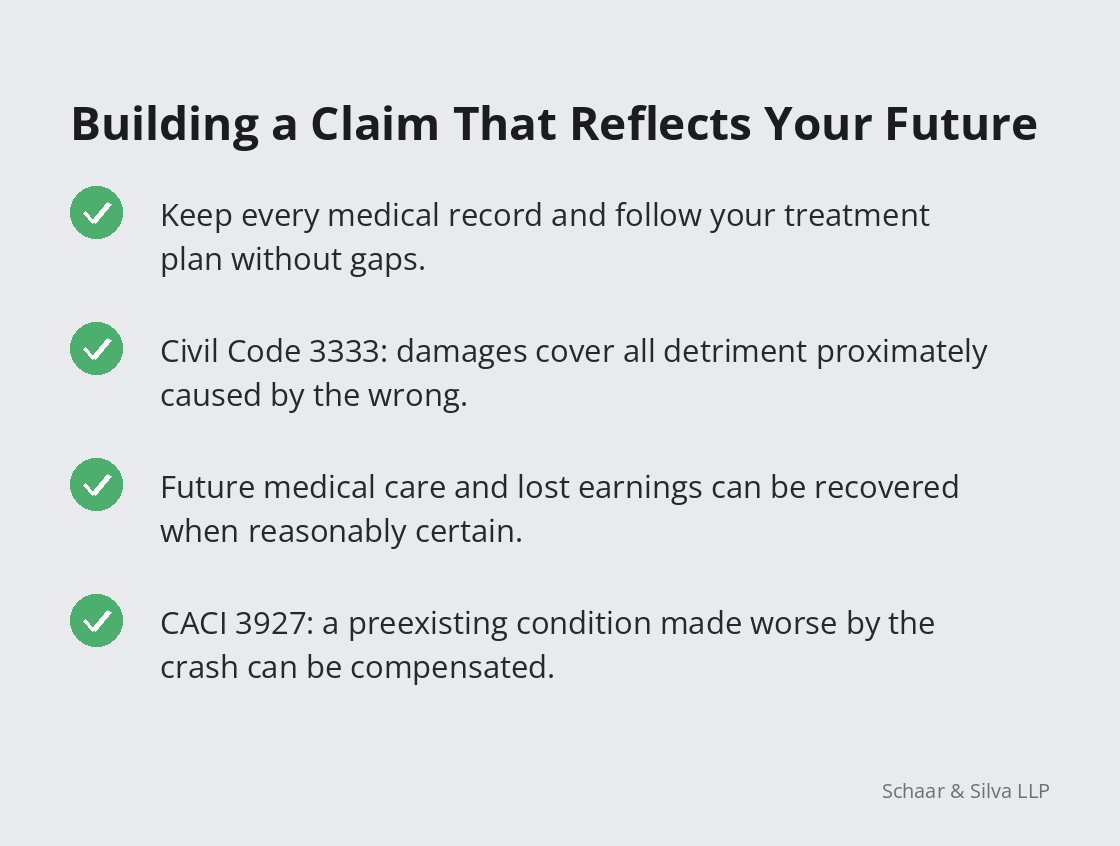
Your medical records are the backbone of the claim. Emergency room notes, imaging results, surgical reports, and rehabilitation records show the nature of the injury and how it has affected your body over time. Keep every appointment, follow your treatment plan, and tell your providers about every symptom, even ones that seem minor or embarrassing. Gaps in treatment are one of the first things an insurance adjuster looks for, and a consistent record makes it much harder to argue that your injury is less serious than it really is.
Accounting for Future Medical Needs and Lost Earnings
California law allows recovery for future harm, not just past harm. Civil Code Section 3333 provides that the measure of damages for a wrong not arising from contract is the amount that will compensate for all the detriment proximately caused by it. The California Civil Jury Instructions reflect this by allowing recovery for future medical care that a person is reasonably certain to need, as well as past and future lost earnings. In a spinal cord injury case, that can include ongoing therapy, surgeries, mobility equipment, home modifications, in-home care, and the effect of the injury on your ability to work. Opinions from treating doctors and other qualified professionals are often needed to show these future needs with reasonable certainty.
Recognizing Non-Economic Losses
Some of the most serious harms from a spinal injury cannot be measured with a receipt. Civil Code Section 1431.2 defines non-economic damages as subjective, non-monetary losses, including pain, suffering, inconvenience, mental suffering, emotional distress, and loss of consortium. The jury instructions add categories such as loss of enjoyment of life, physical impairment, and disfigurement. Keeping a journal about your pain, your limits, and the activities you can no longer enjoy helps show these losses in concrete terms.
Preexisting Back or Neck Problems
Many people who suffer a spinal injury in a crash already had some back or neck issues, and insurance companies are quick to blame the old condition. California’s civil jury instructions address this directly. Under CACI No. 3927, an injured person cannot recover for a condition that existed before the crash, but if that condition was made worse by the defendant’s wrongful conduct, the jury must award damages that reasonably and fairly compensate for the effect on that condition. Clear medical records from before and after the collision are often the best way to show how much the crash changed your health.
Spinal cord injuries often occur together with head trauma, and the two can be difficult to separate in medical records. Our page on Sacramento brain and spinal injury claims explains how we approach cases involving both kinds of harm.
Mistakes That Can Weaken a Spinal Cord Injury Claim
Even a strong spinal injury case can be weakened by a few avoidable mistakes. Many of them happen in the first weeks after the crash, when you are focused on recovery and the other side is already building its version of events. Knowing the common traps makes them easier to avoid.
Settling Before the Full Picture Is Clear
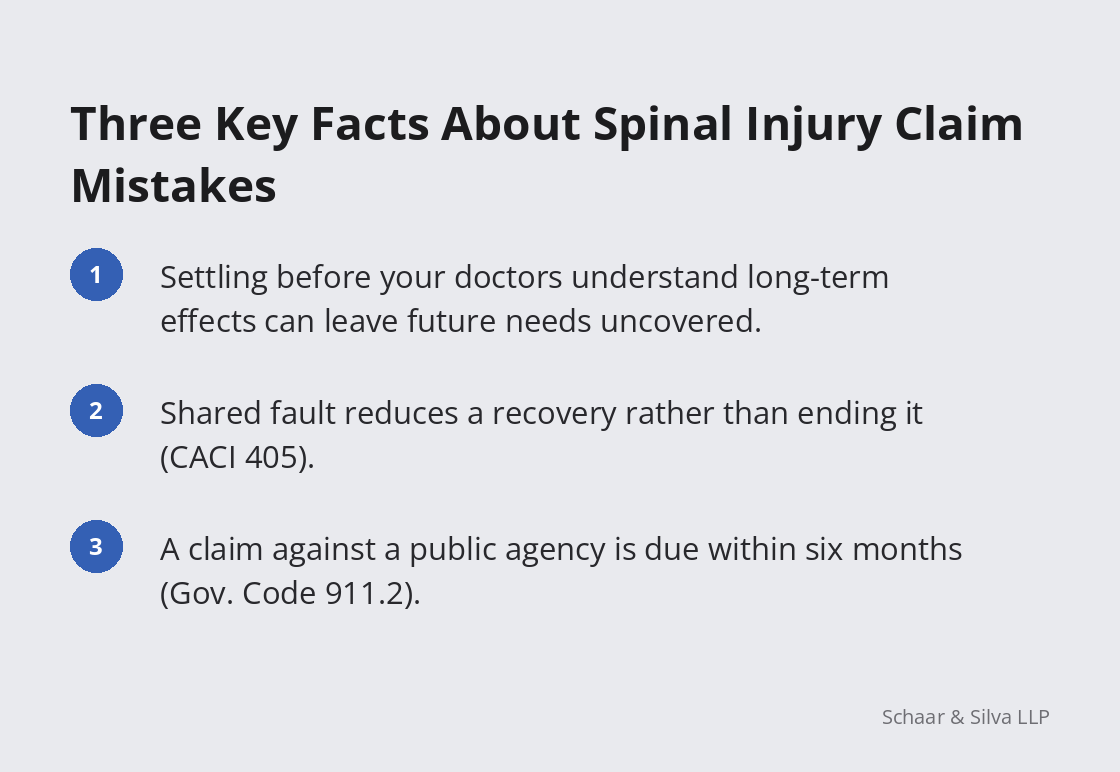
Insurance companies sometimes reach out early with an offer to resolve the claim. Accepting a settlement before your doctors understand the long-term effects of your injury can leave you without resources for future surgeries, therapy, or care. A spinal cord injury may take months to stabilize, and the true extent of recovery or permanent impairment is often not known right away. Waiting until your medical picture is clearer helps make sure any resolution reflects the injury you actually have.
Assuming Shared Fault Ends Your Claim
Some injured people assume they cannot recover if they made any mistake leading up to the crash. California follows comparative fault, and under CACI No. 405 a plaintiff’s damages are reduced by the percentage of the plaintiff’s own responsibility rather than eliminated. When more than one defendant is at fault, Civil Code Section 1431.2 provides that each defendant’s liability for non-economic damages is several only and is allocated in direct proportion to that defendant’s percentage of fault. These rules make careful fault analysis especially important when several drivers or companies were involved.
Missing Reports and Deadlines
Deadlines can be easy to overlook during a long recovery. Vehicle Code Section 16000 requires a driver involved in a crash that results in bodily injury or death to report it to the DMV within 10 days, either personally or through an insurance agent, broker, or legal representative. Code of Civil Procedure Section 335.1 generally sets a two-year period for an action for injury caused by the wrongful act or neglect of another. If a public agency or one of its vehicles was involved, Government Code Section 911.2 requires a claim for personal injury to be presented no later than six months after the cause of action accrues. Acting early protects your rights and preserves evidence such as vehicle data and witness memories.
Final Thoughts
A Sacramento spinal cord injury can affect your health, your work, your relationships, and your independence for years to come. California law allows injured people to pursue compensation for all of the detriment caused by another person’s carelessness, including future medical care, lost earnings, and the non-economic losses that shape everyday life. Thorough medical documentation, careful attention to fault, and timely action are what turn those legal rights into real results.
You do not have to sort through medical records, insurance calls, and legal deadlines on your own while you focus on recovery. Our team can gather the evidence, work with your medical providers to understand your future needs, and explain your options in plain language at every stage.
If you or a loved one suffered a spinal cord injury in a car or truck accident in the Sacramento area, contact Schaar & Silva LLP to speak with our team. We will listen to your story, answer your questions, and help you move forward with confidence.