

A Sacramento big rig accident caused by brake failure is rarely just bad luck. Commercial trucks are heavy, they need far more room to stop than passenger cars, and their braking systems require constant attention. When brakes fade, fall out of adjustment, or fail outright on Interstate 5, Interstate 80, Highway 50, or Highway 99, the results can be devastating for everyone nearby. Understanding the rules that govern truck maintenance gives you real control over your claim and helps you identify every party that may be responsible.
At Schaar & Silva LLP, we help people in Sacramento who have been hurt in car and truck accidents hold the right parties accountable so you can move forward with confidence. This guide explains what a brake failure truck crash actually involves, how maintenance and inspection records can show who is liable, and the mistakes that most often derail these claims.
What a Brake Failure Big Rig Accident Actually Involves
A brake-related truck crash usually starts long before the collision itself. Worn linings, leaking air lines, out-of-adjustment brakes, and ignored warning signs build up over weeks or months. When the truck finally needs to stop quickly in traffic, the brakes may not respond the way they should, and a rear-end, jackknife, or multi-vehicle crash can follow.
Because these crashes are tied to maintenance, the questions that matter go beyond what the driver did in the final seconds. They include how the truck was inspected, who was responsible for repairs, and whether known problems were ignored.
How Brake Problems Lead to Serious Crashes
Brake problems on a big rig can show up in several ways. Brakes that are out of adjustment may not apply with full force. Brakes that are unevenly adjusted can cause the truck to pull to one side during hard braking. Overheated brakes on a long grade can lose effectiveness at exactly the wrong moment. Any of these conditions can turn an ordinary slowdown on a Sacramento freeway into a high-impact collision.
The weight of a loaded tractor-trailer magnifies every one of these problems. A passenger car caught in front of a truck that cannot stop has very little protection, which is why brake failure crashes often lead to serious injuries such as fractures, spinal injuries, and traumatic brain injuries.
The Legal Duty to Keep Brakes in Working Order
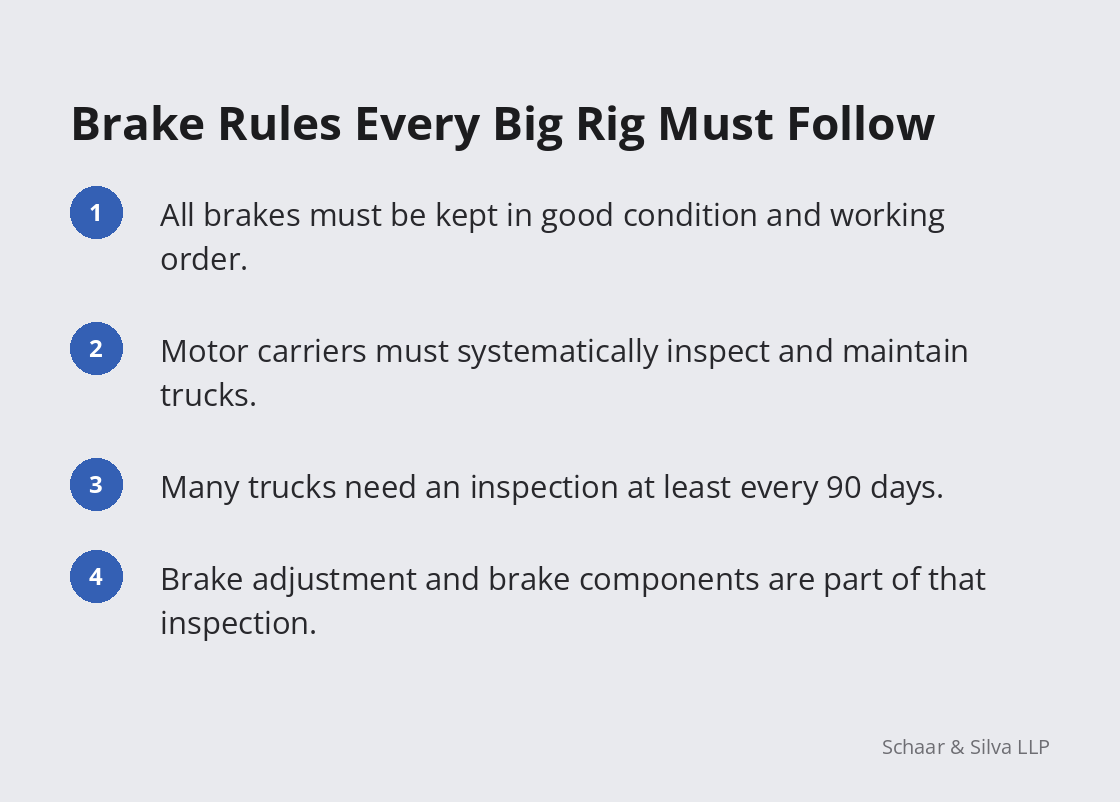
California law is direct about brake maintenance. Vehicle Code Section 26453 states that all brakes and component parts thereof shall be maintained in good condition and in good working order, and that the brakes shall be adjusted to operate as equally as practicable on opposite sides of the vehicle. This requirement applies to every vehicle on the road, including commercial trucks.
Federal safety rules add another layer for motor carriers. Under 49 CFR 396.3, every motor carrier must systematically inspect, repair, and maintain all motor vehicles subject to its control, and parts and accessories must be in safe and proper operating condition at all times. When a truck company falls short of these standards and a crash follows, those failures can become powerful evidence.
Why Sacramento Freeways Raise the Stakes
Sacramento sits where several major freight corridors meet. Interstate 5 and Highway 99 carry goods up and down the Central Valley, while Interstate 80 and Highway 50 connect the region to the Bay Area and the Sierra. That mix of long-haul trucks, local delivery vehicles, and heavy commuter traffic means sudden slowdowns and merges are common.
In stop-and-go conditions, a truck with weak brakes has little margin for error. A crash that begins with one truck that cannot stop can quickly involve several vehicles, which makes it even more important to understand how the collision started and why the brakes failed.
How Maintenance Records Show Who Is Liable
In a brake failure case, paperwork can matter as much as eyewitness accounts. Trucking companies are required to inspect their vehicles and keep records of that work, and those records often reveal whether a problem was known, ignored, or never checked at all.
Reviewing these records early is one of the most effective ways to build a Sacramento big rig accident claim and to identify everyone who may share responsibility.
Systematic Inspections and the 90-Day Inspection
California requires periodic inspections for many commercial trucks. Vehicle Code Section 34505.5 requires covered motor carriers, as part of their systematic inspection, maintenance, and lubrication program, to have their vehicles inspected at least every 90 days, or more often if necessary to ensure safe operation. That inspection must include brake adjustment and brake system components and leaks, along with steering, suspension, tires, wheels, and connecting devices.
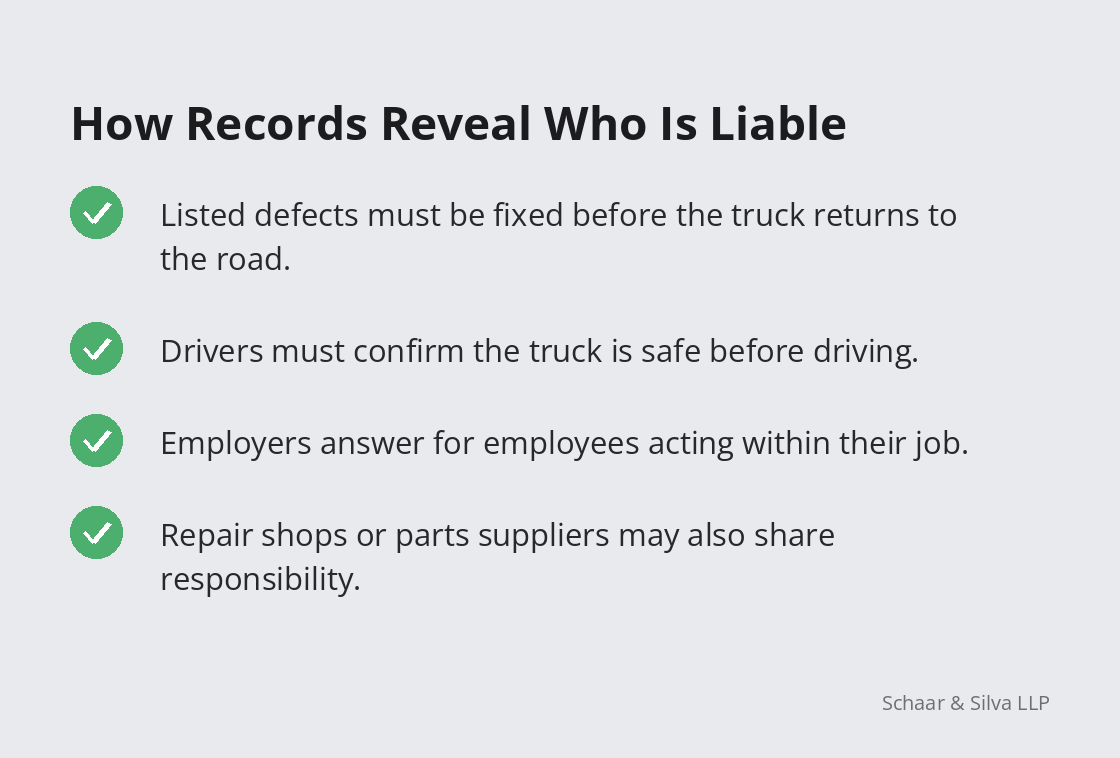
The same section says a vehicle may not be operated on the highway, other than to a place of repair, until the defects listed during the inspection have been corrected and attested to by the motor carrier’s authorized representative. Records of these inspections must be kept for two years. Missing inspections, unrepaired defects, or incomplete records can all point to the carrier’s responsibility for a crash.
The Driver’s Pre-Trip Responsibilities
Truck drivers have their own duties. Under 49 CFR 396.13, before driving a motor vehicle, the driver must be satisfied that the vehicle is in safe operating condition, review the last driver vehicle inspection report when one is required, and sign it to acknowledge that any required repairs have been certified. A driver who skips these steps, or who keeps driving after noticing brake problems, may share responsibility for the crash.
These requirements create a paper trail. Inspection reports, repair orders, and driver logs can show whether a brake issue was reported and whether anyone acted on it before the truck went back on the road.
More Than One Party May Share Responsibility
Brake failure crashes often involve several potentially responsible parties. The trucking company may be responsible for its own maintenance failures. Under California’s civil jury instructions, an employer is also responsible for harm caused by the wrongful conduct of its employees while acting within the scope of their employment, which can make the carrier answerable for a driver’s negligence.
Depending on the facts, an outside maintenance shop that performed faulty brake work or a company that supplied defective parts may also play a role. Identifying every party early helps ensure that the people and companies who contributed to the crash are held accountable. For a broader look at truck cases, see our guide on building your case after a Sacramento big rig crash.
What Derails a Truck Brake Failure Claim
Brake failure cases can be strong, but they are also vulnerable to delay and missed steps. Trucking companies and their insurers often move quickly after a crash, and injured people who wait can find that key evidence is gone.
The problems below are among the most common reasons these claims lose strength.
Waiting While Records and the Truck Disappear
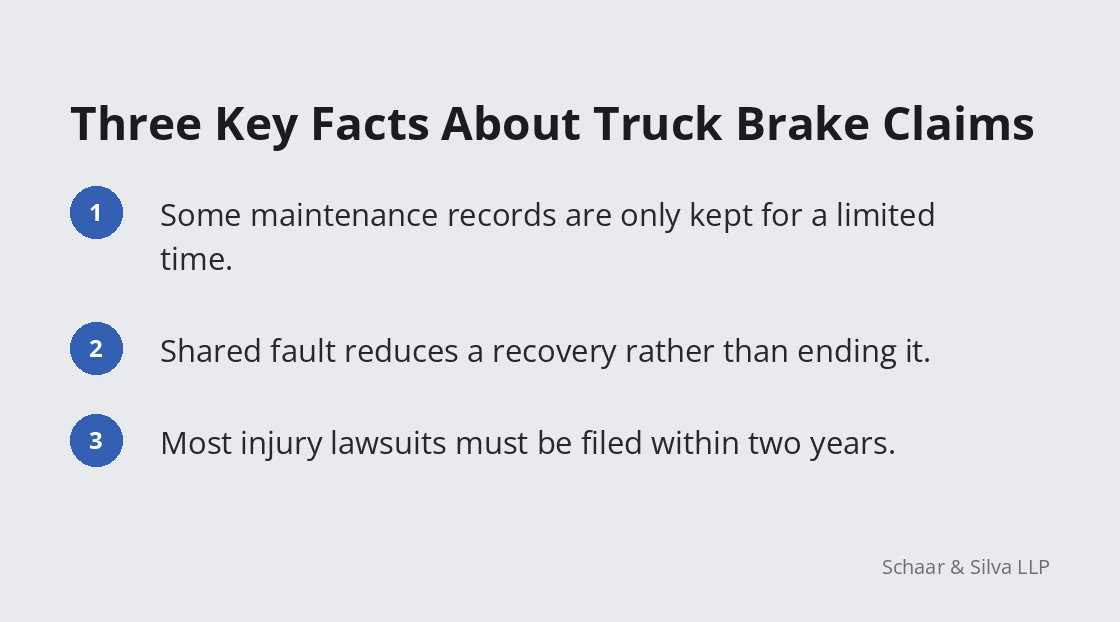
Maintenance records are not kept forever. Federal rules in 49 CFR 396.3 require motor carriers to retain maintenance records where the vehicle is housed or maintained for one year, and for six months after the vehicle leaves the carrier’s control. The truck itself may be repaired, returned to service, or sold, which can erase physical evidence of what went wrong with the brakes.
Prompt action to request that the company preserve the truck, its brake components, inspection reports, and electronic data can make the difference between proving a maintenance failure and arguing about it. The longer the wait, the harder that proof becomes.
Assuming the Truck Driver Alone Is to Blame
It is natural to focus on the driver who was behind the wheel. In a brake failure case, though, the driver may be only part of the story. If the carrier skipped required inspections or kept a truck in service with known defects, its responsibility may be significant.
Focusing only on the driver can leave important parties out of the claim. A careful review of inspection records, repair history, and company practices helps show the full picture of how the crash happened.
Overlooking Shared Fault and Filing Deadlines
Truck companies sometimes argue that the other driver was partly at fault, for example by cutting in front of the truck. California uses a comparative fault system, and under the state’s civil jury instructions, a plaintiff’s damages are reduced by the plaintiff’s percentage of responsibility rather than eliminated. Shared fault does not automatically end a claim.
Deadlines matter just as much. Code of Civil Procedure Section 335.1 generally allows two years to file an action for injury or death caused by the wrongful act or neglect of another. Vehicle Code Section 16000 also requires drivers involved in an accident resulting in bodily injury or death to report it to the Department of Motor Vehicles within 10 days. Missing these deadlines can seriously harm or end a claim.
Final Thoughts
A Sacramento big rig accident caused by brake failure usually points to choices made long before the crash, such as skipped inspections, ignored defects, or a truck kept on the road when it should have been repaired. California and federal rules require trucks to have working brakes, regular inspections, and records that show what was done. Those requirements can help reveal who is responsible when something goes wrong.
If you or a loved one was hurt in a truck crash in the Sacramento area, acting quickly to preserve evidence can protect your claim. Contact Schaar & Silva LLP to talk with our team about what happened and the next steps that make sense for you.