

A rainy day car accident in Santa Cruz County can happen in an instant when wet pavement, poor visibility, and a driver who refuses to slow down come together. The first storms of the season can leave oil and debris on Highway 1, Highway 17, and the winding roads through the Santa Cruz Mountains, and drivers who keep their usual speed are far more likely to lose control or rear-end someone. Many people assume that a crash in bad weather is simply an accident that no one caused. California law sees it differently, and understanding how gives you real control over your claim.
At Schaar & Silva LLP, we help people injured in car and truck accidents throughout Santa Cruz County hold careless drivers accountable so you can move forward with confidence. This guide explains how California law actually treats driving in the rain, how fault is proven after a wet-weather crash, and the mistakes that can weaken a rainy-day accident claim.
How California Law Actually Treats Driving in the Rain
California does not have a separate set of traffic laws for storms. Instead, several everyday rules of the road require drivers to adjust to conditions, and those rules become especially important when the roads are wet. When a driver ignores them and causes a crash, the violation can become key evidence in an injury claim. Knowing these rules helps you recognize whether the other driver’s conduct crossed the line.
The Basic Speed Law
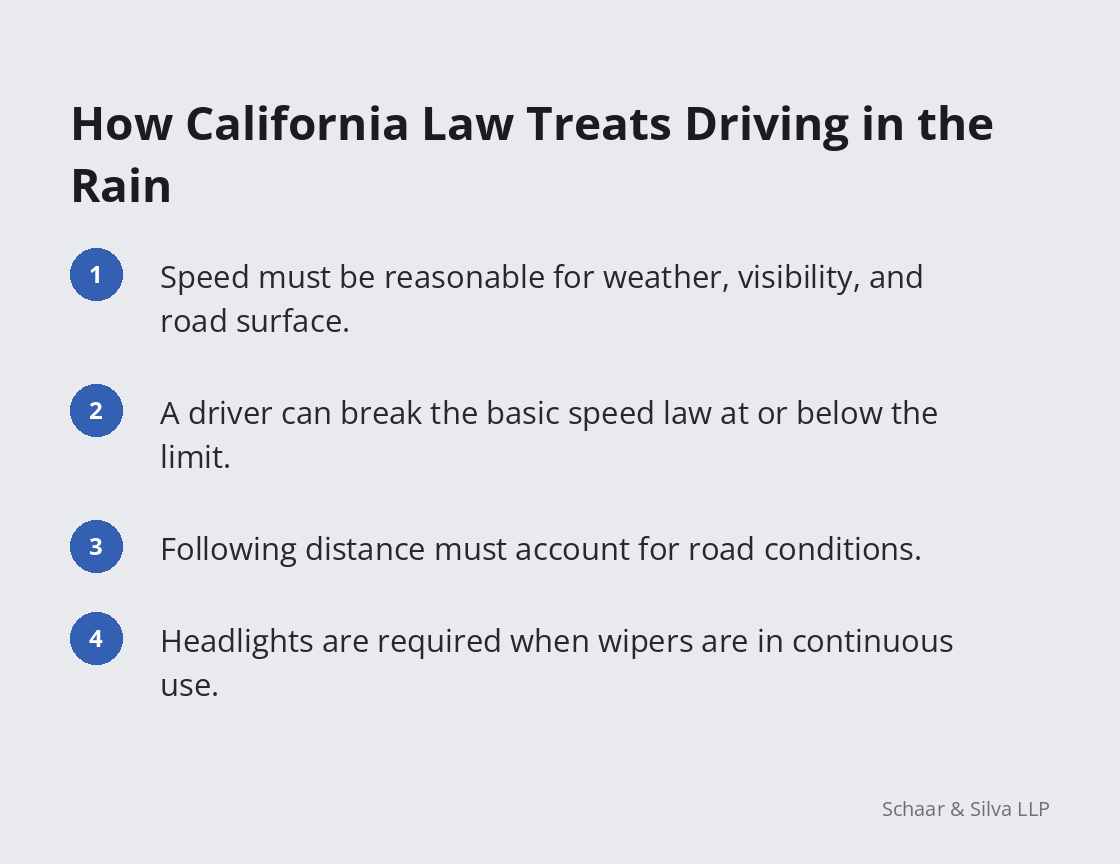
Vehicle Code Section 22350, often called the basic speed law, provides that no person shall drive a vehicle upon a highway at a speed greater than is reasonable or prudent having due regard for weather, visibility, the traffic on, and the surface and width of, the highway, and in no event at a speed which endangers the safety of persons or property. This means a driver can violate the law while traveling at or below the posted limit. If heavy rain, standing water, or fog made the posted speed unsafe, the driver was required to slow down.
Following Distance on Wet Roads
Vehicle Code Section 21703 provides that a driver shall not follow another vehicle more closely than is reasonable and prudent, having due regard for the speed of the vehicle and the traffic upon, and the condition of, the roadway. Wet pavement takes longer to stop on, so a following distance that might be acceptable on a dry afternoon can be unreasonable during a storm. Rear-end collisions in stop-and-go traffic on Highway 1 near Soquel and Aptos are one example of how this rule applies when it rains.
Headlights When the Wipers Are On
California also requires drivers to make themselves visible in bad weather. Vehicle Code Section 24400 requires a motor vehicle, other than a motorcycle, to be operated during darkness, or inclement weather, or both, with at least two lighted headlamps. The statute defines inclement weather to include a condition requiring the windshield wipers to be in continuous use due to rain, mist, snow, fog, or other precipitation or atmospheric moisture. A driver who causes a crash in the rain without headlights on may have violated this rule.
Proving Fault After a Wet-Weather Crash in Santa Cruz County
Insurance companies sometimes treat rain as a reason to deny responsibility. In reality, weather is one of the conditions every driver must account for. Proving fault after a rainy-day crash depends on showing what the other driver should have done differently and gathering evidence before it disappears.
Why Weather Is Not an Excuse
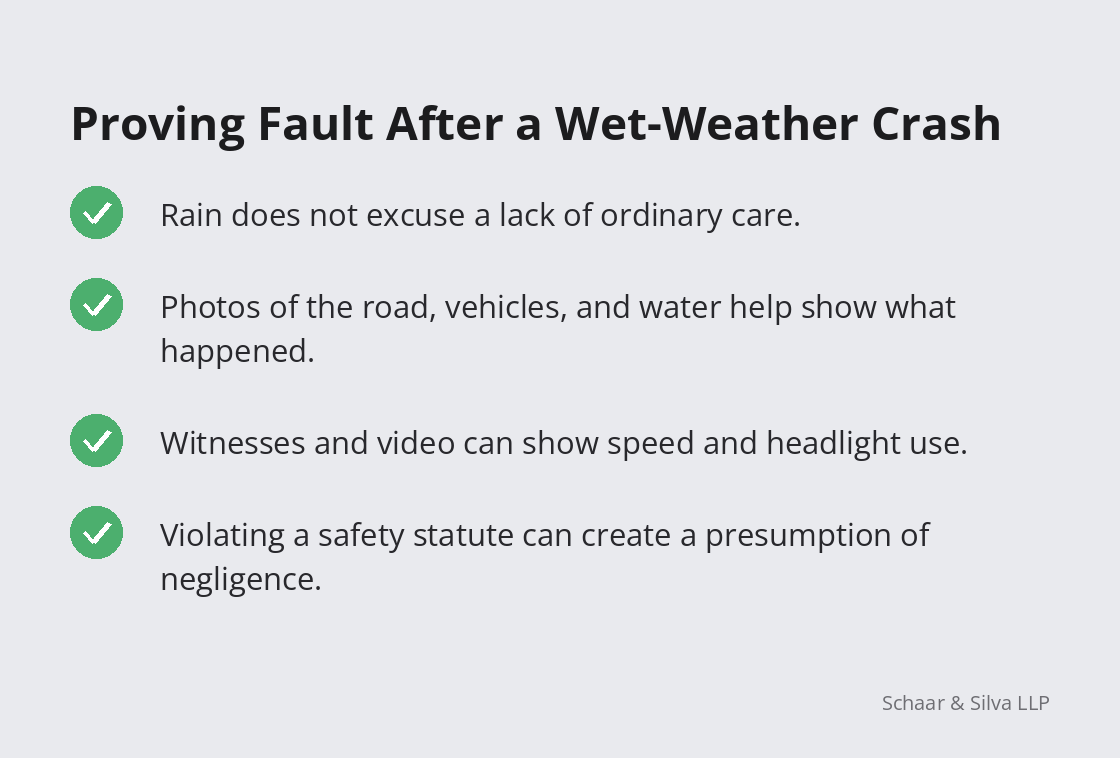
Under Civil Code Section 1714, everyone is responsible for an injury caused to another by a lack of ordinary care in the management of their property or person. A reasonably careful driver in a Santa Cruz County storm slows down, leaves more room, turns on headlights, and watches for hydroplaning and standing water. When a driver fails to do those things and causes a collision, the rain does not erase that driver’s responsibility. The question is not whether the weather was bad, but whether the driver responded to it with ordinary care.
Evidence That Shows Unsafe Driving
Useful evidence after a wet-weather crash includes photos of the vehicles, the road surface, and any standing water, along with the location of skid marks and debris. Witness statements can describe how fast the other driver was traveling and whether headlights were on. Dash camera and nearby business video, vehicle damage patterns, and the official collision report all help reconstruct what happened. Because rain can wash away marks and change road conditions within hours, photos taken at the scene are especially valuable.
How a Traffic Violation Supports Your Claim
California law gives special weight to safety-statute violations. Under Evidence Code Section 669, a failure to exercise due care is presumed if a person violated a statute, the violation proximately caused injury, the injury resulted from an occurrence the statute was designed to prevent, and the injured person was among those the statute was meant to protect. The presumption can be rebutted, but evidence that a driver violated the basic speed law, the following distance rule, or the headlight requirement can be a powerful part of a rainy-day accident claim.
Mistakes That Weaken a Rainy-Day Accident Claim
Many weather-related claims become harder than they need to be because of a few avoidable mistakes. Knowing them ahead of time helps you protect your claim from the start.
Accepting That the Storm Caused the Crash
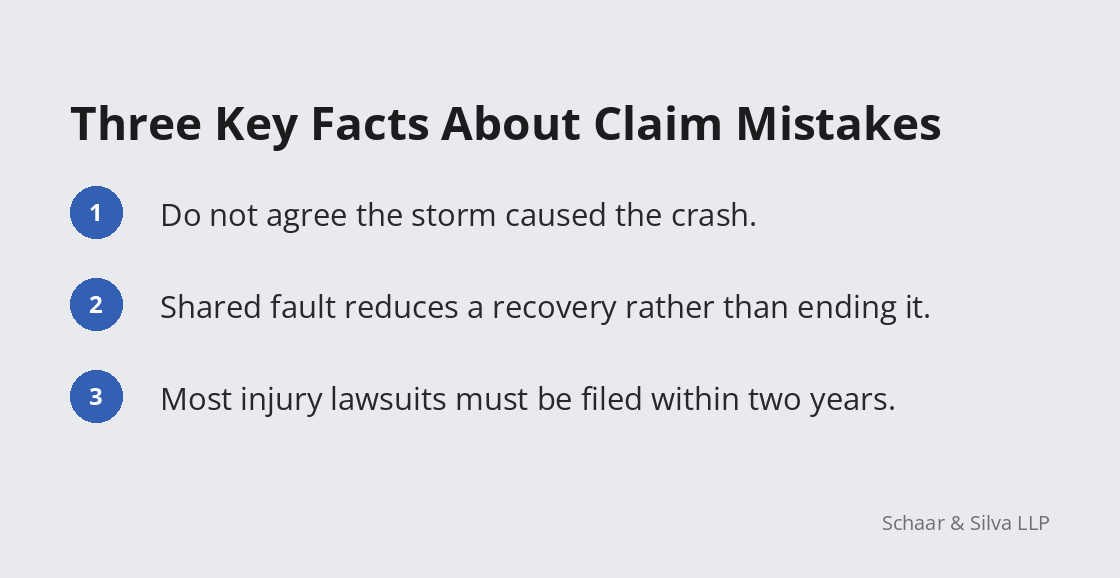
One of the most common mistakes is agreeing, at the scene or later with an insurance adjuster, that the crash was nobody’s fault because of the rain. Statements like that can be used to argue that the other driver acted reasonably. Stick to the facts you know, such as where you were, what you saw, and how the crash happened, and avoid guessing about speeds or blaming the weather before the evidence has been reviewed.
Overlooking a Dangerous Road Condition
Sometimes a road itself contributes to a wet-weather crash, such as a clogged drain that floods a lane or a known slick curve with no warning. Under Government Code Section 835, a public entity can be liable for injury caused by a dangerous condition of its property when certain requirements are met, including that the condition created a reasonably foreseeable risk of the kind of injury that occurred. A claim against a public entity generally must be presented within six months after the claim accrues under Government Code Section 911.2, so this possibility should be evaluated quickly.
Assuming Your Own Share of Fault Ends the Claim
The other driver’s insurer may argue that you were also driving too fast for the conditions. California follows comparative fault. Under the Judicial Council’s civil jury instruction CACI No. 405, if a defendant proves that the injured person was negligent and that the negligence was a substantial factor in causing the harm, the injured person’s damages are reduced by the percentage of that person’s responsibility. A share of fault reduces a recovery rather than eliminating it.
Missing Reporting and Filing Deadlines
Vehicle Code Section 16000 requires a driver involved in a crash that results in bodily injury or death, among other situations, to report the accident to the Department of Motor Vehicles within 10 days on an approved form. Separately, under Code of Civil Procedure Section 335.1, an action for injury to an individual caused by the wrongful act or neglect of another generally must be filed within two years. Keeping track of both deadlines protects your rights while you focus on recovery.
Final Thoughts
A rainy day car accident in Santa Cruz County is not automatically a no-fault event. California law requires drivers to slow down for weather, leave a safe following distance for road conditions, and turn on headlights when the wipers are in continuous use. When a driver ignores those rules and causes a crash, the violation can support a presumption of negligence. Acting quickly to document the scene and protect your rights gives your claim the best chance of success. You can learn more on our page about auto accident claims.
Focus on your health first, but keep your photos, medical records, and notes about the weather and road conditions in one place. Those details often make the difference in showing what really happened.
If you were hurt in a wet-weather crash in Santa Cruz County, contact Schaar & Silva LLP for a case evaluation. We will review your evidence, explain your rights under California law, and help you take the next step with confidence. We serve Santa Cruz County and surrounding areas.