
An Oakland wrongful death claim is never something a family expects to think about. When a car crash, a truck collision, or a driver’s careless turn takes someone you love, the grief comes first and the legal questions follow later. Yet California law sets clear rules about who can bring a claim, what it covers, and how long a family has to act, and understanding those rules early can protect your options while you focus on each other.
At Schaar & Silva LLP, we help families in Oakland and throughout Alameda County who have lost someone in a vehicle crash. This guide walks you through what a wrongful death claim actually is, the steps a family takes to pursue one, and the mistakes that can quietly weaken it, so you can move forward with confidence during a very difficult time.
What a Wrongful Death Claim Actually Is in California
A wrongful death claim is a civil case brought by certain family members, or on their behalf, when a person dies because of someone else’s wrongful act or neglect. In the context of Oakland roads, that usually means a driver who was speeding, distracted, impaired, or ignoring a signal, or a trucking company that put an unsafe driver or vehicle on the road. The claim focuses on the family’s loss, and it exists separately from any criminal case.
Who Can Bring the Claim
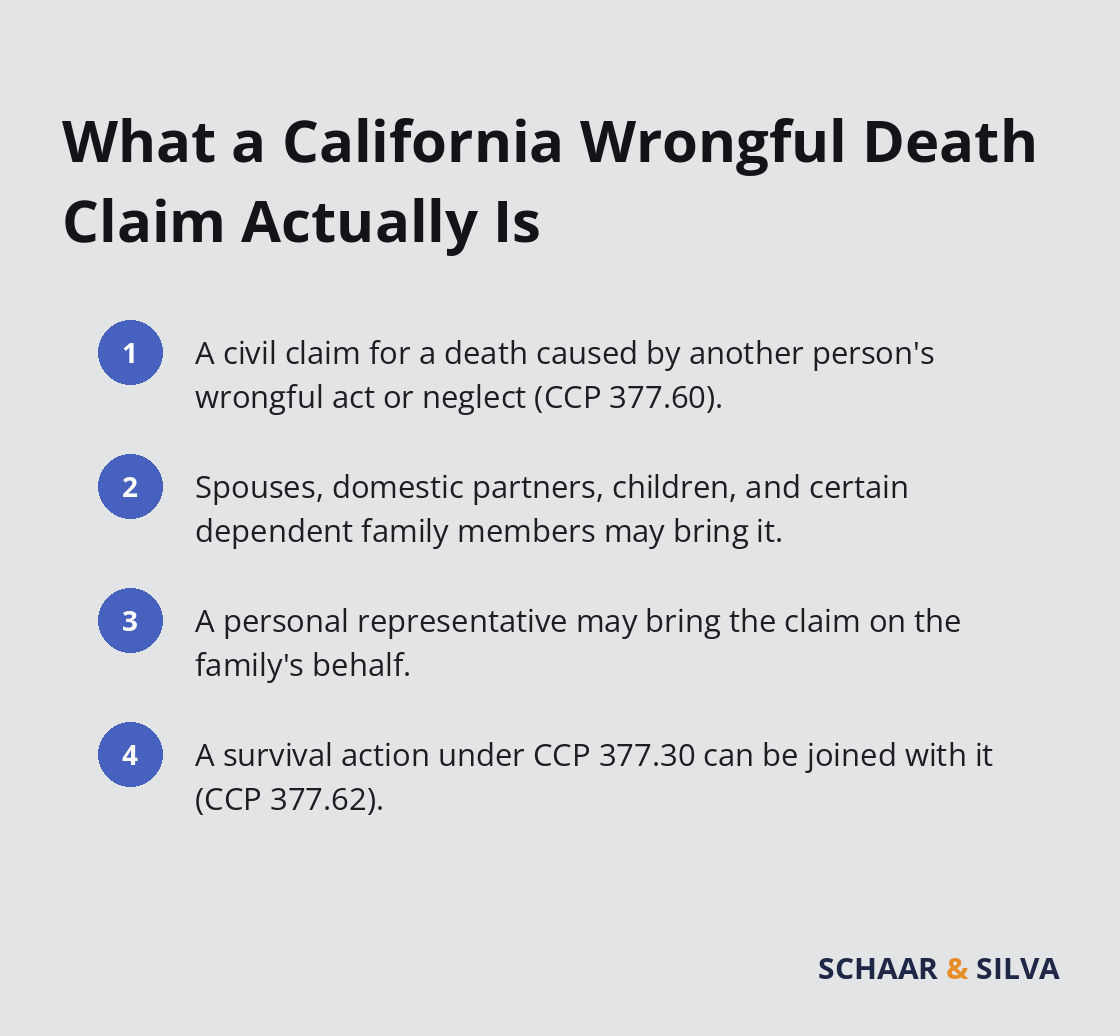
California Code of Civil Procedure 377.60 lists the people who may assert a cause of action for the death of a person caused by the wrongful act or neglect of another, either directly or through the decedent’s personal representative on their behalf. The first group is the surviving spouse, domestic partner, children, and issue of deceased children; if there is no surviving issue, the people who would inherit the decedent’s property by intestate succession can bring the claim. A second group includes a putative spouse, children of a putative spouse, stepchildren, parents, or legal guardians if the parents are deceased, when those people were dependent on the decedent. The statute also covers a minor who lived in the decedent’s household for the previous 180 days and depended on the decedent for one-half or more of the minor’s support.
What the Claim Is Meant to Address
Code of Civil Procedure 377.61 provides that in a wrongful death action, damages may be awarded that, under all the circumstances of the case, may be just. The statute does not list every category, but California’s civil jury instructions for wrongful death describe losses such as the decedent’s love, companionship, comfort, care, assistance, protection, affection, society, and moral support, along with training and guidance where it applies. The focus is on what the family lost when that relationship ended. The same section directs the court to determine the respective rights of the people entitled to share in an award, which matters when several family members are involved.
How a Survival Claim Differs
A wrongful death claim is brought for the family’s own loss. A separate claim, often called a survival action, carries forward the claim the person who died could have brought. Under Code of Civil Procedure 377.30, a cause of action that survives a person’s death passes to the decedent’s successor in interest, and an action may be commenced by the decedent’s personal representative or, if there is none, by the successor in interest. Code of Civil Procedure 377.62 allows a survival action to be joined with a wrongful death action arising from the same wrongful act or neglect, so both claims can often move forward together.
Steps Families Take to Pursue an Oakland Wrongful Death Claim
Every family’s path looks a little different, but most claims follow a similar arc: confirming the facts of the crash, identifying everyone who may be responsible, organizing the family’s side of the claim, and filing on time. Each step builds on the last, and none of them requires a family to have every answer on day one.
Establishing What Happened
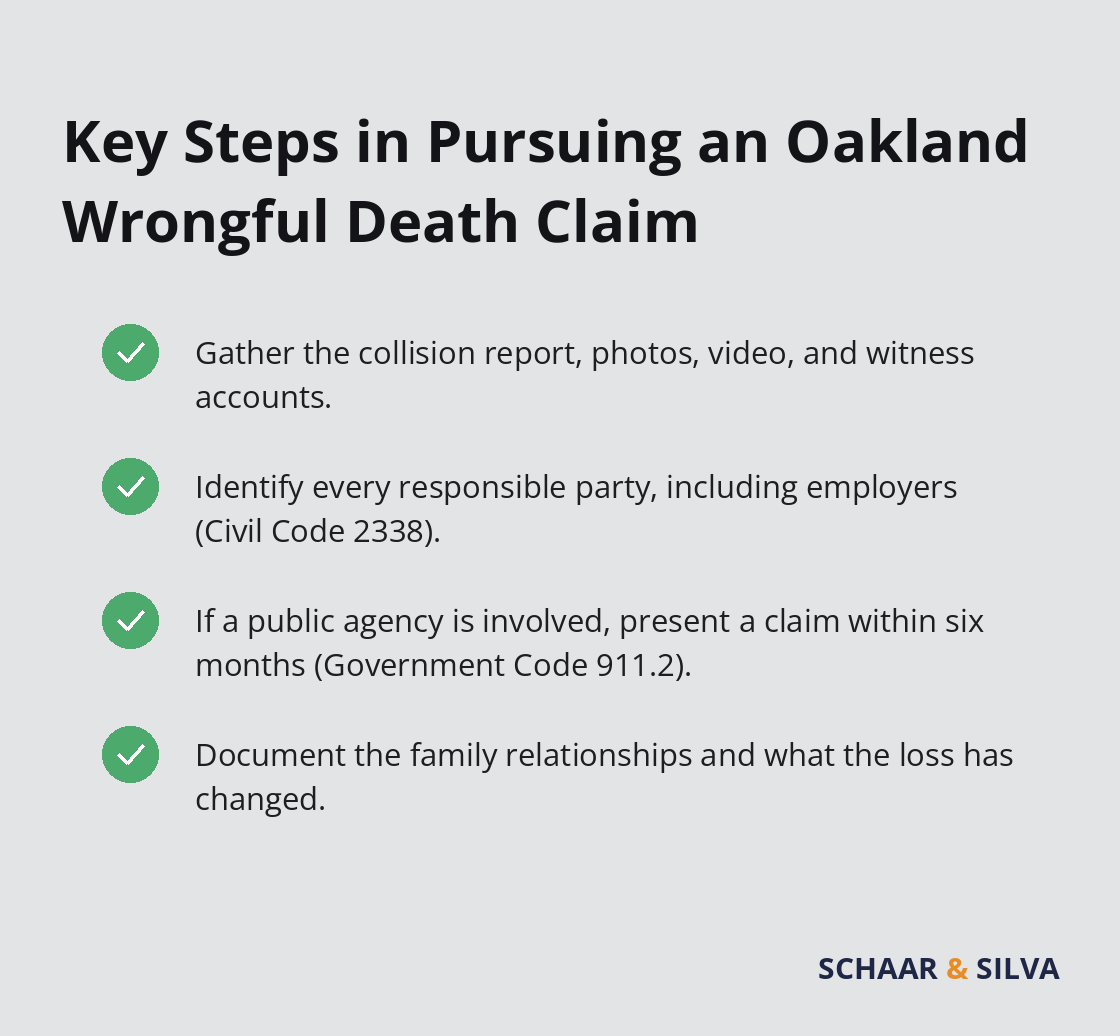
The foundation of a wrongful death claim is the same as any negligence case. California Civil Code 1714 provides that everyone is responsible for an injury caused to another by a lack of ordinary care or skill. Proving that a driver fell short of that standard usually depends on the traffic collision report, photographs and video from the scene, witness statements, vehicle data, and, in truck cases, the carrier’s driver and maintenance records. On busy Oakland corridors and freeways, nearby businesses and transit vehicles may have captured footage that is later recorded over, so identifying it early helps.
Identifying Every Responsible Party
Fatal crashes often involve more than one source of responsibility. A delivery driver’s employer, a trucking company, a vehicle owner who lent a car, or a public agency whose vehicle or roadway played a role may all need to be examined. When a public entity may be responsible, Government Code 911.2 requires a claim for death or injury to be presented to that entity no later than six months after the cause of action accrues, which is far sooner than the usual lawsuit deadline. Looking at the full picture early helps make sure no responsible party is overlooked and no shorter deadline slips by.
Employers deserve particular attention. Under California Civil Code 2338, a principal is generally responsible to third persons for the negligence of its agent in the transaction of the business of the agency. In practical terms, when a driver was working at the time of a fatal crash, making deliveries, hauling freight, or traveling for a job, the company that employed or directed that driver may share responsibility. Employment records, dispatch logs, delivery app data, and route assignments can help show what the driver was doing and for whom. These details often determine whether the employer, and not just the individual driver, is part of the claim.
Organizing the Family’s Side of the Case
Because the claim is about the family’s loss, the family’s story matters. That includes who depended on the person who died, how they were involved in each other’s daily lives, and what has changed since the crash. Gathering photos, letters, school and work records, and accounts from friends and relatives helps show the depth of the relationship. If a personal representative will be appointed, or if a minor child is among the heirs, those roles should be clarified early so the claim is brought by the right people.
Mistakes That Can Weaken a Wrongful Death Claim
Families dealing with a sudden loss are understandably focused on funeral arrangements, children, and each other. Insurance companies, meanwhile, begin building their side of the case almost immediately. A few common missteps can make a valid claim harder to pursue, and knowing them in advance helps a family avoid them.
Waiting for the Criminal Case to Finish
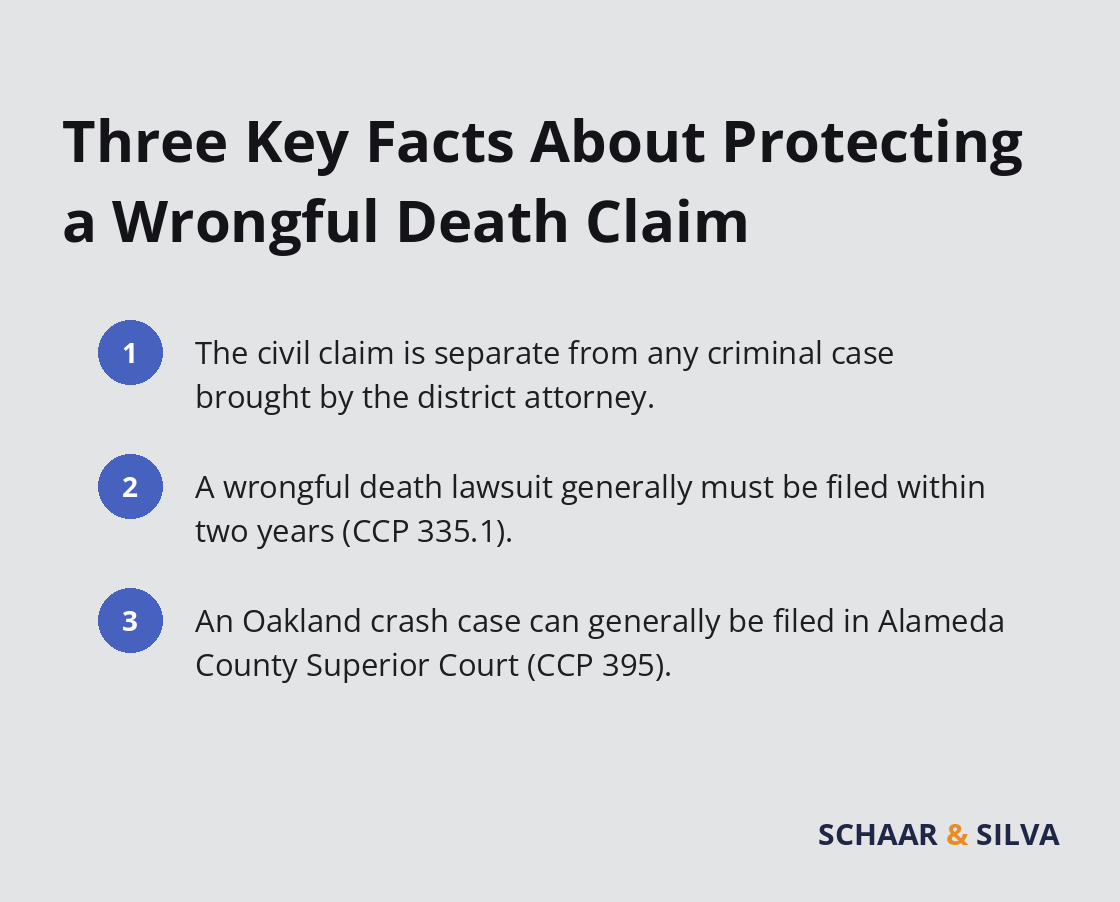
When a crash leads to criminal charges, many families assume the civil claim has to wait. In California, the district attorney is the public prosecutor and conducts prosecutions on behalf of the people under Government Code 26500, which means the criminal case is the state’s case, not the family’s. The family’s civil claim follows its own timeline. Under Code of Civil Procedure 335.1, an action for the death of an individual caused by the wrongful act or neglect of another generally must be filed within two years. Waiting on the outcome of a criminal case without checking the civil deadline can put the family’s claim at risk.
Leaving Family Members Out
Because California treats the wrongful death claim as belonging to the eligible heirs, it is important to identify everyone who may have a right to participate. Overlooking an adult child, a dependent parent, or another eligible family member can create complications later. Taking the time to map out the family under Code of Civil Procedure 377.60 at the start keeps the claim on solid ground.
Talking to Insurers Too Soon
Adjusters may reach out quickly, sometimes before a family has even received the collision report. Recorded statements, casual comments about the person who died, or signed forms can later be used to minimize the claim. It is reasonable to decline to give a statement until you understand the facts and your rights. A lawsuit for a crash in Oakland would generally be filed in the Alameda County Superior Court, because Code of Civil Procedure 395 makes the county where the fatal injury occurred a proper court for a wrongful death action, and having the claim organized before that point gives the family a stronger voice.
Final Thoughts
Losing someone in a crash is one of the hardest things a family can face, and no legal claim can undo that loss. What California law can do is hold the responsible parties accountable and help the family stabilize its future. Knowing who can bring the claim, how it differs from a survival action, and which deadlines apply puts you in a far better position to make decisions when you are ready.
You do not have to work through the collision report, the insurance calls, and the court rules alone. Learning more about how an Oakland wrongful death attorney can help is a good place to start.
If your family lost a loved one in a car, truck, or pedestrian crash in Oakland, contact Schaar & Silva LLP for a compassionate case evaluation. We’ll listen, review what happened, and explain your options so you can take the next step on your own terms.