
An Oakland hit-and-run accident leaves you hurt, shaken, and facing a frustrating question: how do you pursue a claim when the driver who hit you is gone? Many people assume there is nothing they can do, but California law gives injured people a path through their own uninsured motorist coverage, as long as certain reporting steps and deadlines are met. Knowing those rules from the start puts you back in control.
At Schaar & Silva LLP, we help people injured in Oakland crashes understand their rights and protect their claims after a driver flees. This guide walks through the duties drivers owe after a crash, how uninsured motorist coverage actually works for hit-and-run cases, and the mistakes that can quietly derail a claim so you can move forward with confidence.
What the Law Actually Requires After an Oakland Crash
California’s Vehicle Code sets clear duties for any driver involved in a crash that injures or kills someone. A driver who leaves the scene without meeting those duties has broken the law, and that conduct can be important evidence in your claim even if the driver is never found.
The Duty to Stop
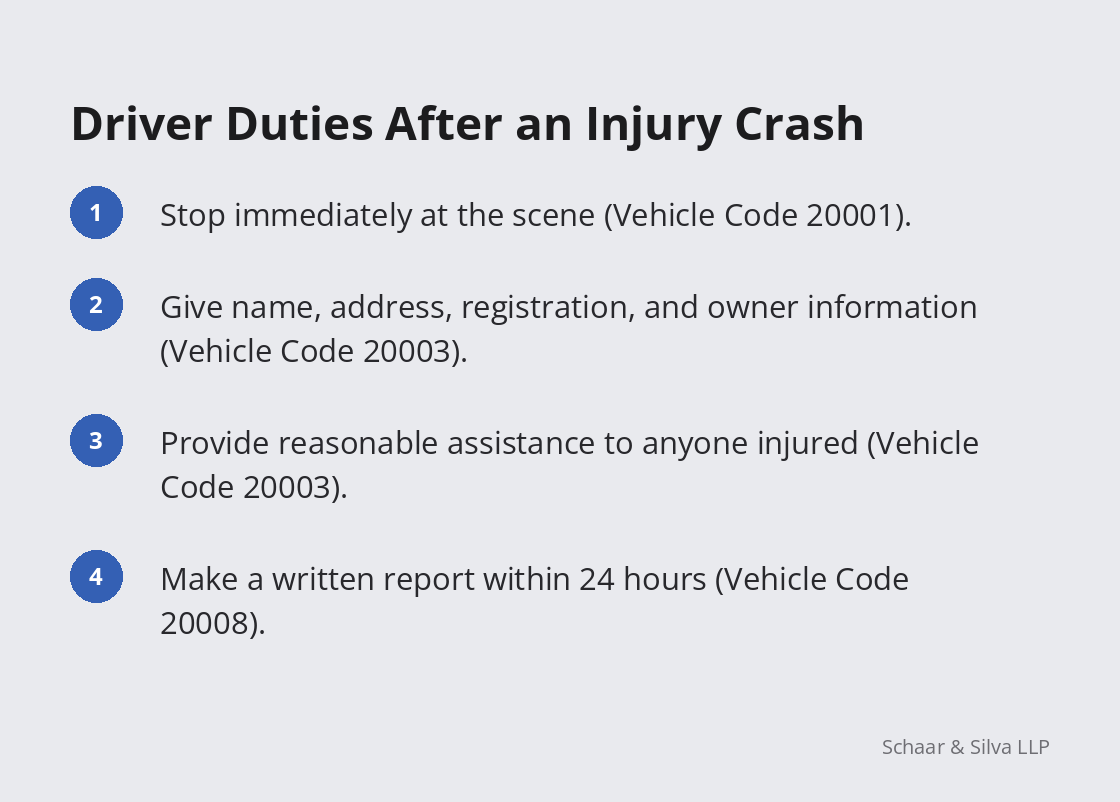
Under Vehicle Code section 20001, the driver of a vehicle involved in an accident resulting in injury to another person or in death must immediately stop at the scene and fulfill the requirements of sections 20003 and 20004. Driving away from a collision that hurt someone is not a minor traffic violation. It is a serious offense, and police take reports of injury hit-and-runs seriously.
The Duty to Share Information and Help
Vehicle Code section 20003 requires a driver involved in an injury crash to give their name, current residence address, the registration number of the vehicle, and the name and address of the owner to the person struck or the occupants of the other vehicle, and to any officer at the scene. The same section requires the driver to give reasonable assistance to anyone injured, including arranging transportation to medical care when it is apparent that treatment is necessary or when the injured person asks.
The Duty to Report Within 24 Hours
Vehicle Code section 20008 requires the driver of a vehicle involved in an accident resulting in injury or death to make a written report within 24 hours to the California Highway Patrol or, if the accident happened within a city, to either the Highway Patrol or the city’s police department. Making your own prompt report to the Oakland Police Department or the Highway Patrol after a hit-and-run also creates an official record of what happened, which matters a great deal for insurance purposes.
Gathering Evidence Before It Disappears
Oakland streets are lined with businesses, homes, and transit stops that often have cameras, but many systems record over footage within days. If you are able, note the time and exact location of the crash, the direction the other vehicle traveled, and any part of a plate number, color, make, or model you remember. Ask nearby businesses whether they have footage, and collect names and phone numbers from anyone who saw the crash. Even small details can help police locate the driver or confirm that physical contact occurred.
How Uninsured Motorist Coverage Works for Hit-and-Run Claims
When the at-fault driver cannot be identified, there is no one else’s liability insurance to claim against. That is where your own uninsured motorist coverage comes in. This coverage is designed for exactly this situation, allowing you to recover from your own insurer for injuries that a missing or uninsured driver legally caused. It does not require you to prove who the driver was, but it does require you to show that an unknown driver was at fault and to follow the steps the statute lays out. Because the coverage comes from your own policy, reading that policy carefully is one of the first things to do after a hit-and-run.
Why Your Policy Probably Includes It
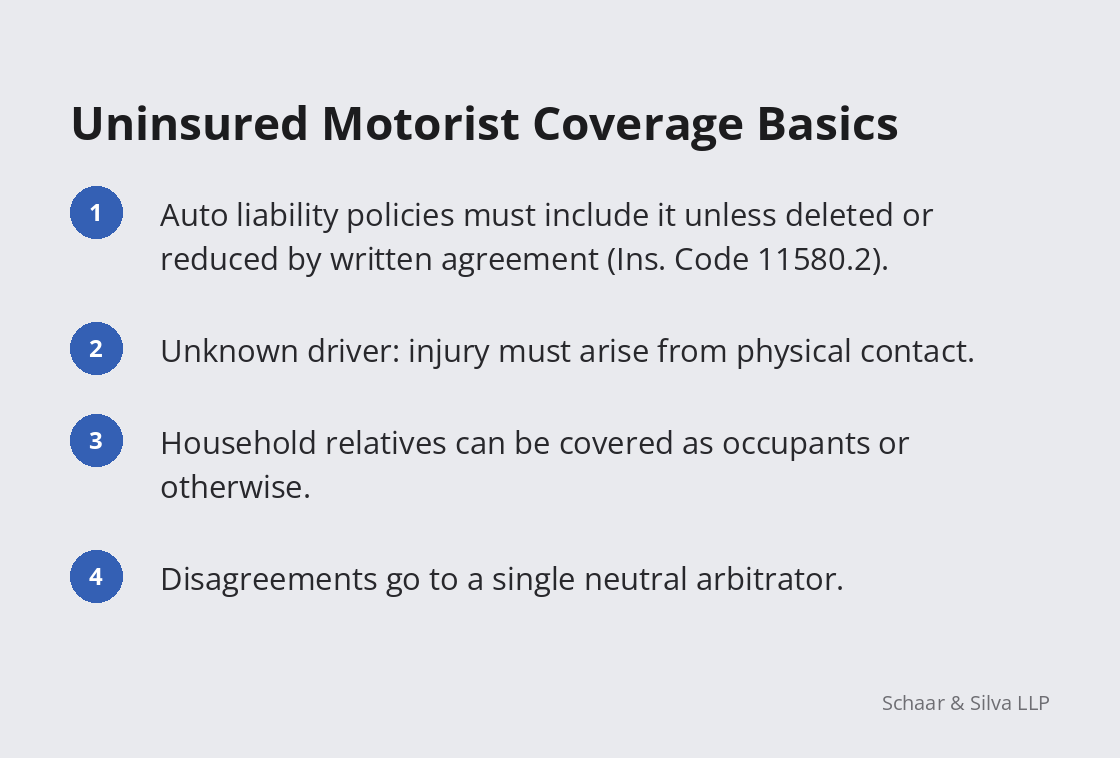
Insurance Code section 11580.2 requires California auto liability policies to include uninsured motorist coverage for bodily injury and wrongful death. The insurer and the named insured can agree in writing to delete the coverage or reduce it, so it is worth checking your declarations page and any signed waivers. If you did not sign a written agreement removing it, the coverage is likely part of your policy.
The Physical Contact Requirement
For a vehicle whose owner or operator is unknown to count as an uninsured motor vehicle, section 11580.2 requires that the bodily injury arose out of physical contact between that vehicle and the insured or the vehicle the insured was occupying. This rule means that a “phantom vehicle” that ran you off the road without touching you can create serious problems for a hit-and-run claim. Photographs of paint transfer, damage to your vehicle, and debris left at the scene help show that contact occurred.
Who Counts as an Insured
The statute defines an insured to include the named insured and their spouse and, while residents of the same household, relatives of either, whether they are occupants of a motor vehicle or otherwise. That language can matter for a family member struck while walking in an Oakland crosswalk, riding a bike along Telegraph Avenue, or crossing a parking lot. Passengers in an insured vehicle are also covered under the statute’s definition.
What Derails Hit-and-Run Claims in Oakland
Hit-and-run claims are often lost because of timing and paperwork, not because the injuries were minor. Several deadlines in the statute are much shorter than people expect.
Missing the 24-Hour Report and 30-Day Statement
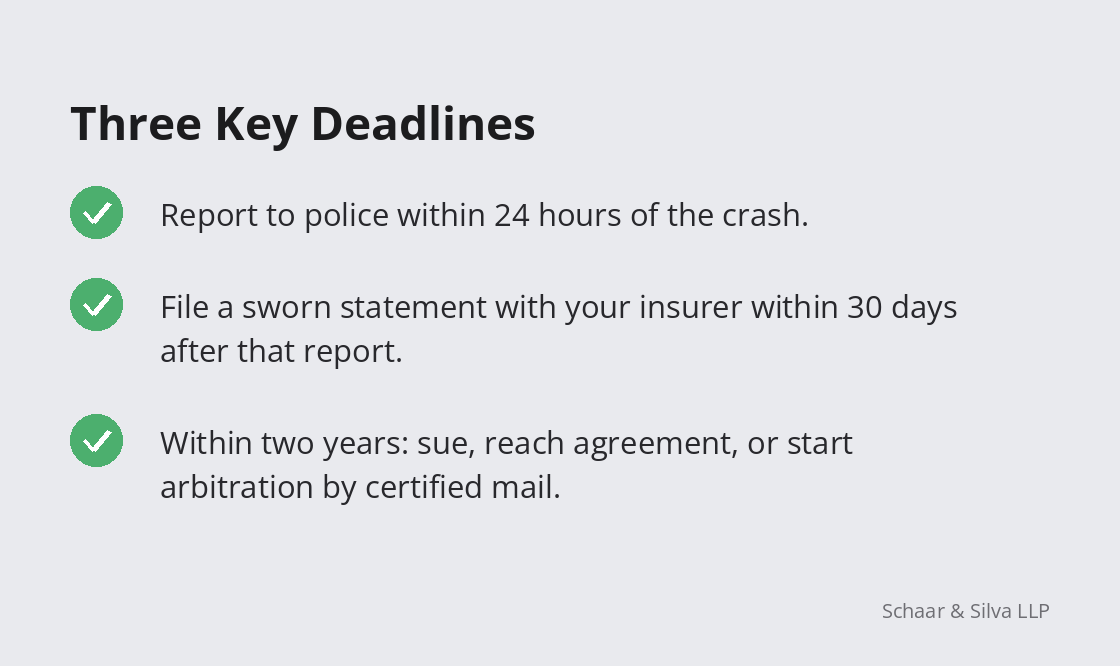
Under section 11580.2, coverage for an unknown driver depends on the insured, or someone on their behalf, reporting the accident within 24 hours to the police department of the city where it happened or, in unincorporated territory, to the county sheriff or the local Highway Patrol office. The insured must also file with the insurer, within 30 days after that report, a statement under oath that they have a cause of action against a person whose identity cannot be determined, along with supporting facts. Missing either step can put the claim at risk.
Letting the Two-Year Window Close
The statute also says that no cause of action accrues under the uninsured motorist coverage unless, within two years from the date of the accident, a suit for bodily injury has been filed against the uninsured motorist, an agreement as to the amount due has been reached, or the insured has formally started arbitration by written notice to the insurer sent by certified mail, return receipt requested. If you and your insurer disagree about whether you are entitled to recover or about your damages, the statute calls for arbitration before a single neutral arbitrator. Waiting for the insurer to make the next move can let this deadline slip by.
Treating Your Own Insurer as a Neutral Party
Even though you are making a claim under your own policy, your insurance company evaluates the claim the way it would evaluate any other. Adjusters may ask for recorded statements, broad medical authorizations, and examinations. Keep copies of everything you send, write down the names of everyone you speak with, and get advice before signing a release. If the driver is later identified, your options may change, so preserving witness names, video sources, and your vehicle’s damage remains important.
Waiting Too Long to See a Doctor
Adrenaline can hide pain for hours or even days after a crash, and some injuries, such as concussions and soft tissue damage, do not show their full effect right away. Getting checked promptly protects your health and creates a medical record that connects your injuries to the collision. Gaps in treatment are one of the first things an adjuster looks for when questioning whether an injury was caused by the crash, so follow your provider’s instructions and keep track of every appointment.
Final Thoughts
Being hurt by a driver who flees is unsettling, but it does not have to mean you are left without options. California law requires drivers to stop, share information, and help, and it gives injured people access to uninsured motorist coverage when the driver cannot be found. The key is acting quickly to report the crash, document physical contact, give your insurer the required sworn statement, and protect the two-year window.
Oakland hit-and-run cases often turn on details gathered in the first days after the crash, such as nearby business cameras, witness contact information, and photographs of the scene. The sooner those pieces are collected, the stronger your position will be.
If you were injured in a hit-and-run crash in Oakland, contact Schaar & Silva LLP to speak with our team. We will review your policy, explain your options, and help you take the next step with confidence.