

An Oakland bus accident can leave you injured and unsure where to turn. Maybe you were a passenger thrown forward when an AC Transit bus braked hard on International Boulevard, a driver whose car was struck by a bus pulling away from a stop on Broadway, or a pedestrian hit in a crosswalk near a transit hub. Claims involving a public bus follow different rules from an ordinary crash between two private cars, and the most important of those rules is a deadline that is much shorter than most people expect.
At Schaar & Silva LLP, we help people hurt in auto accidents, truck accidents, and pedestrian accidents throughout Oakland so you can move forward with confidence. This guide explains how bus accident claims against a public transit agency work, what California’s government claim rules require, and the mistakes that most often put these claims at risk.
How an Oakland Bus Accident Claim Actually Works
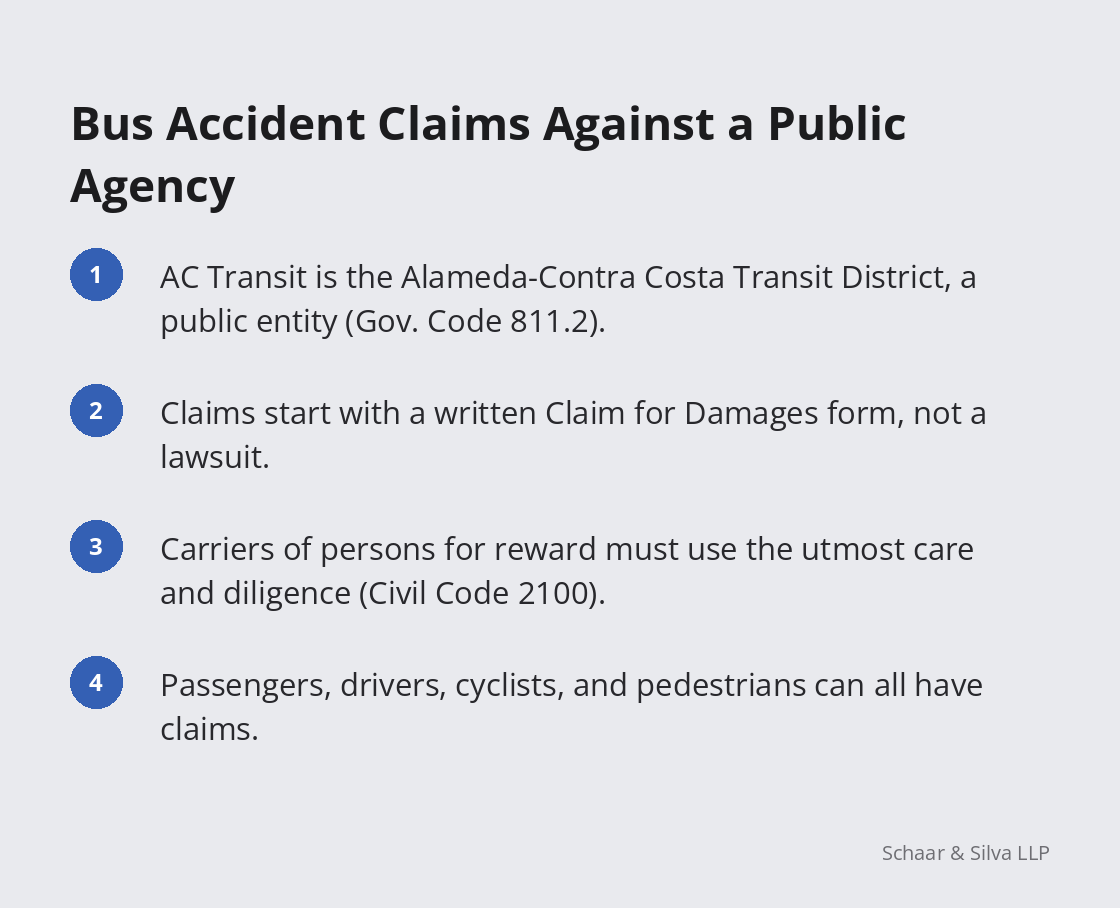
Many of the buses you see on Oakland streets are operated by AC Transit, the Alameda-Contra Costa Transit District. Because it is a public agency, a claim against it does not begin with a call to an ordinary insurance company. It begins with a written government claim, and that claim must meet strict requirements before a lawsuit is even possible.
AC Transit Is a Public Entity
California’s Government Claims Act defines a public entity broadly. Government Code section 811.2 states that a public entity includes the state, a county, city, district, public authority, public agency, and any other political subdivision or public corporation in the State. A transit district fits within that definition, which means the claim procedures in the Government Code apply. AC Transit’s own claims page explains that to pursue a claim against the district, you must file a Claim for Damages form with the AC Transit District Secretary’s Office.
The Duty Owed to Bus Passengers
Passengers are owed a high level of care. Civil Code section 2100 provides that a carrier of persons for reward must use the utmost care and diligence for their safe carriage, must provide everything necessary for that purpose, and must exercise to that end a reasonable degree of skill. California’s civil jury instructions, in CACI No. 902, describe this as using the highest care and the vigilance of a very cautious person. The sources listed with that instruction include California Supreme Court decisions applying the standard to public transit districts. The same instruction notes that a common carrier does not guarantee the safety of its passengers, so whether the standard was met depends on the facts of each incident. A careful record of what happened inside the bus is what allows those facts to be evaluated.
Drivers, Cyclists, and Pedestrians Have Claims Too
You do not need to be on the bus to have a claim. A driver rear-ended by a bus, a cyclist squeezed at a stop, or a pedestrian struck while crossing can bring a claim based on ordinary negligence. The government claim procedure generally applies whenever the claim for damages is against the transit agency itself. If another private vehicle also contributed to the crash, a separate claim against that driver may follow the ordinary rules, so it helps to identify every party involved early. Write down the plate numbers of any other vehicles, and note whether a private shuttle, a charter coach, or a city bus was involved, because the type of operator shapes which rules and deadlines apply.
The Government Claim Process and Its Deadlines
The claim process is where many bus accident cases are won or lost. The rules are found in the Government Code, and they are applied strictly. Knowing the sequence ahead of time helps you avoid a technical mistake that has nothing to do with the merits of your injuries.
Six Months to Present Your Claim
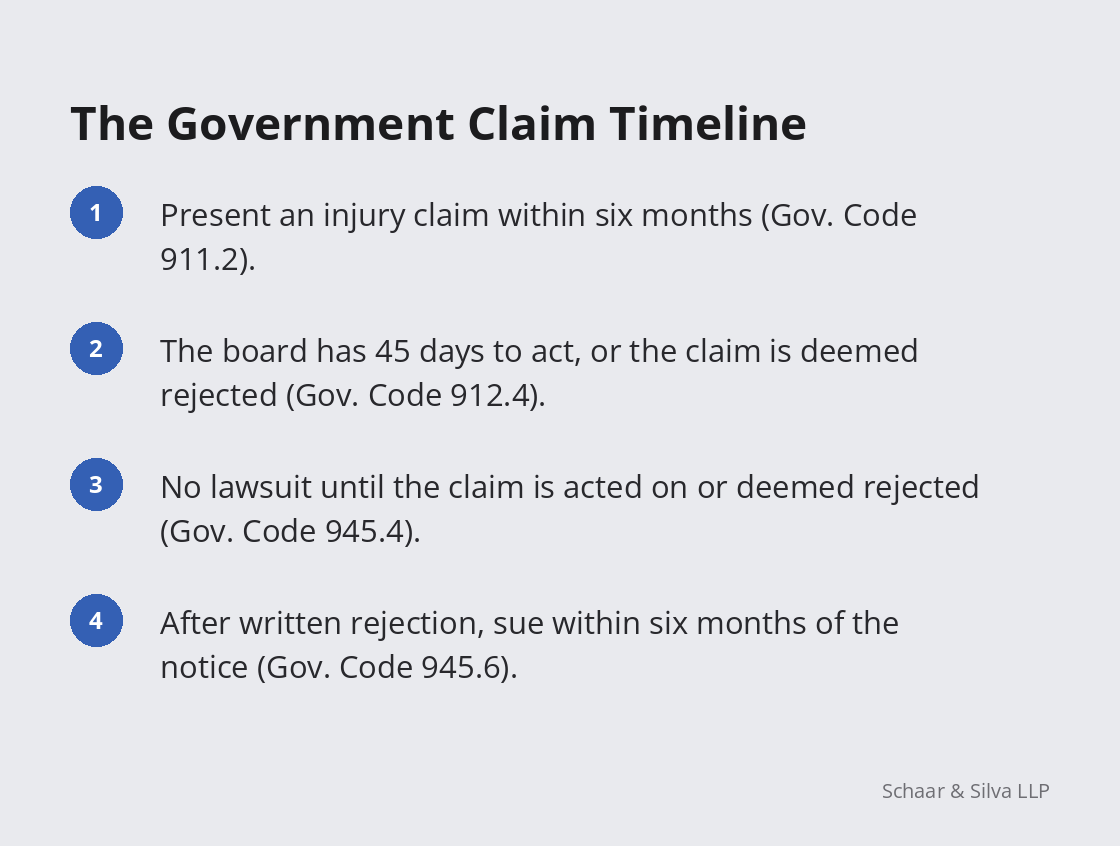
Government Code section 911.2 provides that a claim relating to a cause of action for death or for injury to person or to personal property shall be presented not later than six months after the accrual of the cause of action. Treat the date of the crash as your starting point when planning, rather than waiting to find out exactly when the clock began. Six months passes quickly while you are seeing doctors and recovering, which is why the claim should be one of the first things you address.
How to File With AC Transit
AC Transit’s claims page explains that you complete its Claim for Damages form, sign it according to the instructions, and personally deliver or mail the original signed form with supporting documents to the District Secretary. The district states that claims sent by fax or email will not be accepted. The form itself asks for details such as the bus number, route number, direction of travel, and the driver’s badge number, along with a description of the incident and your injuries. Collecting that information early makes the form far easier to complete accurately.
What Happens After You File
Government Code section 912.4 requires the agency’s board to act on a claim within 45 days after it is presented, and the claimant and the board may extend that period by written agreement. If the board fails or refuses to act within that time, the claim is deemed rejected on the last day of the period. AC Transit’s page notes that after its investigation, you will receive written notice that your claim was accepted, allowed in part, or rejected.
Filing a Lawsuit After Rejection
Government Code section 945.4 provides that no suit for money or damages may be brought against a public entity on a claim that must be presented until a written claim has been presented and acted upon or deemed rejected. Once that happens, section 945.6 sets the next deadline. If written notice of rejection is given, a lawsuit must be commenced not later than six months after the notice is personally delivered or deposited in the mail. If written notice is not given, the deadline is two years from the accrual of the cause of action. Because these two paths lead to very different deadlines, keep every letter you receive from the agency, together with the envelope, and write down the date each one arrived. Those small details can matter a great deal later.
Mistakes That Can Derail an Oakland Bus Accident Claim
Bus accident claims rarely fail because the injuries were not real. They fail because a deadline passed, a form was incomplete, or key evidence disappeared. Each of the mistakes below is avoidable.
Assuming the Usual Two-Year Rule Applies
Many people know that California generally allows two years to file a personal injury lawsuit. Code of Civil Procedure section 335.1 sets two years for an action for injury caused by the wrongful act or neglect of another. When the responsible party is a public agency, however, the six-month government claim requirement comes first. Waiting until month seven because you were relying on the two-year rule can create serious problems for the claim.
Missing the Late Claim Window
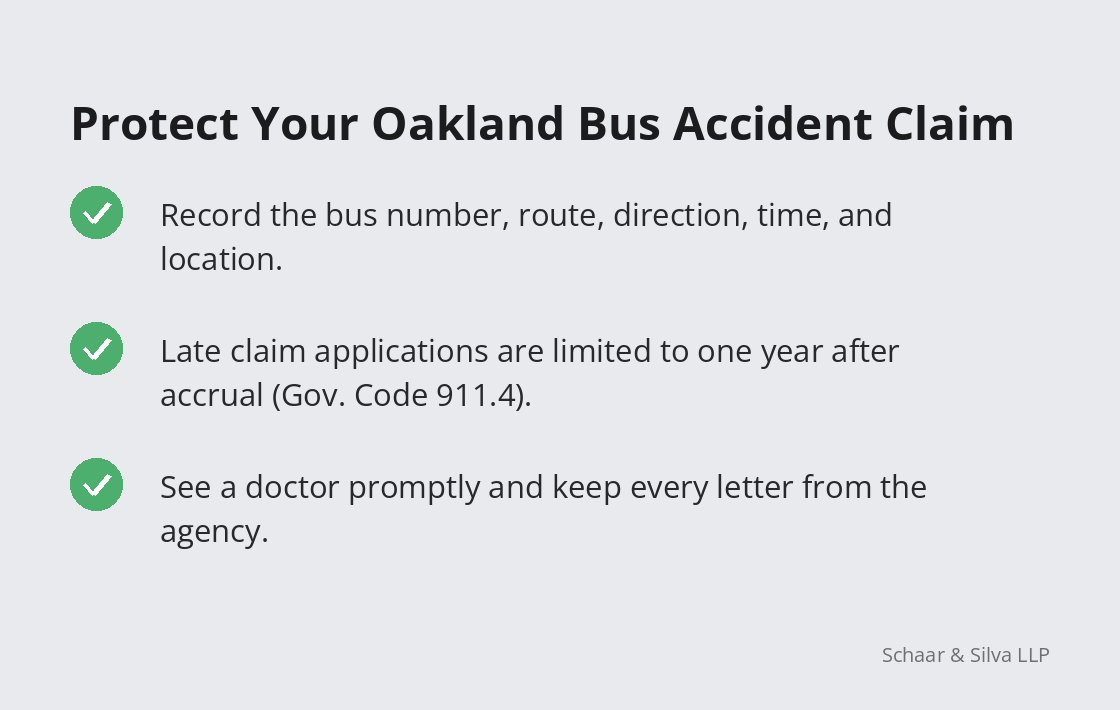
If the six-month period has already passed, all is not necessarily lost, but the path narrows. Government Code section 911.4 allows a written application to the public entity for leave to present a late claim. The application must be presented within a reasonable time not to exceed one year after the accrual of the cause of action, must state the reason for the delay, and must attach the proposed claim. Acting quickly matters even more at this stage.
Not Recording the Bus Details
Buses look alike, routes overlap, and drivers change shifts. If you can, note or photograph the bus number, the route, the direction of travel, the time, and the location. Ask witnesses for their names and contact information, and photograph your injuries, the scene, and any vehicle damage. Transit vehicles and stops may have video cameras, and that footage may not be kept indefinitely, so raising the issue early is important.
Delaying Medical Care
Passengers who fall inside a bus often feel embarrassed and wave off help, then discover a back, hip, wrist, or head injury later that day. See a doctor promptly, tell them exactly how the incident happened, and follow the treatment plan. Your medical records connect the incident to your injuries, and the claim form asks for the names of the providers who treated you.
Final Thoughts
An Oakland bus accident claim is not like an ordinary fender bender. Because AC Transit is a public entity, a written government claim generally must be presented within six months, the agency has a set period to respond, and a lawsuit after rejection has its own short deadline. At the same time, passengers are owed the utmost care, and drivers, cyclists, and pedestrians injured by a bus have the right to pursue their claims.
The steps that protect you are clear: get medical care, record the bus details and witness information, ask about video early, and treat the six-month claim deadline as the most important date on your calendar.
If you were hurt in a bus accident in Oakland, contact Schaar & Silva LLP to speak with our team. We will review what happened, help you meet the government claim requirements, and help you move forward with confidence. We serve Oakland and communities throughout the East Bay.