

Neck pain after a car accident in Santa Cruz County is one of the most common complaints people bring to their doctors in the days after a crash. A rear-end collision on Highway 1, a sudden stop on Highway 17, or a low-speed impact in a parking lot in Capitola can all snap the head forward and back faster than the muscles and ligaments of the neck can handle. Many people feel fine at the scene, only to wake up stiff and sore the next morning or several days later.
At Schaar & Silva LLP, we help people across Santa Cruz County who have been hurt in car and truck collisions so you can move forward with confidence. This guide explains what whiplash and other neck injuries actually are, why symptoms are often delayed, how neck injury claims are proven under California law, and the mistakes that most often weaken a claim.
What Whiplash and Neck Injuries Actually Are
The neck supports the weight of the head while allowing it to turn, tilt, and nod. That flexibility comes from a complex system of vertebrae, discs, joints, ligaments, muscles, and nerves, and every one of those structures can be strained or damaged when a vehicle is struck and the body is thrown in one direction while the head lags behind.
Understanding the basic medical picture helps explain why neck injuries are taken seriously by doctors, and why insurance companies often try to minimize them.
How Whiplash Happens
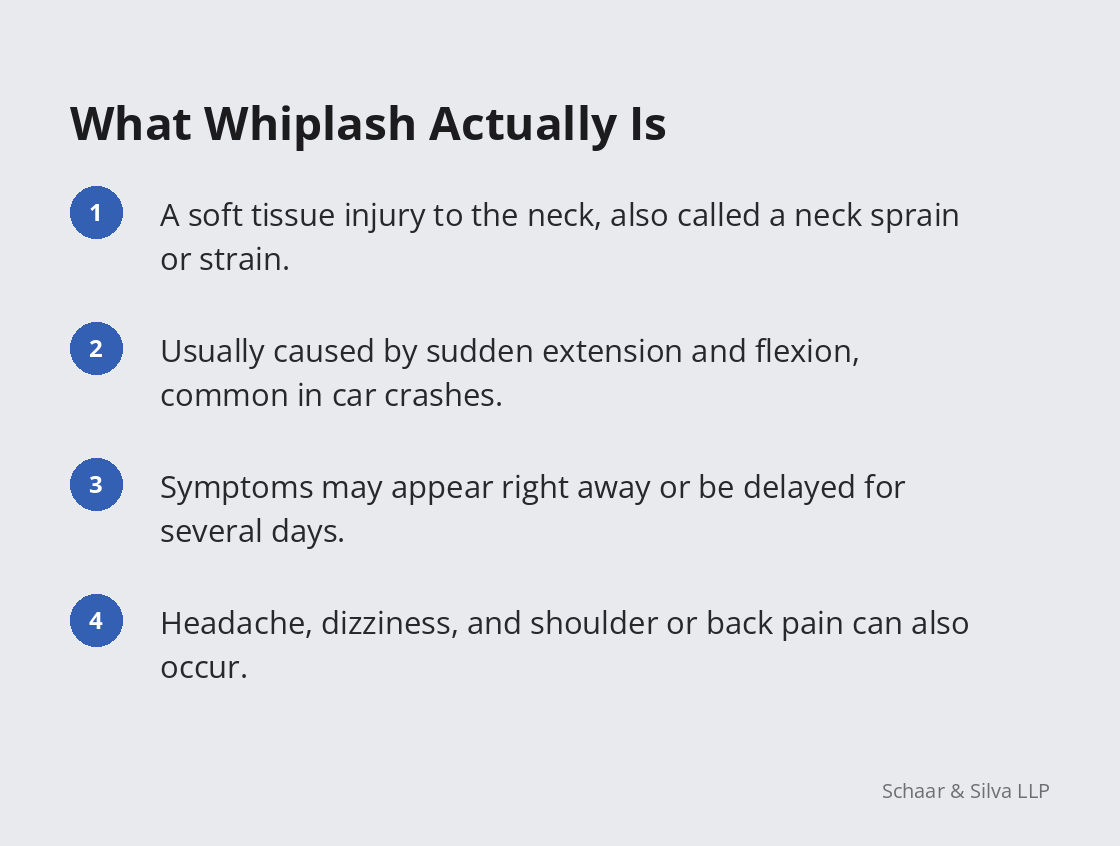
The National Institute of Neurological Disorders and Stroke describes whiplash as a soft tissue injury to the neck, also called a neck sprain or neck strain, that usually results from sudden extension and flexion. The institute notes that it commonly occurs as the result of an automobile accident and may include injury to the joints between the vertebrae, the discs, ligaments, neck muscles, and nerve roots.
Rear-end collisions are a classic example. When a stopped or slowing car is hit from behind, the seat pushes the torso forward while the head briefly stays in place, and then the head whips forward. That rapid motion can stretch or tear tissue even when the damage to the vehicles looks minor.
Why Symptoms Are Often Delayed
According to the National Institute of Neurological Disorders and Stroke, symptoms such as neck pain may be present directly after the injury or may be delayed for several days. Adrenaline and the stress of the crash can mask discomfort, and inflammation often builds gradually over the following hours and days.
This delay is one of the main reasons people decline medical care at the scene and then struggle to explain later why they are hurting. It is also why prompt evaluation matters, even if the pain seems mild at first.
Symptoms Beyond Neck Pain
Neck injuries do not always stay in the neck. The National Institute of Neurological Disorders and Stroke lists other possible symptoms including neck stiffness, headache, dizziness, abnormal sensations such as burning or prickling, and shoulder or back pain. Some people also experience difficulty concentrating, sleep problems, fatigue, irritability, or depression.
Keeping track of all of these effects, not only the neck pain itself, gives your doctors a fuller picture and helps document how the injury actually affects your daily life at work and at home.
How a Neck Injury Claim Is Proven in California
A neck injury claim after a crash generally requires showing that another driver was careless, that the crash caused your injury, and how that injury has affected you through physical pain, limitations, and disruption to your life. Each of those pieces depends on evidence gathered from the scene, from medical providers, and from your own records.
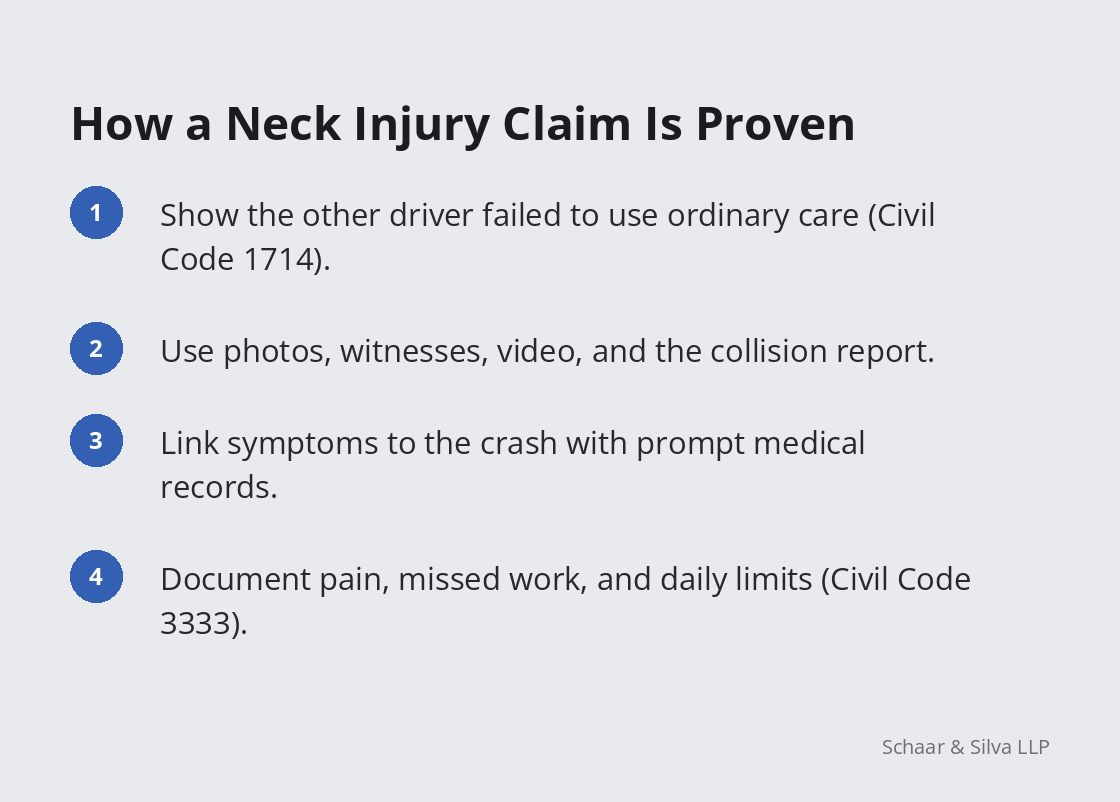
California Civil Code Section 1714 states that everyone is responsible for an injury caused to another by his or her want of ordinary care or skill. In a car accident case, that means a driver who follows too closely, speeds, or looks at a phone instead of the road can be held responsible for the injuries that result.
Proving the Other Driver Was at Fault
Fault is often clearer in rear-end collisions, but it is never automatic. Photos of the vehicles and the scene, statements from witnesses, dashcam or business security video, and the collision report all help show what happened. In Santa Cruz County, crashes on narrow two-lane roads, curving mountain routes, and congested stretches near beaches and downtown areas often involve sudden stops, so evidence about following distance and speed can be important.
If the other driver claims you stopped suddenly or changed lanes unexpectedly, the timing and position of each vehicle become central questions. Gathering evidence early helps prevent the story from changing later.
Connecting the Injury to the Crash
Insurance companies frequently argue that neck pain came from something else, such as an old injury, normal aging, or an activity that happened after the crash. Medical records created soon after the collision are the strongest answer to that argument because they link your symptoms to the crash while the timeline is still fresh.
A prior neck condition does not automatically defeat a claim. A crash that makes an existing condition worse can still cause real harm, and your medical providers can help explain the difference between your condition before and after the collision.
Documenting the Full Impact on Your Life
California Civil Code Section 3333 provides that, for wrongs not arising from contract, the measure of damages is the amount which will compensate for all the detriment proximately caused. For a neck injury, that detriment can include physical pain, lost time from work, limits on sleep, driving, and exercise, and the emotional strain of a slow recovery.
A simple journal noting your pain levels, missed activities, and appointments can help show how the injury changed your routine. Photographs of medical devices, therapy schedules, and notes from your employer about missed shifts can also support your claim.
Mistakes That Weaken Neck Injury Claims
Neck injuries are often labeled as minor by insurers, which makes the way you handle the weeks after a crash especially important. A few common mistakes can make it much harder to receive fair treatment for an injury that is genuinely affecting your life.
Most of these mistakes are easy to avoid once you know about them, and avoiding them helps keep the focus on what the other driver did and how the crash affected you.
Waiting Too Long to See a Doctor
Gaps between the crash and your first medical visit, or long breaks in treatment, are often used to argue that your injury was not serious or was caused by something else. Seeking care promptly, following your treatment plan, and telling each provider that your symptoms began after the crash create a clear and consistent record.
Talking to the Other Driver’s Insurer Too Soon
An adjuster for the other driver may call within days and ask for a recorded statement. Comments such as “I’m fine” or “it was just a bump” can be used against you later, especially if your symptoms appear or worsen after that conversation. It is wise to understand your injuries and your rights before giving any detailed statement.
Shared fault can also come up. Under California’s comparative fault rule, as reflected in the state’s civil jury instructions, if the other side proves you were also negligent, your damages can be reduced by your percentage of responsibility. That makes accurate, careful statements about the crash all the more important.
Missing Reporting Duties and Deadlines
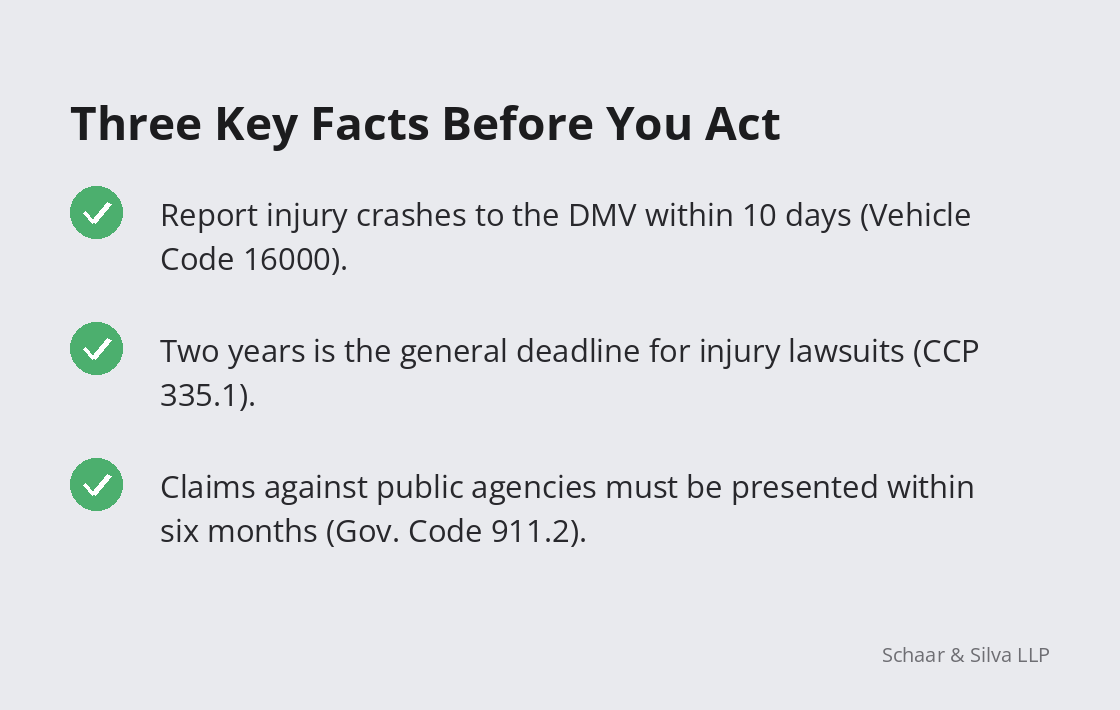
California Vehicle Code Section 16000 requires a driver involved in a collision that results in bodily injury or death to report it to the DMV within 10 days on an approved form, which is separate from any police report. Vehicle Code Section 20008 also generally requires a driver involved in a collision resulting in injury or death to make, or cause to be made, a written report within 24 hours to the California Highway Patrol or, if the crash happened within a city, to either the Highway Patrol or that city’s police department.
Lawsuit deadlines are strict as well. Code of Civil Procedure Section 335.1 sets a two-year limit for most personal injury actions, and Government Code Section 911.2 generally requires a claim against a public entity for personal injury to be presented within six months after the claim accrues. If a county or city vehicle was involved in your crash, that shorter deadline can apply.
Final Thoughts
Neck pain after a car accident in Santa Cruz County is a real injury that can affect your work, sleep, and daily life for weeks or longer. Whiplash symptoms are often delayed, which makes prompt medical care, consistent treatment, and careful documentation especially important.
Understanding how fault and causation are proven, and avoiding early mistakes with insurers and deadlines, can make a meaningful difference in the outcome of your claim. Learn more about how we handle auto accident cases for injured drivers and passengers.
If you are dealing with neck pain after a crash on a Santa Cruz County road, contact Schaar & Silva LLP to speak with our team. We’ll review what happened, explain your options, and help you move forward with confidence. We serve Santa Cruz County and surrounding areas.