

A car accident can stop your income overnight. If you’re unable to work due to injuries, lost wages become one of your biggest financial concerns alongside medical bills and recovery costs.
At Schaar & Silva LLP, we help people in Santa Cruz County, Sacramento, and Oakland recover the income they’ve lost. This guide shows you exactly how to document, calculate, and claim every dollar you’re owed.
What Income Actually Counts as Lost Wages
Beyond Your Base Salary
Auto accidents interrupt your paycheck in ways that extend far beyond missing a few days of work. When injuries prevent you from your job, you lose wages, overtime, bonuses, and sometimes entire business revenue if you’re self-employed. Many clients underestimate their total income loss because they only count their base salary, missing thousands of dollars they’re actually owed.
Your lost wages claim covers far more than your regular hourly rate or salary. Commission income counts. Overtime hours factor into your calculation. Bonuses you would have received during your recovery period belong in your claim.
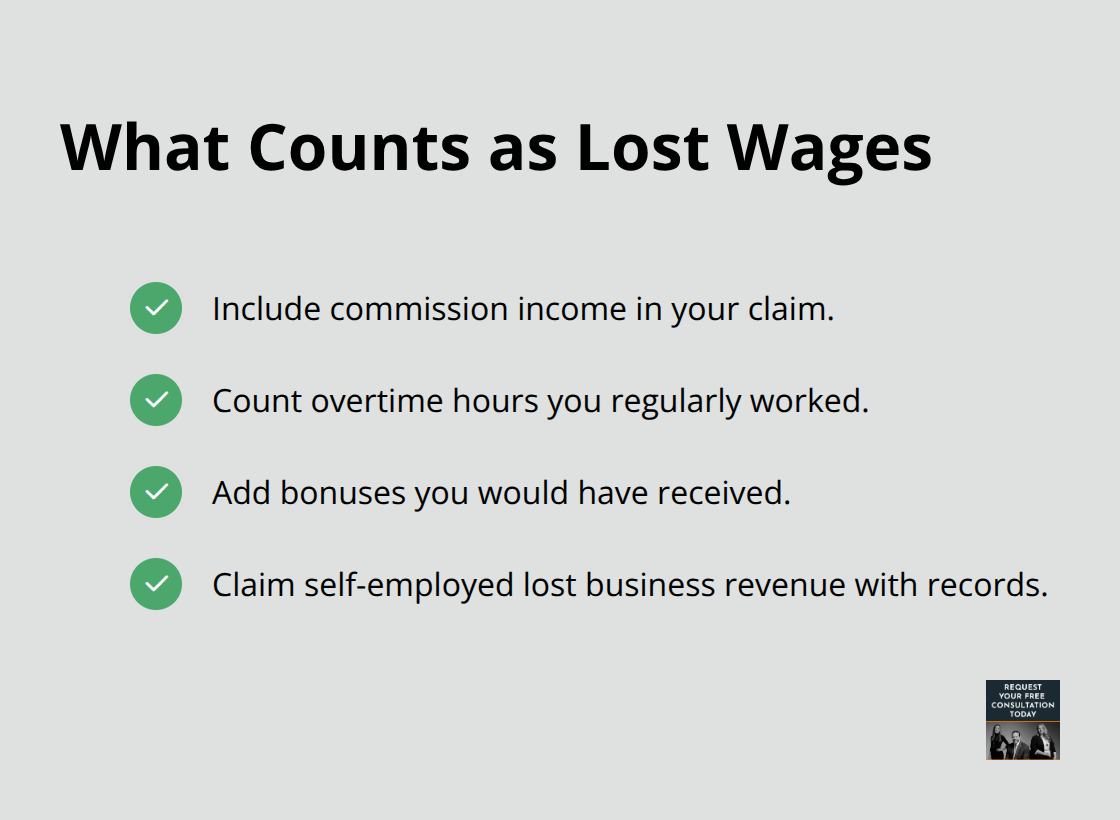
Self-employed individuals can recover lost business income, though this requires detailed financial records showing your average monthly earnings before the accident.
What the Numbers Show
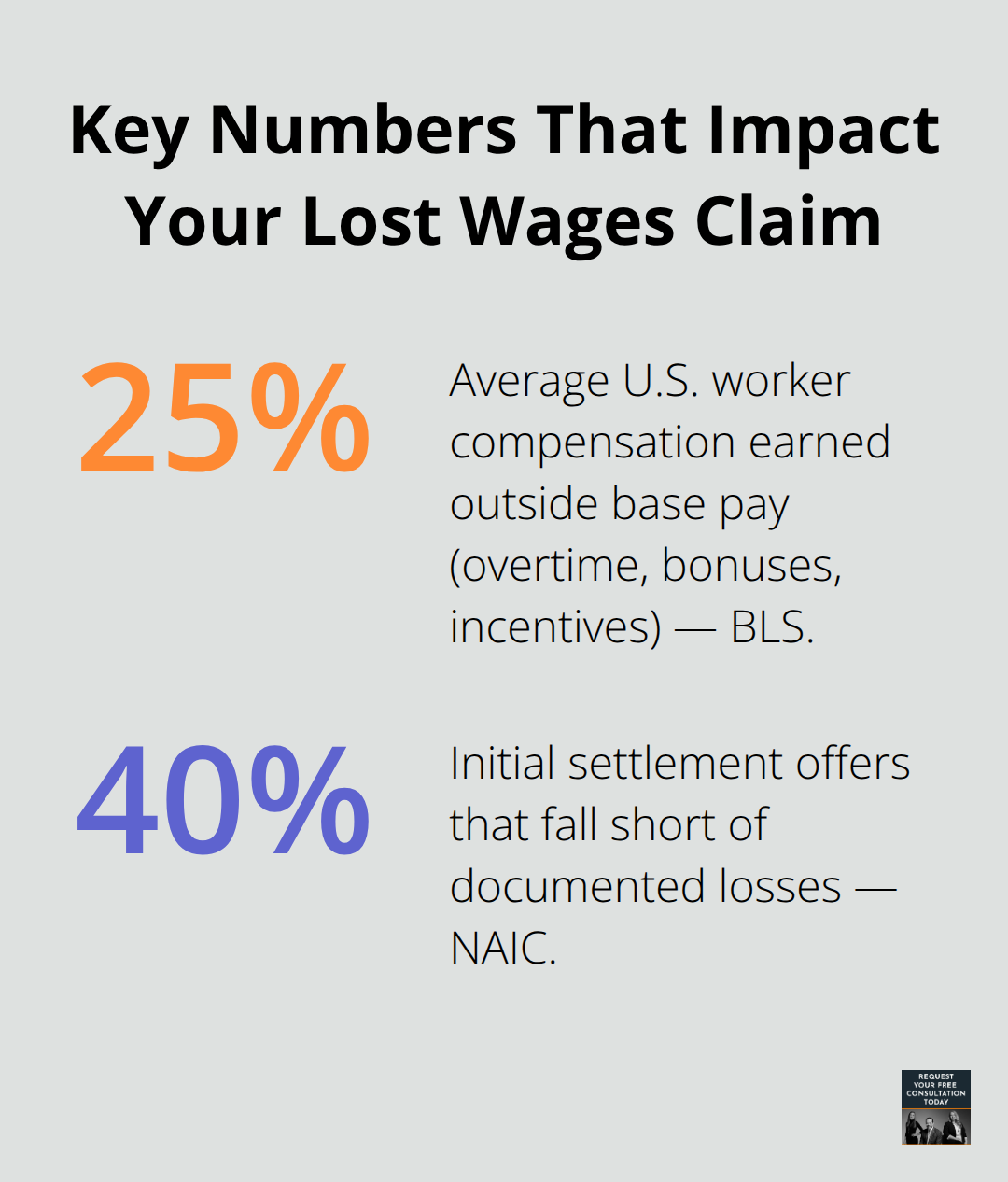
The Bureau of Labor Statistics reports that the average American worker earns approximately 25% of their total compensation outside their base wage through overtime, bonuses, and incentive pay. Yet many accident victims fail to document these amounts. Your claim should reflect what you actually earned, not just what appears on your base paycheck.
Documentation That Strengthens Your Claim
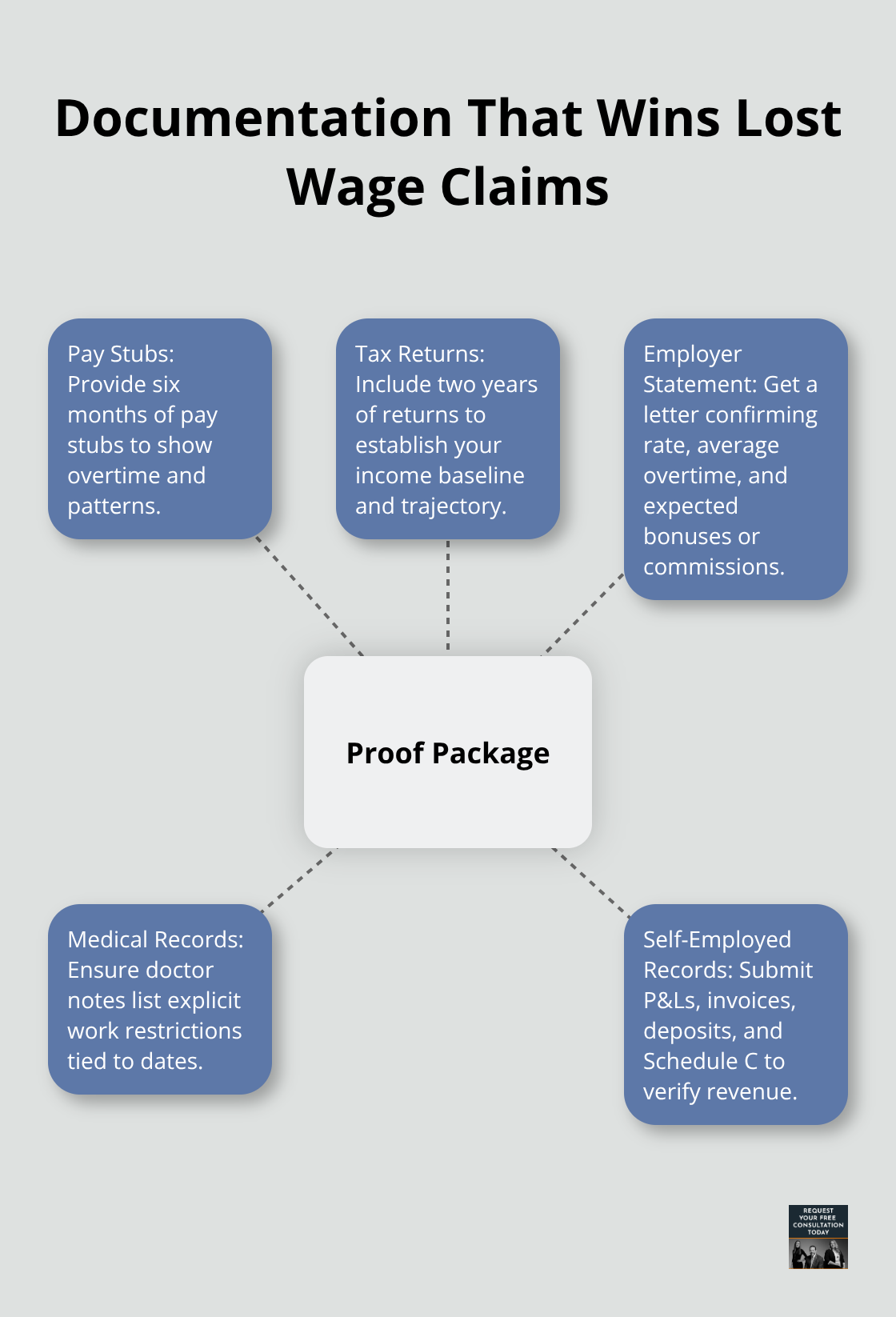
Calculating your total income loss requires specific documentation that insurance companies will scrutinize heavily. Gather your last two years of tax returns, which establish your average annual income and show commission structures or business profits. Request pay stubs from the past three months before your accident to confirm your current rate and any overtime patterns.
If you’re self-employed, compile profit and loss statements, bank deposits, and invoices that demonstrate your typical monthly earnings. Ask your employer for a written statement confirming your hourly rate, salary, average overtime hours, and any bonuses or commissions you would have earned during your recovery period (this letter should come directly from your HR department or supervisor).
Medical Records Connect Injury to Lost Income
Medical records should clearly show when your doctor restricted you from work, as this directly connects your injury to your lost income. Without this documentation, insurance adjusters will lowball your claim or deny it entirely, forcing you to accept far less than you actually lost.
The strength of your documentation determines whether you recover your full losses or settle for a fraction of what you’re owed. Insurance companies know that many injured workers lack proper paperwork, and they count on this weakness to reduce payouts. Your next step involves understanding how insurance companies evaluate these claims and what tactics work best when negotiating with them.
How Insurance Companies Evaluate Lost Wage Claims
The Adjuster’s Playbook
Insurance adjusters follow a predictable pattern when reviewing lost wage claims, and understanding their tactics gives you a significant advantage in negotiation. Most adjusters request documentation, then deliberately misinterpret it to lower your payout. They’ll claim your medical restrictions weren’t specific enough, that your overtime was inconsistent, or that your business income projections are inflated. The National Association of Insurance Commissioners found that 40% of initial settlement offers fall short of actual documented losses.
This means your first conversation with an adjuster should never be your final negotiation.
Presenting Evidence That Adjusters Cannot Dismiss
Present your evidence in the format adjusters expect: tax returns showing your income pattern, medical records with explicit work restrictions from your doctor, and employer statements confirming your earning history. When an adjuster pushes back on your overtime calculations, respond with specific pay stub data showing your average hours over the six months before your accident. If they claim your business income is speculative, provide bank statements and client invoices demonstrating consistent monthly revenue.
Your medical provider’s role extends beyond treatment-they must document the specific activities you cannot perform, not just general restrictions. A note saying you cannot work holds no weight. One stating you cannot sit for more than two hours, lift over ten pounds, or operate machinery gives adjusters no room to dispute your lost income claim.
Building Your Future Earning Capacity Claim
Future earning capacity often gets completely ignored in initial settlement offers, yet it represents substantial money you’re entitled to recover. If your injury prevents you from returning to your previous job or limits your earning potential going forward, this loss belongs in your claim. Calculate this by comparing your pre-accident earning trajectory to your realistic post-injury earning capacity. If you earned $65,000 annually and your injury prevents you from working overtime or returning to your previous position, limiting you to $45,000 yearly, that $20,000 annual difference multiplied by your remaining work years becomes recoverable compensation.
Medical professionals play the critical role here-they must testify or document in writing that your restrictions are permanent or long-term, not temporary. Insurance companies resist future earning capacity claims aggressively because the numbers are large. Expect them to argue that you’ll recover fully, that you can retrain for different work, or that your restrictions will improve. Counter this with vocational rehabilitation assessments from qualified professionals who evaluate your actual capabilities post-injury.
Moving Forward With Professional Support
The gap between what insurance companies offer and what you actually deserve grows wider when you lack professional guidance. Vocational professionals and medical experts build the foundation for these claims, ensuring your future earning losses are documented and defended throughout negotiations. Your next step involves gathering the specific financial documents that transform your claim from estimates into undeniable proof.
Building Your Documentation Arsenal
Pay Stubs Reveal Your True Earnings Pattern
Your pay stubs tell the story that insurance companies want to dismiss. Collect the last six months of pay stubs before your accident, not just three months. This extended history reveals patterns that matter: whether you consistently work overtime, how your commissions fluctuate, and what your actual average earnings look like beyond a single paycheck. An adjuster might claim your overtime was inconsistent if you show only three months where one month had minimal extra hours.
Six months of data exposes the truth. If you averaged thirty hours of overtime monthly over six months but worked only ten hours in one particular month due to scheduling, the adjuster cannot use that single low month to argue your overtime doesn’t count.
Tax Returns Establish Your Income Baseline
Your tax returns from the two years before your accident establish your income baseline and show whether your earnings were growing, stable, or declining. This matters because future earning capacity calculations depend on your trajectory. If you earned $50,000 the first year and $58,000 the second year, you were on an upward path. An insurance company will argue your future earnings would have stalled or declined anyway, but tax returns showing consistent growth support your claim that the accident interrupted a positive earning trend.
Employment Letters Document Specific Amounts
Your employer or HR department should provide a written statement on company letterhead confirming your position, hourly rate or salary, average overtime hours per month, and the specific dollar amount of bonuses or commissions you would have earned during your recovery period. Request this letter immediately and ask them to reference specific time periods and amounts, not vague estimates. For overtime and bonuses, ask your employer to calculate what you would have earned had you worked your typical schedule during your recovery months. If you average four thousand dollars monthly in overtime and were unable to work for four months, that sixteen thousand dollars belongs in your claim.
Insurance adjusters frequently ignore bonuses entirely unless you present documentation showing you received them consistently in prior years. Your last two years of pay stubs should clearly show these bonus deposits, and your employment letter should confirm you were on track to receive them.
Self-Employed Income Records Require Detailed Documentation
Self-employed individuals and commission-based workers face the harshest scrutiny from adjusters, yet the strongest documentation exists in your business records. You must compile detailed profit and loss statements, bank deposits showing client payments, and invoice records demonstrating your monthly revenue average. The IRS Schedule C from your tax returns becomes your strongest weapon here because it shows documented income the government already verified. When an adjuster claims your business income projections are inflated, your actual tax filings prove otherwise.
Final Thoughts
Recovering lost wages after an auto accident requires complete documentation, accurate calculations, and strategic negotiation with insurance companies. You now understand how to gather pay stubs, tax returns, and employment letters that transform your claim from estimates into proof. Most initial offers fall significantly short of actual documented losses, which means your negotiation typically continues well beyond the adjuster’s first proposal.
If you haven’t yet filed your loss of wages auto claim, start collecting documentation immediately while your records remain fresh and your employer can easily provide employment letters. If an adjuster has already made an offer, compare it against your calculated total using the methods outlined here. Request a detailed breakdown of how the adjuster calculated their offer and present your documentation showing where their numbers miss income sources you’re entitled to recover.
The negotiation process with insurance companies demands experience and persistence that most injured workers lack on their own. We at Schaar & Silva LLP help people throughout Santa Cruz County, Sacramento, and Oakland recover what they actually lost after accidents. Contact us to discuss your specific situation and learn what your claim is actually worth.
