
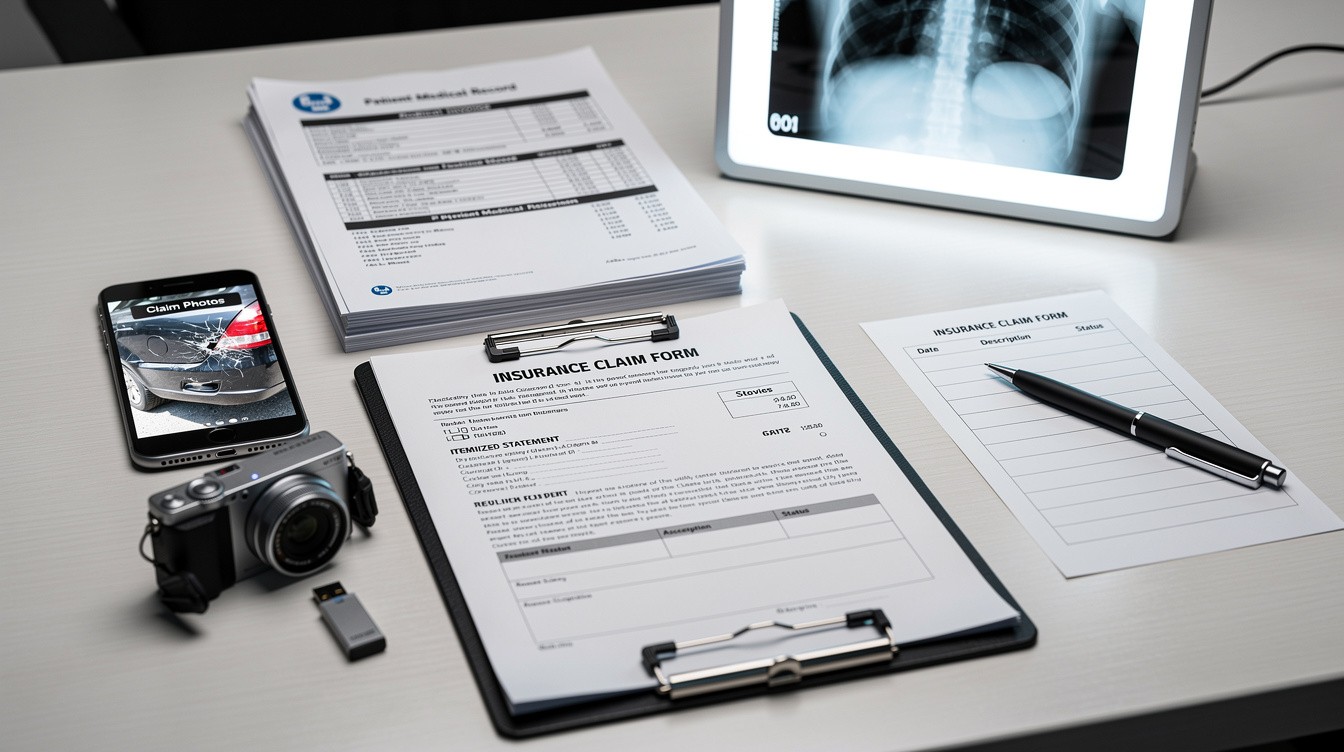
After a car accident in Santa Cruz County, what you document in the first days and weeks can determine whether you receive fair compensation for your injuries.
Insurance companies won’t take your claim seriously without solid evidence linking your injuries to the accident. We at Schaar & Silva LLP have seen countless claims weakened or denied simply because people didn’t follow injury documentation essentials from the start.
Why Documentation Proves Your Injuries Are Real
Insurance Adjusters Need Objective Evidence
Insurance adjusters process thousands of claims annually, and without proper documentation, yours becomes another file they can dismiss. Medical records serve as the objective proof that ties your injuries directly to the accident, not to some pre-existing condition or unrelated event. When you visit an emergency room after an accident, that visit timestamp and the medical findings create an official record that’s difficult for insurers to challenge.
The American Association for Justice reports that documented claims receive settlements approximately 3.5 times higher than undocumented ones-a stark difference that reflects how seriously insurers treat evidence-backed claims.
How Insurance Companies Evaluate Your Claim
Insurance companies operate on a simple principle: if you can’t prove it happened, they assume it didn’t. They employ adjusters trained to find reasons to minimize payouts, and weak documentation gives them ammunition. A claimant who waits three weeks before seeing a doctor signals to the insurer that injuries weren’t serious enough to warrant immediate attention, creating doubt about causation.
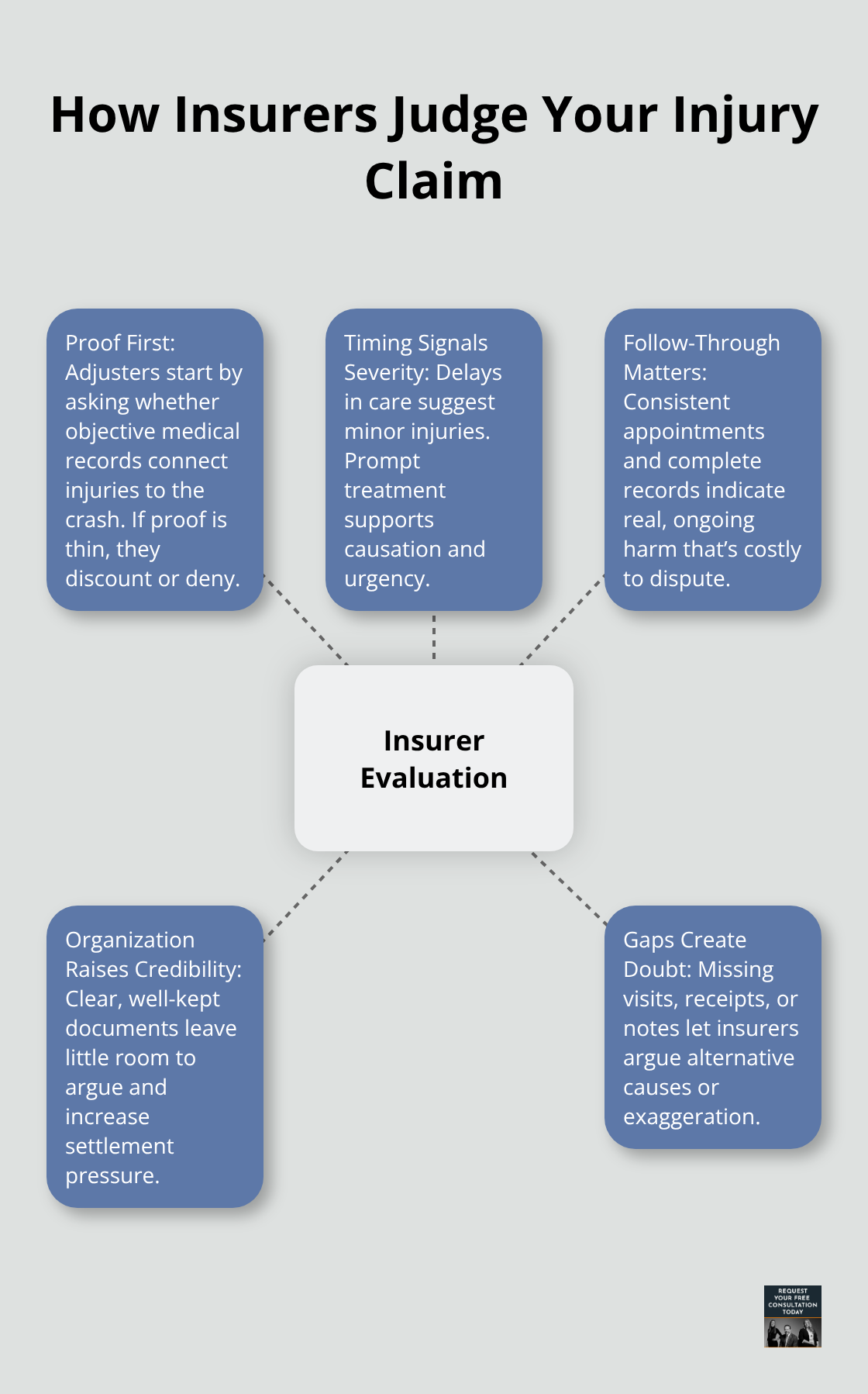
Conversely, someone who documents injuries within 48 hours, follows through with medical appointments, and maintains organized records presents a case that’s expensive and risky for insurers to dispute.
Documentation Shifts Negotiating Power
Thorough documentation dramatically shifts negotiating power in your favor. Documentation also protects you legally by creating a contemporaneous record that matches your testimony, whereas memory degrades over time and becomes vulnerable to cross-examination. Your medical providers’ independent observations about your condition carry far more weight than your word alone, especially when the insurance company’s own medical reviewers examine those records months later.
This foundation of solid evidence is what separates claims that insurers settle quickly from those that face prolonged disputes-and it’s exactly why the next section walks you through the specific steps to document your injuries properly.
Start Recording Your Injuries Immediately
The moment you leave the accident scene, your documentation timeline begins. Medical professionals timestamp everything they observe and treat, which creates an official record that insurance companies cannot dispute. Visit an emergency room or urgent care clinic within 24 hours of your accident, even if you feel fine-many serious injuries like whiplash, internal bleeding, or traumatic brain injury don’t show symptoms immediately. The National Highway Traffic Safety Administration found that delayed medical visits correlate with lower settlement amounts, partly because insurers question whether the accident actually caused your injuries. When you arrive at the clinic, tell medical staff about every pain point, even minor discomfort, because what seems insignificant to you might indicate a serious condition. Request copies of your medical report before leaving, and ask the provider to note the accident date and circumstances on the record.
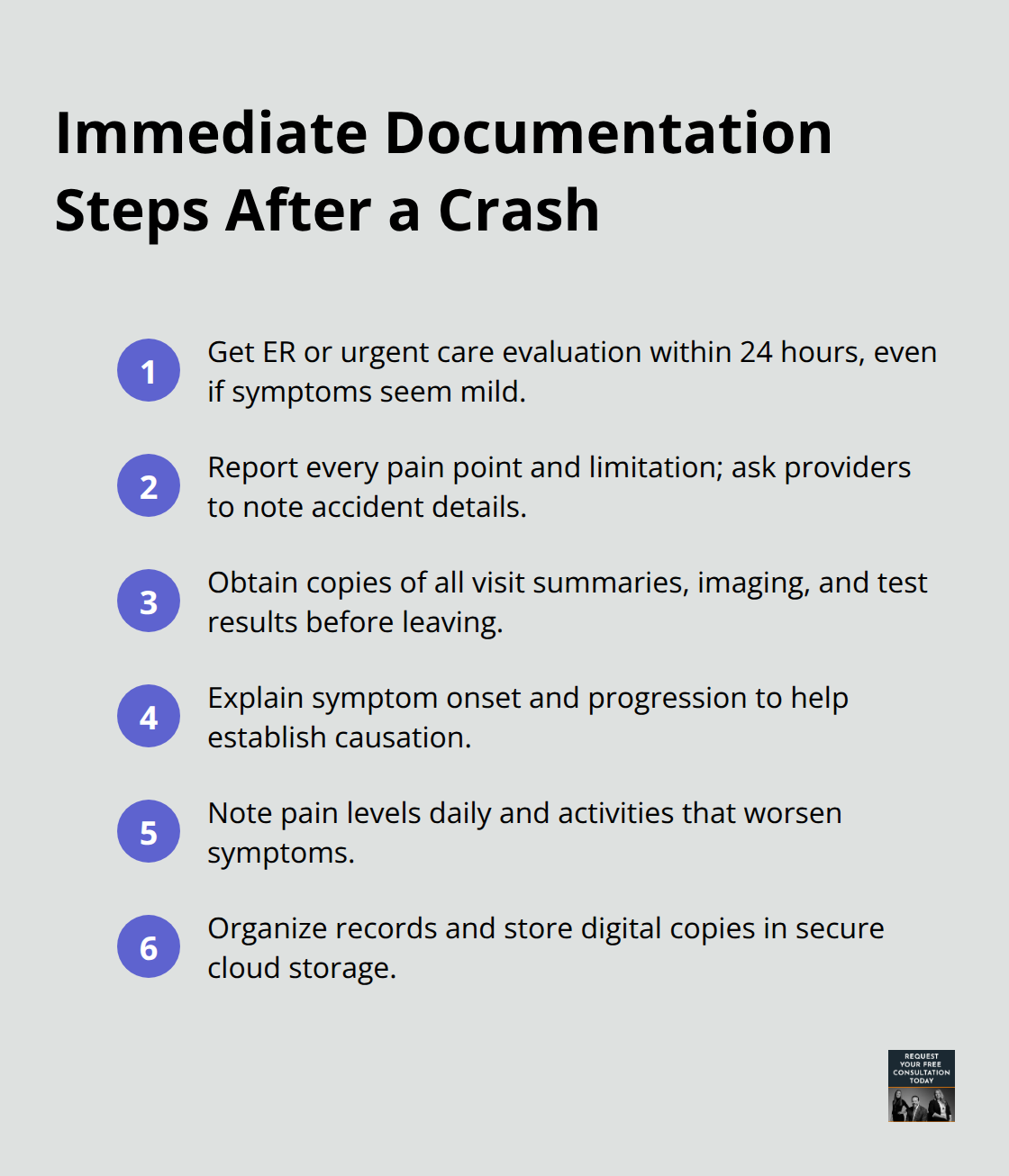
This connection between accident and treatment becomes the foundation that insurers cannot ignore.
Photography and Video Documentation
Photograph your visible injuries from multiple angles within the first 48 hours while bruising and swelling are most apparent. Take close-up shots and wider shots showing the injury in context, and photograph the same injuries again over the following weeks to document the healing process. Video recordings of your movement limitations work powerfully-film yourself attempting normal activities like reaching for objects, bending, or walking, which demonstrates functional impact beyond what photos alone can show. Many claimants skip this step because it feels awkward, but insurers weight visual evidence heavily since it eliminates debate about injury severity. Store these images and videos on cloud services like Google Drive or OneDrive to prevent loss if your phone is damaged.
Medical Records and Daily Tracking
Obtain complete medical records from every healthcare provider you visit, including initial emergency room paperwork, specialist reports, physical therapy notes, and imaging results like X-rays or MRI reports. Start a daily journal the day of your accident and maintain it consistently, noting specific pain levels on a scale of one to ten, which symptoms worsen during certain activities, and how injuries affect your work and personal life. Insurance adjusters specifically look for pattern consistency in journals-sporadic entries raise skepticism, while daily entries demonstrate credibility. Keep all receipts for medical expenses, medications, medical equipment like braces or crutches, and mileage to appointments since these costs strengthen your claim’s financial foundation.
What Happens When You Skip Documentation Steps
Claimants who delay medical visits or fail to maintain organized records hand insurers the justification they need to deny or minimize payouts. Insurance companies exploit gaps in your documentation by arguing that injuries weren’t serious enough to warrant immediate attention or that you fabricated symptoms after the fact. The longer you wait to seek treatment, the more distance grows between your accident and your medical diagnosis, making causation harder to prove. Inconsistent or incomplete records signal to adjusters that your claim lacks merit, which shifts negotiating power entirely in their favor. Your next move determines whether insurers take your claim seriously or dismiss it outright.
How Documentation Gaps Destroy Your Claim
The 48-Hour Window That Changes Everything
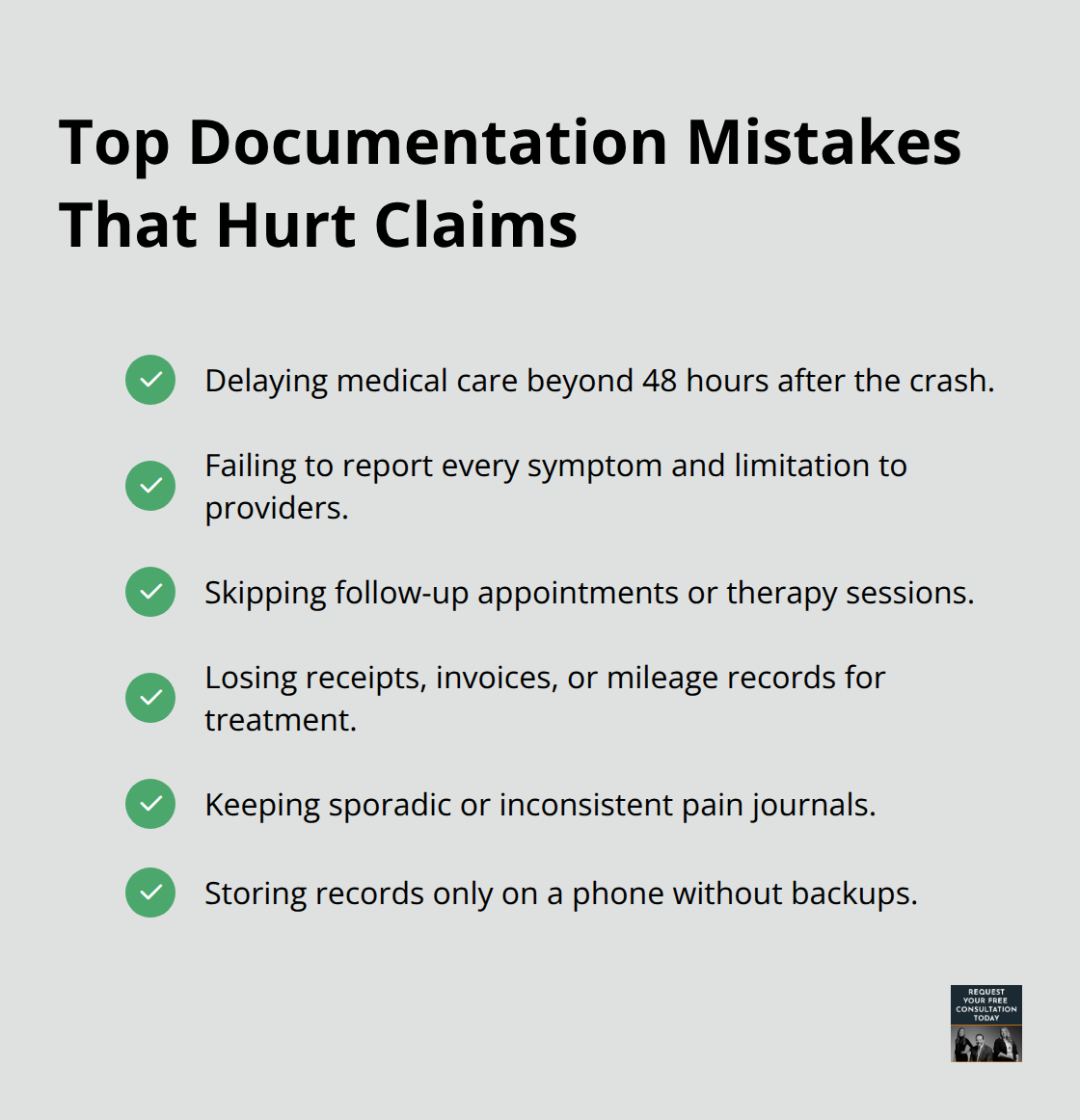
Most people in Santa Cruz County who’ve been in an accident don’t realize that the mistakes they make in the first few weeks determine whether insurers pay or deny their claims outright. Waiting more than 48 hours to seek medical attention is the single biggest error we see, because insurers immediately use that delay against you, arguing your injuries weren’t serious enough to warrant urgent care. When you finally visit a doctor three weeks after your accident, the insurer’s medical reviewer will question whether the accident caused your injuries or whether something else happened in between. This gap creates reasonable doubt that insurers exploit relentlessly.
Incomplete Medical Reporting Costs You Thousands
Failing to mention every injury to your healthcare provider cripples your claim because medical records document only what you reported. If you tell the emergency room doctor about neck pain but don’t mention the sharp pain in your lower back, your medical record shows no back injury, and the insurer will deny compensation for that area entirely. Many accident victims minimize their symptoms to avoid seeming dramatic, but that restraint costs them thousands in lost compensation. You must tell healthcare providers about every sensation, every ache, and every limitation, because what feels minor to you might indicate serious injury that develops later.
Disorganized Records Signal Weakness to Insurers
Disorganized record-keeping transforms winnable claims into disputes. Insurers receive hundreds of claims monthly and process them based on documentation completeness, so missing receipts, incomplete medical reports, or scattered expense records signal to adjusters that your claim lacks credibility. One claimant in California lost over $15,000 in compensation because she couldn’t locate receipts for physical therapy sessions, even though her medical records confirmed she attended treatment. Start a spreadsheet on your first day documenting every medical expense, appointment date, provider name, and cost, then photograph every receipt and store copies in cloud storage.
Functional Impact Documentation Determines Your Settlement
Underestimating how injuries affect your daily work and personal life represents another critical mistake because insurers calculate compensation partly based on functional limitations you document. If you never mention that your shoulder injury prevents you from your construction job or that neck pain makes sitting at a desk unbearable, the insurer assumes minimal impact and offers minimal payment. Write specifically about lost work hours, activities you cannot perform, and how pain changes throughout your day, because these details directly translate to higher settlement amounts. Insurance companies count on accident victims making these mistakes because each gap in documentation reduces their financial exposure.
Final Thoughts
The documentation you create in the days and weeks following your accident directly determines whether you receive fair compensation or face a denied claim. Insurance companies process claims based on evidence, not promises, and every gap in your records becomes a reason for them to minimize or reject your payout. Injury documentation essentials form the foundation that separates settlements covering your actual losses from those that leave you paying out of pocket for medical bills and lost wages.
Starting immediately after your accident changes everything. Visit a healthcare provider within 24 hours, photograph your injuries, maintain organized records, and document how your injuries affect your work and daily life (these actions create the objective evidence that insurers cannot dispute). The claimants who receive the highest settlements aren’t necessarily those with the most severe injuries-they’re the ones who documented everything thoroughly from day one.
Contact Schaar & Silva LLP to discuss how we can help strengthen your claim and maximize your compensation for your Santa Cruz County accident.