
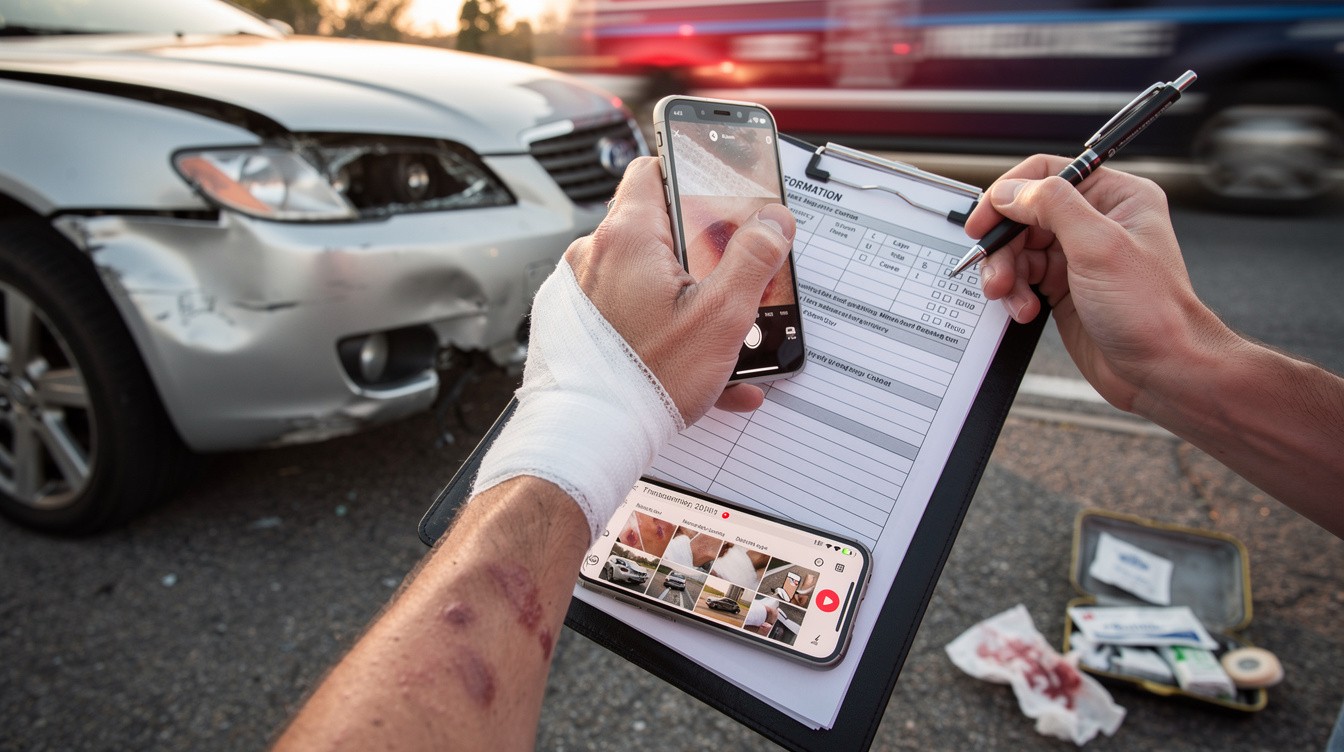
After a car accident, most people focus on immediate medical care and insurance calls. What they often overlook is injury documentation after a crash-the paper trail that determines whether you receive fair compensation.
Insurance companies won’t take your word for it. They need medical records, receipts, photos, and detailed accounts of your injuries to process your claim properly. We at Schaar & Silva LLP have seen countless cases where incomplete documentation cost people thousands in lost compensation.
This guide shows you exactly what to document and how to do it right.
Why Insurance Companies Need Your Documentation
Adjusters Require Medical Evidence
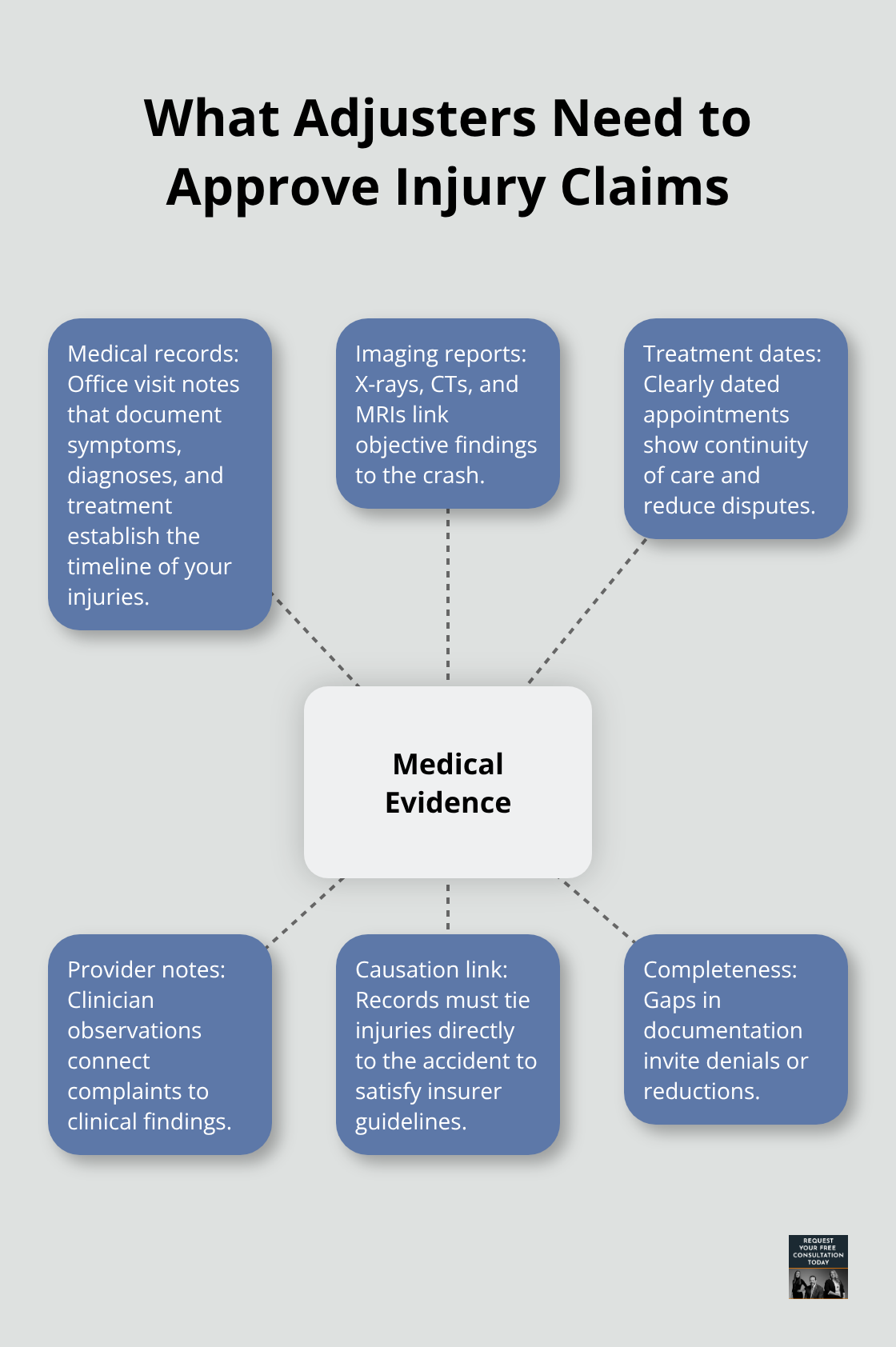
Insurance adjusters process thousands of claims annually and operate under strict guidelines. They cannot approve compensation without medical evidence that connects your injuries directly to the accident. A 2023 Insurance Information Institute report found that claims with complete medical documentation are approved 3.2 times faster than those with gaps. The adjuster reviewing your case needs medical records, imaging reports, treatment dates, and provider notes to establish causation. Without this paper trail, they have legal grounds to deny or significantly reduce your claim, regardless of how severe your injuries actually are.
The Power of Timestamped Medical Records
Documentation creates an official record that protects you legally. When you report symptoms to your doctor immediately after the accident, that visit note becomes timestamped evidence of your condition. If you wait weeks or months before seeking treatment, insurance companies will argue your injuries weren’t caused by the crash. Medical records from the days and weeks following the accident carry far more weight than retrospective accounts (statements made long after the fact lose credibility with adjusters).
Financial Impact Requires Proof
Keeping receipts for medications, physical therapy, transportation to appointments, and other accident-related expenses gives you concrete proof of financial impact. This documentation transforms your experience into verifiable facts that no adjuster can dispute. Each receipt, each medical bill, each treatment date builds a stronger foundation for your compensation case.
The next section covers exactly how to gather and organize this documentation so your claim stands on solid ground.
Building Your Documentation Timeline
Photograph Injuries Within Hours of the Accident
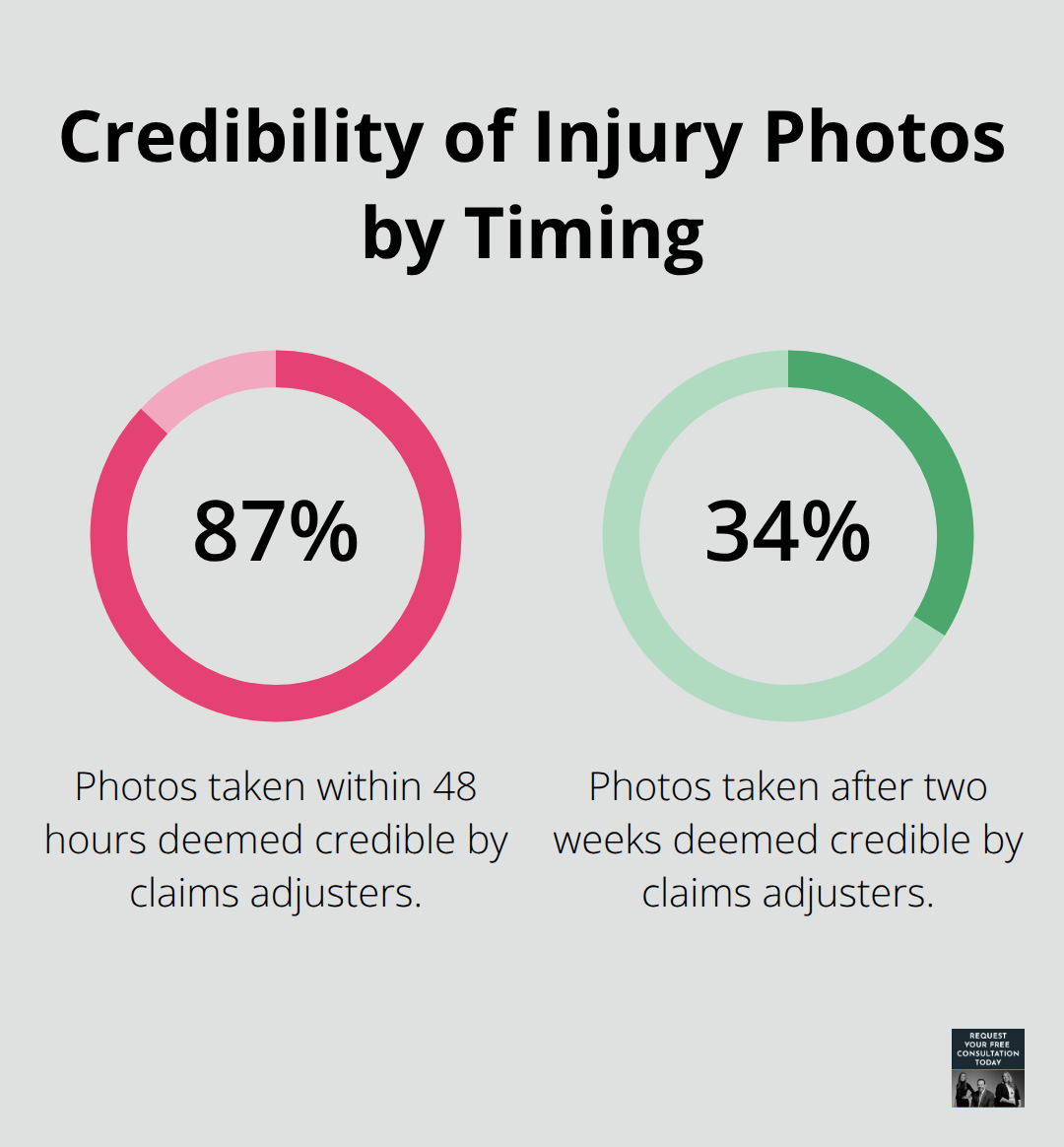
Start photographing injuries within hours of the accident, not days later. Visible bruises, cuts, and swelling change rapidly, and insurance adjusters know this. Take photos from multiple angles in natural lighting, and include timestamp metadata if your phone captures it automatically. Video footage showing you moving carefully or struggling with basic tasks carries weight that still images cannot. One study from the Journal of Legal Medicine found that injury photos taken within 48 hours were deemed credible by 87% of claims adjusters, compared to just 34% for photos taken after two weeks. Store these images in a secure cloud backup immediately, not just on your phone.
Schedule Medical Appointments Promptly
Medical records form your foundation, but only if they’re complete and timely. Schedule an appointment with your primary care doctor within 72 hours of the accident, even if you feel relatively fine. Many serious injuries like whiplash, concussions, and internal injuries don’t show symptoms immediately. When you see your doctor, report every symptom you’re experiencing, no matter how minor it seems. Document the exact date and time of each appointment, the provider’s name, and what was discussed. Request copies of all medical reports, imaging results, and treatment plans directly from your healthcare provider’s office. Keep these organized chronologically in a single folder.
Maintain a Daily Injury Journal
A personal injury journal records daily pain levels on a scale of 1 to 10, how injuries affect your work or daily activities, and any new symptoms that emerge. Write entries at the same time each day for consistency. This documentation demonstrates the ongoing impact of your injuries over weeks and months. Insurance adjusters view consistent, dated entries as reliable evidence of your condition’s progression.
Collect and Organize All Receipts
Collect every receipt related to your accident: medications, physical therapy sessions, medical equipment, mileage to appointments, and even parking fees. These receipts transform intangible suffering into documented financial losses. Insurance companies cannot dispute what receipts prove. Each receipt strengthens your claim by showing the actual costs you incurred because of the crash.
The documentation you gather now determines how thoroughly your claim reflects the true scope of your injuries and expenses. The next section covers the mistakes that undermine even well-intentioned documentation efforts.
What Ruins Documentation and How to Avoid It
Medical Delays Sabotage Your Claim
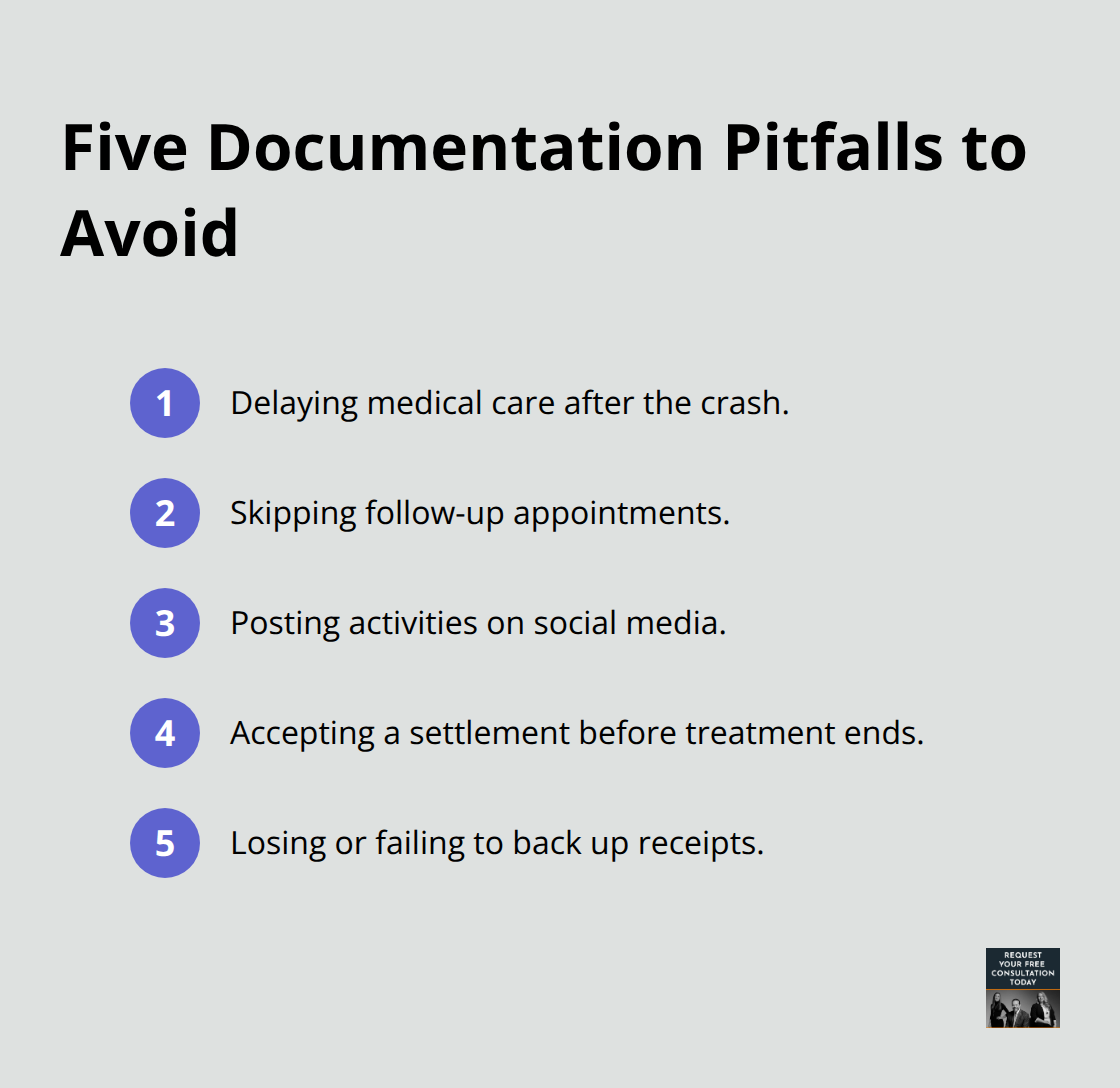
Waiting weeks to see a doctor after your accident is one of the fastest ways to sabotage your claim. Insurance adjusters interpret delays as a sign that your injuries weren’t serious or weren’t caused by the crash. The American Journal of Emergency Medicine reports that accident victims who seek medical attention within 72 hours have claim approval rates 2.8 times higher than those who delay treatment. When you finally do see a doctor, failing to mention every symptom compounds the problem. Tell your healthcare provider about headaches, tingling sensations, sleep disruptions, and emotional distress, even if they seem minor. These details become part of your medical record and form the foundation adjusters use to evaluate your claim.
Incomplete Treatment Records Weaken Your Position
Skipping follow-up appointments creates gaps in your treatment timeline that insurers exploit to argue your injuries improved or weren’t serious enough to require ongoing care. Each missed appointment weakens your documentation and gives adjusters ammunition to reduce your settlement. Your medical records must show continuous, consistent treatment throughout your recovery period. Adjusters scrutinize these timelines closely, and any significant gaps raise red flags about the legitimacy of your injuries.
Social Media Posts Destroy Your Case
Insurance adjusters routinely search for accident victims on Facebook, Instagram, and TikTok, looking for posts or photos that contradict your injury claims. A post showing you at a restaurant or hiking trail weeks after your accident, even if you were in significant pain that day, will be used against you to argue you’re not genuinely injured. The photos and comments you share online become evidence that adjusters present to justify lower settlements or claim denials. Avoid posting anything related to your accident, your recovery, or your activities until your claim is fully resolved.
Premature Settlement Agreements Lock You Out
Accepting settlement offers before your medical treatment is complete is equally damaging because you forfeit the right to pursue additional compensation once you sign the agreement. If new symptoms emerge three months after accepting a settlement, you cannot go back and ask for more money. Insurance companies structure early settlement offers to be attractive precisely because they eliminate your future claims. Wait until your doctor confirms your treatment is complete before considering any settlement proposal.
Lost Receipts Mean Lost Compensation
Discard receipts and medical records, and you’ve eliminated your proof. Insurance companies won’t accept your word that you paid for medications or attended physical therapy sessions if you cannot produce documentation. We at Schaar & Silva LLP have reviewed cases where claimants lost thousands in compensation because they couldn’t locate receipts from the previous year. Store every receipt in a dedicated folder, photograph it, and maintain digital copies in cloud storage the same day you receive it. Your documentation is only valuable if it survives the months between your accident and claim resolution.
Final Thoughts
Your injury documentation after a crash determines whether your claim receives fair treatment or gets dismissed. The medical records, photos, receipts, and journal entries you gather now become the evidence that insurance adjusters use to evaluate your compensation. Without this paper trail, even legitimate injuries go underfunded because adjusters have no concrete proof of your condition or expenses.
We at Schaar & Silva LLP review documentation for accident victims throughout Santa Cruz County, Sacramento, and Oakland, and we help identify gaps before they damage your claim. Our team works directly with your medical providers to verify that your treatment records are complete and properly organized. We understand how insurance companies operate and what documentation they require to approve fair settlements.
Start photographing injuries immediately, schedule medical appointments within 72 hours, maintain daily journal entries, and preserve every receipt (these actions create the foundation that transforms your experience into verifiable facts). If you’re uncertain whether your documentation is complete or if you’ve already made mistakes that might affect your claim, contact Schaar & Silva LLP for a review. We can assess what you’ve gathered, identify what’s missing, and guide you toward proper documentation moving forward.