

After an auto accident, calculating what you’re owed isn’t straightforward. Medical bills pile up, lost wages add pressure, and pain from your injuries lingers-but how do you put a number on all of it?
We at Schaar & Silva LLP help people in Santa Cruz County, Sacramento, and Oakland evaluate damages claims every day. This guide walks you through the types of damages you can claim, how to document them properly, and the mistakes that cost people thousands in compensation.
What Damages Can You Recover After an Auto Accident
Three Categories of Damages
Damages fall into three distinct categories, and understanding the difference between them matters because it directly affects how much compensation you can recover. Economic damages represent actual money you’ve spent or lost-medical bills, repair costs, lost wages. According to the National Highway Traffic Safety Administration, the average cost of a serious injury crash exceeds $95,000 when accounting for medical care, lost productivity, and property damage.
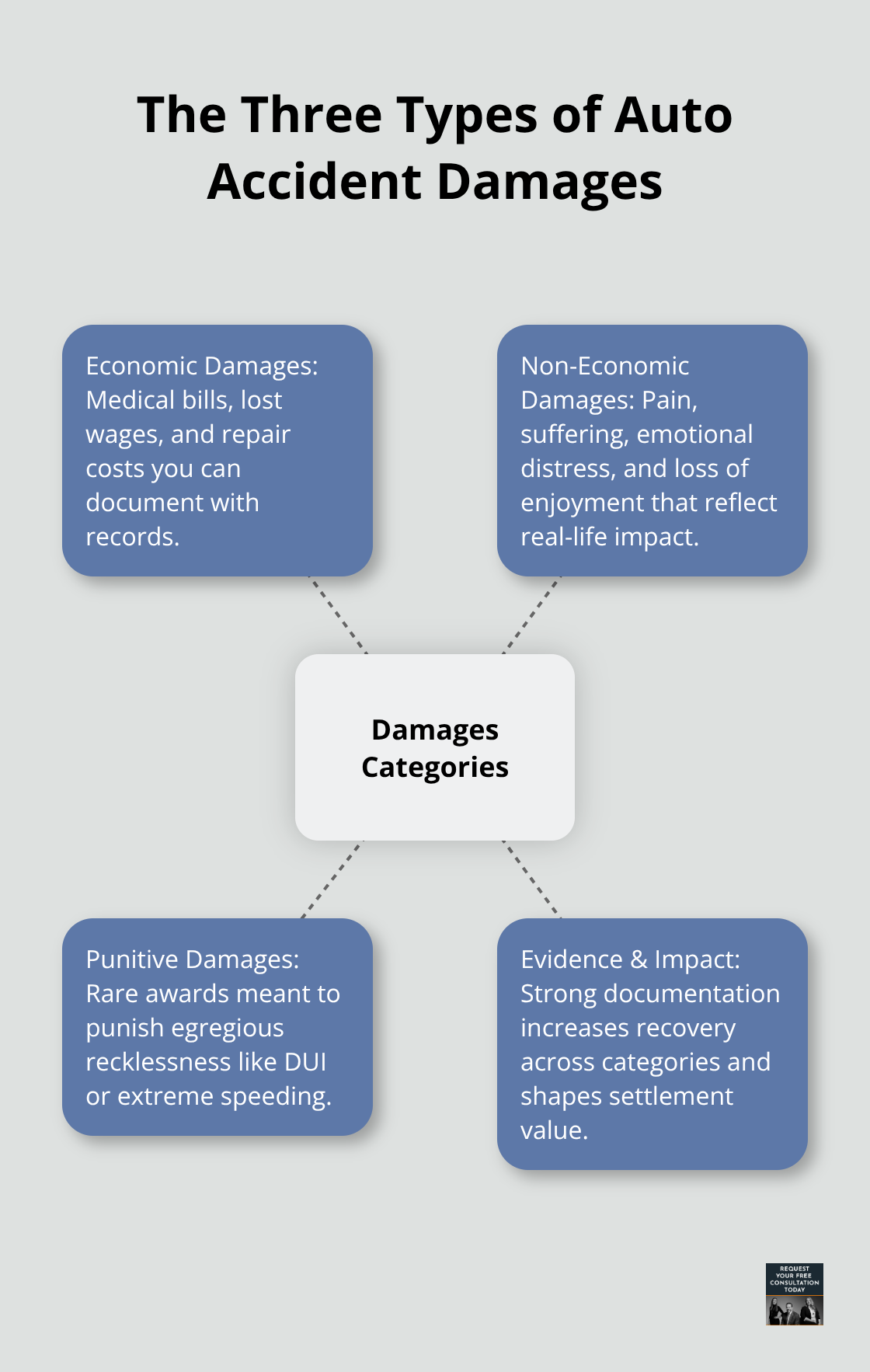
Non-economic damages compensate you for harm that doesn’t have a clear price tag: pain, suffering, emotional distress, loss of enjoyment in activities you once loved. These often represent the largest portion of your settlement. Punitive damages punish the at-fault party when their behavior was egregiously reckless-think driving 40 miles over the speed limit or operating a vehicle while intoxicated. California courts award these rarely, but when they do, they send a message that certain conduct won’t be tolerated.
Economic Damages: What You Can Prove
Economic damages require documentation you can point to. Your medical records show treatment costs; your pay stubs prove lost income; repair estimates from body shops establish vehicle damage. The challenge most people face is accounting for future costs. If your accident caused a spinal injury requiring ongoing physical therapy, you need to calculate those future treatment expenses and include them in your claim. This forward-looking calculation often makes the difference between an adequate settlement and one that leaves you short.
Non-Economic Damages: Valuing Your Suffering
Non-economic damages demand a different approach. Insurance adjusters use formulas-typically multiplying your economic damages by a factor of 1.5 to 5 (depending on injury severity)-but this is where many people underestimate their own suffering. If you spent six months unable to work, couldn’t play sports, or experienced chronic pain affecting sleep, you deserve compensation that reflects that reality. Insurance companies will challenge anything they can’t verify, which is why thorough documentation matters.
Punitive Damages: When Recklessness Crosses the Line
Punitive damages require proof that the at-fault party acted with deliberate disregard for safety. A single traffic citation won’t qualify, but a pattern of reckless behavior, DUI, or fleeing the scene strengthens your case considerably. The key is gathering evidence early-witness statements, police reports, traffic camera footage-before details fade or become inaccessible. This evidence foundation sets the stage for evaluating what your specific damages actually total.
Building Your Damages Documentation
Collect Medical Records Immediately
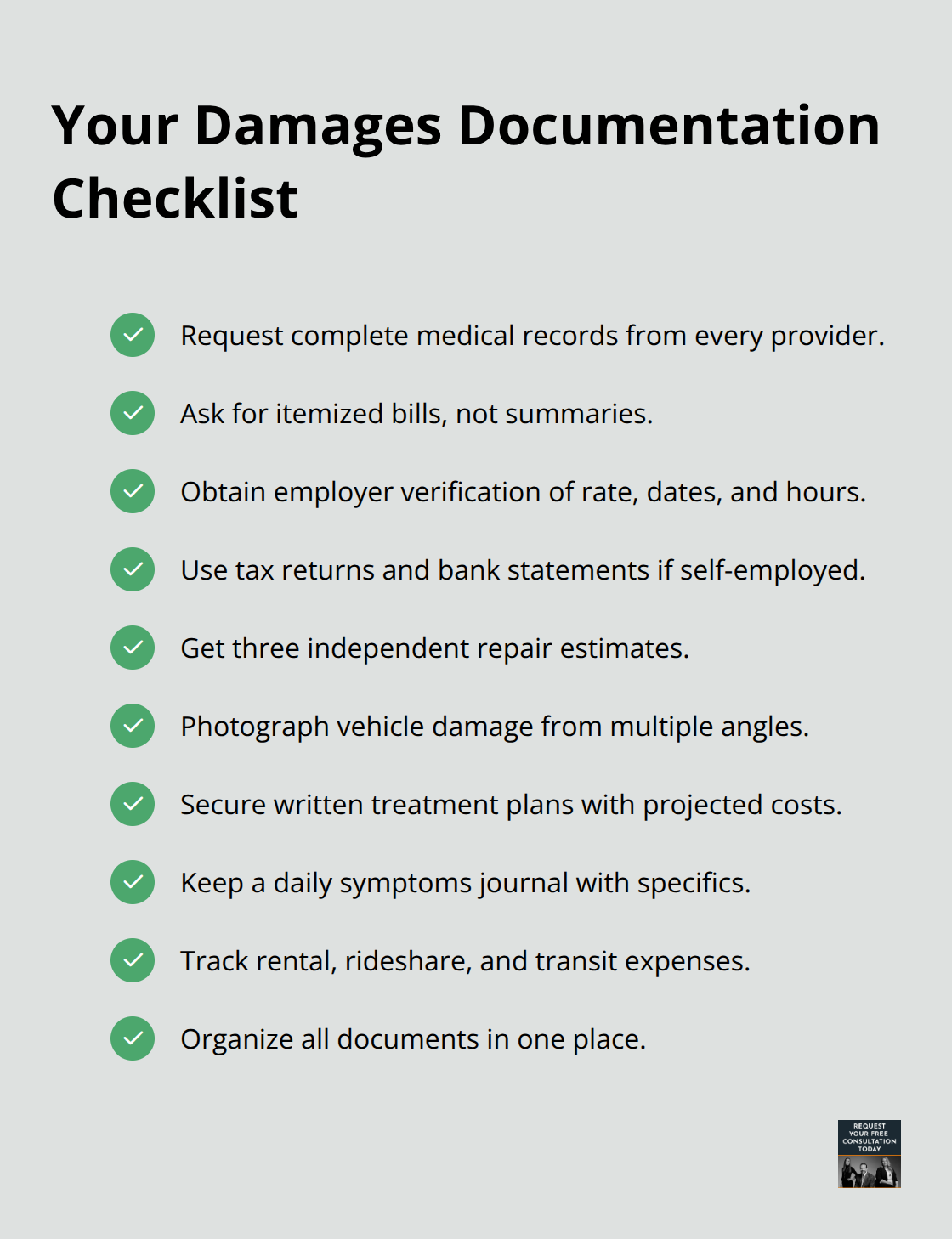
Documentation transforms your damages claim from a vague request into a compelling case backed by evidence. Start collecting medical records immediately after your accident-request them from every healthcare provider you visit, including emergency rooms, urgent care facilities, physical therapists, and specialists. The American Medical Association reports that medical documentation errors delay settlements by an average of 45 days, so accuracy matters. Request itemized bills, not summary statements, because insurance adjusters scrutinize line-item charges and will challenge anything unclear.
Establish Lost Wages With Financial Records
For lost wages, obtain written verification from your employer showing your hourly rate, the dates you missed work, and your typical hours. If you’re self-employed, bank statements and tax returns from the previous two years establish your average income-then you calculate lost earnings by multiplying your daily rate by missed work days. Don’t estimate; use actual financial records instead. This approach removes ambiguity that insurance companies exploit to reduce your settlement.
Document Vehicle Damage Thoroughly
Repair estimates should come from multiple body shops; California law allows you to choose your own repair facility, and getting three estimates protects you if the insurance company disputes the damage assessment. Photograph your vehicle from multiple angles immediately after the accident, before repairs begin, because photos provide irrefutable evidence of damage severity that estimates alone cannot convey. These images create a visual record that strengthens your claim considerably.
Plan for Future Costs and Lost Earning Capacity
Future costs demand forward-thinking documentation that many people overlook entirely. If your doctor indicates ongoing physical therapy for six months, get a written treatment plan with estimated session frequency and costs rather than guessing. Rehabilitation centers provide detailed cost projections if your injuries require long-term care. For lost earning capacity (the income you’ll lose if your injuries prevent you from returning to your previous job), medical records showing your restrictions combined with labor statistics help quantify this. The Bureau of Labor Statistics publishes wage data by occupation and region, which establishes what you would have earned had the accident not occurred.
Track Daily Symptoms and Transportation Expenses
Keep a symptoms journal that documents daily pain levels, activities you couldn’t perform, and how your injuries affected your life; this written record becomes powerful evidence for non-economic damages that insurance companies otherwise minimize. Property damage extends beyond vehicle repair-document rental car costs, rideshare expenses during recovery, and any transportation limitations your injuries imposed. Organized, detailed documentation removes the insurance company’s ability to dispute your numbers, which directly impacts the settlement amount you receive. With this foundation in place, the next step involves identifying the common mistakes that undermine otherwise solid claims.
Where Most Damage Claims Fall Short
Underestimating Future Medical Costs
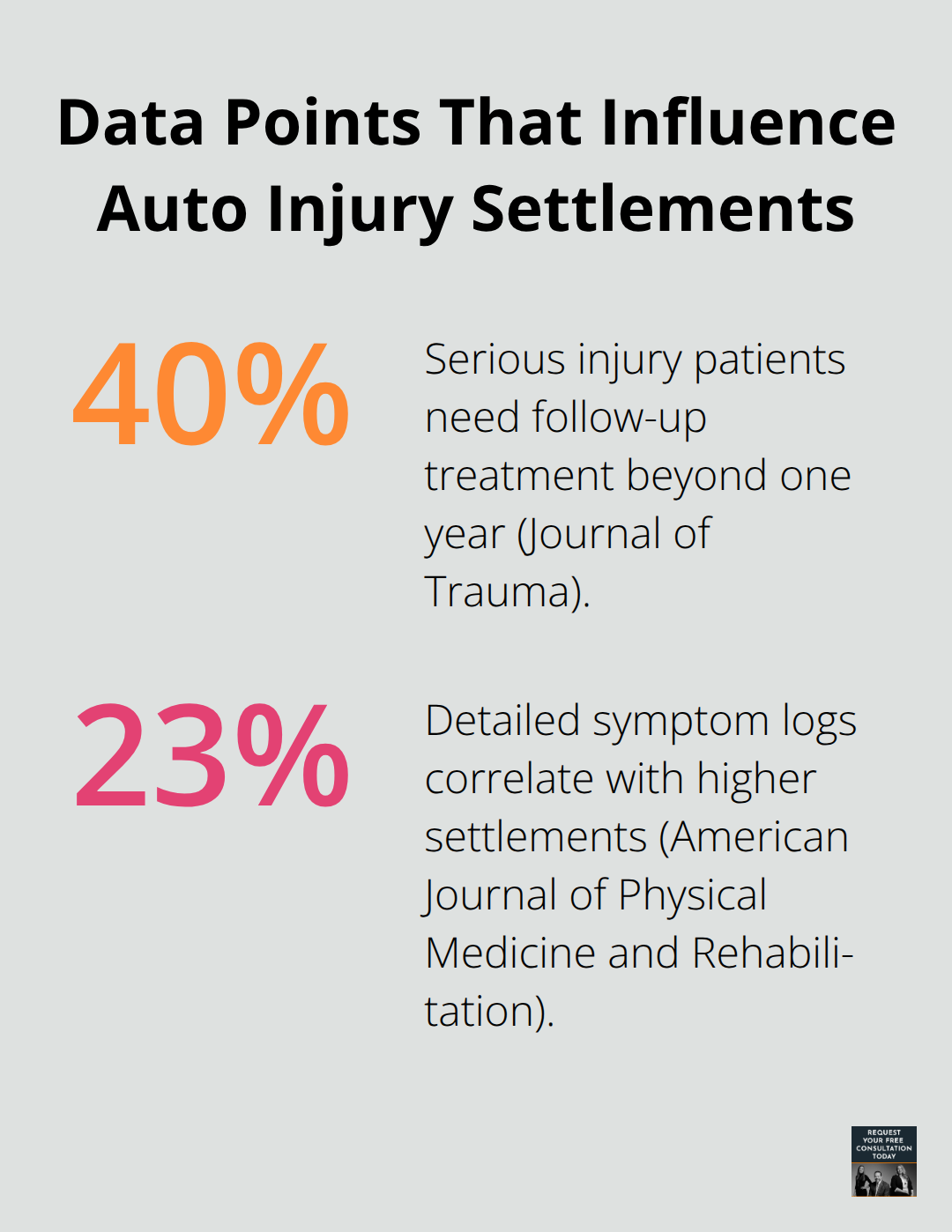
Most people anchor their damages claims to what they see right now. You have a medical bill for $15,000 in emergency room care and orthopedic treatment, so you base your claim on that number. But here’s what happens next: six months into recovery, your physical therapist recommends another four months of treatment at $200 per session. That’s $3,200 more. Then your doctor identifies nerve damage requiring ongoing management, adding another $8,000 in future care costs you didn’t anticipate. The Journal of Trauma reports that 40 percent of serious injury patients require follow-up treatment extending beyond one year post-injury, yet most initial settlement discussions happen within three months of the accident. Insurance companies know this timing works in their favor-they push for quick settlements before you understand the full scope of your medical future.
Accepting their initial offer locks you into compensation that doesn’t cover what actually happens. A client accepts $30,000, thinking it’s generous, then faces $40,000 in unanticipated medical costs two years later with no recourse. The mistake wasn’t greed; it was insufficient documentation of future treatment needs. Get written treatment plans from every provider involved in your care, not casual verbal estimates. Ask your doctor specifically: What treatment will you need over the next two years? What’s the timeline? What are the costs? Write this down and keep copies. Insurance adjusters respect medical documentation from treating physicians far more than your own projections.
Failing to Document Daily Limitations
Documentation of daily limitations matters equally but gets overlooked far more often. You stop attending your daughter’s soccer games because standing for two hours causes sharp pain in your lower back. That’s lost enjoyment of life, a non-economic damage worth substantial compensation, but only if you document it. A symptoms journal showing specific dates, activities you couldn’t perform, and pain levels creates an evidentiary record that generic statements cannot match. The American Journal of Physical Medicine and Rehabilitation found that patients with detailed symptom logs received settlements 23 percent higher than those without documentation.
Write specific entries instead of vague ones. Rather than pain level five out of ten, write: Saturday, March 15th, attempted thirty-minute walk with family, experienced sharp stabbing pain in lower back after fifteen minutes, had to stop and sit down, missed daughter’s soccer game as a result. That specificity transforms vague suffering into documented harm. When insurance companies see a symptoms journal spanning months, they recognize the consistency and severity of your limitations in ways they simply ignore when you verbally describe your experience.
Accepting Offers Without Proper Evaluation
Insurance companies present offers as if they’re final, creating artificial urgency. They phrase it as we need your response within seven days. That pressure forces decisions without adequate information about your true damages. Obtain a thorough evaluation of your claim before accepting anything. This means medical records reviewed, future costs projected, documentation organized, and your case assessed against comparable settlements in Santa Cruz County. The difference between accepting quickly and waiting for proper evaluation often reaches thousands of dollars. We at Schaar & Silva LLP can help direct you through this evaluation process, connecting you with the resources and support you need to understand your claim’s true value.
Final Thoughts
Evaluating damages claims requires you to understand what you can recover, document everything thoroughly, and avoid the mistakes that cost people thousands in compensation. Economic damages represent your concrete losses-medical bills, lost wages, vehicle repairs-while non-economic damages compensate for pain, suffering, and lost enjoyment of life. The difference between a strong claim and a weak one comes down to documentation that transforms vague statements into evidence insurance companies cannot dismiss.
The mistakes outlined earlier-underestimating future costs, failing to document daily limitations, and accepting quick settlements-cost people thousands they rightfully deserve. Medical records, repair estimates, pay stubs, and a symptoms journal create the foundation for a claim that holds up under scrutiny. Your medical future matters, your lost time matters, and your suffering matters.
If you’re in Santa Cruz County, Sacramento, or Oakland and navigating an auto accident claim, Schaar & Silva LLP can guide you through this process. We help with medical bill assistance, property damage evaluation, and connecting you with psychological support when emotional trauma accompanies your physical injuries. Contact us to discuss your specific situation and understand what your damages claim is actually worth.
