
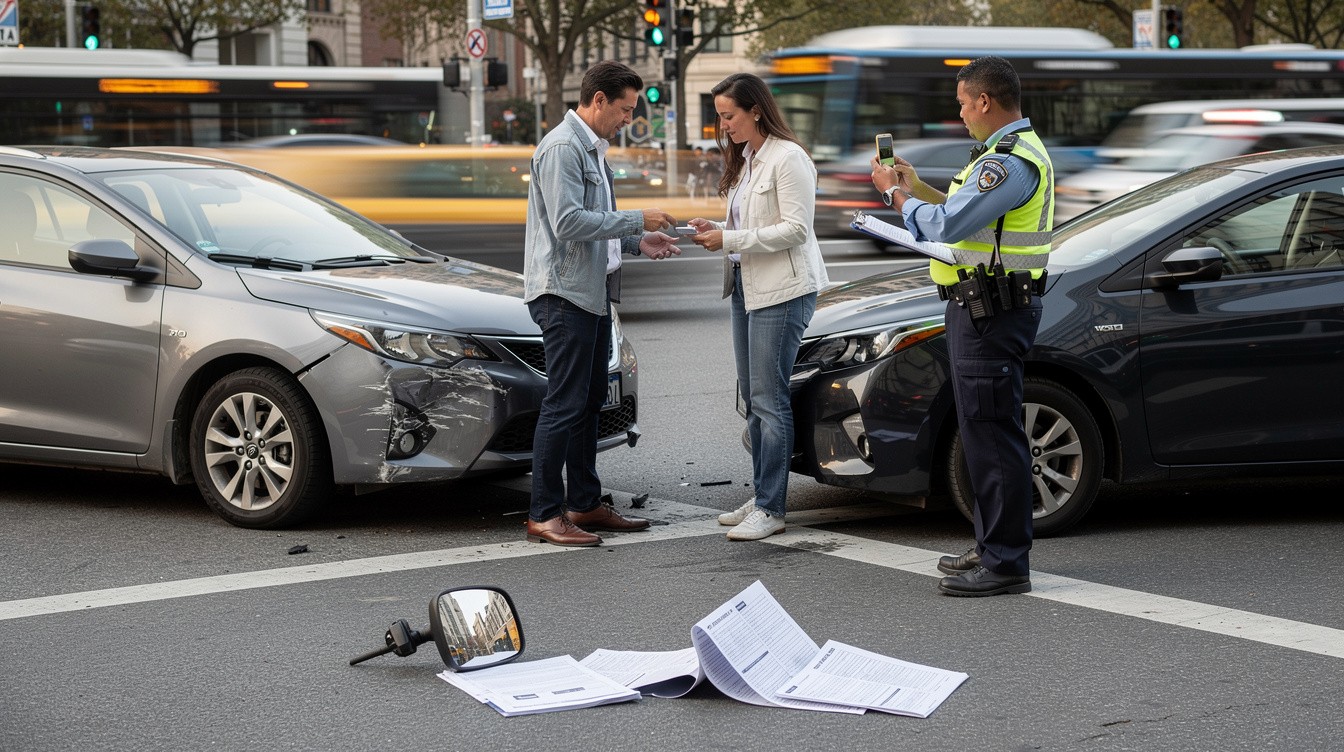
California’s pure comparative negligence rule means you can recover damages even if you’re partially at fault for your accident. However, your compensation gets reduced by your percentage of fault, which makes understanding how this law works essential for your case.
At Schaar & Silva LLP, we’ve seen how comparative negligence in California dramatically changes settlement amounts. The difference between being found 20% liable versus 40% liable can mean tens of thousands of dollars in your pocket.
How Comparative Negligence Changes What You Actually Recover
California’s Rule Gives You More Recovery Options Than Other States
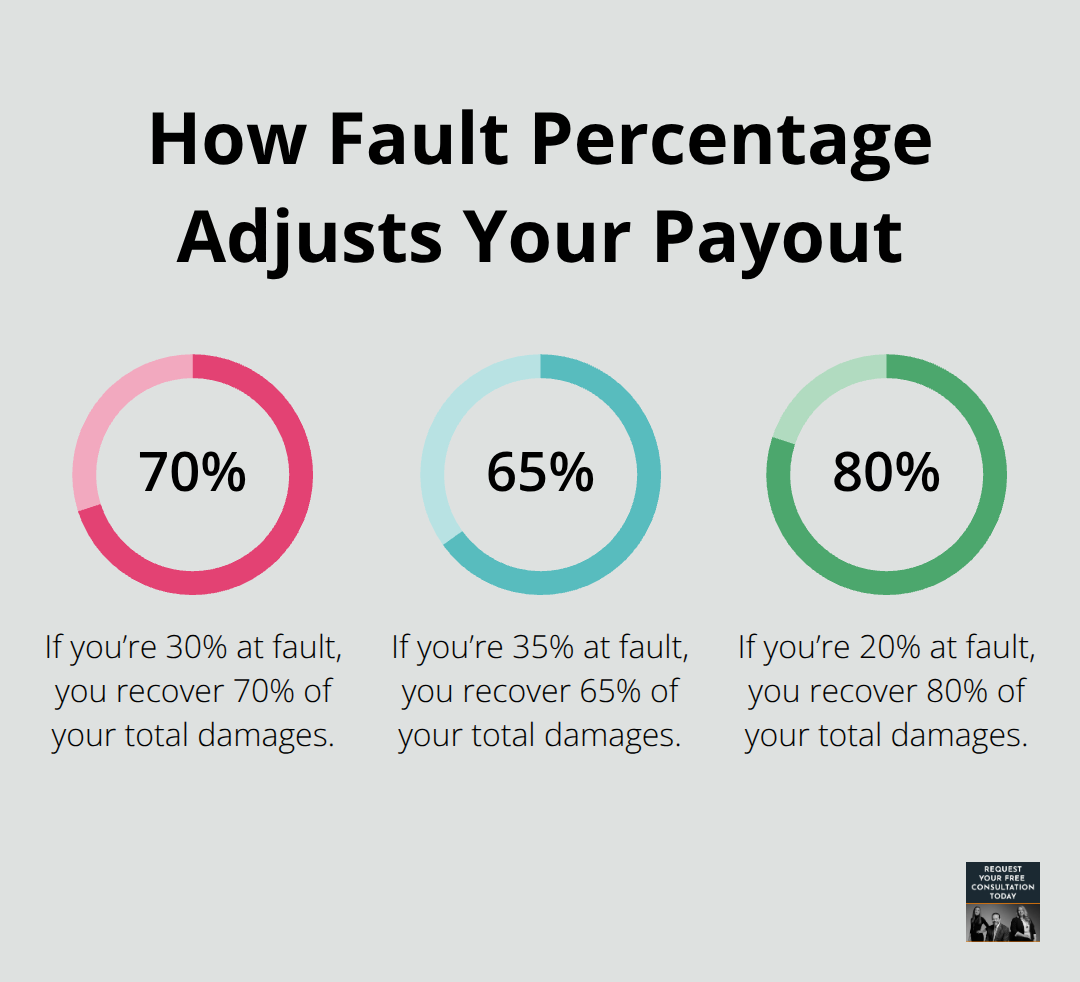
California’s pure comparative negligence rule is fundamentally different from what most other states follow, and this difference directly impacts how much money you walk away with after an accident. Under California law, your compensation gets reduced by exactly your percentage of fault, nothing more and nothing less. If you’re found 30% at fault for a collision, you recover 70% of your total damages.
This contrasts sharply with states like Virginia and North Carolina, which follow contributory negligence rules that bar you from recovery entirely if you’re found even 1% responsible. Other states use modified comparative negligence, which allows recovery only if you’re 50% or less at fault.
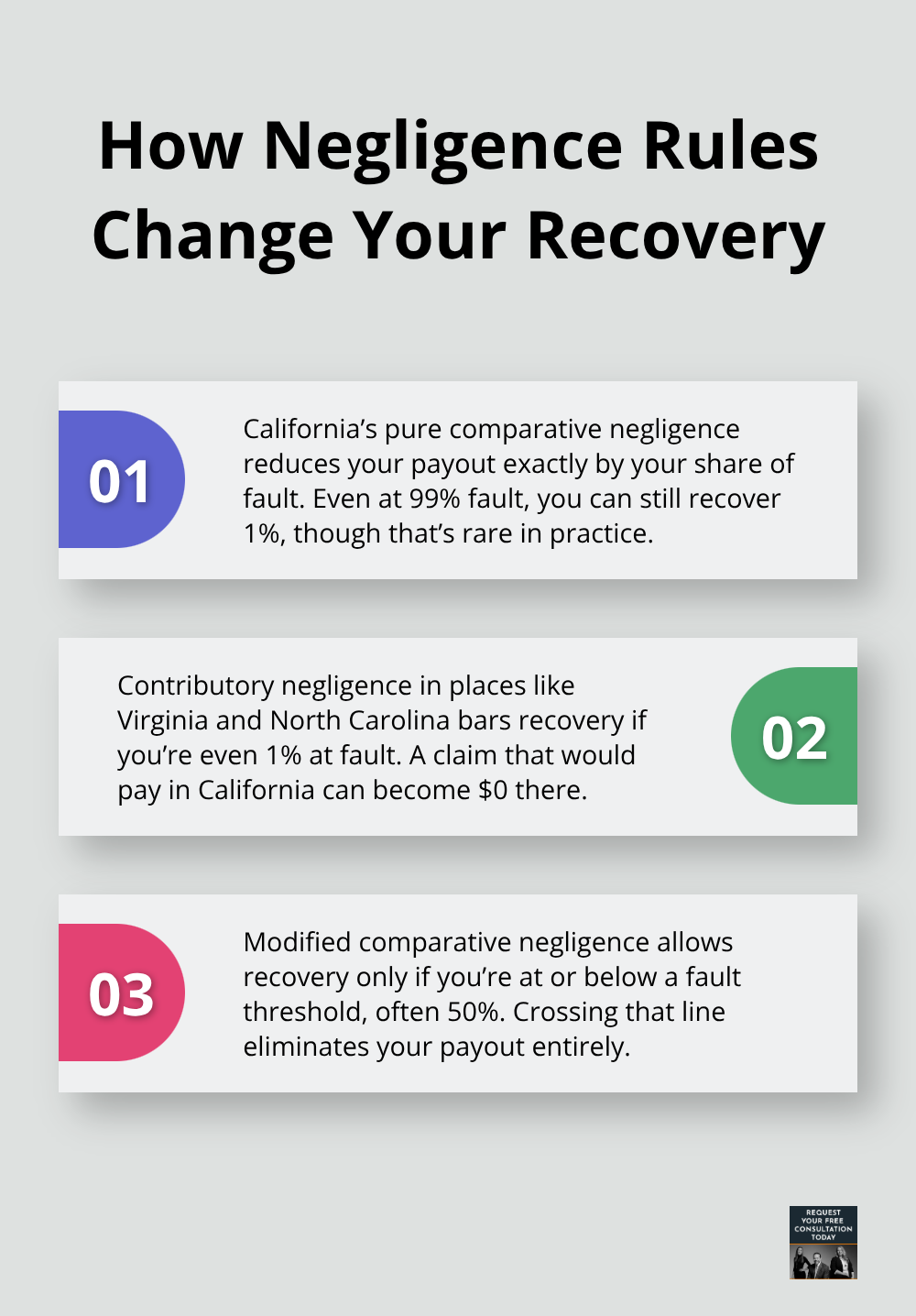
California’s approach is the most favorable to injured people because it removes that threshold entirely. You could be 99% at fault and still recover 1% of damages, though that scenario is rare in practice. The practical implication is straightforward: a $100,000 injury claim becomes $70,000 if you’re 30% liable, but it becomes $0 in Virginia or North Carolina if comparative fault applies to you there.
Fault Percentages Shift Based on Evidence and Investigation
The reason this matters for your specific case is that fault percentages fluctuate based on evidence, witness credibility, and how well your side presents the accident sequence. Initial police reports often suggest clients were substantially at fault, but investigation reveals the other driver violated a traffic law that shifted liability dramatically. A driver texting while driving, for instance, can be found 60-80% at fault even if they didn’t cause the initial contact.
Medical records, vehicle damage patterns, and surveillance footage all contribute to how a judge or jury assesses fault. Insurance adjusters often lowball initial fault percentages to minimize their payouts, which is why challenging their assessment matters enormously. The difference between accepting a 40% fault determination and fighting for 25% can mean $15,000-$30,000 more in your pocket on a six-figure claim.
Strong Representation Shifts Liability in Your Favor
Comparative negligence in California rewards thorough investigation and strong legal representation because the percentages genuinely shift based on what evidence you present and how persuasively you present it. The next section examines the specific evidence that supports your claim and the common mistakes that increase your fault percentage.
How Your Fault Percentage Directly Reduces Your Settlement
Your compensation amount in California follows a straightforward mathematical formula: total damages multiplied by your percentage of responsibility. If a jury determines your total damages at $100,000 and finds you 35% at fault, you receive $65,000. If that same jury finds you 20% at fault, you receive $80,000. The difference is real money-$15,000 that either stays in your pocket or goes away based entirely on how fault gets calculated.
Insurance companies know this formula precisely, which is why they aggressively push high fault percentages in settlement negotiations. They’re not trying to be fair; they’re trying to reduce what they pay by inflating your liability share. A client received an initial settlement offer of $45,000 after being assigned 50% fault for a rear-end collision. Investigation revealed the other driver had failed to maintain safe following distance and had brake failure due to negligent maintenance. The fault percentage shifted to 15%, and the settlement increased to $78,500. That $33,500 difference came directly from challenging the initial fault assessment with evidence rather than accepting the insurance company’s first number.
Damage Awards Shrink Proportionally to Your Fault Percentage
Every percentage point of fault you’re assigned reduces your recovery in direct proportion. On a $200,000 claim, moving from 40% to 30% fault means $20,000 more in your pocket. On a $500,000 claim, that same 10-point shift means $50,000 more.
Insurance adjusters count on injured people not understanding this leverage, so they anchor negotiations with inflated fault percentages knowing many will accept rather than fight. Medical records documenting your injuries, accident scene photographs showing road conditions and vehicle positions, and traffic violation citations for the other driver all push fault percentages in your favor. Surveillance footage from nearby businesses or traffic cameras proves particularly powerful because it shows the accident sequence objectively without relying on anyone’s memory or interpretation.
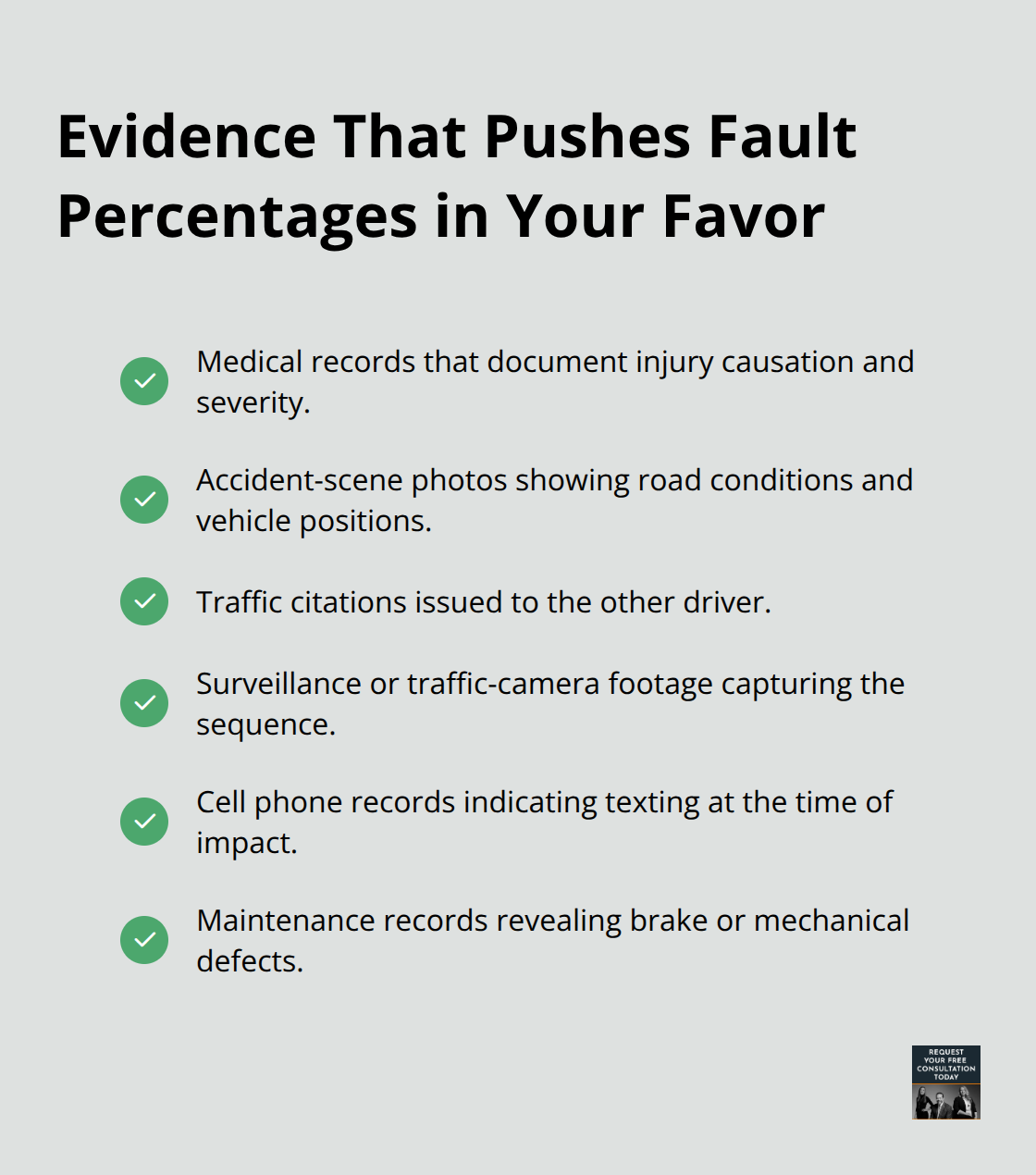
Cell phone records proving the other driver was texting, maintenance records showing their vehicle had known defects, and prior accident history showing a pattern of similar collisions all contribute to establishing higher fault against them. This evidence directly translates to settlement dollars.
Small Shifts in Fault Create Large Settlement Differences
A 10-percentage-point reduction in your assigned fault on a six-figure claim typically means $10,000 to $20,000 more in recovery, depending on your total damages. On larger claims exceeding $300,000, that same 10-point shift can mean $30,000 to $50,000 in additional compensation. This is why initial settlement offers from insurance companies often come with high fault percentages attached-they’re testing whether you’ll accept without pushing back.
Accepting their first number without investigation means leaving substantial money on the table. The investigation that shifts fault percentages requires examining the accident scene, reviewing maintenance records, analyzing vehicle damage patterns, and interviewing witnesses while their memories remain fresh. These steps demand attention to detail and knowledge of what evidence actually moves fault percentages in your favor-which brings us to the specific evidence that supports your claim and the common mistakes that increase your liability.
What Evidence Actually Shifts Fault in Your Favor
Vehicle Damage Patterns Reveal the Accident Sequence
Vehicle damage patterns tell the story of how an accident happened, and insurance companies know this better than anyone. The location and severity of damage on both vehicles reveal impact angles, vehicle positions at contact, and which direction forces traveled. If you were rear-ended, the front-end damage on the other vehicle combined with rear damage on yours proves the sequence of events objectively. Photos taken at the accident scene within hours show skid marks, road conditions, traffic signal timing, and visibility obstacles that existed in that moment. These photos deteriorate quickly as weather, traffic, and time alter the scene, which is why immediate documentation matters enormously.
Police Reports and Scene Documentation Create Objective Records
Police reports often contain officer observations about road conditions, weather, visibility, and vehicle positions, though the officer’s fault determination itself carries less weight than the physical facts they documented. The officer’s observations of scene conditions, vehicle positions, and damage patterns provide objective evidence independent of what either driver claims happened. Witness statements recorded while memories remain sharp provide accounts of traffic violations, distracted driving, or unsafe speeds that the other driver exhibited. Witness statements from neutral third parties carry substantial weight because they have no financial interest in the outcome and their accounts align with or contradict driver statements in ways that establish credibility. Getting witness contact information at the scene and following up within days while their memories remain accurate produces statements far more detailed and reliable than statements taken weeks later.
Technical Evidence Eliminates Ambiguity About Fault
Cell phone records proving the other driver was texting at the time of impact, obtained through discovery, eliminate any possibility of their claim that they were paying attention. Maintenance records from the other vehicle showing brake defects, tire failures, or mechanical issues that contributed to the accident directly establish their negligence in vehicle maintenance. This evidence combined with scene documentation and witness accounts creates a compelling picture of how the accident occurred and who bears responsibility.
Common Mistakes That Increase Your Fault Percentage
Common mistakes that increase your fault percentage stem largely from early statements and inaction rather than the accident itself. Telling the other driver’s insurance company that you’re sorry, that you could have done something differently, or that you partially caused the accident hands them ammunition to assign you fault you don’t deserve. Accepting the initial police report’s fault determination without investigating further locks you into their assessment when evidence might shift liability significantly. Waiting weeks or months to document the accident scene allows conditions to change and witnesses to forget details. Posting about the accident on social media, even vague references to feeling fine or being grateful to be alive, gets used against you to minimize injury severity. Failing to seek medical attention immediately after the accident creates gaps in your medical records that insurance companies exploit to argue your injuries weren’t serious or weren’t caused by the collision.
Why Immediate Action Protects Your Fault Determination
The difference between winning and losing on fault determinations often comes down to evidence collected in those first hours and days after an accident, not arguments constructed months later during settlement negotiations. Insurance adjusters count on injured people not acting quickly, so they anchor negotiations with inflated fault percentages knowing many will accept rather than fight. The investigation that shifts fault percentages requires examining the accident scene, reviewing maintenance records, analyzing vehicle damage patterns, and interviewing witnesses while their memories remain fresh and before the scene changes. These steps demand attention to detail and knowledge of what evidence actually moves fault percentages in your favor.
Final Thoughts
Comparative negligence in California means your fault percentage directly reduces your settlement amount, so a 10-point difference in liability can mean $10,000 to $50,000 in additional recovery depending on your claim size. The evidence you collect immediately after an accident-vehicle damage photos, witness statements, police reports, and scene documentation-determines whether you accept an insurance company’s inflated fault assessment or fight for a lower percentage that protects your recovery. Fault percentages shift based on investigation quality and the evidence you present, which is why insurance adjusters count on injured people accepting their initial offers without pushing back.
Resist the urge to accept settlement offers quickly and request the insurance company’s fault determination in writing along with the evidence supporting their percentage. Obtain the police report and review it for inaccuracies, photograph vehicle damage and road conditions if you haven’t already, and gather witness statements while memories remain sharp. These steps take days rather than weeks but directly impact your final settlement amount in ways that matter significantly.
We at Schaar & Silva LLP help clients challenge fault percentages that don’t reflect what actually happened and navigate the complexities of comparative negligence California cases. Contact us to discuss your case and learn how we can protect your recovery in Santa Cruz County and surrounding areas.
