
Car insurance fraud costs Americans over $40 billion annually, with California ranking among the top states for fraudulent claims. These schemes range from staged accidents to fake injury reports.
We at Schaar & Silva LLP see how car insurance fraud cases impact Santa Cruz County residents through higher premiums and legal complications. Understanding real fraud examples helps protect honest drivers from becoming victims or unwitting participants in these costly schemes.
What Are the Most Common Car Insurance Fraud Schemes?
Fraudsters employ three primary methods to steal millions from insurance companies and drive up premiums for honest drivers. Staged accidents represent the most profitable scheme, with organized rings in California that generate an average of $174,000 through coordinated collisions. The Santa Clara County case from August 2023 involved 23 individuals who used 40 different vehicles over four years, many already damaged when purchased. These rings stage rear-end collisions at intersections, then file claims for vehicle damage and fake injuries.
Fake Injury Claims Cost Drivers Billions
False injury claims follow staged accidents, with fraudsters who visit multiple doctors to document non-existent injuries. Medical mills in California charge insurance companies for unnecessary treatments, which inflates costs that get passed to all drivers through higher premiums. The California Department of Insurance reports that exaggerated soft tissue injuries account for 60% of fraudulent medical claims. Fraudsters target busy intersections where minor impacts can allegedly cause whiplash (these injuries are difficult to disprove medically).
Vehicle Theft and Arson Schemes Target High-Value Cars
California Penal Code 548 addresses cases where owners damage, hide, or abandon vehicles to collect insurance proceeds. Vehicle arson cases often involve cars with mechanical problems or loans that exceed the vehicle’s value. The California Highway Patrol investigates approximately 200 suspected arson cases annually, with conviction rates that reach 85% when proper evidence collection occurs. These schemes typically involve luxury vehicles or commercial trucks, where insurance payouts can exceed $50,000 per claim.
The financial impact of these fraud schemes extends far beyond individual cases, as insurance companies pass investigation costs and fraudulent payouts directly to consumers through premium increases (affecting every driver in California).
What Happens When Fraud Cases Go to Court?
California prosecutors pursue insurance fraud cases with determination, and the Santa Clara County District Attorney’s Office secures convictions in 85% of cases that reach trial. The August 2023 organized fraud ring case shows how prosecutors handle complex schemes with multiple defendants. Twenty-three individuals faced felony charges for a four-year fraud operation that generated $174,000 through staged collisions and fictitious identities. Each defendant faced potential sentences of up to five years in prison and fines that reach $50,000 under California Penal Code provisions.
Criminal Penalties Strike Fraudsters Hard
Jeffrey Thranow’s workers’ compensation fraud case resulted in over $47,000 in premium restitution payments to insurance companies, according to the California Department of Insurance. Courts routinely order restitution payments that double the original fraud amount (a $25,000 fraudulent claim can result in $50,000 in penalties). Repeat offenders face enhanced penalties that eliminate probation options and mandate prison sentences. The California Department of Insurance reports that criminal convictions for insurance fraud have increased by 23% over the past three years, which reflects stronger enforcement efforts. These convictions create permanent criminal records that affect employment opportunities, professional licenses, and future insurance coverage options for defendants.
Premium Increases Hit All California Drivers
Insurance Commissioner Ricardo Lara confirmed that organized fraud rings drive premium increases statewide, with honest drivers who pay an estimated $400 annually in additional costs due to fraudulent claims. The National Association of Insurance Commissioners calculates that fraud accounts for 10% of all property and casualty claims, which translates to higher rates for every policyholder. Insurance companies pass investigation costs and fraudulent payouts directly to consumers through rate adjustments that the California Department of Insurance approves during annual reviews.

Detection Methods Catch More Fraudsters
Insurance companies now employ sophisticated technology and investigation techniques to identify suspicious claims before they result in payouts (these methods have revolutionized fraud prevention efforts).
How Do Insurance Companies Catch Fraudsters
Insurance companies deploy advanced artificial intelligence systems that analyze claim patterns and flag suspicious activities within hours of submission. State Farm and Allstate use predictive analytics that examine over 150 data points per claim, including accident location, time stamps, and claimant history. These systems identify anomalies like multiple claims from the same intersection or medical providers who appear frequently in injury claims. The Insurance Information Institute reports that technology-driven investigations prevent approximately $2.4 billion in fraudulent payouts annually across all carriers.

Digital Evidence Reveals Truth Behind Claims
Modern fraud detection relies heavily on social media monitoring and digital forensics that expose contradictions between reported injuries and actual activities. Insurance investigators routinely examine Facebook, Instagram, and TikTok accounts to find evidence of claimants who report severe back injuries while posting videos of themselves playing sports or lifting heavy objects. The National Insurance Crime Bureau operates a database that cross-references vehicle identification numbers, previous claims, and repair shop histories to identify patterns across multiple insurers.
License plate recognition technology at repair shops automatically alerts investigators when vehicles involved in suspicious claims arrive for estimates. Cell phone tower data provides precise location information that can contradict accident reports, while dash cam footage from nearby vehicles increasingly serves as evidence in disputed claims.
Law Enforcement Partnerships Target Organized Rings
The Urban Automobile Insurance Fraud Task Force combines resources from the California Department of Insurance, California Highway Patrol, and local district attorneys to investigate complex fraud schemes that span multiple counties. This multi-agency approach resulted in the Santa Clara County case that dismantled a 23-person fraud ring that operated across four years. Insurance companies share claim data with law enforcement through secure databases that identify shared contact information, addresses, and medical providers across seemingly unrelated claims.
Red Flags That Trigger Investigations
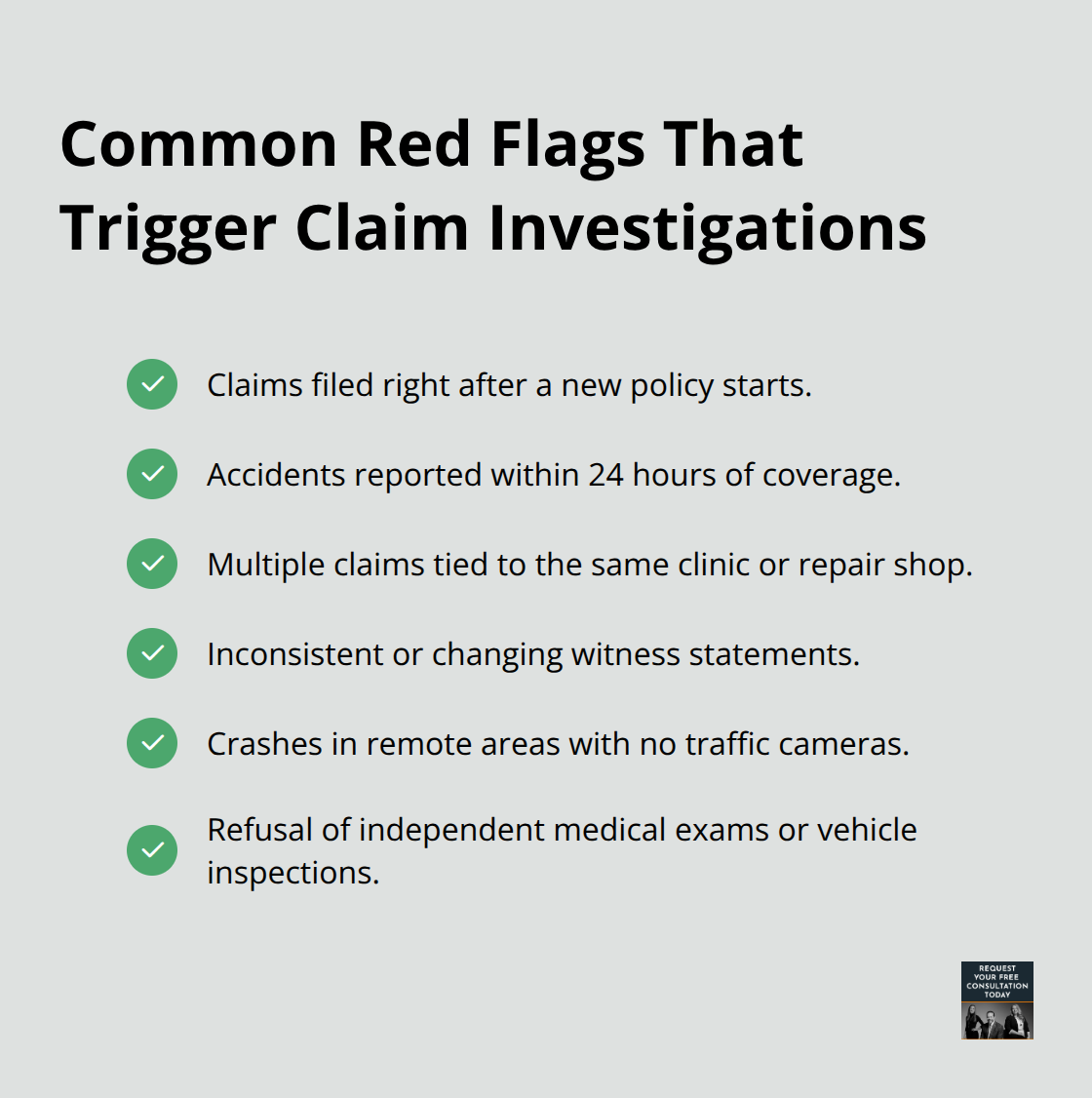
Insurance companies watch for specific patterns that indicate potential fraud. Claims filed immediately after policy activation raise suspicions (especially when accidents occur within 24 hours of coverage). Multiple claims from the same medical clinic or repair shop trigger automatic reviews. Investigators also examine inconsistent witness statements, accidents that occur in remote locations without traffic cameras, and claimants who refuse independent medical examinations or vehicle inspections.
Final Thoughts
Car insurance fraud cases cost California drivers an estimated $400 annually in higher premiums, which makes every fraudulent claim a burden on honest policyholders. The Santa Clara County fraud ring that netted $174,000 shows how organized schemes drive up costs for everyone in the state. Honest claims help protect the entire insurance system from collapse.
Accurate reports and truthful information keep premiums affordable for all California residents. The California Department of Insurance relies on consumer cooperation to identify suspicious patterns and prevent future fraud. Criminal penalties for insurance fraud include up to five years in prison and $50,000 in fines under California Penal Code provisions (repeat offenders face enhanced sentences without probation options).
If you’ve been involved in a legitimate accident in Santa Cruz County, Schaar & Silva LLP can help navigate the claims process while protecting your rights. We work with clients on medical bill issues, property damage evaluations, and connections to support services. These convictions create permanent criminal records that affect employment and future insurance coverage.
