

A Capitola car accident can turn an ordinary trip to the beach, the grocery store, or work into weeks of medical appointments, missed time, and phone calls with insurance adjusters. Capitola may be a small seaside city, but its traffic is anything but quiet, with commuters on Highway 1, shoppers along 41st Avenue, and visitors circling Capitola Village for parking. Knowing how California law applies to the kinds of crashes that happen here gives you real control over your claim from the very first day.
At Schaar & Silva LLP, we help people injured in car and truck accidents throughout Santa Cruz County hold careless drivers accountable so you can move forward with confidence. This guide explains how Capitola crashes actually happen, how to build a strong claim afterward, and the mistakes that can quietly weaken a case.
How Capitola Car Accidents Actually Happen
Every community has its own traffic patterns, and Capitola’s are shaped by geography. The city sits between the Highway 1 corridor and the coastline, so much of its traffic funnels through a handful of interchanges, commercial streets, and narrow village roads. Crashes here tend to follow those patterns, and each one is governed by specific rules in the California Vehicle Code that help determine who was at fault.
Highway 1 Congestion and Rear-End Collisions
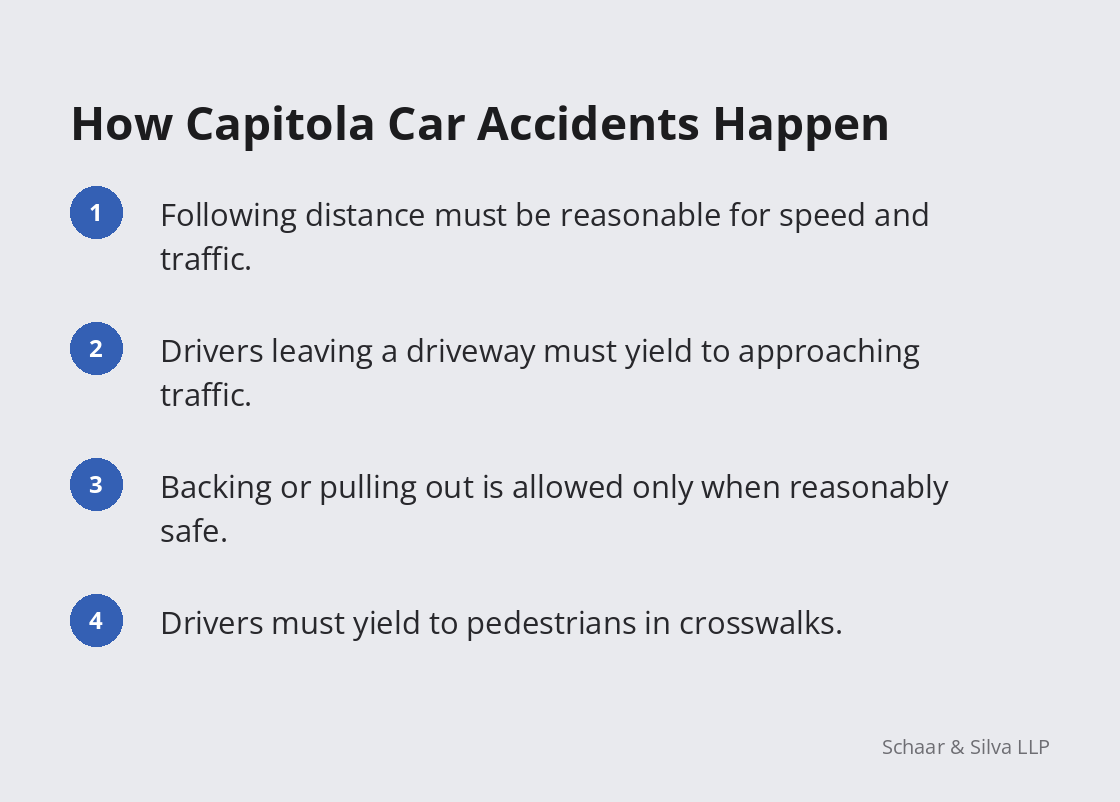
Highway 1 through Capitola often slows to stop-and-go traffic during commute hours and busy beach weekends. Sudden slowdowns are a common setting for rear-end crashes, especially when drivers are distracted or tailgating. Vehicle Code Section 21703 provides that a driver shall not follow another vehicle more closely than is reasonable and prudent, having due regard for the speed of such vehicle and the traffic upon, and the condition of, the roadway. When a driver cannot stop in time because they were following too closely, that conduct is often central to proving fault.
Driveways and Shopping Centers Along 41st Avenue
The shopping centers, restaurants, and businesses along 41st Avenue create constant traffic in and out of parking lots and driveways. Vehicle Code Section 21804 requires the driver of any vehicle about to enter or cross a highway from any public or private property to yield the right-of-way to all traffic approaching on the highway close enough to constitute an immediate hazard, and to continue yielding until they can proceed with reasonable safety. A driver who pulls out of a parking lot into the path of oncoming traffic, or cuts across lanes to reach a driveway, may be responsible for the resulting collision.
Parking, Backing, and Pedestrians in Capitola Village
Capitola Village draws residents and visitors to its beach, shops, and restaurants, which means tight streets, frequent parking maneuvers, and many people on foot. Vehicle Code Section 22106 provides that no person shall start a vehicle stopped, standing, or parked on a highway, nor back a vehicle on a highway, until such movement can be made with reasonable safety. Drivers must also watch for people crossing the street. Under Vehicle Code Section 21950, a driver must yield the right-of-way to a pedestrian crossing the roadway within any marked crosswalk or within any unmarked crosswalk at an intersection, and must exercise all due care and reduce speed as necessary to safeguard pedestrians in a crosswalk.
Building Your Claim After a Capitola Crash
A strong injury claim is built on evidence that shows what happened, why the other driver was responsible, and how the crash affected your life. Much of that evidence is easiest to gather in the first days after a collision. Taking a few organized steps early can make a significant difference when you later deal with insurance companies. It also helps to keep a simple journal describing your pain, sleep, daily limitations, and the activities you have had to give up, because those details are easy to forget as the months pass and they help show the full impact of the crash on your life.
Getting the Collision Report and Preserving Evidence
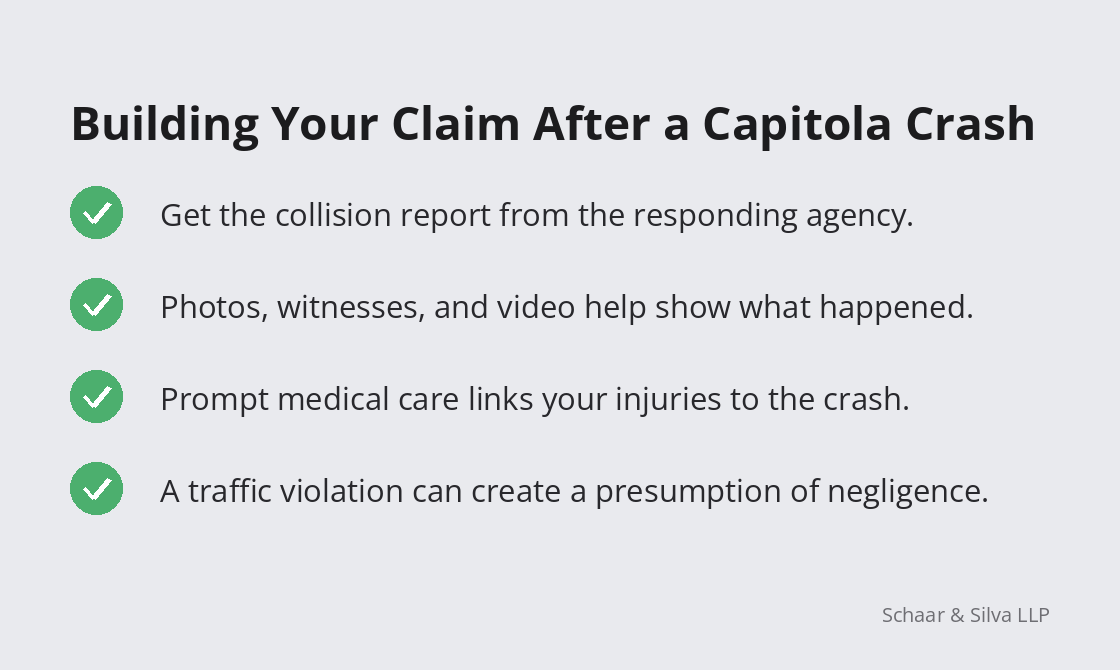
Which agency responds depends on where the crash occurred. Collisions on Capitola’s city streets are typically handled by the Capitola Police Department, while Vehicle Code Section 2400 gives the California Highway Patrol primary jurisdiction for investigating traffic accidents on state highways constructed as freeways, which generally includes crashes on Highway 1. The CHP’s Santa Cruz Area office serves the County of Santa Cruz. Along with the report, photographs of the vehicles and the scene, contact information for witnesses, and video from nearby businesses or dashcams can all help, but security footage is often recorded over quickly, so it is important to identify it early.
Medical Care and Treatment Records
Seeking medical care promptly after a crash protects both your health and your claim. Some injuries, such as concussions and soft-tissue damage to the neck and back, may not cause noticeable symptoms until hours or days later. Following your doctor’s recommendations and keeping records of appointments, therapy, and time away from work creates a clear link between the crash and your injuries. Insurers often point to delays or gaps in treatment to argue that an injury was minor or unrelated.
How Traffic Rules Help Prove Negligence
Under Civil Code Section 1714, everyone is responsible for an injury caused to another by a lack of ordinary care in the management of their property or person. When the other driver also broke a traffic law, Evidence Code Section 669 can strengthen the claim. That section creates a presumption that a person failed to exercise due care if they violated a statute, the violation caused the injury, the injury was the kind the statute was designed to prevent, and the injured person was among those the statute was meant to protect. The presumption can be rebutted, but it often shifts the focus of the dispute toward the driver who broke the rule.
Mistakes That Can Weaken a Capitola Car Accident Claim
Even a clear case can be undermined by decisions made in the stressful days after a crash. Insurance companies look for statements, delays, and gaps they can use to reduce or deny a claim. Knowing the most common mistakes helps you avoid them.
Accepting Blame or Assuming Shared Fault Ends the Case
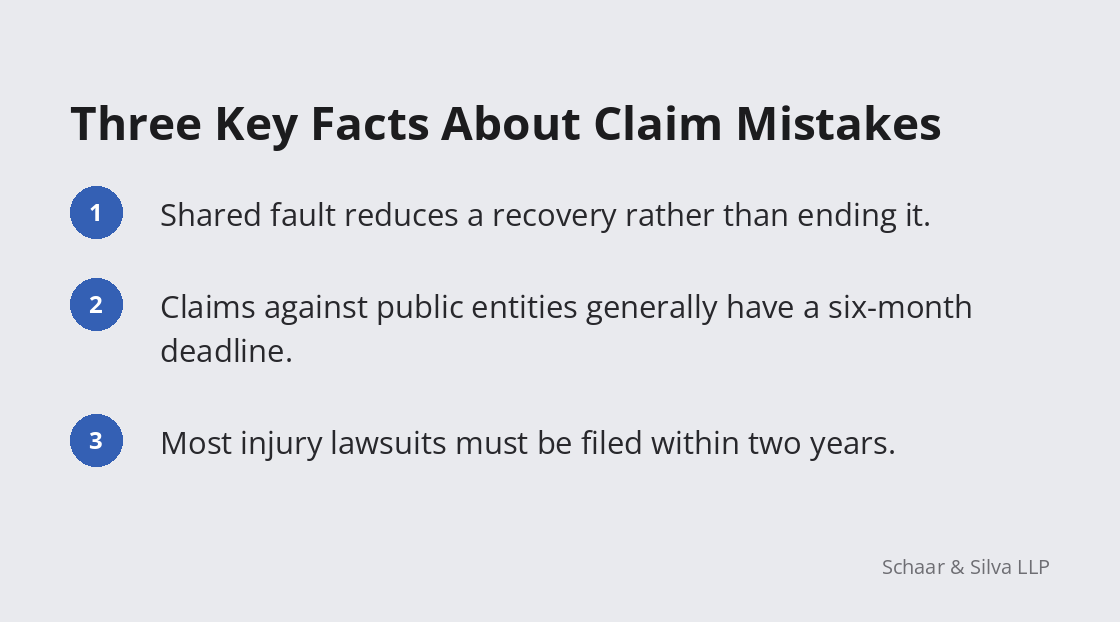
People often apologize at the scene out of politeness or shock, and those words can later be used to suggest they caused the collision. It is better to stick to the facts and let the evidence speak. Even if you may have played some role in the crash, California follows a comparative fault system. Under CACI No. 405, the instruction California juries receive on this issue, an injured person’s damages are reduced by the percentage of their own responsibility rather than eliminated, so shared fault does not automatically end a claim.
Overlooking a Claim Against a Public Entity
Some Capitola crashes involve a city vehicle or a dangerous road condition, such as a poorly maintained roadway or a hazard a public agency knew about and failed to address. Government Code Section 835 allows a public entity to be held liable for injury caused by a dangerous condition of its property when certain requirements are met, including that the condition created a reasonably foreseeable risk of the kind of injury that occurred. These claims have their own procedure, and Government Code Section 911.2 generally requires a claim for personal injury to be presented to the public entity within six months after the cause of action accrues.
Waiting Too Long to Act
Other deadlines apply as well. Vehicle Code Section 16000 requires a driver involved in an accident that results in bodily injury or death, among other situations, to report the accident to the Department of Motor Vehicles within 10 days on an approved form. For the injury claim itself, Code of Civil Procedure Section 335.1 generally allows two years to file a lawsuit for injury or death caused by the wrongful act or neglect of another. Evidence fades and witnesses become harder to find over time, so acting early is one of the best ways to protect your case. Speaking with an attorney before you give a recorded statement or sign any release can also help make sure you do not accidentally give up rights you did not know you had.
Final Thoughts
A Capitola car accident can happen on the freeway, in a busy shopping corridor, or on a crowded village street, but the same California rules of the road apply in each place. Following distance, yielding when leaving a driveway, safe backing, and care for pedestrians all set expectations that every driver must meet, and those rules often become the foundation of an injury claim.
Gathering evidence, getting prompt medical care, and watching your deadlines can make a meaningful difference in the outcome of your case. You can learn more about how we handle auto accident claims in Santa Cruz County as you consider your next steps.
If you were hurt in a crash in Capitola or anywhere in Santa Cruz County, contact Schaar & Silva LLP to speak with our team about your situation. We’ll explain your rights under California law, help you understand your options, and support you as you move forward with confidence.