

A California car crash settlement can mean the difference between recovering fully and struggling financially after an accident. If you’ve been hit by another driver, you deserve compensation that covers your medical bills, lost income, and vehicle damage.
At Schaar & Silva LLP, we’ve helped accident victims in Santa Cruz, Sacramento, and Oakland navigate the settlement process and push back against lowball offers. This guide walks you through the laws, factors that determine your payout, and strategies to negotiate effectively.
How California’s Liability Rules Shape Your Settlement
Understanding Pure Comparative Negligence
California’s pure comparative negligence rule fundamentally changes how your settlement gets calculated, and most accident victims don’t understand this until they’re already negotiating. Under California Code of Civil Procedure Section 1431.2, you can recover damages even if you’re partly responsible for the crash. If you’re 30% at fault in a collision that caused $100,000 in damages, you recover $70,000. The insurer reduces your payout dollar-for-dollar based on your percentage of fault. However, if you’re found 51% or more at fault, you recover nothing. This rule applies in every California county, including Santa Cruz, Sacramento, and Oakland.
The practical implication is brutal: insurers will aggressively argue you share blame to shrink what they owe. They’ll claim you were distracted, speeding, or failed to brake in time. Building solid evidence of the other driver’s fault is non-negotiable.
Building Your Evidence of Fault
Photograph the accident scene within 24 hours, capturing road conditions and vehicle positions from multiple angles. Obtain the official police report from the Sheriff’s Office immediately. Witness statements carry enormous weight because they corroborate fault independently and establish the sequence of events without bias. These documents prevent the insurer from inflating your responsibility and create a factual record that’s difficult to challenge.
Critical Deadlines You Cannot Miss
Your deadline to file a lawsuit is two years from the accident date for personal injury claims and three years for property damage claims, according to California law. Government vehicle accidents have a much tighter six-month window. Missing these deadlines eliminates your right to sue entirely, and tolling (extending deadlines) is rare and difficult to prove. File your insurance claim within 30 days of the crash to speed up processing and keep your memory sharp for statements.
Damage Categories California Law Recognizes
California law recognizes economic losses like medical expenses, lost wages, vehicle repair costs, and rental car fees, plus non-economic damages for pain and suffering. California has no cap on pain and suffering awards, unlike many other states. Courts typically apply a multiplier of 1.5 to 5 times your medical expenses, or sometimes calculate pain and suffering at a daily rate depending on your injury’s severity and duration. Serious injuries like brain damage or spinal cord damage often command multipliers at the higher end.
Documentation That Strengthens Your Claim
Collect medical records from your first visit forward and maintain organized receipts for all accident-related costs. Track lost income with pay stubs or tax returns. Documentation gaps between the crash and treatment weaken your claim significantly because insurers argue you weren’t truly injured. These records establish the full scope of your losses and make it harder for insurers to minimize what they owe you.
Understanding how fault percentages apply to your specific facts and ensuring every damage category is properly documented before negotiating with insurers sets the foundation for what comes next: learning which factors insurers actually use to calculate your settlement amount.
What Drives Your Settlement Amount
Medical Expenses Form Your Settlement Foundation
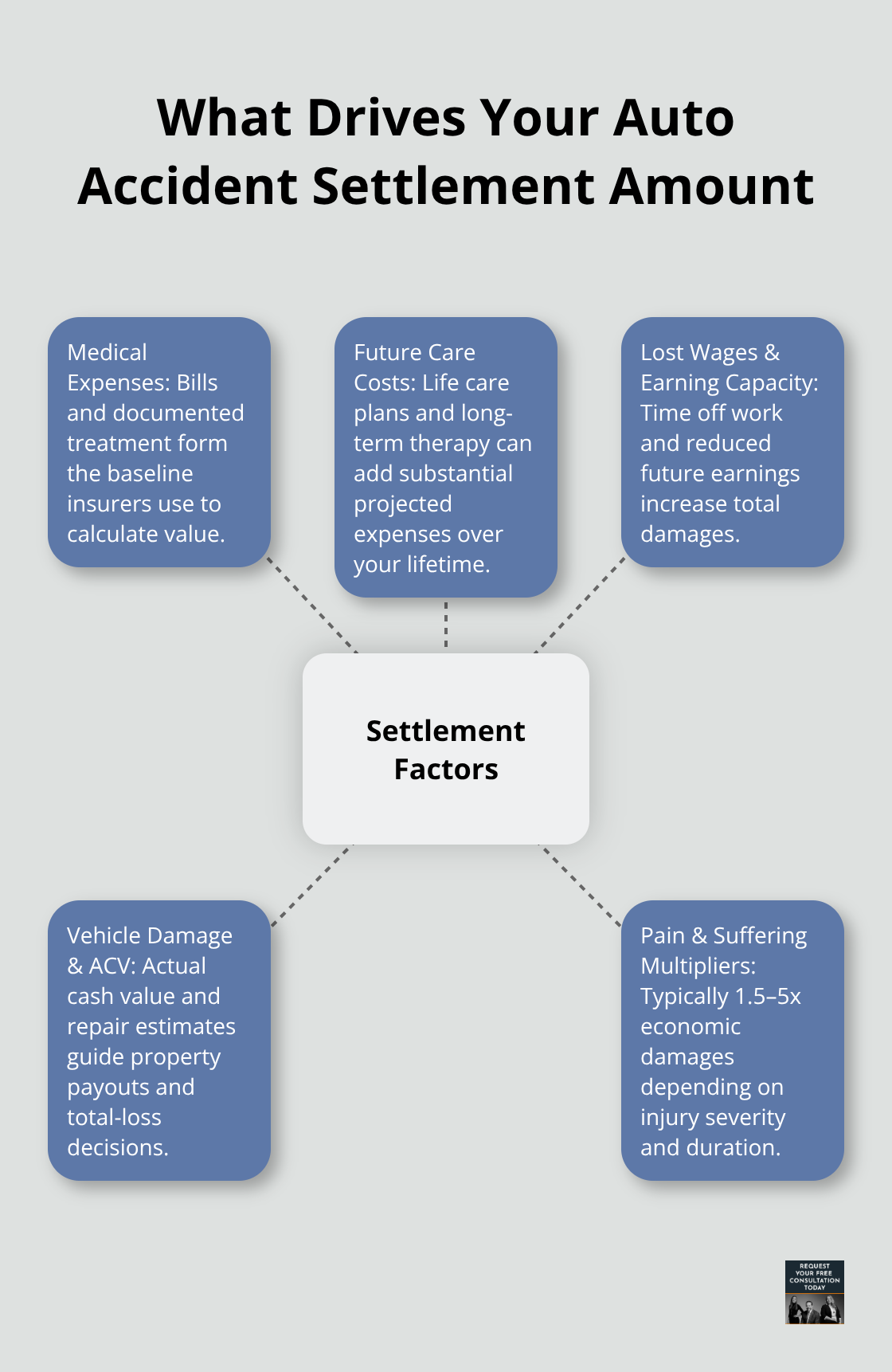
Medical bills create the concrete baseline of your settlement calculation, and insurers scrutinize every charge to find reasons to deny or reduce them. Surgery, spinal imaging, or ongoing physical therapy produce documented costs that are difficult for insurers to challenge. The real problem emerges when treatment gaps exist between your accident and your first medical visit. A two-week delay after a crash gives insurers ammunition to argue your injuries weren’t serious, even if you were simply overwhelmed or couldn’t afford immediate care. Start treatment immediately and maintain consistent appointments throughout your recovery.
Long-term care costs matter enormously for serious injuries. Brain injuries or spinal cord damage often require years of physical therapy, medication management, or home care assistance. Courts recognize these future medical needs through life care plans prepared by medical professionals, which project costs over your lifetime.
A 35-year-old with a spinal injury requiring ongoing treatment could see settlement values increase by $200,000 to $500,000 based solely on projected future care costs.
Lost Wages and Earning Capacity
Lost wages represent the second major settlement component, and this extends far beyond your immediate time off work. If you earn $60,000 annually and missed three months recovering, that’s a $15,000 loss. However, if your injury prevents you from returning to your previous job, you can claim lost earning capacity. A construction worker with a permanent hand injury might have earned $80,000 annually but can now only work desk jobs at $45,000, creating a $35,000 annual loss that compounds over decades.
Tax returns, pay stubs, and employment letters document these losses convincingly. Self-employed individuals need to provide three years of tax returns to establish average income, which strengthens claims for lost business revenue during recovery.
Vehicle Damage and Actual Cash Value
Vehicle damage settlement hinges on actual cash value, not what you paid for the car. California insurers determine actual cash value by examining comparable vehicles in your local market, adjusting for mileage, condition, and mechanical issues. If your 2019 Honda Civic with 80,000 miles was worth $12,000 before the crash but the insurer offers $9,500, you have grounds to dispute that valuation.
Repair estimates from local body shops carry significant weight in these disputes. If repairs cost $8,000 but the vehicle’s actual cash value is only $7,500, the insurer treats this as a total loss and pays the lower amount. Aftermarket parts versus original equipment manufacturer parts also affect settlement amounts. California law requires replacement parts to match OEM parts in kind, quality, safety, fit, and performance, but insurers often push for cheaper aftermarket alternatives.
Rental and Transportation Costs
Rental car coverage typically pays up to $30 per day for 30 days during repairs, though your specific policy may differ. Document every expense related to your vehicle-repair invoices, rental receipts, towing charges, and transportation costs-because these accumulate quickly and strengthen your demand for full compensation.
How Pain and Suffering Multipliers Apply
The combination of medical expenses, lost income, and vehicle damage creates your economic damages foundation. Pain and suffering multipliers then apply to this total, typically ranging from 1.5 to 5 times your economic damages depending on injury severity. Serious injuries command the higher multipliers, while minor soft tissue injuries settle closer to the 1.5 multiplier range. Understanding how insurers calculate these multipliers and what evidence strengthens your position in negotiations determines whether you accept a lowball offer or push for what your case actually deserves.
Building Your Settlement Case Before Negotiations Begin
Document Everything in the First 72 Hours
The strength of your settlement hinges entirely on what you document in the first 72 hours after the crash. Photograph the accident scene from multiple angles within 24 hours, capturing vehicle positions, road conditions, traffic signals, weather, and any visible injuries. Request the official police report from the Sheriff’s Office immediately, as this document establishes fault and creates a contemporaneous record that insurers cannot later dispute. Gather contact information from every witness and ask them to provide written statements about what they saw. These independent accounts carry far more weight than your own recollection because they corroborate your version without bias.
Organize Medical Records and Expense Documentation
Collect medical records starting from your first appointment and maintain them chronologically, including diagnoses, treatment dates, and provider notes. Gaps between your accident and treatment are weaponized by insurers to argue your injuries were minor, so seeking immediate medical attention matters as much as the injury itself. Organize receipts for all accident-related expenses, pay stubs documenting lost wages, repair estimates from local body shops, and rental car invoices. Back everything up digitally on a cloud service because physical documents get lost or damaged. Create a spreadsheet tracking all deadlines, especially the two-year statute of limitations for personal injury claims and the 30-day window for filing your insurance claim. This documentation becomes your negotiating leverage because it transforms your claim from your word against the insurer’s into verifiable facts the insurer cannot easily challenge.
Navigate Initial Contact with Insurance Adjusters
Insurance adjusters are trained to minimize payouts, and their first settlement offer typically ranges 25 to 40 percent below what your case actually deserves. When the adjuster contacts you, provide only factual information and never give a recorded statement without consulting a lawyer first. Recorded statements lock you into positions that can later be used against you, especially if you’re uncertain about injury severity or liability. Submit your demand letter in writing, itemizing economic damages with supporting documentation and proposing a settlement figure that reflects the full value of your claim including pain and suffering. The California Department of Insurance notes that insurers must respond to settlement demands within 15 days and reach a decision within 40 days after proof of loss, so follow these timelines closely and document every communication.
Counter Lowball Offers with Evidence-Based Arguments
Reject lowball offers immediately and counter with a detailed explanation of why your claim justifies a higher amount. If the insurer refuses to move after multiple rounds of negotiation, this signals they either dispute liability or undervalue your injuries, which means accepting their offer leaves you financially short. At this point, legal representation becomes essential because an experienced attorney can negotiate from a position of strength, file a lawsuit if necessary, and ensure you don’t settle prematurely before reaching maximum medical improvement. We at Schaar & Silva LLP assist in evaluating the extent of property damage and ensure you receive a fair valuation for your loss, while also helping direct you to medical lien services that facilitate payment of your bills until your case is resolved.
Final Thoughts
A California car crash settlement requires three critical actions: document everything immediately after the accident, understand how fault and damages affect your payout, and reject lowball offers backed by solid evidence. The difference between accepting an insurer’s first offer and negotiating aggressively often amounts to thousands of dollars you rightfully deserve. Your medical records, witness statements, police reports, and expense documentation transform your claim from a conversation into an undeniable case that insurers cannot easily minimize.
The settlement process moves faster when you act decisively-file your insurance claim within 30 days, seek medical treatment immediately, and organize your documentation before the adjuster contacts you. Insurers count on accident victims being overwhelmed and uninformed, which is why they push quick settlements that undervalue pain and suffering and future medical costs. You have leverage if you understand how comparative negligence reduces your recovery, how multipliers apply to your economic damages, and what evidence strengthens your negotiating position.
We at Schaar & Silva LLP help accident victims in Santa Cruz, Sacramento, and Oakland navigate this entire process and secure fair compensation for your California car crash settlement. Our team evaluates property damage claims to ensure fair valuations, directs you to medical lien services that cover your bills during recovery, and handles communications with insurers so you can focus on healing. Contact us for a free consultation to discuss your case and understand what a fair settlement actually looks like for your specific injuries and circumstances.
