

A back injury from a car accident can turn your life upside down, leaving you with pain, medical bills, and uncertainty about your future. If you’ve suffered a back injury in Santa Cruz, you’re likely wondering how to move forward with your claim and get the compensation you deserve.
We at Schaar & Silva LLP help accident victims navigate the settlement process and fight for fair payouts. This guide walks you through the types of injuries, how to document your claim, and what to expect during negotiations.
What Back Injuries Actually Look Like After a Car Crash
Whiplash and Soft Tissue Damage
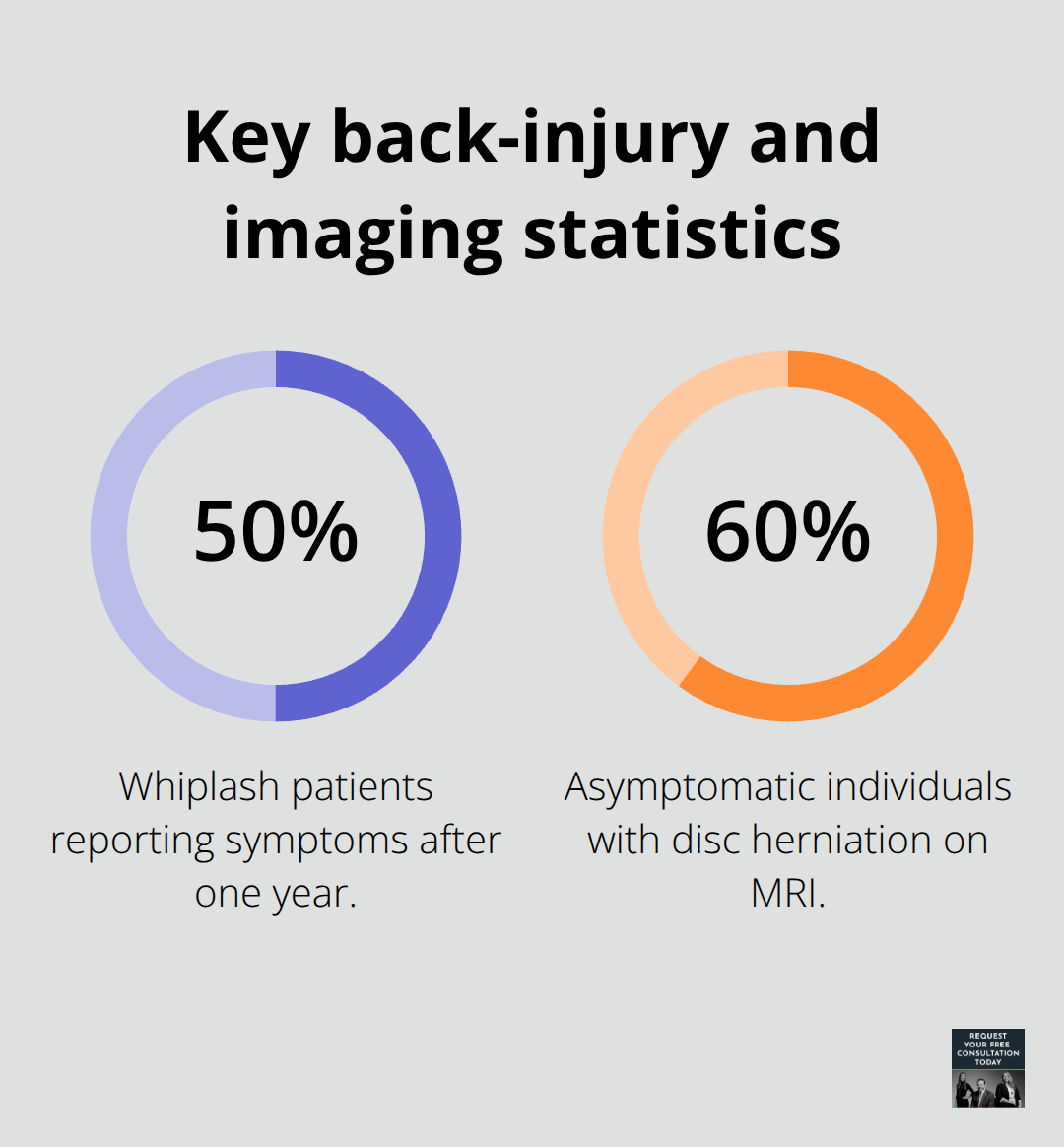
Whiplash occurs when your body experiences sudden acceleration and deceleration, causing muscles and ligaments in your neck and upper back to stretch beyond their normal range. Soft tissue injuries like these produce pain that lasts weeks or months, and according to the Journal of Orthopaedic Surgery and Research, approximately 50% of whiplash patients still report symptoms after one year. The problem is that soft tissue damage doesn’t always show up on standard X-rays, which insurance companies use as an excuse to undervalue claims.
MRI imaging documents these injuries properly, and that distinction matters enormously when building your case. Insurance adjusters rely on what they can see on basic X-rays, so they’ll push back on soft tissue claims without proper documentation. Getting an MRI early in your treatment protects your settlement value and prevents insurers from dismissing your injury as minor.
Herniated Discs and Nerve Compression
Herniated discs represent a more serious category of back injury where the gel-like center of a spinal disc pushes through the outer layer, potentially pressing on nerves and causing radiating pain down your legs or arms. This condition requires imaging confirmation through MRI or CT scans, and the American Academy of Orthopaedic Surgeons notes that disc herniation can lead to long-term complications requiring ongoing physical therapy or epidural injections. These ongoing treatments add substantial costs to your claim and justify higher settlement demands.
The radiating pain from nerve compression often persists for months or years, affecting your ability to work and perform daily activities. Insurance companies take disc herniation more seriously than soft tissue injuries because the imaging evidence is undeniable and the treatment costs are documented.
Spinal Fractures and Severe Outcomes
Spinal fractures are the most severe outcome, ranging from hairline cracks to complete breaks that may require surgery and extended recovery periods. Insurance companies treat fractures differently because they’re visible on X-rays, which actually works in your favor since there’s no room for them to deny the injury occurred. The settlement difference between a soft tissue case and a spinal fracture case is substantial-fractures typically command settlements three to five times higher because they involve demonstrable structural damage and longer recovery timelines.
Fractures often require surgical intervention and months of rehabilitation, creating clear documentation of your damages. When you move forward with your claim, this visibility on imaging makes your case significantly stronger and harder for insurers to minimize.
Building Your Claim With Documentation and Numbers
Collect Medical Records and Imaging Immediately
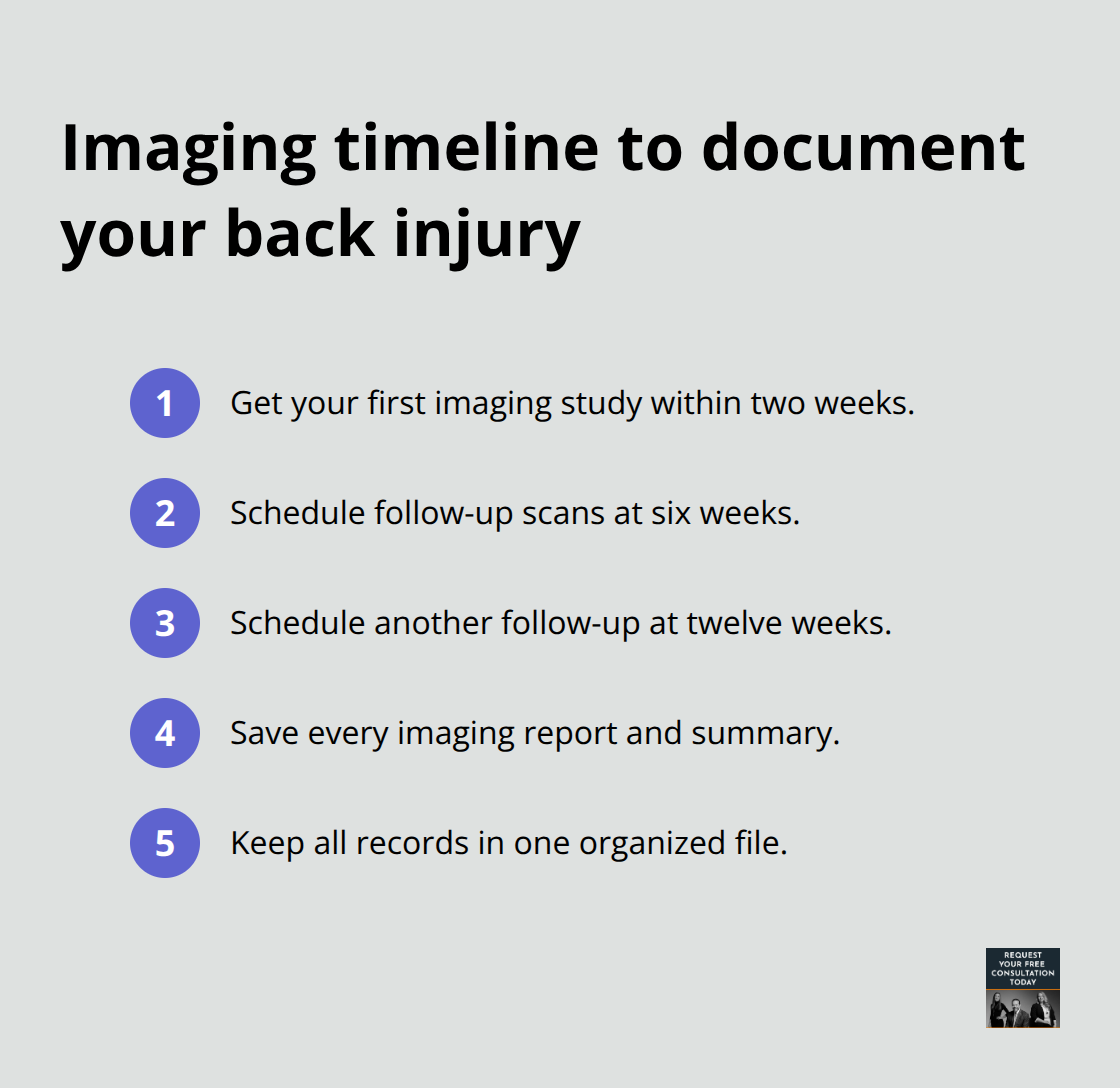
Medical records and imaging form the foundation of your back injury claim, and the difference between a well-documented case and a poorly documented one can mean tens of thousands of dollars. Start collecting records immediately after your accident-the first imaging study you obtain establishes the baseline for your injury. Request MRI or CT scan results, not just X-rays, because insurers will argue that soft tissue injuries are minor if you only have basic imaging. The National Institutes of Health found that MRI identifies disc herniation in approximately 60% of asymptomatic individuals, which means imaging alone doesn’t prove your injury caused your pain, so the timing of your first scan matters enormously. Get imaging within two weeks of your accident if possible, then obtain follow-up imaging at six and twelve weeks to show how your condition has evolved. This timeline demonstrates that your injury didn’t resolve quickly and justifies ongoing treatment costs. Keep every medical record in one organized file, including emergency room reports, physical therapy notes, physician visit summaries, and diagnostic test results.
Organize Documentation to Strengthen Your Position
Insurance adjusters receive hundreds of claims monthly and will only offer fair money if your documentation is comprehensive and organized. Disorganized claims signal weakness and give adjusters reason to lowball their offers. Create a master spreadsheet listing every medical provider, visit date, service provided, and cost. This approach takes a few hours but transforms how insurers perceive your case. When your adjuster sees organized, detailed records, they recognize you’ve prepared thoroughly and take your claim seriously.
Document Lost Wages With Pay Stubs and Employer Confirmation
Lost wages and treatment costs create the measurable portion of your damages, and these numbers drive settlement value more than pain descriptions ever will. Collect pay stubs showing your actual earnings for at least three months before your accident, then document every missed work day with written confirmation from your employer. If you’re self-employed, provide tax returns and bank statements showing your typical monthly income. This documentation removes guesswork from your claim and gives insurers concrete numbers they cannot dispute.
Track All Medical Expenses and Calculate Your Multiplier
Ongoing treatment costs matter significantly-physical therapy typically runs $1,200 to $3,000 per month depending on frequency and location, and if your injury requires long-term management, this multiplies your claim value substantially. Track every medical expense including copays, specialist visits, imaging, medications, and equipment like braces or heating pads. Insurance companies value pain and suffering by multiplying your actual damages (medical bills plus lost wages) by a factor that ranges from 1.5 to 5 depending on injury severity and recovery timeline. A serious back injury with six months of physical therapy and three months of lost wages easily justifies a multiplier of 3 to 4, meaning if your documented damages total $50,000, your pain and suffering component could justify $150,000 to $200,000 in total settlement demand. Calculate this number yourself before negotiations begin so you know your baseline and can recognize when an insurer’s offer falls short of what your case actually warrants.
How Settlements Actually Get Negotiated
Your Demand Letter Sets the Negotiation Tone
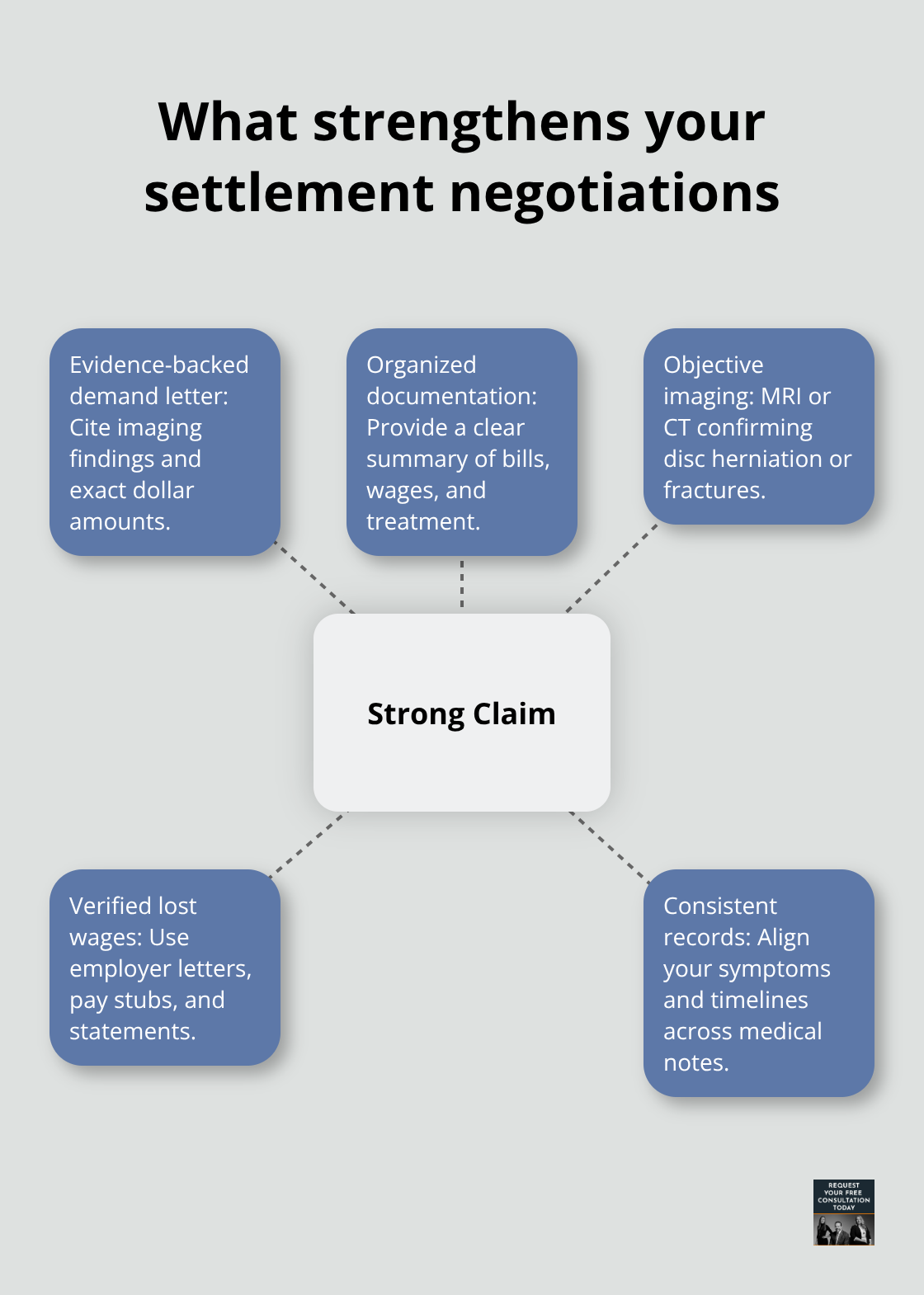
Your demand letter sets the tone for everything that follows, and most accident victims underestimate its importance by treating it as a formality rather than a strategic document. The demand letter isn’t a request-it’s your opening position in a negotiation that will determine whether you walk away with fair compensation or accept far less than your case warrants. Insurance adjusters receive demand letters that lack supporting documentation and immediately discount them by 30 to 50 percent because they recognize the claimant hasn’t prepared properly.
Your letter should reference specific medical findings, cite your documented damages with exact dollar amounts, and explain why your multiplier is justified based on injury severity and recovery timeline. If you calculated a 3.5 multiplier because your herniated disc required six months of physical therapy, your demand letter should state exactly that reasoning. Include copies of your medical records summary, imaging reports showing the disc herniation, and your spreadsheet of treatment costs.
When your adjuster opens that envelope and finds organized, detailed evidence backing up your demand, they know you’ve done the work and will take your number seriously. Most adjusters will counter at 40 to 60 percent of your initial demand, which is why starting at a defensible but aggressive number matters enormously. If you demand $200,000 and they counter at $120,000, you have room to negotiate down to $140,000 or $150,000.
If you demand $150,000 out of timidity and they counter at $90,000, you’re already negotiating from weakness.
Discovery Separates Strong Claims From Weak Ones
The discovery phase separates serious claims from weak ones because both sides exchange evidence under oath, which means insurance companies can no longer hide behind assumptions. They must produce their investigation files, communications about your claim, and any prior claims history your adjuster reviewed. You’ll provide detailed interrogatories answering specific questions about your injury, treatment, and damages, plus requests for production of documents that force both sides to show their actual evidence.
This is where many claims either strengthen or collapse because if your medical records don’t support your injury story, the insurer will exploit those gaps ruthlessly. If you told your emergency room doctor your pain was moderate but your demand letter claimed severe, debilitating pain, that contradiction will cost you tens of thousands in settlement value. Consistency between your medical records, your statements, and your demand documentation is non-negotiable-any inconsistency gives adjusters ammunition to devalue your claim.
Settlement Authority Limits Often Create Temporary Deadlocks
Once discovery concludes and both sides understand the actual strength of the evidence, settlement negotiations intensify because everyone knows what the case is actually worth. Insurance companies have internal settlement authority limits, meaning an adjuster can approve settlements up to a certain amount without supervisor approval. If your case is worth $125,000 based on the evidence but the adjuster’s authority limit is $75,000, they cannot settle at your number without escalating to management.
This is why many cases stall temporarily-the adjuster isn’t being unreasonable, they simply lack the authority to accept your demand. Pushing for supervisor involvement or management review at this stage often breaks through settlement deadlocks. When you work with an attorney who understands these internal insurance company structures, you know which pressure points move cases forward and when to accept reasonable offers versus holding firm on your actual claim value.
Final Thoughts
Your back injury from a car accident doesn’t have to derail your financial recovery. The path from initial pain to fair settlement follows a clear sequence: document your injuries with proper imaging within weeks of the accident, organize your medical records and expenses into a comprehensive file, calculate your actual damages including lost wages and treatment costs, and then build a demand letter backed by evidence rather than emotion. Insurance adjusters respond to organized documentation and clear reasoning, not to sympathy or vague descriptions of suffering.
Back injury cases in Santa Cruz succeed when victims understand that settlement value comes from numbers, not narratives. Your herniated disc matters because it shows on MRI. Your six months of physical therapy matters because it’s documented with invoices. Your three months of lost wages matter because your employer confirms it. These concrete facts drive settlement offers upward, while unsupported claims drive them downward.
We at Schaar & Silva LLP help accident victims in Santa Cruz County navigate this entire process, from organizing your medical records to negotiating with insurance companies who undervalue claims. We connect you with medical lien services to manage your bills during recovery and link you with support specialists when emotional trauma compounds your physical injuries. Contact us at schaarsilvalaw.com to discuss your back injury claim and learn what your case actually warrants.
