

After a car accident, one of the first questions people ask is how much their claim might be worth. The average personal injury settlement varies widely depending on your specific situation.
At Schaar & Silva LLP, we’ve helped countless accident victims in Santa Cruz County, Sacramento, and Oakland understand what their compensation could look like. This guide breaks down the real factors that determine settlement amounts and what you should know about your case.
What Determines Your Settlement Amount
The amount you receive after an auto accident depends on concrete factors that insurers and courts evaluate systematically. Injury severity sits at the center of this calculation. California has no cap on pain and suffering damages, which means the more serious your injury, the higher your potential recovery. A mild concussion might settle between $20,000 and $30,000, while a spinal cord injury can reach $500,000 to $1,000,000 or more. Medical expenses directly influence this tier. If you spent $100,000 on treatment, insurers typically apply a multiplier of 1.5 to 5 times that amount for general damages-meaning your case could be valued between $150,000 and $500,000 before considering other factors.
Medical Bills Shape Your Claim Value
The actual medical bills you paid matter significantly. Under California law, as established in Howell v. Hamilton Meats & Provisions, medical damages may be limited to the amount your insurer actually paid, not the full billed amount. This means negotiated insurance rates can reduce your claim value, so documenting what was genuinely paid versus what was charged becomes essential. Insurers scrutinize every receipt and invoice, so maintain meticulous records of all accident-related expenses to substantiate your damages.
Insurance Limits Set Hard Ceilings
Your settlement cannot exceed the at-fault driver’s insurance policy limits, regardless of your actual damages. If someone hits you with $15,000 in coverage and you have $100,000 in medical bills, you recover only $15,000 from their policy. This is why identifying all available insurance sources matters-the at-fault driver’s policy, your own uninsured or underinsured motorist coverage, and any commercial policies if a truck or business vehicle caused the accident.
Lost Wages and Future Earning Potential
Lost wages and future earning potential add substantial value to your claim. If your injuries prevented you from working for six months at $50,000 annually, that amounts to $25,000 in lost wages alone. If your injury permanently reduces your earning capacity-say you can no longer work overtime or advance in your position-you can recover damages for that lost future income. Age matters here. A 35-year-old with 30 years of earning potential ahead has a higher claim value than a 65-year-old with fewer working years remaining.
Liability Determines What You Can Actually Collect
Fault determination directly impacts your recovery. California follows comparative negligence rules, meaning if you were 20% at fault for the accident, your settlement reduces by 20%. If the other driver was unambiguously at fault-they ran a red light, were intoxicated, or violated a clear traffic law-you have a stronger negotiating position. About one in three clients historically receive settlements of $100,000 or more, but this depends heavily on injury severity and clear liability.

Gathering evidence immediately strengthens your claim. Photos of vehicle damage, witness statements, police reports, and medical records from the day of the accident all support higher valuations. The more documentation you have, the less room insurers have to dispute your damages or downplay injury severity. Understanding how these factors combine prepares you for the next critical step: evaluating what your specific injuries might be worth.
What Different Injuries Cost in Your Settlement
Soft Tissue Injuries: Lower Settlement Values
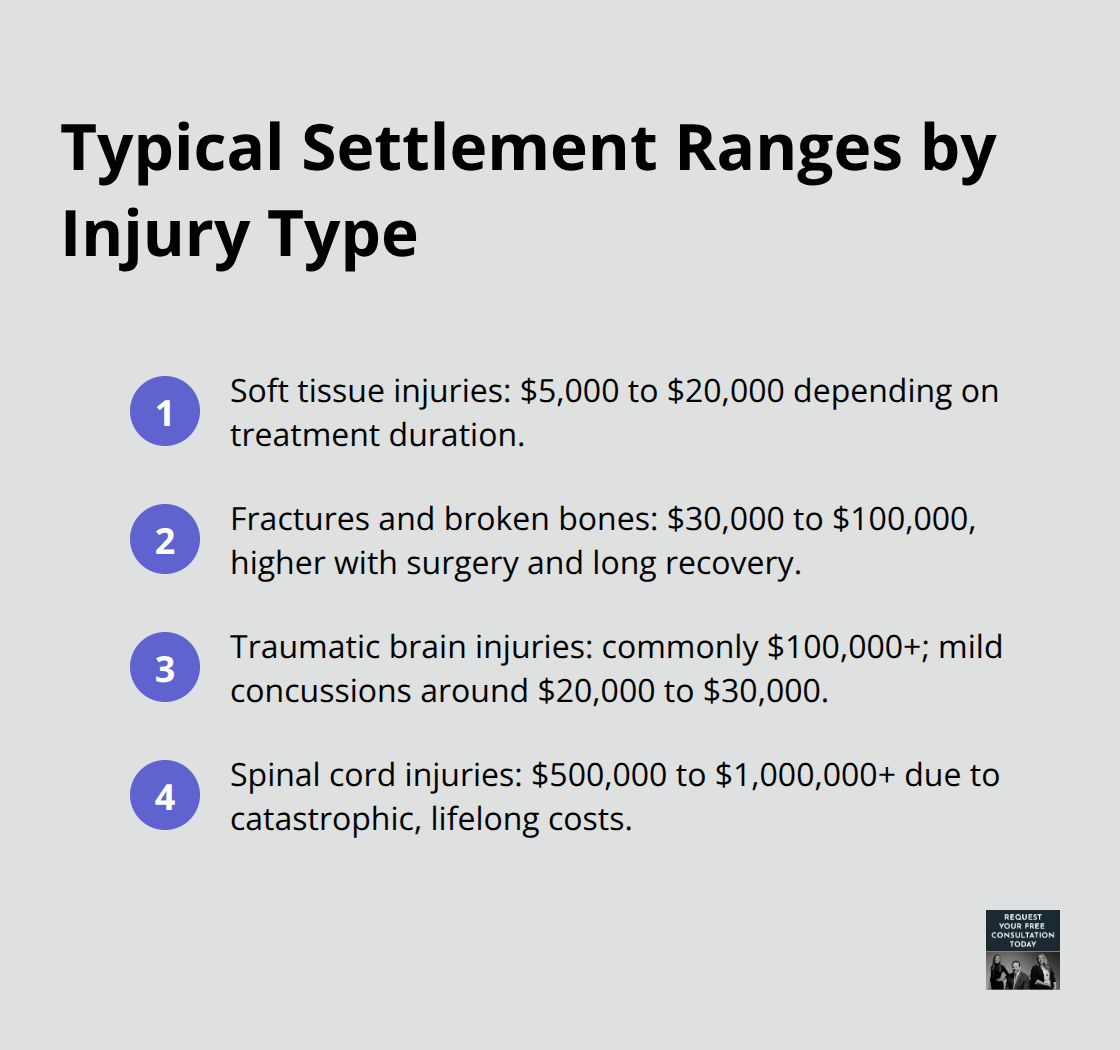
Whiplash and soft tissue injuries represent the lower end of settlement values, typically ranging from $5,000 to $20,000 depending on treatment duration and documented pain. These injuries involve neck strains, shoulder sprains, or back contusions that require physical therapy but resolve within weeks or months. The settlement calculation hinges on your medical bills and how long you needed treatment.
If you spent $3,000 on physical therapy and chiropractor visits over eight weeks, insurers apply a 1.5 to 2.5 multiplier, yielding $4,500 to $7,500 in general damages. Soft tissue injuries lack visible structural damage on X-rays, so insurers frequently undervalue them. Detailed records of every therapy session, medication, and day you missed work due to pain strengthen your position. Photographs of visible bruising or swelling taken immediately after the accident also support your claim.
Fractures and Broken Bones: Mid-Range Settlements
Fractures and broken bones settle between $30,000 and $100,000 for most cases, though severity dramatically affects the final amount. A simple wrist fracture requiring a cast for six weeks lands on the lower end, while a compound leg fracture requiring surgery and months of recovery commands substantially higher compensation. Medical expenses alone often exceed $50,000 when surgery, anesthesia, imaging, hospitalization, and follow-up care are included. Using the multiplier method, $60,000 in medical bills generates $90,000 to $300,000 in general damages depending on injury complexity and permanency.
Traumatic Brain Injuries: Serious Long-Term Impact
Traumatic brain injuries present far more serious outcomes, with settlements commonly starting at $100,000 and extending well beyond depending on cognitive impairment severity. A mild concussion with brief loss of consciousness and full recovery might settle around $20,000 to $30,000, but moderate to severe traumatic brain injuries causing lasting memory problems, concentration difficulties, or personality changes reach $200,000 or more. These cases require neurological evaluations, cognitive testing, and expert testimony about long-term impacts on employment and daily functioning.
Spinal Cord Injuries: The Most Catastrophic Outcomes
Spinal cord injuries and permanent paralysis represent the most catastrophic outcomes, with settlements frequently reaching $500,000 to over $1,000,000. These cases involve lifetime care costs, mobility equipment, home modifications, lost earning potential across decades, and substantial pain and suffering damages. The multiplier method becomes less relevant for these severe injuries because the economic damages alone (medical care, home accessibility modifications, specialized equipment) often exceed $500,000 before general damages are even calculated. Understanding how injury severity translates to settlement value helps you evaluate what your specific case might be worth, but the path forward requires careful documentation of your medical treatment and its impact on your life.
How Medical Bills Drive Your Settlement Value
Your medical bills form the foundation of your entire settlement calculation, and this is where most accident victims leave money on the table. Every invoice, receipt, and treatment record translates directly into compensation dollars. Under California law, as established in Howell v. Hamilton Meats & Provisions, your recoverable medical damages are limited to what your insurer actually paid, not the full billed amount. This distinction matters enormously. A hospital might bill $50,000 for emergency care, but your insurer negotiates that down to $30,000. You can only claim the $30,000 figure in your settlement.
Obtain Itemized Statements From Every Provider
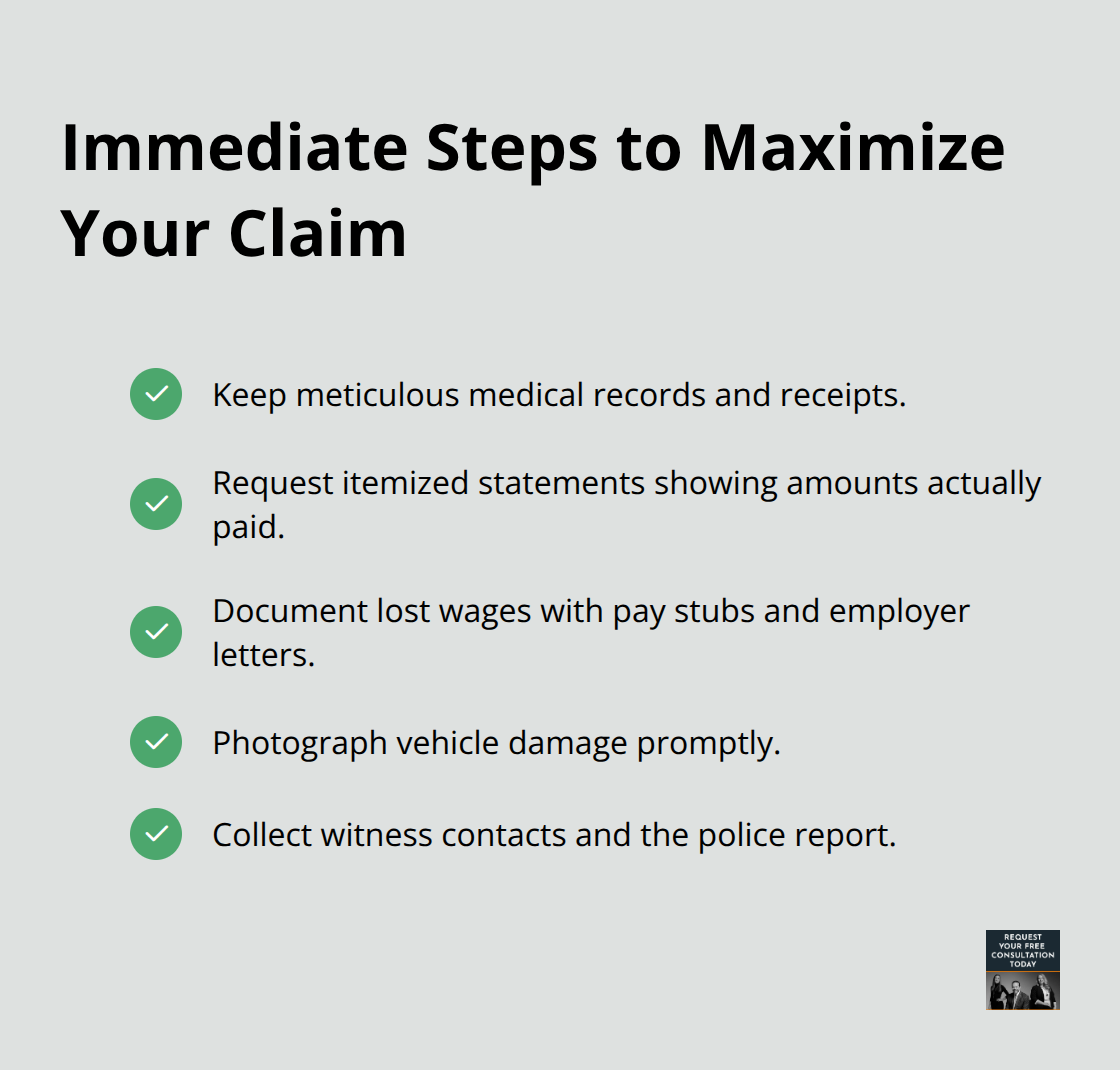
Request detailed breakdowns from each provider that show exactly what your insurer paid versus what was written off. Many victims overlook this step and accept lower settlements based on inflated billed amounts rather than actual paid amounts. Photograph or scan every receipt, medical record, and explanation of benefits statement the moment you receive it. Store these documents in a single folder, both digitally and physically. Insurers will request this documentation multiple times during negotiations, and having everything organized strengthens your position immediately.
Account for Future Medical Care Costs
Future medical care costs amplify your settlement value significantly, especially for injuries that require ongoing treatment. If your herniated disc requires physical therapy for two years at $150 per session twice weekly, that amounts to roughly $15,600 in future medical expenses. Your settlement must account for these costs upfront since you cannot return to the insurance company later asking for more money. Medical providers can document anticipated future treatment needs through detailed reports that outline your prognosis and recommended care duration. Obtain a written statement from your treating physician that specifies how long you will need treatment, what types of care are medically necessary, and estimated costs.
Navigate Pre-Existing Conditions
Pre-existing conditions complicate this calculation but do not eliminate your recovery. If you had a previous back injury and the accident aggravated it, you recover damages for the aggravation, not the original condition. The key is demonstrating through medical records that the accident worsened your pre-existing condition. Your medical records from before the accident become critical evidence here. Medical lien services offer practical assistance by paying your medical providers directly from your eventual settlement, allowing you to receive treatment immediately without personal out-of-pocket costs. We at Schaar & Silva LLP can direct you toward these services, ensuring your medical care continues uninterrupted while your case progresses.
Final Thoughts
Your settlement amount reflects injury severity, medical expenses, lost wages, and liability-the core factors that determine what you actually recover. An average personal injury settlement in California ranges from $5,000 for soft tissue injuries to over $1,000,000 for spinal cord damage, but your specific case depends entirely on documented medical treatment, future care costs, and evidence supporting your claim. Soft tissue injuries yield $5,000 to $20,000, while spinal cord injuries reach $500,000 or more.
Three actions maximize your compensation immediately. Maintain meticulous records of every medical bill, receipt, and treatment session, then request itemized statements showing what your insurer actually paid rather than inflated billed amounts. Document lost wages through pay stubs and employer statements, and photograph vehicle damage while collecting witness contact information and the police report right after the accident.
These steps prevent insurers from undervaluing your claim through incomplete documentation.
We at Schaar & Silva LLP help accident victims in Santa Cruz County, Sacramento, and Oakland recover the full value of their injuries and losses. Our team connects you with medical lien services so you receive treatment without personal financial burden while your case progresses, and we direct you toward psychological support specialists who strengthen your general damages claim. Contact us today to discuss what your specific case might be worth.
