

A Sacramento bicycle accident can change everything in a matter of seconds. Whether you were commuting along the river trail, riding through midtown, or heading home on a neighborhood street, a collision with a car can leave you with serious injuries and a stack of questions. Who was at fault, what the traffic laws required of the driver, and what the law expects of a cyclist all shape the outcome of your claim.
At Schaar & Silva LLP, we help people hurt in car, truck, and bicycle collisions in Sacramento so you can move forward with confidence. This guide explains the California rules that matter most after a Sacramento bicycle accident, including passing distance, bike lanes, a cyclist’s rights, and the steps that protect your claim.
How a Sacramento Bicycle Accident Claim Actually Works
Bicycle accident claims are built on the same foundation as other injury claims. You must show that another person failed to use reasonable care, that the failure caused the collision, and that you were hurt as a result. What makes bicycle cases different is the set of traffic rules that apply specifically to bicycles and to the drivers who share the road with them.
Cyclists Have the Rights of Drivers
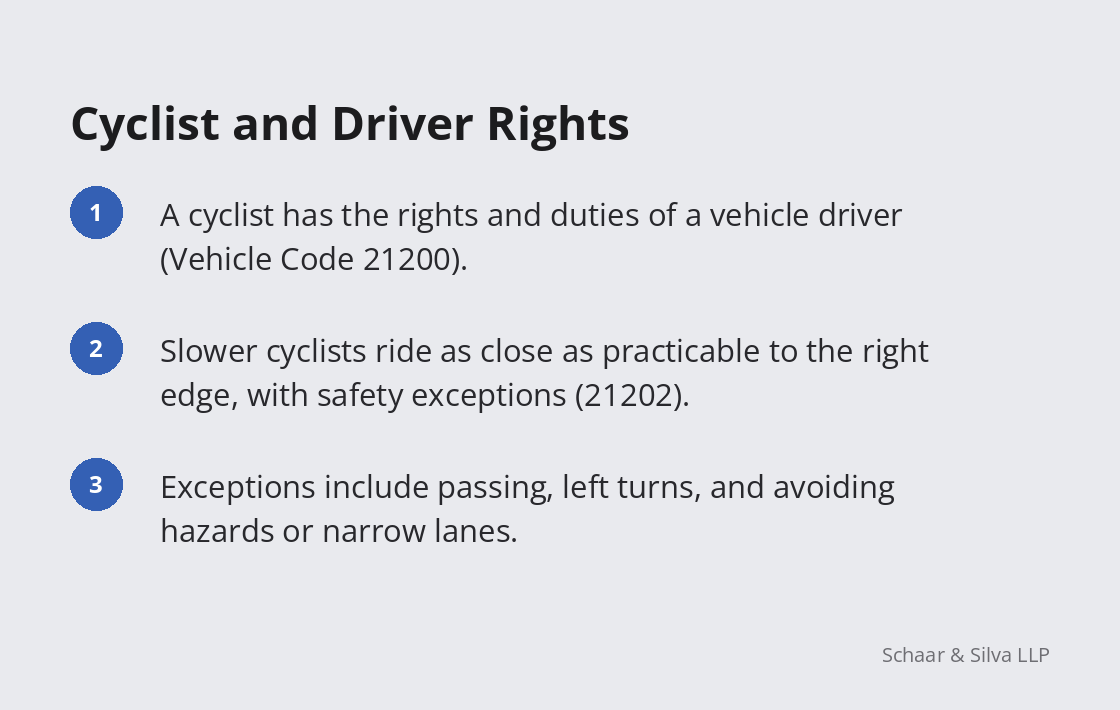
Vehicle Code section 21200(a)(1) provides that a person riding a bicycle upon a highway has all the rights and is subject to all the provisions applicable to the driver of a vehicle, except those provisions which by their very nature can have no application. This is an important starting point. A bicyclist is not a second-class road user. Cyclists are entitled to use the road, to be treated as vehicles at intersections, and to expect drivers to follow the same rules of the road that apply when two cars meet.
The Same Duties Apply to You
The same section means that a cyclist must also follow the rules that apply to drivers. Running a stop sign, riding against traffic, or turning without checking for vehicles can be used by an insurer to argue that the cyclist shares blame for the crash. In Sacramento, where bicycle traffic mixes with heavy car traffic on busy corridors, the facts about each rider’s conduct often decide how a claim is evaluated.
Where You Ride on the Roadway
Section 21202(a) provides that a person operating a bicycle upon a roadway at a speed less than the normal speed of traffic moving in the same direction must ride as close as practicable to the right-hand curb or edge of the roadway, with several exceptions. Those exceptions include overtaking and passing another bicycle or vehicle, preparing for a left turn, approaching a place where a right turn is authorized, and when reasonably necessary to avoid conditions that make it unsafe to continue along the right-hand edge, including parked vehicles, surface hazards, pedestrians, or a substandard width lane. When a rider moves out of the edge of the lane for one of these reasons, the choice is not a violation.
What Drivers Must Do Around Bicycles in Sacramento
Many of the most serious bicycle crashes involve a driver who passed too closely, drifted into a bike lane, or failed to notice a rider. California has specific statutes that address each of these behaviors.
The Three Feet for Safety Act
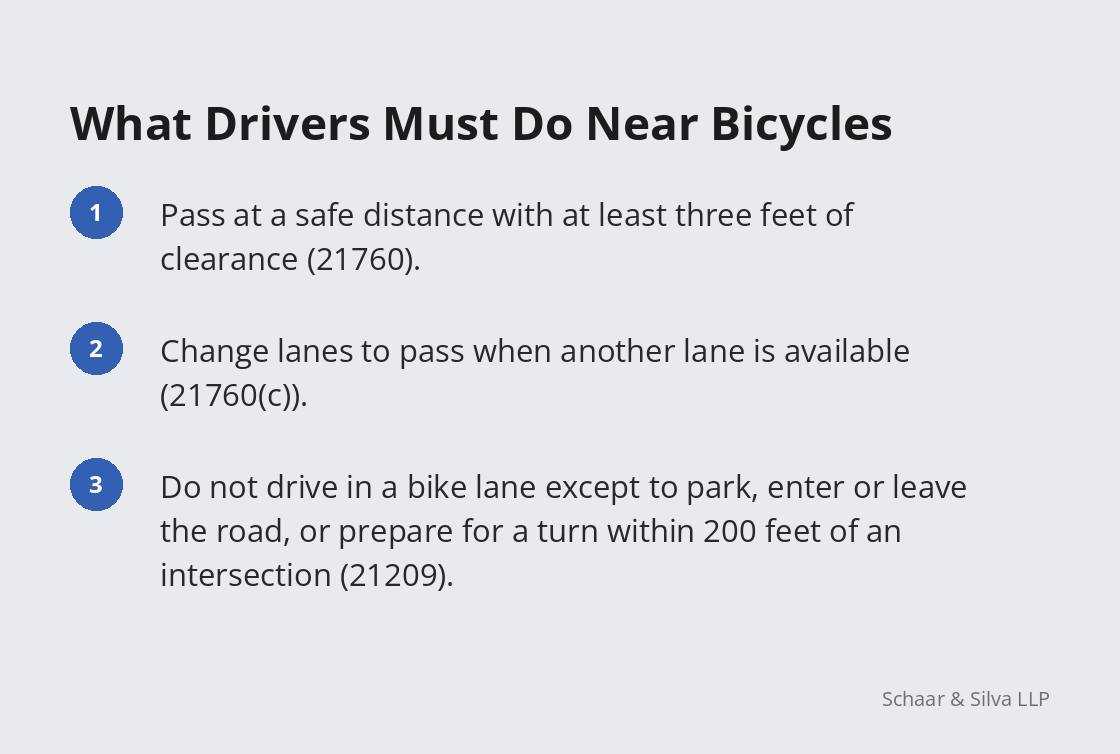
Vehicle Code section 21760, known as the Three Feet for Safety Act, requires the driver of a motor vehicle overtaking and passing a bicycle proceeding in the same direction to pass at a safe distance that does not interfere with the safe operation of the bicycle, having due regard for the size and speed of the vehicle and the bicycle, traffic conditions, weather, visibility, and the surface and width of the highway. Subdivision (c) states that a driver shall not overtake or pass a bicycle at a distance of less than three feet between any part of the motor vehicle and any part of the bicycle or its operator.
Changing Lanes to Pass
Section 21760(c) also provides that when a driver overtakes a bicycle in the same lane of travel, and another lane of traffic proceeding in the same direction is available, the driver shall make a lane change into the other lane with due regard for safety and traffic conditions, if practicable and not prohibited by law, before passing. If the driver cannot comply with the three-foot requirement because of traffic or roadway conditions, subdivision (d) requires the driver to slow to a reasonable and prudent speed and to pass only when doing so would not endanger the cyclist.
Staying Out of Bike Lanes
Section 21209(a) provides that no person shall drive a motor vehicle in a bicycle lane established on a roadway, with limited exceptions: to park where parking is permitted, to enter or leave the roadway, or to prepare for a turn within a distance of 200 feet from the intersection. A driver who cuts across a bike lane too early, or who uses the lane as a passing space, may be violating this statute. Evidence such as skid marks, vehicle damage, and the position of the bicycle at the point of impact can show whether a driver was where the law did not allow.
Why Traffic Law Violations Matter
When a driver breaks one of these rules, that violation can help show that the driver failed to use reasonable care. It does not automatically decide the case, but it gives a strong starting point for explaining to an insurer or a jury why the crash happened. Photographs of the scene, witness names, video from nearby businesses, and the police report help turn a statute into proof.
Steps to Take After a Sacramento Bicycle Accident
What you do in the hours and days after a crash can protect your health and your claim. Cyclists are often hurt more seriously than people in cars, so medical attention should come first.
Get Medical Care and Report the Crash
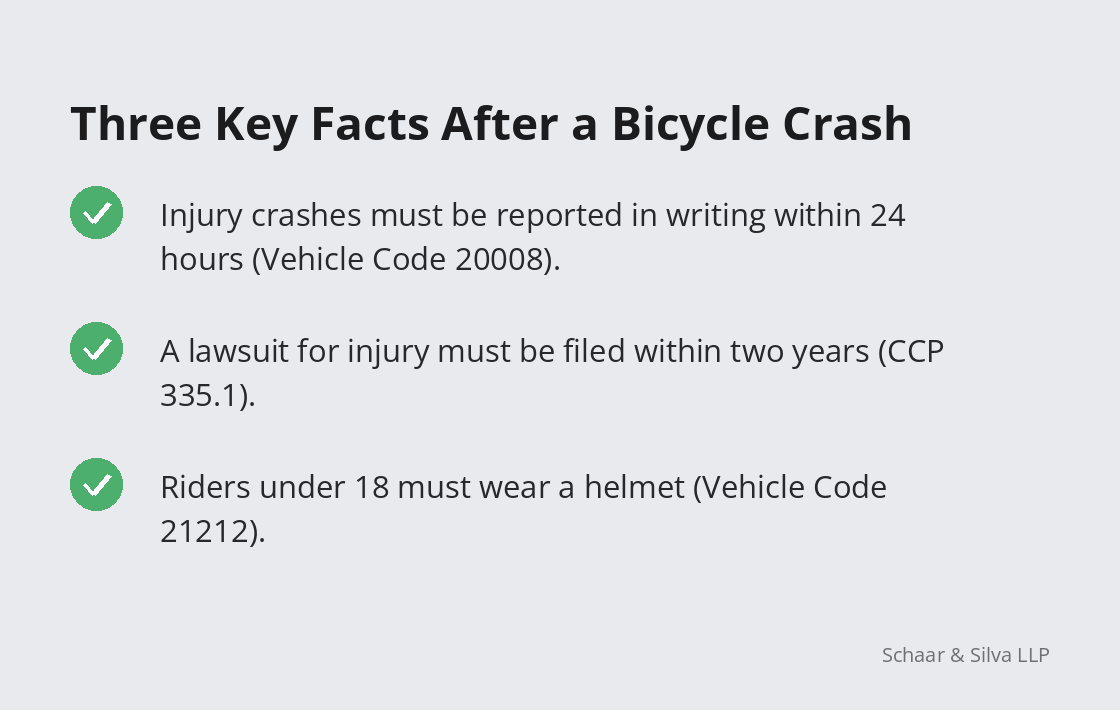
See a doctor promptly, even if you feel able to walk away. Adrenaline can mask injuries, and symptoms such as head, neck, and back pain may appear later. Vehicle Code section 20008(a) provides that the driver of a vehicle involved in an accident resulting in injuries to or death of any person must make a written report of the accident within 24 hours to the California Highway Patrol or, within a city, to either the Highway Patrol or the city police department. Confirm that a report exists and write down the report number.
Protect the Evidence
Take photographs of the scene, the driver’s vehicle, your bicycle, your helmet, and your injuries. Do not repair or discard your bicycle or gear until it has been photographed and, if needed, examined. Collect the driver’s name, insurance information, and the names of any witnesses. A cracked helmet and a damaged frame can help show the force of the impact.
Helmet Rules and What They Mean for a Claim
Section 21212(a) requires a person under 18 years of age to wear a properly fitted and fastened bicycle helmet that meets safety standards when operating or riding on a bicycle on a street, bikeway, or public bicycle path or trail. For adult riders, that section does not impose the same requirement, but insurers sometimes still raise helmet use in arguments about injuries. Wearing a helmet is a wise safety choice, and the law should be applied carefully to your age and the facts of your crash.
Mind the Two-Year Deadline
Code of Civil Procedure section 335.1 provides that an action for injury to, or for the death of, an individual caused by the wrongful act or neglect of another must be brought within two years. For most bicycle injury cases, that means the clock starts on the date of the crash. Contact a lawyer well before the deadline, because investigating a case, gathering medical records, and negotiating with an insurer all take time.
Final Thoughts
Bicycle accident law in California rests on a simple idea: cyclists and drivers share the road and share the responsibility to use it safely. Drivers must pass at a safe distance, leave at least three feet, stay out of bike lanes, and watch for riders. Cyclists must follow the rules that apply to drivers and ride where the law directs. When a driver fails to meet these duties and a rider is hurt, the injured cyclist has the right to seek accountability.
If you were injured in a bicycle accident in Sacramento, contact Schaar & Silva LLP to speak with our team. We will review what happened, explain how the law applies, and help you move forward with confidence.