

A second car accident in one year can feel like a cruel coincidence, and it raises hard questions about your health and your legal rights. If you were hurt in a crash in Santa Cruz County months after another collision, you may wonder whether the earlier injury will hurt your new claim, whether the insurance company will blame the first accident for everything, and how soon you need to act. Those worries are common, and California law gives clear guidance on most of them.
At Schaar & Silva LLP, we help people hurt in car and truck accidents across Santa Cruz County so you can move forward with confidence. This guide explains how a second accident affects an injury claim, what the law says about earlier injuries, and the steps that protect your case.
How a Second Car Accident in Santa Cruz County Actually Affects Your Claim
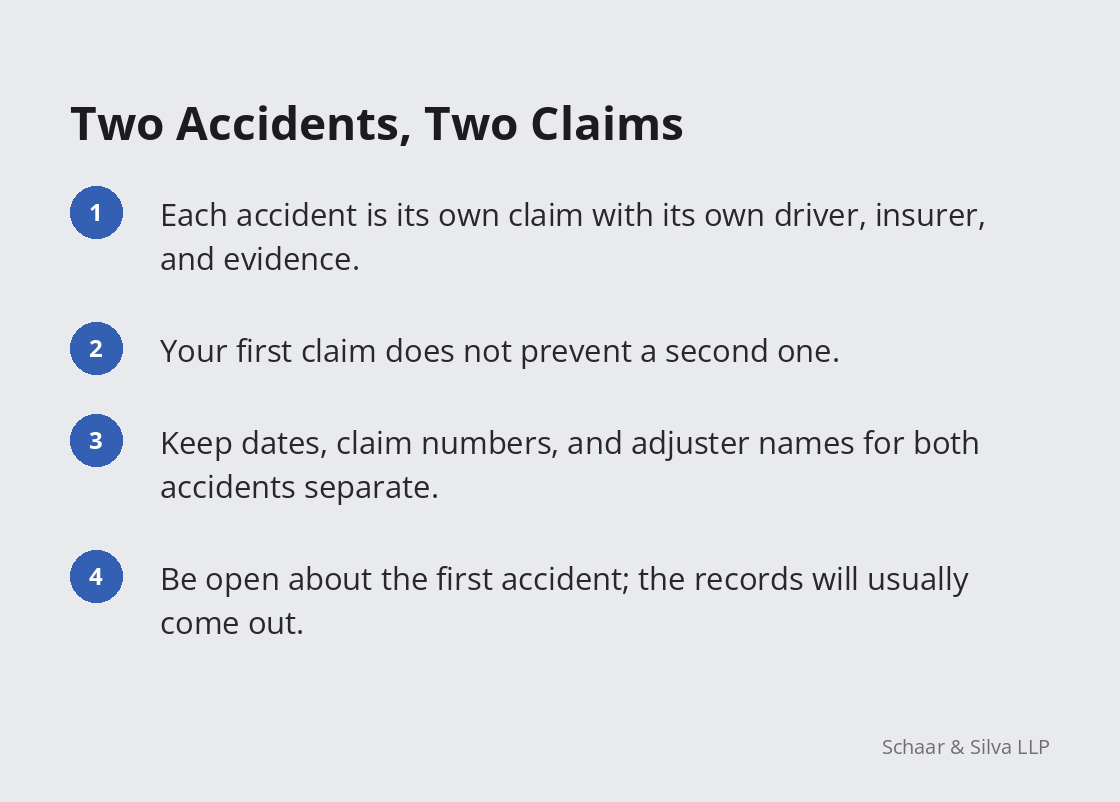
Two accidents in a short period do not cancel each other out. Each collision is its own event with its own driver, its own insurance policy, and its own evidence. What connects them is your body. A neck, back, or shoulder that was injured the first time may be more vulnerable the second time, and the medical record will need to show what changed.
Each Accident Is a Separate Claim
The driver who caused the second crash is responsible for the harm that crash caused, regardless of what happened in the first one. Your first claim may still be open, or it may have ended, but neither fact prevents a second claim. The important work is separating the two events so that the right insurer answers for the right injuries. Keep the dates, claim numbers, and adjuster names for both accidents in one place so nothing gets mixed together.
Why Insurers Focus on the First Accident
Adjusters know that a prior injury can be used to argue that the new accident did not cause your pain. They may request records from your earlier treatment, ask whether you had completely recovered, and suggest that your symptoms were already there. Being open about the first accident is important. Hiding it almost always backfires, because the records will usually come out. Telling the truth and letting your medical providers explain the difference is the stronger path.
Two Years to Bring a Lawsuit for Each Accident
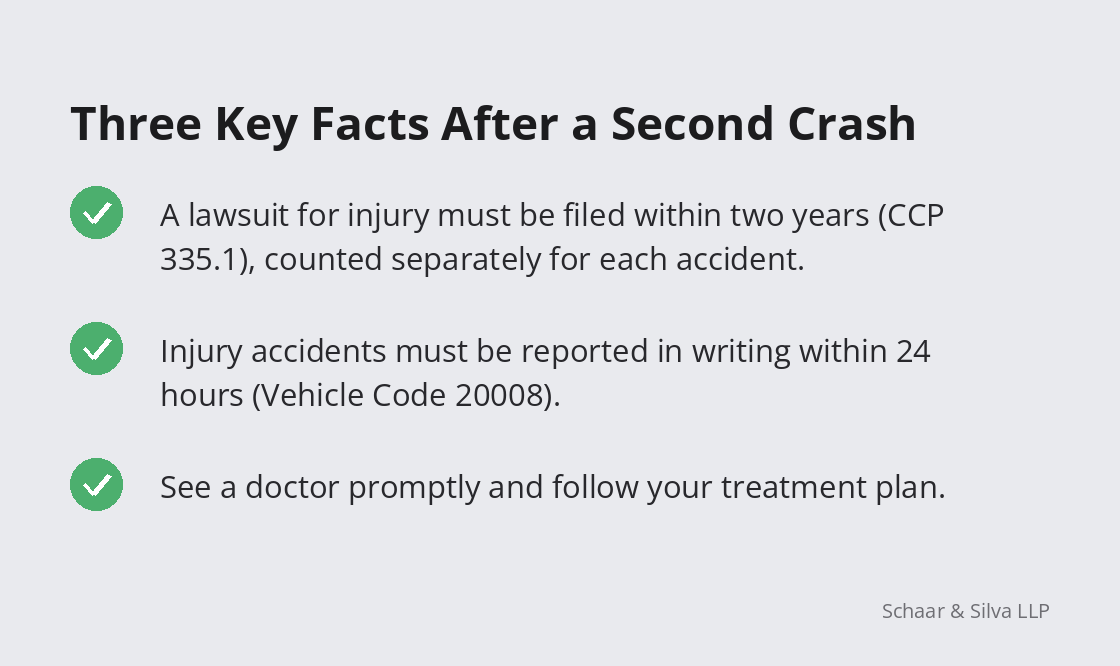
California sets a deadline for personal injury lawsuits. Code of Civil Procedure section 335.1 provides that an action for assault, battery, or injury to, or for the death of, an individual caused by the wrongful act or neglect of another must be brought within two years. Each accident has its own clock, running from its own date. If you were hurt in the first accident long ago, do not assume the second accident’s deadline is gone, and do not assume it is farther away than it is. Count each one separately and speak with a lawyer early.
What California Law Says About Earlier Injuries
Having been hurt before does not disqualify you from recovery. California’s civil jury instructions explain the principle that applies when a new accident makes an old problem worse, and it protects people who were already dealing with an injury or health condition.
You Are Not Held Responsible for the Old Condition
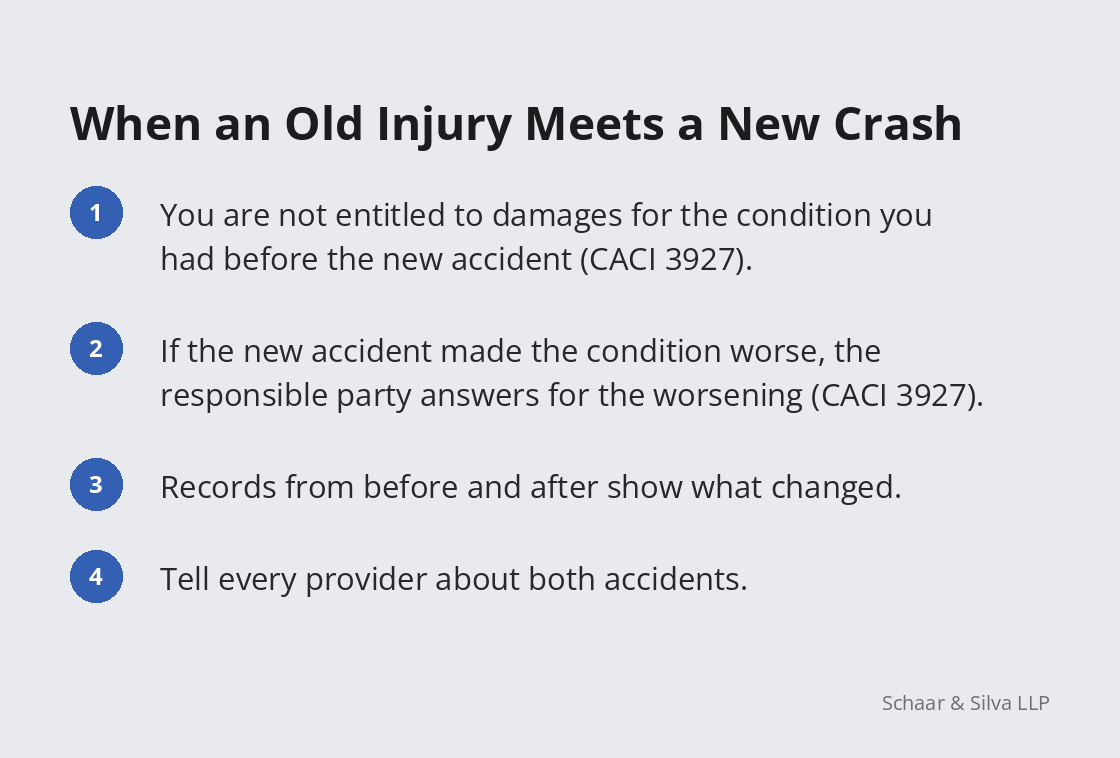
The Judicial Council of California’s jury instruction on aggravation of a preexisting condition, CACI No. 3927, states that the plaintiff is not entitled to damages for any physical or emotional condition that the plaintiff had before the defendant’s conduct occurred. The other side of that statement is that you are not asked to prove the old injury was caused by the new accident. You only need to show what the new accident changed. An insurer cannot treat a prior diagnosis as proof that the new crash did nothing.
Making an Existing Condition Worse
The same instruction says that if the plaintiff had a physical or emotional condition that was made worse by the defendant’s wrongful conduct, the jury must award damages that reasonably and fairly compensate the plaintiff for the effect on that condition. In plain terms, when a second accident aggravates an injury from the first, the person responsible for the second accident answers for the worsening. This is why careful documentation of your condition before and after each crash matters so much.
Building a Before-and-After Picture
The strongest claims compare your condition before the new accident with your condition afterward. Medical records from the first accident show where you started. Records from the second show the change. Describe to your providers what you could do before the second crash, such as work, exercise, sleep, or lift your children, and what you cannot do now. Specific details are more convincing than general statements that you hurt more than before.
Telling Your Doctors Everything
Be complete with every provider. If you leave out the earlier accident, the record may look inconsistent, and an adjuster may use the gap to doubt you. If a doctor can say, in writing, how the second crash changed your symptoms or recovery, that opinion can carry real weight in negotiations and in court. Follow your treatment plan, attend appointments, and keep a simple journal of your symptoms.
Steps to Protect Your Claim After a Second Crash
The first hours and days after any collision shape the rest of the case. A second accident adds another layer, because you will be dealing with insurers who may already have your earlier file.
Report the Accident Promptly
Vehicle Code section 20008(a) provides that the driver of a vehicle involved in an accident resulting in injuries to or death of any person must, within 24 hours after the accident, make or cause to be made a written report of the accident to the California Highway Patrol or, if the accident occurred within a city, to either the Highway Patrol or the police department of that city. Even if an officer came to the scene, confirm that a report exists and obtain the report number.
Get Medical Care Right Away
See a doctor quickly, even if you think the pain will pass. Delayed symptoms are common after crashes, and a gap in treatment gives the insurer room to argue that something else caused your pain. Tell the provider that you were in an earlier accident and describe how your body was feeling in the days before the new crash. This helps the physician explain what changed.
Keep the Two Cases Organized
Keep separate folders for each accident, including photographs, repair paperwork, medical bills, pharmacy receipts, and correspondence. Write down the date and time of every conversation with an adjuster. Avoid giving recorded statements about your prior injuries without understanding how they may be used. A short, accurate summary is better than a long answer that mixes the two events.
Be Careful With Social Media
Photos of a hike, a workout, or a family trip can be used to suggest that you were not hurt, even when the picture does not show how you felt afterward. In a case with two accidents, insurers look closely at your activity between them. Keep posts private or avoid posting until your case is resolved.
Final Thoughts
A second accident does not end your right to recover, and a prior injury does not make your new claim worthless. California law recognizes that a collision can make an existing condition worse, and it holds the person responsible for the new crash accountable for the worsening. The keys are honesty with your medical providers, clear records that show what changed, prompt reporting, and attention to the two-year deadline that applies to each accident.
If you were injured in a second crash in Santa Cruz County and are not sure how the earlier accident affects your claim, contact Schaar & Silva LLP to speak with our team in Santa Cruz. We will review both accidents, explain your options, and help you move forward with confidence. We serve Santa Cruz County and surrounding areas.