
An e-bike accident in Santa Cruz County can happen in a split second, whether you are commuting along Soquel Avenue, riding the coastal stretch of West Cliff Drive, or climbing toward Scotts Valley. Electric bikes have made it easier for thousands of local riders to get around, but they share the road with cars and trucks whose drivers do not always look for them, and the injuries from a collision can be serious.
At Schaar & Silva LLP, we help people in Santa Cruz County who have been hurt in car and truck crashes so you can move forward with confidence. This guide explains how California law actually treats e-bikes, the driver duties that most often decide fault, how a claim is built after a collision with a car or truck, and the mistakes that can weaken your case.
How California Law Actually Treats E-Bikes
Many riders are surprised to learn that California has a detailed legal definition of an electric bicycle. That definition matters after a crash, because it decides which rules of the road apply to you and how an insurance company is likely to view the collision. If your bike fits the definition, you are generally treated as a bicyclist rather than as the operator of a motorized vehicle.
Knowing where your e-bike fits, and what rights come with that status, gives you a clearer picture of how fault will be judged and what the other driver owed you on the road.
The Three Classes of Electric Bicycles
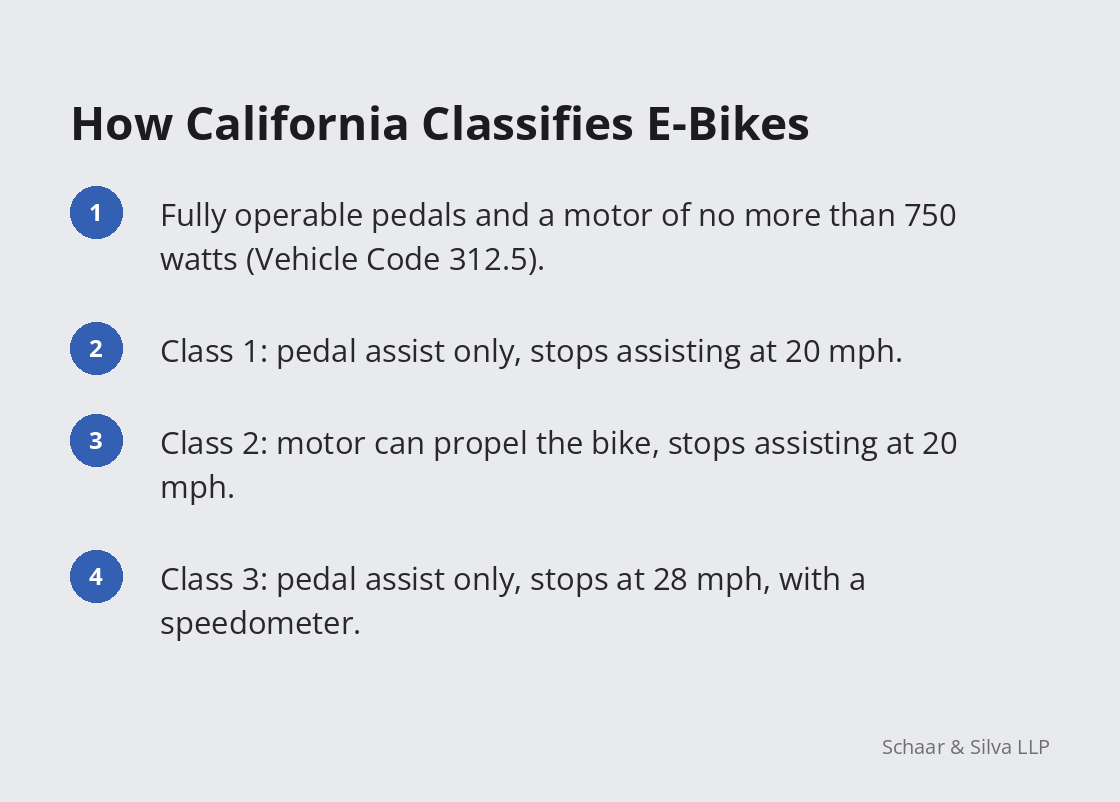
California Vehicle Code Section 312.5 defines an electric bicycle as a bicycle equipped with fully operable pedals and an electric motor that does not exceed 750 watts of power. The statute then divides e-bikes into three classes. A class 1 e-bike provides motor assistance only while the rider is pedaling and stops assisting when the bike reaches 20 miles per hour. A class 2 e-bike has a motor that can propel the bike on its own, such as with a throttle, but it stops assisting at 20 miles per hour.
A class 3 e-bike provides assistance only while the rider is pedaling, stops assisting at 28 miles per hour, and must be equipped with a speedometer. The same section requires manufacturers to attach a permanent label showing the classification number, top assisted speed, and motor wattage. That label can become useful evidence after a crash if the other side questions what kind of bike you were riding.
Your Rights as a Rider on the Road
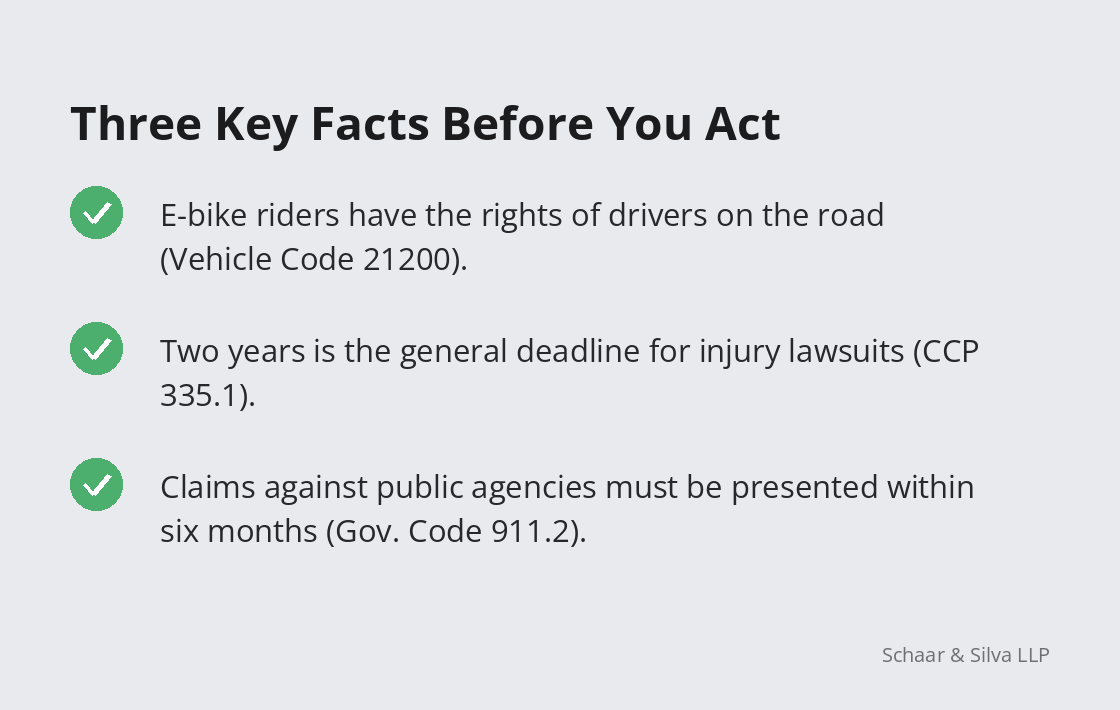
Section 312.5 states that a person riding an electric bicycle is subject to the same article of the Vehicle Code that governs bicycles. Under Vehicle Code Section 21200, a person riding a bicycle on a highway has all the rights and is subject to all the provisions that apply to the driver of a vehicle, except those that by their very nature cannot apply. In practical terms, you are entitled to use the road, and drivers must treat you as a lawful road user rather than an obstacle.
That status cuts both ways. Riders are expected to follow traffic signals, stop signs, and other rules of the road. When an insurance adjuster reviews an e-bike collision, one of the first questions will be whether each person involved was following the rules that applied to them at the moment of impact.
Age and Helmet Rules for Class 3 Bikes
Class 3 e-bikes carry a few extra requirements. Vehicle Code Section 21213 provides that a person under 16 years of age shall not operate a class 3 electric bicycle. The same section requires anyone operating or riding as a passenger on a class 3 e-bike on a street, bikeway, or other public bicycle path or trail to wear a properly fitted and fastened bicycle helmet that meets recognized safety standards.
Insurers sometimes raise these rules after a crash, especially when a head injury is involved. Following them protects you physically and removes an argument the other side might otherwise use to shift blame. Even when a rider was not following one of these rules, it does not automatically mean the driver who caused the collision is off the hook.
How Fault Is Proven After an E-Bike Crash
Most e-bike collisions with cars and trucks come down to a handful of familiar situations: a driver passing too closely, a driver turning across a bike lane without checking, a parked driver opening a door into the rider’s path, or a driver pulling out without seeing the rider at all. California’s Vehicle Code speaks directly to several of these situations, and those rules often become the backbone of a claim.
Beyond the specific traffic rules, California’s general negligence law asks whether the driver used ordinary care. Evidence that a driver broke a rule of the road is frequently the clearest way to show that care was missing.
Unsafe Passing and the Three Feet for Safety Act
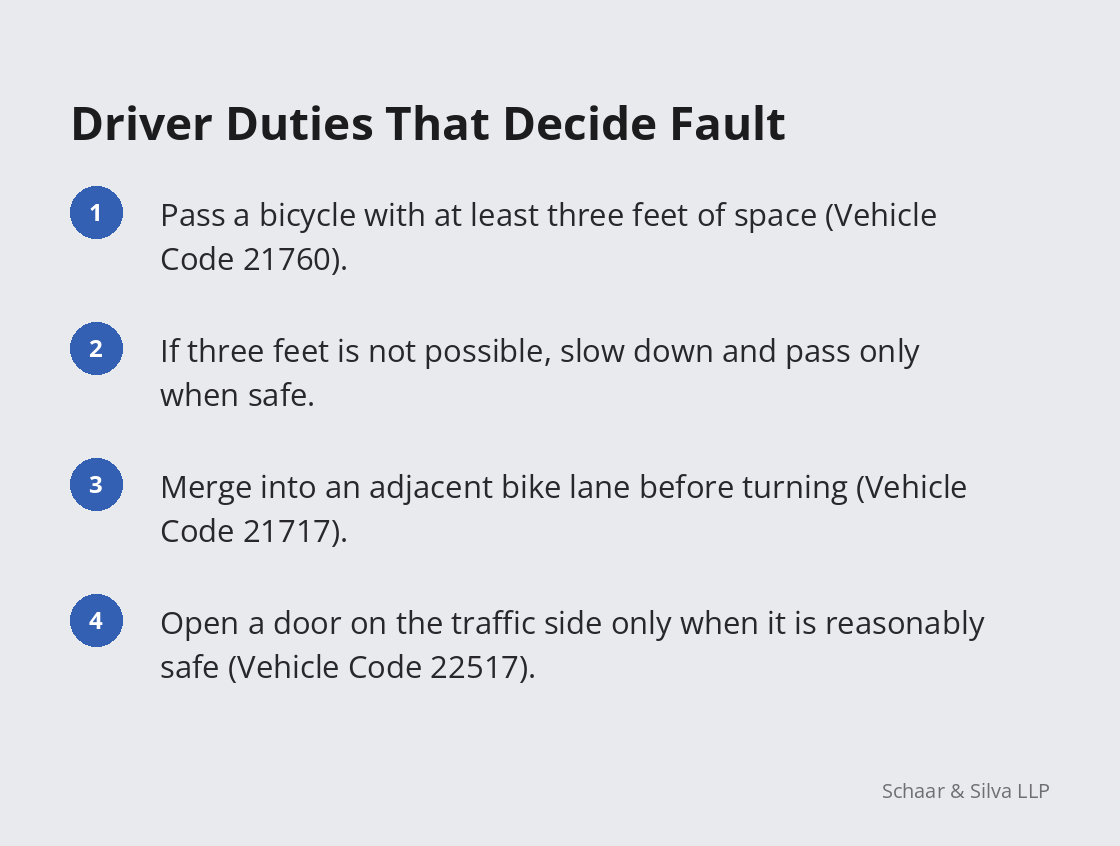
Vehicle Code Section 21760, known as the Three Feet for Safety Act, says a driver of a motor vehicle shall not overtake or pass a bicycle proceeding in the same direction at a distance of less than three feet between any part of the vehicle and any part of the bicycle or its operator. When another lane is available, the driver must change lanes before passing if it is practicable and not prohibited by law. If traffic or road conditions prevent a driver from leaving three feet, the driver must slow to a reasonable and prudent speed and pass only when doing so would not endanger the rider.
Narrow mountain roads and busy commercial corridors in Santa Cruz County make close passes a common cause of sideswipe crashes. Video from a helmet camera, a nearby business, or another driver can be powerful evidence of how close the vehicle actually came.
Right Turns Across a Bike Lane
Many collisions happen when a driver turns right across the path of a rider traveling straight in a bike lane. Vehicle Code Section 21717 provides that whenever it is necessary for the driver of a motor vehicle to cross a bicycle lane that is adjacent to the driver’s lane of travel to make a turn, the driver shall drive the vehicle into the bicycle lane before making the turn and shall make the turn as the Vehicle Code requires.
A driver who swings across the bike lane at the last moment, rather than merging into it safely before the turn, can cut directly in front of a rider who has no time to stop. Photos of the intersection, the lane markings, and where each vehicle came to rest help show how the turn was made.
Dooring and Parked Cars
Riders who pass parked cars face the risk of a door opening suddenly in front of them. Vehicle Code Section 22517 states that no person shall open the door of a vehicle on the side available to moving traffic unless it is reasonably safe to do so and can be done without interfering with the movement of that traffic. It also prohibits leaving a door open on the traffic side longer than necessary to load or unload passengers.
Dooring crashes can involve a driver, a passenger, or even a rideshare customer stepping out of a car. Identifying who opened the door, and whose insurance applies, is an early step in building this type of claim.
Building Your E-Bike Accident Claim
Once fault is established, the focus turns to showing what the crash took from you. California Civil Code Section 1714 makes everyone responsible for an injury caused to another by a lack of ordinary care in the management of his or her property or person. A driver who fails to watch for riders, passes too closely, or opens a door into traffic can be held responsible for the harm that follows.
A strong claim connects the driver’s conduct to your injuries with clear, organized evidence. The sooner that evidence is gathered, the less room there is for the other side to dispute what happened.
Evidence to Gather After the Crash
Useful evidence includes photos of the scene, your bike, the vehicle, and your injuries, along with the names and contact information of witnesses. Keep the damaged e-bike, your helmet, and any clothing in their post-crash condition, because they can help show the force and direction of the impact. If your bike has a classification label, photograph it as well.
Ask nearby businesses and homeowners about security cameras as quickly as possible, since many systems overwrite footage within a short time. A copy of the collision report from the investigating agency, such as the Santa Cruz Police Department, the Santa Cruz County Sheriff’s Office, or the California Highway Patrol, can also help identify witnesses and the officer’s observations.
Medical Care and Documenting Injuries
E-bike riders have little protection in a collision with a car or truck, and injuries can include fractures, head injuries, road rash, and damage to the shoulders, wrists, and knees. Getting prompt medical care protects your health and creates records that link your injuries to the crash. Gaps in treatment are one of the first things an insurer looks for when it wants to argue that an injury was minor or unrelated.
Keep a simple journal of your symptoms, missed work, and the activities you can no longer do comfortably. Those day-to-day details help show the full impact of the crash in a way medical records alone sometimes cannot.
Dealing With the Driver’s Insurance Company
After a crash, the at-fault driver’s insurance company may call quickly and ask for a recorded statement. Adjusters often look for comments suggesting the rider was going too fast, riding outside the bike lane, or hard to see. It is reasonable to provide basic information while politely declining to speculate about fault or the extent of your injuries until you understand your options.
Be cautious about signing medical authorizations or releases early in the process. A broad authorization can give the insurer access to unrelated medical history, and a release can end your claim before you know how serious your injuries really are.
Final Thoughts
An e-bike accident in Santa Cruz County is often decided by a few key questions: what kind of bike you were riding, which rules applied to each person on the road, and whether the evidence clearly shows how the collision happened. California law gives e-bike riders the same rights as other road users and places clear duties on drivers who pass, turn, and open doors near them.
Deadlines also matter. Code of Civil Procedure Section 335.1 sets a two-year limit for most lawsuits for injury caused by the wrongful act or neglect of another, and Government Code Section 911.2 generally requires a claim for personal injury against a public entity to be presented within six months after the claim accrues. Under California’s comparative fault rule, as reflected in the state’s civil jury instructions, any share of responsibility assigned to you reduces your recovery rather than automatically ending it.
If you were hurt in an e-bike crash with a car or truck, contact Schaar & Silva LLP to speak with our team in Santa Cruz County. We’ll review what happened, explain your options, and help you move forward with confidence.