

An Oakland car accident police report is often the first official record of what happened in a crash, and it can shape how insurance companies view your claim from the very beginning. Whether your collision happened on International Boulevard, Broadway, MacArthur Boulevard, or a quiet residential street in the hills, knowing how to get the report, what it contains, and how it fits into your claim can save you time and frustration.
At Schaar & Silva LLP, we help people in Oakland who have been hurt in auto, truck, and pedestrian accidents so you can move forward with confidence. This guide explains what a traffic collision report actually is, how to request one from the Oakland Police Department, how the report is used in an injury claim, and the mistakes people commonly make with it.
What an Oakland Collision Report Actually Is
A traffic collision report is a written record prepared by the law enforcement agency that investigated the crash. It typically captures the basic facts of the collision, the people and vehicles involved, and the observations made at the scene. For many injured people, it is the first document an insurance adjuster asks to see.
California law treats these reports in a specific way, giving certain people the right to see them while limiting how they can be used in court. Understanding those rules helps you use the report effectively.
What the Report Usually Contains
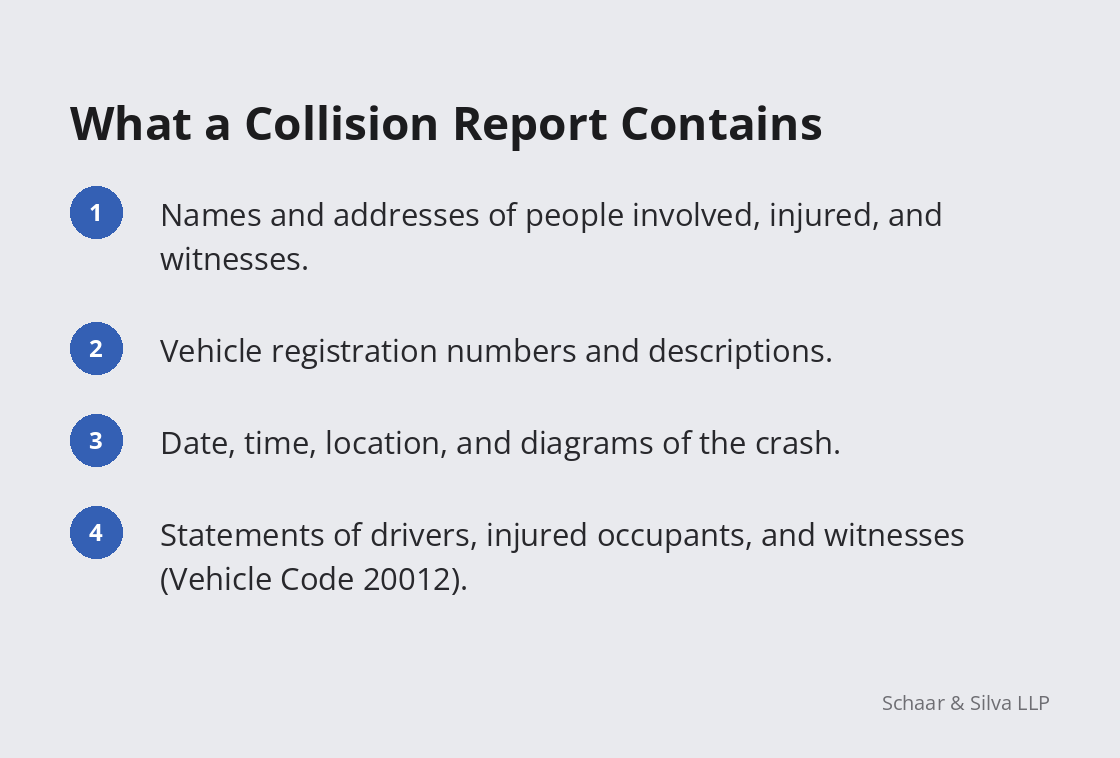
California Vehicle Code Section 20012 describes the contents that must be disclosed to people with a proper interest in an accident report, including the names and addresses of persons involved or injured and of witnesses, the registration numbers and descriptions of the vehicles involved, the date, time, and location of the accident, all diagrams, statements of the drivers involved or occupants injured, and the statements of all witnesses.
That information is valuable even when fault seems obvious. Witness names and contact details, insurance information, and the diagram of vehicle positions can all become important later if the other driver changes the story.
Who Has the Right to Get a Copy
Under Vehicle Code Section 20012, accident reports are generally confidential, but the investigating agency must disclose the entire contents to any person who may have a proper interest. The statute lists examples including the drivers involved, the authorized representative of a driver, any named person injured in the crash, the owners of damaged vehicles or property, persons who may incur civil liability, and an attorney who makes a sworn declaration that he or she represents any of those persons.
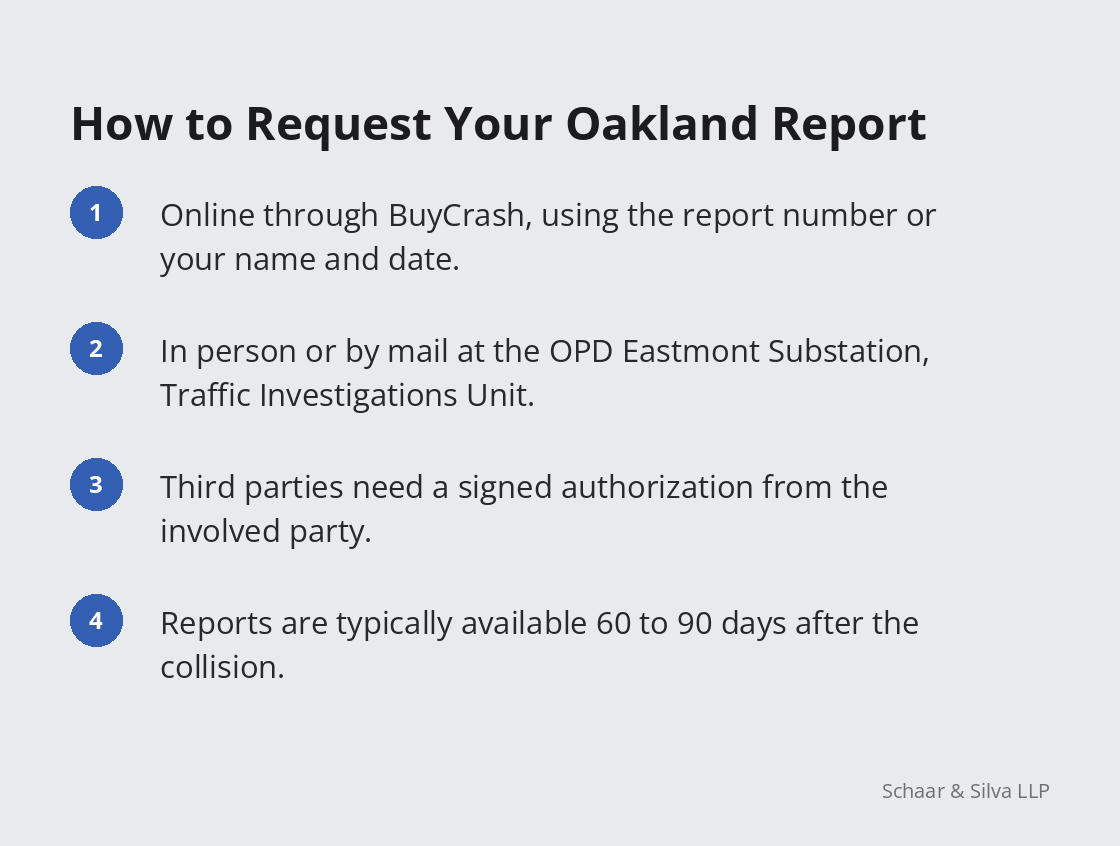
The Oakland Police Department notes that a third party requesting a collision report must include a signed authorization from the involved party, and a death certificate if applicable. Family members helping an injured relative should keep that requirement in mind.
When a Crash Must Be Reported
Vehicle Code Section 20008 generally requires a driver involved in a collision resulting in injury or death to make, or cause to be made, a written report within 24 hours to the California Highway Patrol or, if the crash happened within a city, to either the Highway Patrol or that city’s police department. If the crash was investigated by a different agency than the Oakland Police Department, such as the Highway Patrol, you request the report from that agency.
A separate duty applies to the DMV. Vehicle Code Section 16000 requires a driver in a collision that results in bodily injury or death to report it to the DMV within 10 days on an approved form. That DMV report is not the same as the police report, and filing one does not replace the other.
How to Request Your Oakland Police Report
The Oakland Police Department makes traffic collision reports available online, in person, or by mail. Knowing which details to have ready and what timeline to expect can help you avoid repeated trips or delays.
The process is straightforward once you have the right information, but it does take patience, because reports are not available immediately after a crash.
Requesting the Report Online
According to the City of Oakland, collision reports can be obtained online through the BuyCrash service. To locate a report, you enter the state and jurisdiction along with either the report number, your first and last name and the date of the incident, or your name and the street where the crash happened. The city notes that fatal traffic collision reports are not available online and must be requested in person or by mail.
Requesting the Report in Person or by Mail
The City of Oakland directs in-person and mail requests to the Traffic Investigations Unit at the OPD Eastmont Substation on 73rd Avenue. You will need the report number, or the date, location, and names of the people involved. Mail requests must include a self-addressed, stamped, trackable envelope.
The city also notes that body camera footage, surveillance video, and scene photos can be requested. These materials can sometimes show details a written report leaves out, such as traffic signal timing, road conditions, or the immediate statements of the drivers.
How Long It Takes
The City of Oakland states that reports are typically available within 60 to 90 days from the collision date. That delay surprises many people, especially when an insurance adjuster is asking for the report right away. While you wait, you can keep gathering your own evidence, such as photos, witness contact details, and medical records, so your claim keeps moving.
It also helps to write down the report number, the officer’s name, and the agency that responded before you leave the scene, or as soon as possible afterward. If you did not receive a report number, the date, the exact location, and the names of the drivers are usually enough to begin a search. Keeping copies of everything you send and receive creates a simple paper trail if a request is delayed or a report cannot be located.
How the Report Is Used and Common Mistakes
A police report is important, but it is not the final word on who caused a crash. Understanding both its value and its limits helps you avoid relying on it too heavily or dismissing it when it is helpful.
The most common problems come from assumptions about what the report proves and from waiting too long to act on the evidence it points to.
The Report’s Role in an Insurance Claim
Insurance adjusters routinely review collision reports when evaluating fault and injuries. A report that identifies witnesses, notes a traffic violation, or documents that you complained of pain at the scene can support your account. Even so, an officer’s opinion about fault is only one piece of evidence, and adjusters also consider photos, video, vehicle damage, and medical records.
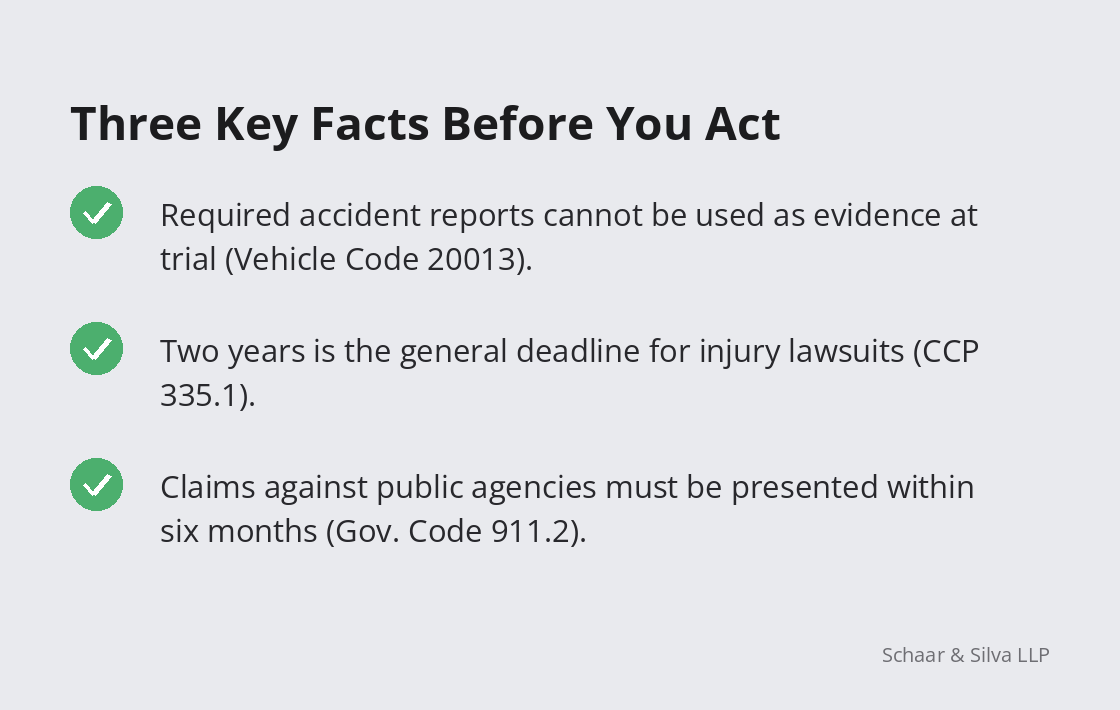
In court, the rules are stricter. Vehicle Code Section 20013 provides that no such accident report shall be used as evidence in any trial, civil or criminal, arising out of an accident. That is one reason the underlying evidence the report points to, such as witnesses and physical evidence, matters so much.
Mistakes to Avoid
One common mistake is assuming the report is accurate without reading it carefully. Names, insurance details, and descriptions of where vehicles were positioned can contain errors, and catching them early lets you gather evidence that shows what really happened. Another mistake is waiting for the report before seeking medical care or contacting witnesses, which can allow memories to fade and video to be overwritten.
Shared fault is also worth understanding. Under California’s comparative fault rule, as reflected in the state’s civil jury instructions, a defendant who proves you were also negligent can reduce your damages by your percentage of responsibility. A report that suggests you share some blame does not end your claim, but it does make careful evidence gathering more important.
Deadlines That Keep Running
Waiting for a report does not pause the legal deadlines. Code of Civil Procedure Section 335.1 sets a two-year limit for most lawsuits for injury or death caused by the wrongful act or neglect of another. If a city or other public agency vehicle was involved, Government Code Section 911.2 generally requires a claim for personal injury to be presented within six months after the claim accrues, which is a much shorter window.
Final Thoughts
An Oakland car accident police report can be one of the most useful documents in your claim, from identifying witnesses to showing where each vehicle was at the moment of impact. Knowing who can request it, how to request it, and how long it typically takes helps you plan the steps that come next.
At the same time, the report has limits, and the legal deadlines keep running while you wait. Gathering your own evidence and getting medical care early protects your claim no matter what the report says. Learn more about how we handle auto accident cases for injured drivers and passengers.
If you were hurt in a crash in Oakland, contact Schaar & Silva LLP to speak with our team. We’ll review your report and the rest of the evidence, explain your options, and help you move forward with confidence.