

An Oakland spinal cord injury after a car accident can upend every part of your life at once. One moment you are merging onto Interstate 880, waiting at a light on International Boulevard, or driving home through the hills on Highway 13, and the next you are facing hospital stays, months of rehabilitation, and real uncertainty about your ability to work, drive, or care for your family. In those first weeks, it is hard to think about insurance claims, but the decisions made early often shape what recovery looks like later.
At Schaar & Silva LLP, we help people in Oakland who have been hurt in auto accidents so you can move forward with confidence. This guide explains what a spinal cord injury claim actually involves, how fault and the full extent of your losses are proven under California law, and the mistakes that most often weaken these claims.
What an Oakland Spinal Cord Injury Claim Actually Involves
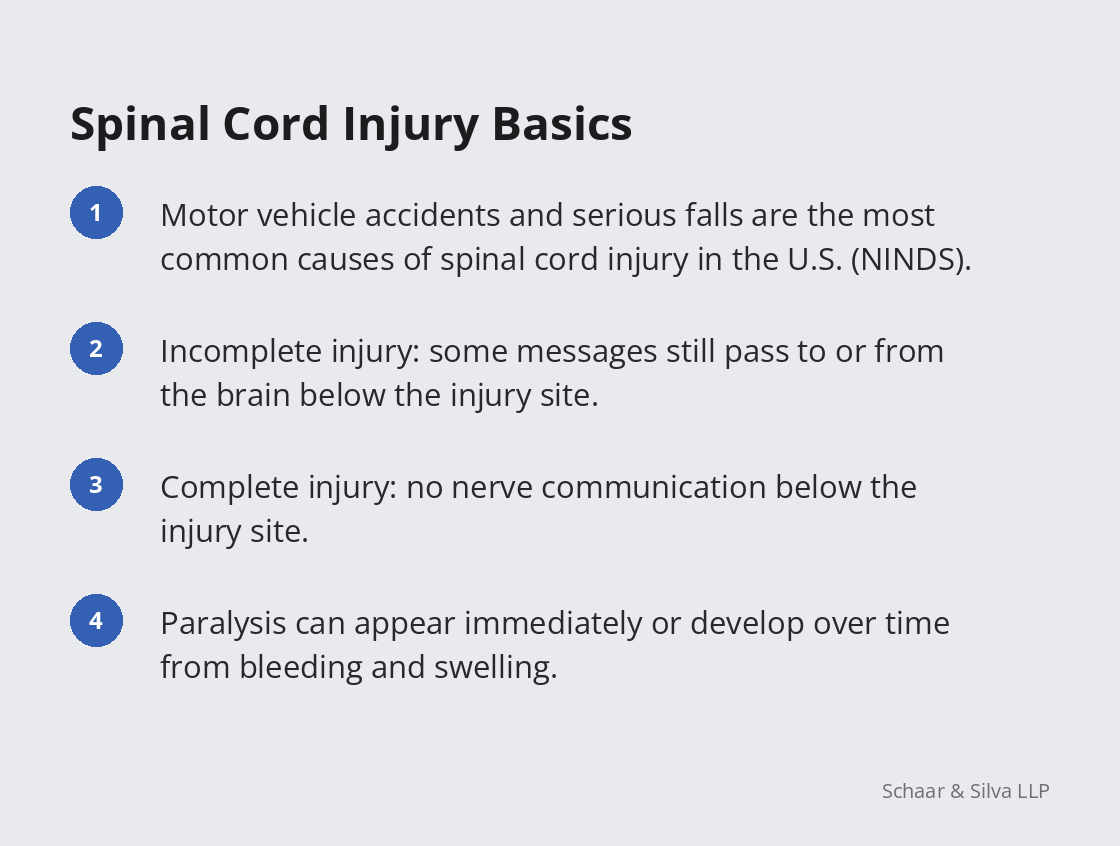
According to the National Institute of Neurological Disorders and Stroke, motor vehicle accidents and serious falls are the most common causes of spinal cord injury in the United States. In a busy urban area like Oakland, where freeways, surface streets, and residential neighborhoods meet, the forces involved in a collision can easily injure the spine and the nerves it protects.
A spinal cord injury claim is different from an ordinary injury claim because the medical picture can take months to settle and the effects can last a lifetime. Understanding the basics of the injury helps you understand why these claims need careful handling.
How a Car Crash Injures the Spinal Cord
The National Institute of Neurological Disorders and Stroke describes a spinal cord injury as damage to the spinal cord, the bundle of nerves and nerve fibers that sends and receives signals from the brain. That damage can come from direct injury to the cord itself or from damage to the tissue and bones, called vertebrae, that surround it. The result can be temporary or permanent changes in feeling, movement, strength, and body functions below the point of injury.
In a car crash, the violent motion of the head, neck, and torso during a rear-end, T-bone, or rollover collision can fracture or shift vertebrae and place pressure on the cord. Even crashes that look moderate from the outside can produce serious spinal damage inside the body.
Complete and Incomplete Injuries
Doctors classify spinal cord injuries as complete or incomplete. According to the National Institute of Neurological Disorders and Stroke, an incomplete injury means the spinal cord can still send some messages to or from the brain, so the person keeps some feeling, function, and muscle control below the injury site. A complete injury means there is no nerve communication below the injury site.
The same source notes that injuries to upper parts of the spinal cord affect more of the body than injuries lower down. The level and type of injury play a major role in the care you will need, and therefore in how your claim should be valued and presented.
Why Symptoms Can Change After the Crash
Spinal cord injuries do not always reveal their full extent at the scene. The National Institute of Neurological Disorders and Stroke explains that paralysis can happen immediately or develop over time from bleeding and swelling in the spinal cord and cell death. Symptoms can include numbness or tingling, weakness, pain or pressure in the neck or back, and loss of bladder and bowel control.
This is one reason to seek prompt medical attention after any significant Oakland car accident, even if you were able to walk away from the vehicle.
How Fault and Losses Are Proven in an Oakland Car Accident Claim
A successful claim must show two things: that another driver or party was responsible for the crash, and the full extent of the harm the injury caused. Both parts require evidence, and insurers will test each one.
Because spinal cord injuries often involve long-term care, insurers tend to scrutinize these claims closely and look for reasons to limit them.
The Duty of Ordinary Care on Oakland Roads
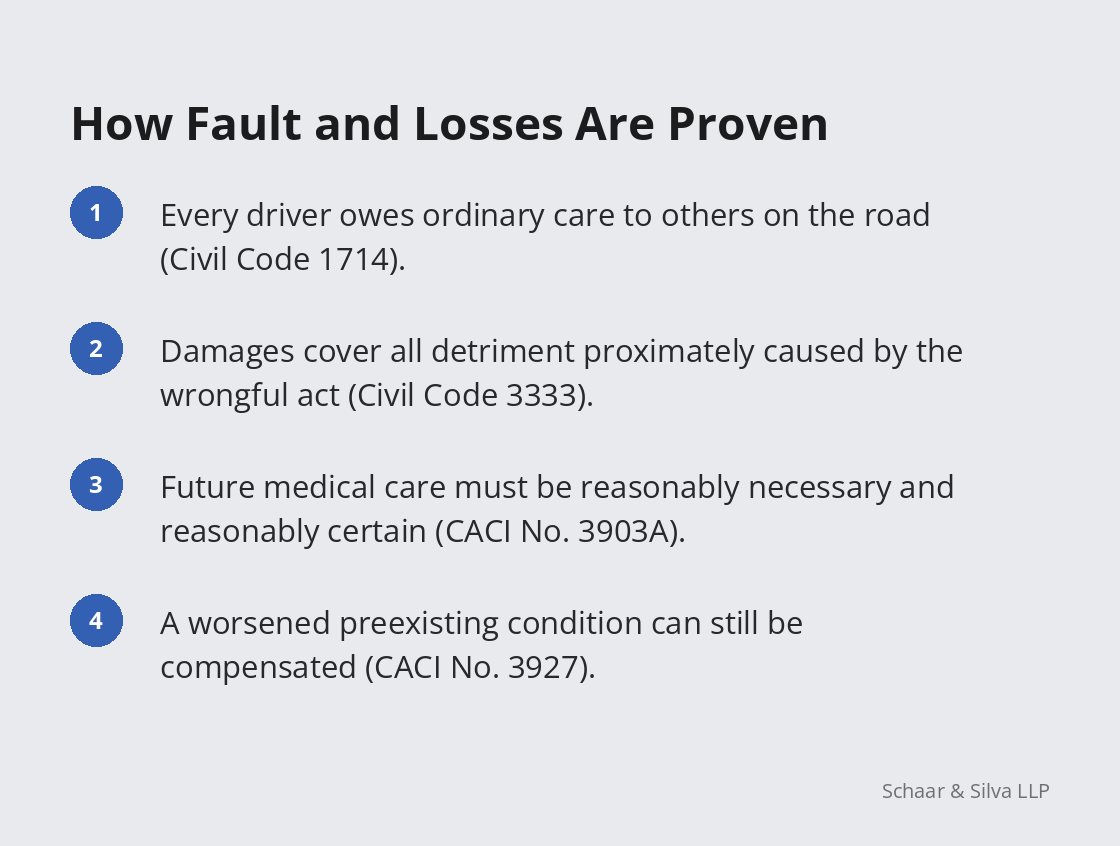
California Civil Code Section 1714 provides that everyone is responsible for an injury caused to another by a want of ordinary care or skill in the management of his or her property or person. For drivers, that includes watching the road, obeying traffic signals, keeping a safe speed, and leaving enough room to stop.
Vehicle Code Section 22350, the basic speed law, adds that no one may drive at a speed greater than is reasonable or prudent given the weather, visibility, traffic, and the surface and width of the highway. Police reports, witness statements, traffic camera footage, and vehicle damage all help show whether a driver met these duties.
Documenting Medical Care and Future Needs
California Civil Code Section 3333 provides that the measure of damages for a wrongful act not arising from contract is the amount that will compensate for all the detriment proximately caused by it. For a spinal cord injury, that detriment often extends years into the future.
Under California jury instruction CACI No. 3903A, a person seeking damages for future medical care must show the care is reasonably necessary and that they are reasonably certain to need it. Rehabilitation, which the National Institute of Neurological Disorders and Stroke describes as combining physical therapies with skill-building activities and counseling, is often a major part of that future care. Detailed medical records and opinions from your treating providers are the foundation of this proof, and CACI No. 3903C addresses past and future lost earnings.
Recognizing Non-Economic Losses
Some of the most significant harms from a spinal cord injury cannot be captured in a bill or a pay stub. California Civil Code Section 1431.2 describes non-economic damages as subjective, non-monetary losses, including pain, suffering, inconvenience, mental suffering, emotional distress, loss of society and companionship, and loss of consortium. Jury instruction CACI No. 3905A also lists items such as loss of enjoyment of life, physical impairment, and disfigurement.
Keeping a journal of your pain levels, sleep, limitations, and missed family activities can help show how the injury has changed your daily life.
Preexisting Back or Neck Conditions
Insurers often point to an old back problem or prior neck pain to argue that your symptoms are not from the crash. California jury instruction CACI No. 3927 explains that a person is not entitled to damages for a condition they had before the defendant’s conduct, but if a preexisting condition was made worse by the wrongful conduct, the jury must award damages that reasonably and fairly compensate for the effect on that condition.
A prior condition does not automatically defeat your claim. Clear medical comparisons between your health before and after the crash can make all the difference.
Mistakes That Can Weaken an Oakland Spinal Cord Injury Claim
Even a strong claim can lose ground because of avoidable missteps. Knowing the most common ones helps you protect both your recovery and your rights.
Each of these problems is far easier to prevent than to fix later.
Settling Before the Full Picture Is Clear
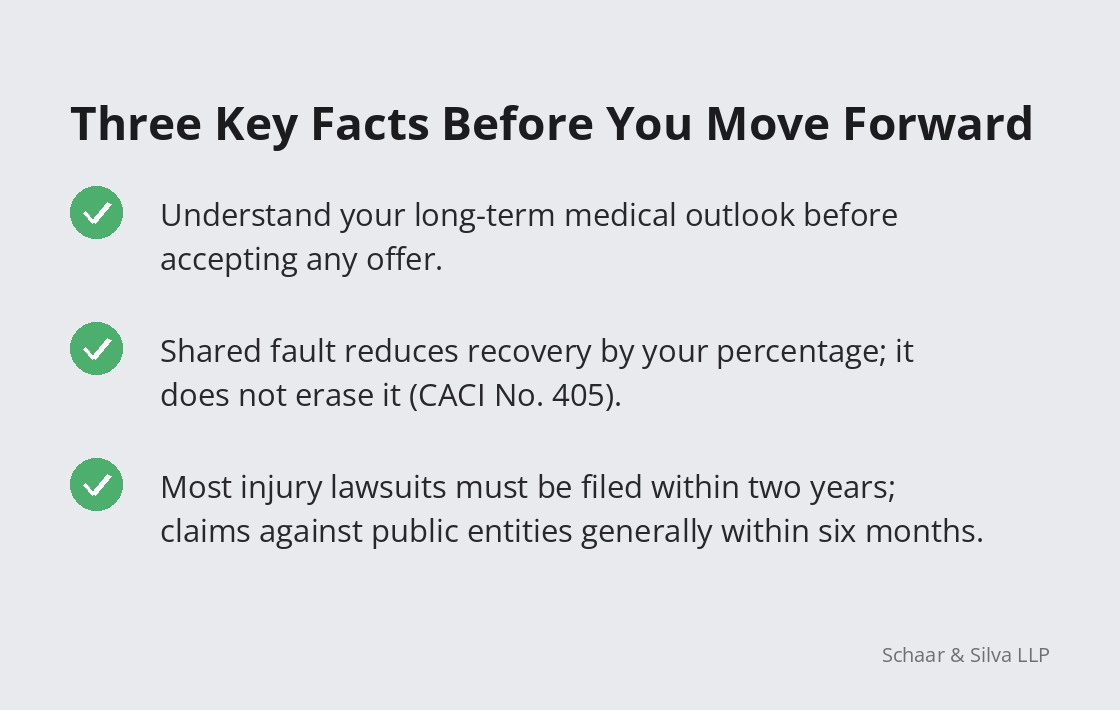
Insurers sometimes make an early offer while you are still in treatment. Because symptoms and prognosis can change over the months after a spinal cord injury, accepting an offer before your doctors understand your long-term needs can leave you without resources for the care you need later. Settlement agreements typically include a release, so it is important to understand exactly what you are giving up before you sign anything.
Take time to understand your medical outlook before making any final decision about your claim.
Assuming Shared Fault Ends Your Claim
Under California’s comparative fault rule, reflected in jury instruction CACI No. 405, an injured person’s damages are reduced by their own percentage of responsibility rather than eliminated. When more than one defendant is responsible, Civil Code Section 1431.2 makes each defendant’s liability for non-economic damages several only and in direct proportion to that defendant’s percentage of fault.
If an insurer suggests you were partly to blame for the crash, that argument does not necessarily end your right to recover, and the percentages themselves are often open to dispute.
Missing Reports and Deadlines
Vehicle Code Section 16000 requires a driver involved in a crash that caused bodily injury or death, among other situations, to report it to the Department of Motor Vehicles within 10 days, either personally or through an insurance agent, broker, or legal representative. Most injury lawsuits in California must be filed within two years under Code of Civil Procedure Section 335.1.
If a city vehicle, a public transit bus, or a dangerous public road condition was involved, Government Code Section 911.2 generally requires a claim to be presented no later than six months after the cause of action accrues. Missing this shorter window can bar an otherwise valid claim.
Final Thoughts
A spinal cord injury from an Oakland car accident affects your health, your work, and your family for years, not weeks. Proving fault, documenting your future medical needs, and accounting for the non-economic harm you live with every day all take time and careful attention.
You do not have to handle insurers and deadlines alone while you focus on rehabilitation. Learn more on our Oakland brain and spinal injury attorney page about how we approach these cases.
If you or a loved one suffered a spinal cord injury in an Oakland auto accident, contact Schaar & Silva LLP to talk with our team. We will listen to what happened, explain your options clearly, and help you take the next step with confidence.