

Sacramento wrongful death damages are rarely the first thing a grieving family wants to think about after a fatal car crash, yet understanding them early can make a real difference in how a claim unfolds. When a spouse, parent, or child is killed by a careless driver on Interstate 80, Highway 50, or a neighborhood street in Sacramento, California law gives certain family members the right to seek compensation for what the loss has taken from them. Knowing what the law allows families to recover, and what it does not, gives you real control over the process at a time when so much feels out of your hands.
At Schaar & Silva LLP, we help Sacramento families who have lost a loved one in a car or truck accident pursue accountability with care and clarity, so you can move forward with confidence. This guide explains what wrongful death damages actually cover in California, how families prove those losses, and the issues that can limit a recovery.
What Wrongful Death Damages Actually Cover in California
California’s wrongful death statute, Code of Civil Procedure Section 377.60, allows a claim for the death of a person caused by the wrongful act or neglect of another. The people who may bring it include the decedent’s surviving spouse, domestic partner, children, and the issue of deceased children, or, if there is no surviving issue, the persons who would be entitled to the decedent’s property by intestate succession. The statute also allows certain dependents, such as a putative spouse, stepchildren, or parents who were dependent on the decedent, to bring a claim. Section 377.61 provides that damages may be awarded that, under all the circumstances of the case, may be just. The Judicial Council’s civil jury instruction for the death of an adult, CACI No. 3921, describes how those damages are organized into two categories: economic and noneconomic.
Financial Support and Gifts the Family Would Have Received
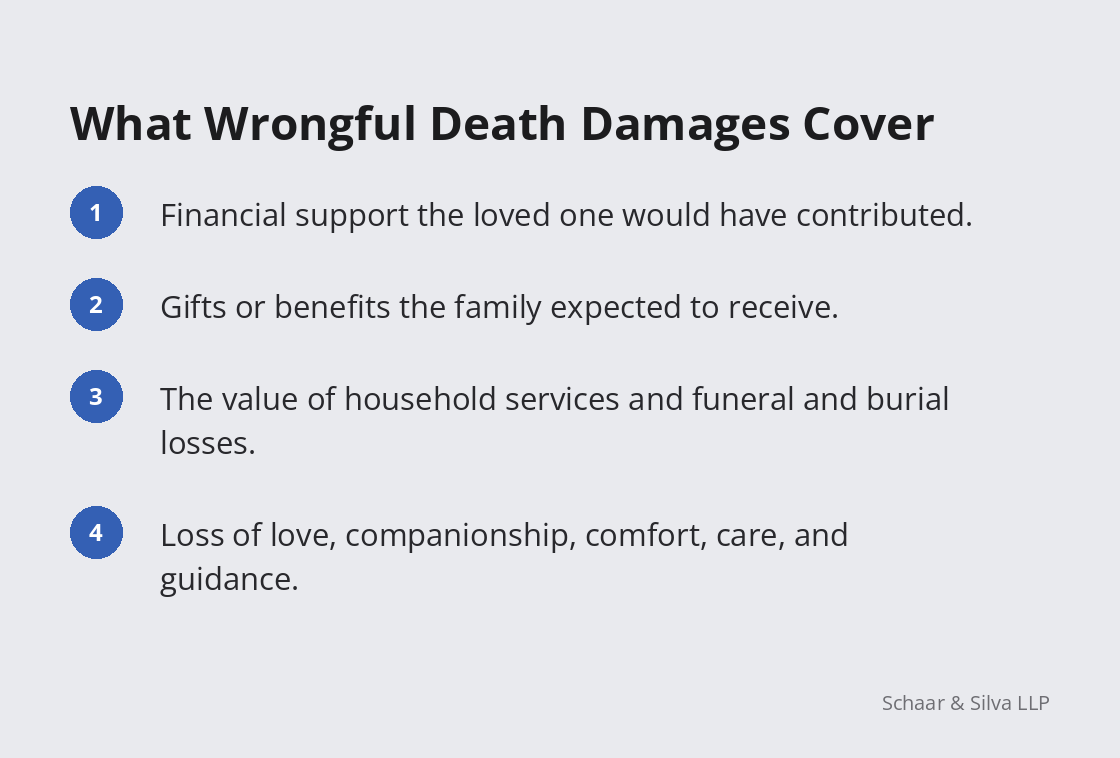
The first economic loss listed in CACI No. 3921 is the financial support, if any, that the decedent would have contributed to the family during either the decedent’s life expectancy before death or the life expectancy of the family member making the claim, whichever is shorter. For many Sacramento families, this is the paycheck that kept the household running, the contribution toward a child’s education, or the help an adult child gave to aging parents. The instruction also lists the loss of gifts or benefits that the family member would have expected to receive from the decedent. These items look forward, asking what the family reasonably would have received if their loved one had lived.
Household Services and Funeral and Burial Losses
Economic damages are not limited to wages. CACI No. 3921 also lists the reasonable value of household services that the decedent would have provided. A parent who drove children to school, cooked family meals, handled home repairs, or cared for a relative with a disability provided real value that the family must now replace or go without. The instruction also includes funeral and burial expenses, which families often face within days of the crash. Keeping a careful record of these losses from the start helps make sure none of them is overlooked later.
Love, Companionship, and Guidance
The second category is noneconomic damages, and for most families it reflects the heart of the loss. CACI No. 3921 lists the loss of the decedent’s love, companionship, comfort, care, assistance, protection, affection, society, and moral support, and in appropriate cases the loss of training and guidance. The instruction tells jurors that no fixed standard exists for deciding the amount of noneconomic damages and that they must use their judgment based on the evidence and common sense. This is where the story of the relationship matters most, because these losses are personal and cannot be read off a pay stub.
How Sacramento Families Prove Wrongful Death Losses
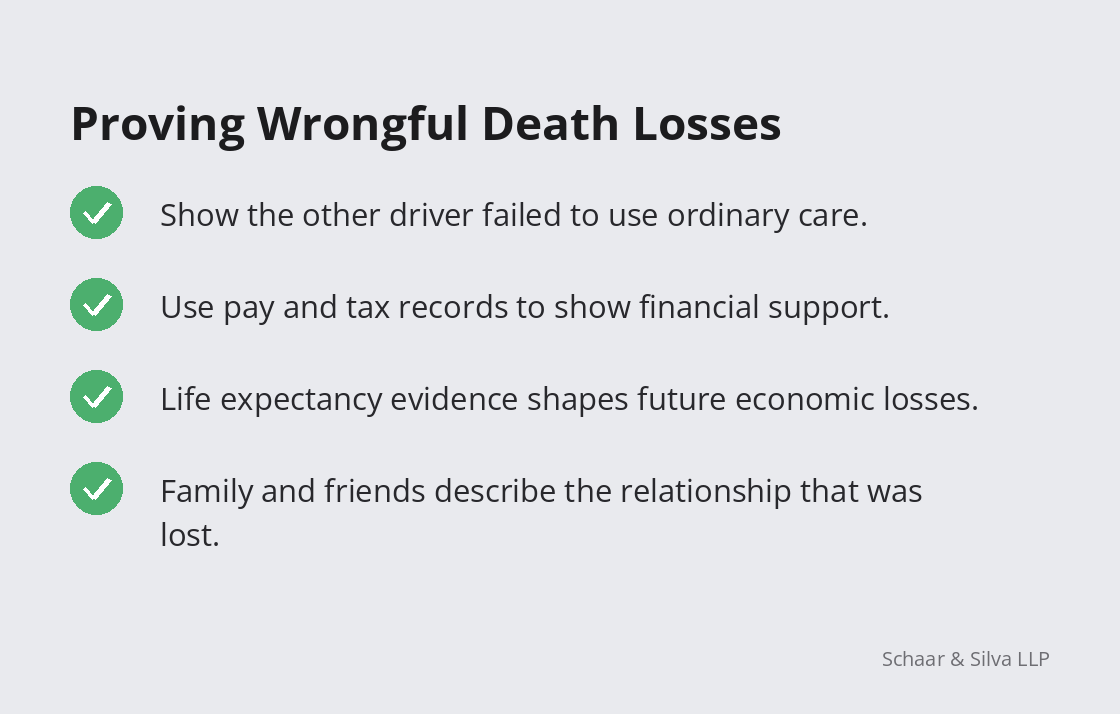
Recovering damages first requires showing that another driver’s negligence caused the crash. Under Civil Code Section 1714, everyone is responsible for an injury caused to another by a lack of ordinary care in managing their property or person, which includes driving a car. Once fault is established, the family must then show the extent of what was lost. Strong claims are built on documents, testimony, and a clear picture of the person who died.
Showing What the Decedent Contributed
Financial support is usually proven with tax returns, pay records, employment history, and evidence of how money was actually shared within the household. If your loved one was early in a career, records of training, promotions, or job offers can show where their earnings were headed. For household services, family members can describe the daily tasks the decedent handled and how those responsibilities are now being covered. It helps to gather these records soon, while employers and others still have them readily available and memories are fresh.
Life Expectancy and the Shorter-Life Rule
Because economic damages are measured over the shorter of two life expectancies, life expectancy evidence plays a central role. CACI No. 3921 allows jurors to consider the average life expectancy of a person of that age along with the person’s health, habits, activities, lifestyle, and occupation. The instruction explains that published life expectancy information is evidence of how long a person is likely to live but is not conclusive. Medical records and testimony about the decedent’s health and habits can help show that a loved one had many years ahead.
Telling the Story of the Relationship
Noneconomic damages are proven largely through people. Family members, close friends, coworkers, and community members can describe the role the decedent played in the family, the traditions they kept, and the guidance they offered. Photos, videos, letters, and cards can bring that relationship to life in a way that is truthful and specific. A clear, honest account of who your loved one was often carries more weight than any summary, because it shows exactly what the family has lost.
What Can Limit a Wrongful Death Recovery
Even a strong wrongful death claim has legal limits. Some losses are excluded by law, some arguments can reduce a recovery, and deadlines can end a claim entirely. Understanding these issues early helps families avoid surprises and make informed choices.
Losses the Law Does Not Allow in a Wrongful Death Claim
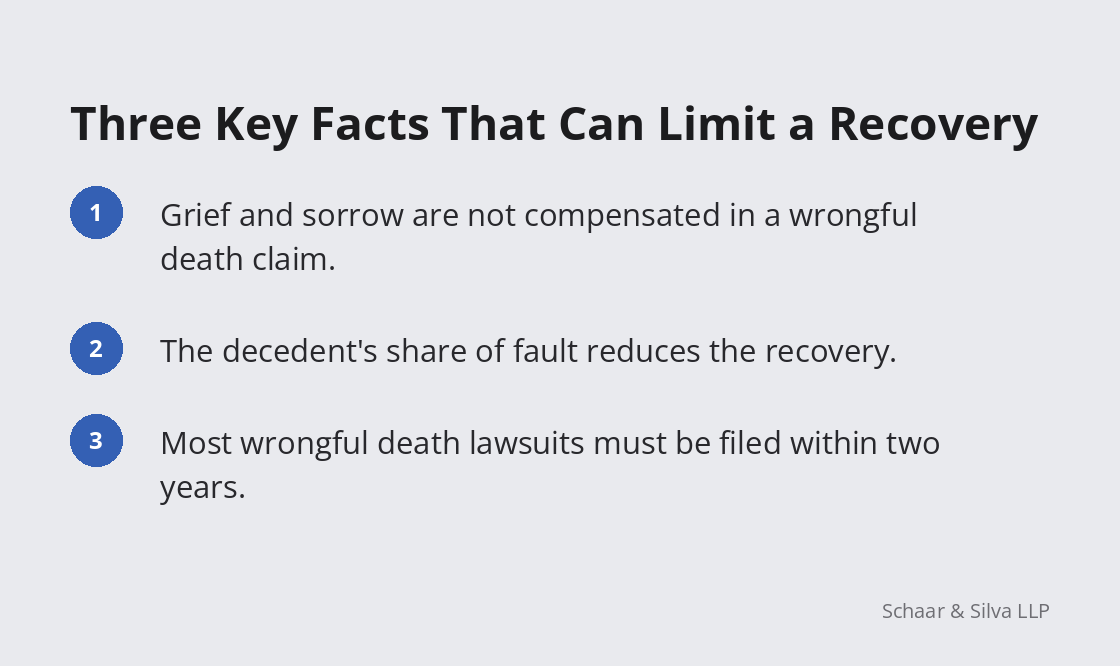
CACI No. 3921 instructs jurors not to consider the family member’s grief, sorrow, or mental anguish, the decedent’s pain and suffering, or the poverty or wealth of the family member bringing the claim. This can feel unfair to families who are living with profound grief. The distinction is that California wrongful death damages focus on the loss of the relationship, support, and services, rather than on the emotional pain of mourning itself. Knowing this helps families focus the evidence on what the law actually recognizes.
The Decedent’s Share of Fault
Insurance companies sometimes argue that the person who died contributed to the crash, for example by speeding or failing to yield. Under CACI No. 407, if the defendant proves that the decedent was negligent and that the negligence was a substantial factor in causing the death, the family’s damages are reduced by the percentage of the decedent’s responsibility. A share of fault reduces a recovery rather than eliminating it. Careful investigation of the crash scene, vehicle data, and witness accounts is often the best answer to these arguments.
Overlooking the Separate Survival Claim
A wrongful death claim belongs to the family members who suffered the loss, but California also recognizes a separate claim that belongs to the decedent. Under Code of Civil Procedure Section 377.30, a cause of action that survives the death passes to the decedent’s successor in interest and may be brought by the decedent’s personal representative or, if there is none, by the successor in interest. Section 377.34 limits those damages to the loss or damage the decedent sustained or incurred before death. A successor in interest who brings the claim without a probate case must file a sworn declaration under Section 377.32, and families should make sure this claim is not left behind.
Missing the Filing Deadline
Under Code of Civil Procedure Section 335.1, an action for the death of an individual caused by the wrongful act or neglect of another generally must be filed within two years. If a government vehicle or a dangerous public road was involved, Government Code Section 911.2 requires a written claim to be presented to the public entity within six months after the claim accrues. Grieving families understandably need time, but waiting too long can close the door on a valid claim, so it is wise to have your situation reviewed early.
Final Thoughts
Sacramento wrongful death damages are meant to address the real losses a family suffers when a loved one is killed by a careless driver. California law recognizes lost financial support, gifts, household services, funeral and burial losses, and the loss of love, companionship, and guidance. At the same time, the law excludes grief itself, allows a recovery to be reduced by the decedent’s share of fault, and sets firm deadlines. You can learn more about how we help families on our page about Sacramento wrongful death claims.
No claim can replace the person you lost. What a claim can do is hold the responsible party accountable and give your family stability for the years ahead.
If your family has lost someone in a car or truck crash in Sacramento, contact Schaar & Silva LLP to speak with our team. We will listen to your story, explain your rights under California law, and help you take the next step with confidence. We serve Sacramento and surrounding areas.