
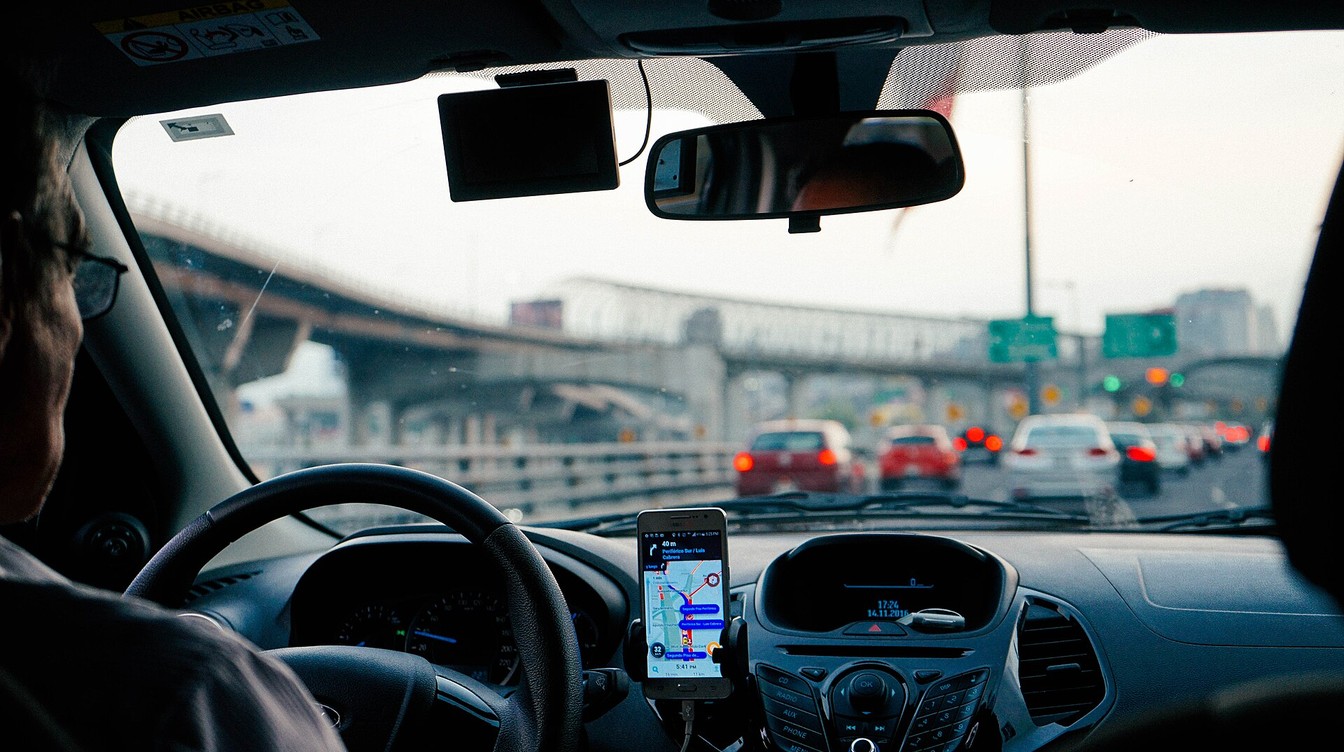
An Oakland left-turn accident often happens in the few seconds it takes a driver to cross oncoming lanes. A driver waiting to turn left on a busy street like Broadway, Telegraph Avenue, or International Boulevard misjudges the gap, the light changes, or a car appears faster than expected, and the result is a violent side-impact or head-on collision. Afterward, the questions start right away: who had the right of way, whether the oncoming driver shares blame, and what you need to do now to protect your health and your claim. Understanding how fault is decided in these crashes gives you real control over what happens next.
At Schaar & Silva LLP, we help people in Oakland who have been hurt in auto accidents, truck accidents, and other serious crashes on the city’s busy streets. This guide explains how California law actually assigns fault in a left-turn collision, the steps that protect your claim, and the mistakes that most often weaken a case, so you can move forward with confidence.
How Fault Actually Works in an Oakland Left-Turn Accident
Left-turn crashes are governed by specific right-of-way rules in the California Vehicle Code. Those rules explain who must wait, when the turning driver may go, and what oncoming drivers must do. Insurance adjusters and courts often begin their analysis with these statutes.
The Turning Driver’s Duty to Yield
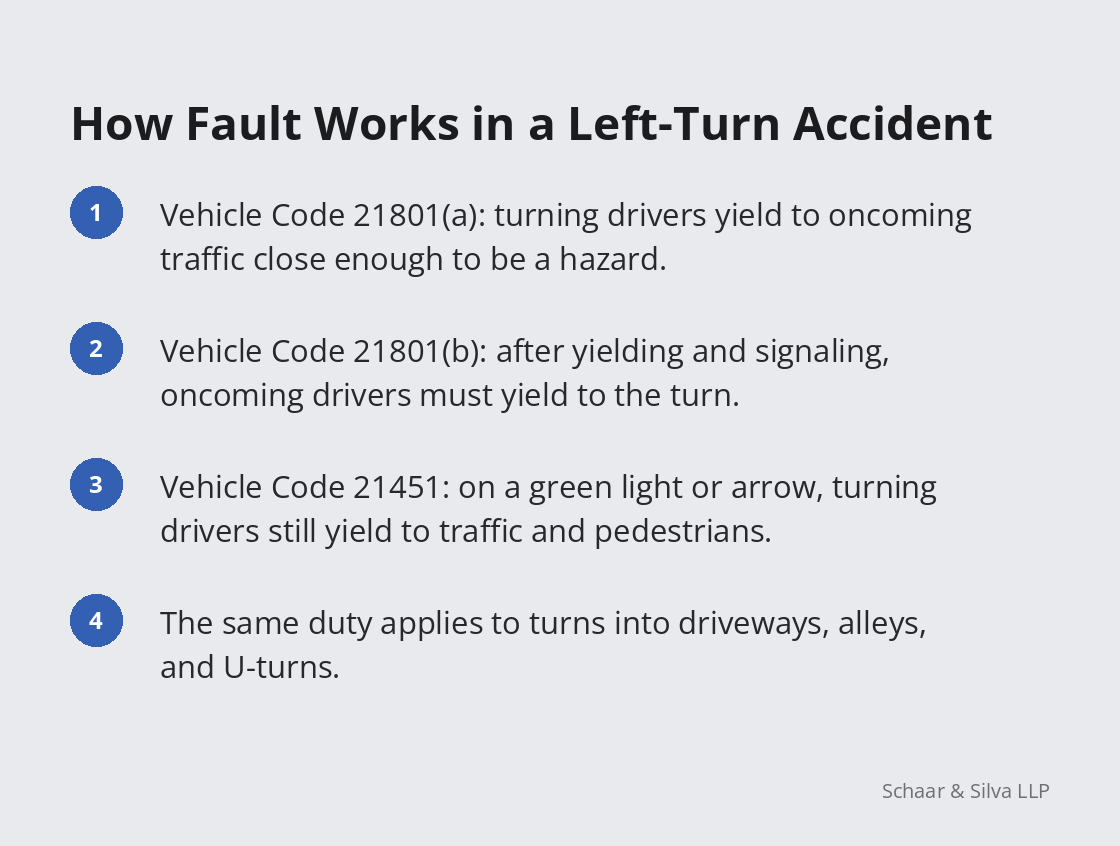
California Vehicle Code Section 21801(a) requires a driver intending to turn left or make a U-turn upon a highway, or to turn left into public or private property or an alley, to yield the right-of-way to all vehicles approaching from the opposite direction that are close enough to constitute a hazard at any time during the turning movement. The turning driver must continue to yield until the left turn can be made with reasonable safety. Because of this rule, the driver making the left turn is often the focus of a fault investigation, especially when the collision happens in the middle of the intersection.
When Oncoming Drivers Must Yield
The rule is not one-sided. Under Section 21801(b), a driver who has yielded as required and has given a signal when and as required by the Vehicle Code may turn left, and drivers approaching from the opposite direction must then yield the right-of-way to the turning vehicle. This means that if a turning driver properly waited for a safe gap and began the turn, an oncoming driver who speeds up or fails to slow may bear responsibility for the crash.
What Traffic Signals Change
Signals matter in these cases. Under Vehicle Code Section 21451(a), a driver facing a circular green signal may proceed straight or turn right or left, but any driver, including one turning, must yield the right-of-way to other traffic and to pedestrians lawfully within the intersection or an adjacent crosswalk. Under Section 21451(b), a driver facing a green arrow may enter the intersection only to make the movement indicated by the arrow, or another movement permitted by signals shown at the same time, and must still yield to other traffic and to pedestrians lawfully within the intersection or an adjacent crosswalk. Determining whether the turning driver had a circular green or a green arrow can change the analysis significantly.
The same signal rules protect people on foot. A left-turning driver who focuses only on oncoming cars can easily miss a pedestrian lawfully crossing in the crosswalk on the street the driver is turning onto. Our article on Oakland pedestrian accident crosswalk rights explains how fault works in those situations.
Turns Into Driveways, Alleys, and U-Turns
Not every left-turn crash happens at a signalized intersection. Section 21801(a) applies equally to a driver turning left into public or private property, such as a parking lot, a gas station, or a driveway, and to a driver turning into an alley or completing a U-turn. On many Oakland commercial streets, drivers turn left across traffic mid-block to reach a business entrance. The same duty applies: the turning driver must yield to oncoming vehicles close enough to constitute a hazard and must wait until the turn can be made with reasonable safety. Those mid-block turns often happen where oncoming drivers are not expecting a vehicle to cross their path, which makes careful evidence about timing, visibility, and speed especially important.
Steps That Protect an Oakland Left-Turn Accident Claim
Left-turn collisions frequently become disputes about timing and speed. Each driver may honestly believe they had the right of way. The evidence you gather in the hours and days after the crash often decides which version of events holds up.
Document the Signal, Lanes, and Vehicle Positions
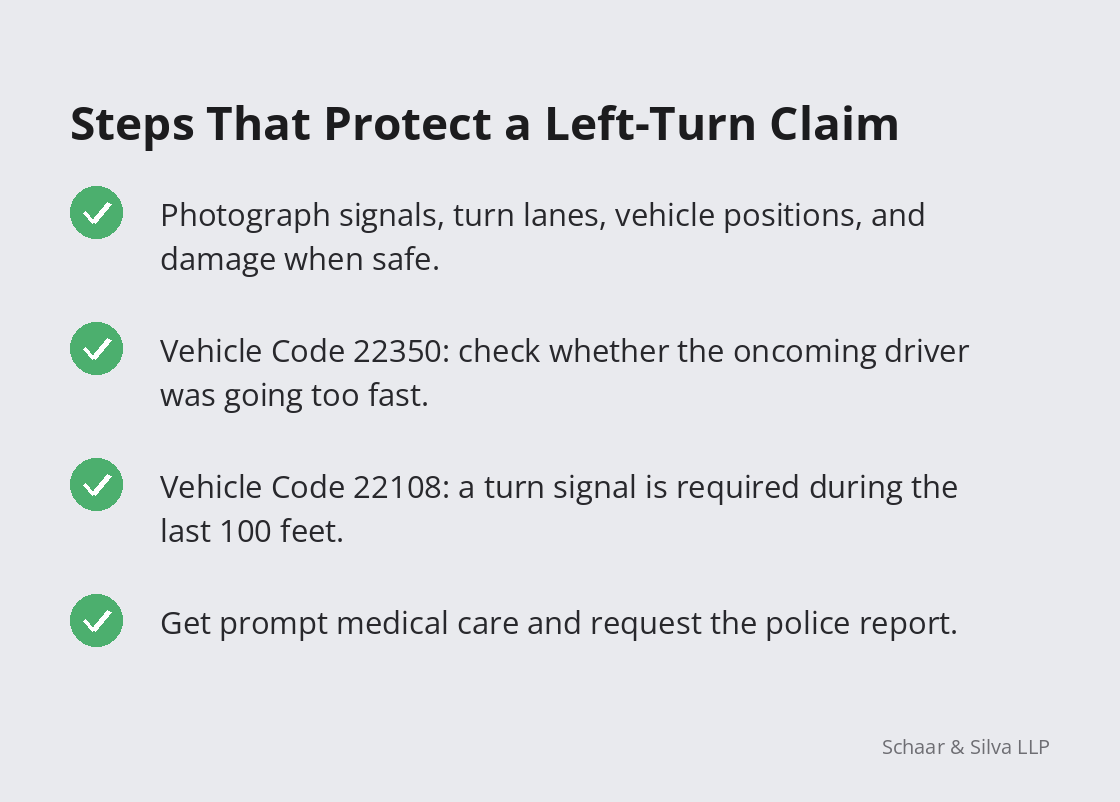
When it is safe, photograph the intersection, the traffic signals, any turn lanes or arrows, the final positions of the vehicles, and the damage to each car. The location of damage can help show whether a vehicle was struck while turning or while traveling straight. Note whether the signal had a dedicated left-turn arrow. Ask nearby businesses and residents whether they have cameras that may have captured the crash, since recordings can be overwritten.
Look Closely at Speed and Signaling
Vehicle Code Section 22350 prohibits driving at a speed greater than is reasonable or prudent given weather, visibility, traffic, and the surface and width of the highway, and in no event at a speed that endangers the safety of persons or property. An oncoming driver who was speeding may share responsibility even if the turning driver also made a mistake. Signaling also matters. Under Section 22107, no person may turn a vehicle from a direct course until the movement can be made with reasonable safety, and then only after giving an appropriate signal if another vehicle may be affected. Section 22108 requires a turn signal to be given continuously during the last 100 feet traveled before turning.
Get the Police Report and Medical Care
Seek medical attention promptly, even if you feel able to walk away. Some injuries from side-impact crashes are not obvious right away, and medical records created soon after the collision help connect your injuries to the crash. Request the police report as soon as it is available and review it for errors. Our guide on how to obtain and use an Oakland police report walks through that process.
Mistakes That Weaken a Left-Turn Accident Claim
Left-turn crash claims are often closer calls than people expect. Small missteps after the collision can give an insurance company room to shift blame or question the seriousness of your injuries.
Assuming the Turning Driver Is Always at Fault
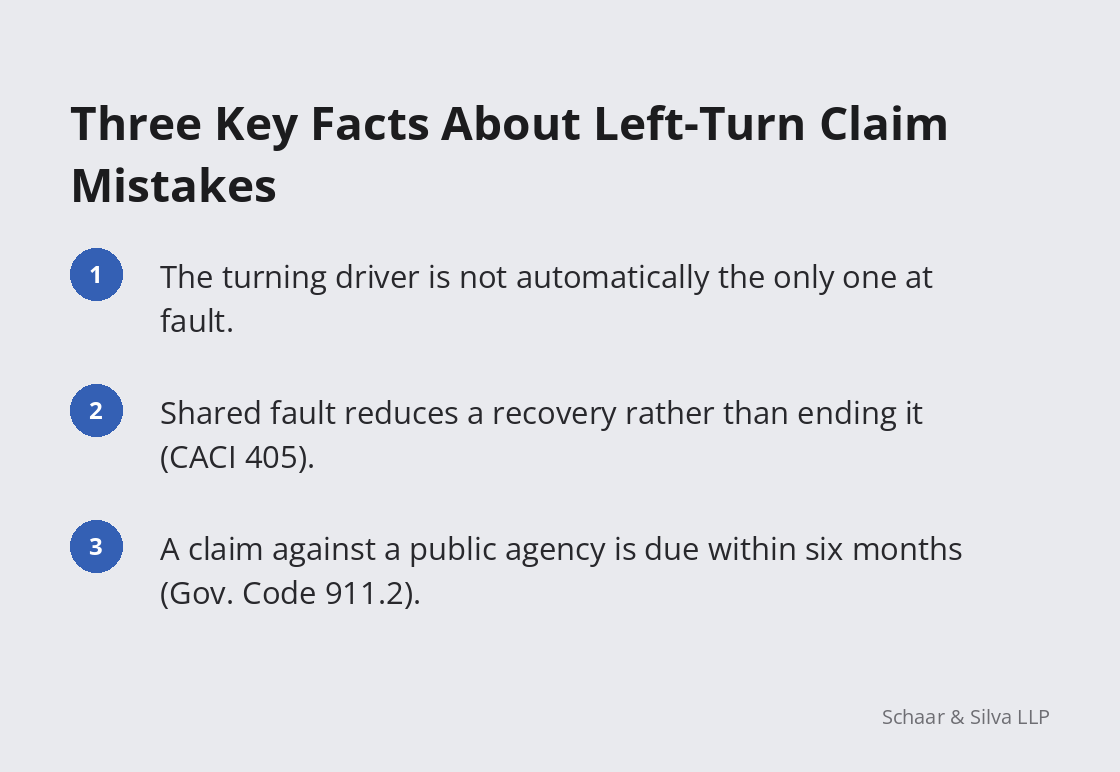
Many people believe the driver turning left is automatically responsible. The Vehicle Code does place a strong duty on turning drivers, but Section 21801(b) also requires oncoming drivers to yield once a turning driver has properly yielded and signaled, and Section 22350 applies to every driver’s speed. Whether you were turning or traveling straight, the full set of facts, including signals, speed, and visibility, should be reviewed before anyone accepts blame.
Giving Up Because You Share Some Fault
California follows comparative fault. Under CACI No. 405, the Judicial Council’s official jury instruction, if a defendant proves that the injured person was negligent and that this negligence was a substantial factor in causing the harm, the injured person’s damages are reduced by the percentage of that person’s responsibility. Sharing some responsibility for a left-turn crash reduces a recovery rather than eliminating it. California Civil Code Section 1714(a) also makes everyone responsible for injuries caused by a want of ordinary care, which applies to both drivers.
Missing Important Deadlines
Under Code of Civil Procedure Section 335.1, an action for injury to, or for the death of, an individual caused by the wrongful act or neglect of another generally must be filed within two years. If a city or other public agency vehicle was involved, or a dangerous signal or roadway condition contributed to the crash, Government Code Section 911.2(a) requires a claim for injury to be presented to the public entity not later than six months after the cause of action accrues. Identifying any public entity involvement early protects your options.
Final Thoughts
An Oakland left-turn accident is rarely as simple as it first appears. California law requires turning drivers to yield to oncoming traffic that is close enough to be a hazard, but it also requires oncoming drivers to yield once a turning driver has properly yielded and signaled, and it holds every driver to a reasonable and prudent speed. Signals, arrows, and the timing of each vehicle’s movement all play a role.
Careful documentation, prompt medical care, a close review of the police report, and attention to deadlines give you the strongest foundation for your claim. Shared fault does not have to end a case, and the details often matter more than first impressions.
If you were hurt in a left-turn crash anywhere in Oakland or the surrounding East Bay, contact Schaar & Silva LLP to speak with our team. We will listen to your story, answer your questions, and help you move forward with confidence.