
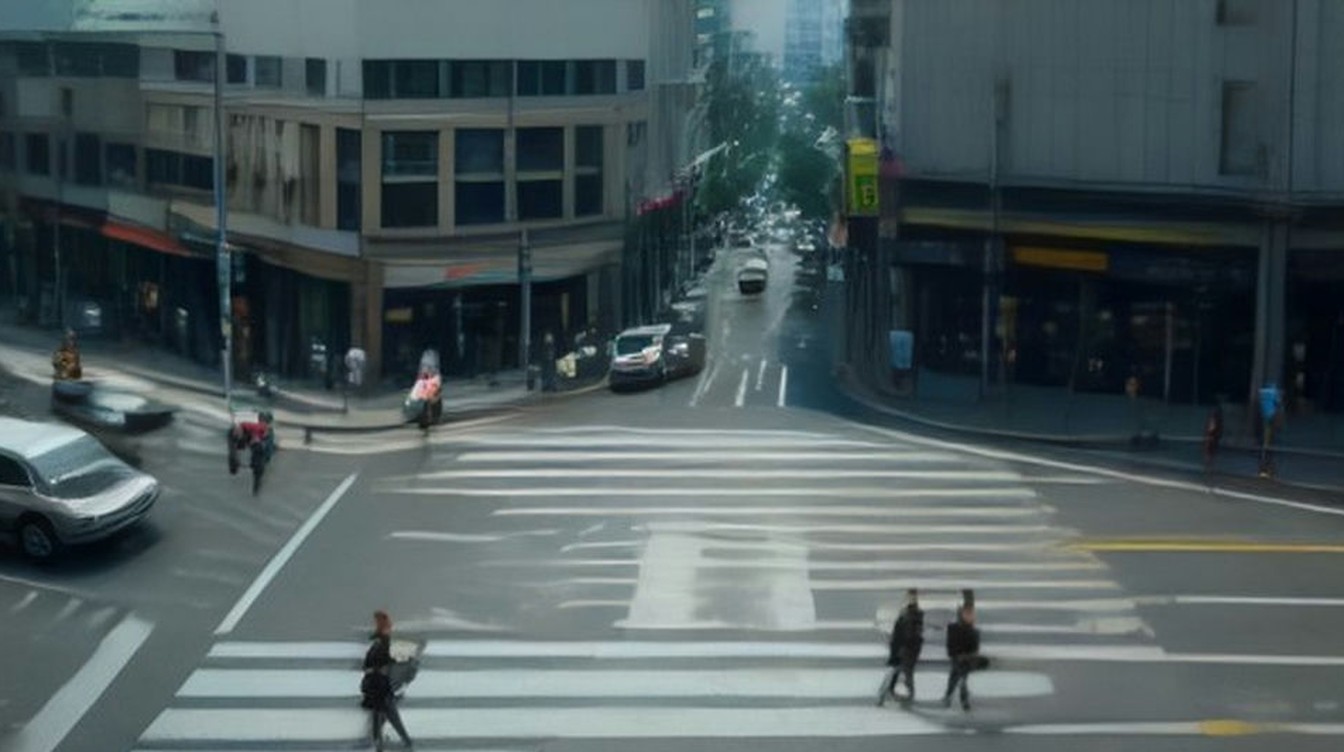
An Oakland pedestrian accident can turn an ordinary walk to work, to a bus stop, or around Lake Merritt into weeks of medical appointments and difficult conversations with insurers. In the days that follow, the question that shapes nearly everything is simple to ask and harder to answer: who had the right-of-way, and did the driver use the care California law requires? Knowing how the crosswalk rules actually work gives you real control over your claim.
At Schaar & Silva LLP, we help people across Oakland who have been hurt by drivers while walking, crossing, or standing near the roadway. This guide explains how crosswalk rights work under the California Vehicle Code, how fault is decided when a pedestrian is hit, and the mistakes that most often weaken a pedestrian claim, so you can move forward with confidence.
How Crosswalk Rights Actually Work in Oakland
Oakland is a city built for walking as much as driving. Busy corridors like Broadway, Telegraph Avenue, and International Boulevard carry heavy traffic right alongside people heading to BART stations, schools, and neighborhood shops. When a driver and a pedestrian meet in that space, the California Vehicle Code sets out who must yield, and those rules are the starting point for every pedestrian injury claim.
What Counts as a Crosswalk
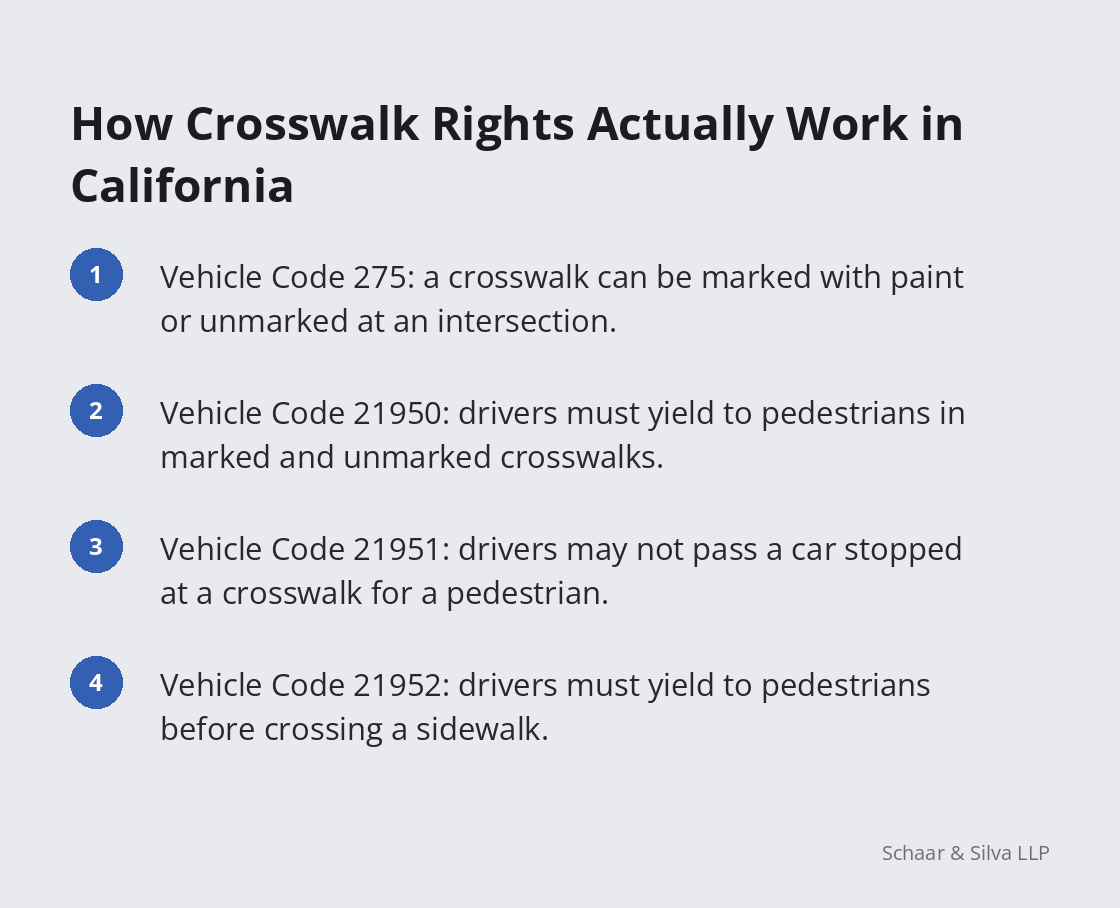
Many people assume a crosswalk only exists where white lines are painted on the street. California law is broader. Vehicle Code 275 defines a crosswalk as either the portion of a roadway at an intersection that connects the boundary lines of the sidewalks, or any portion of a roadway distinctly marked for pedestrian crossing by lines or other markings on the surface. That means most ordinary intersections in Oakland include an unmarked crosswalk even when no paint is visible. The main exception is where local authorities have placed signs indicating no crossing, in which case there is no crosswalk at that spot. Where you were standing or walking when you were hit can change how the rest of the rules apply, so it is worth pinning down early.
The Driver’s Duty to Yield
Vehicle Code 21950 requires the driver of a vehicle to yield the right-of-way to a pedestrian crossing the roadway within any marked crosswalk or within any unmarked crosswalk at an intersection, except as otherwise provided in the pedestrian chapter of the code. The same section goes further than simply yielding. A driver approaching a pedestrian within a marked or unmarked crosswalk must exercise all due care and must reduce speed or take any other action necessary to safeguard the pedestrian. In practice, this means a driver who was rolling through a turn, looking only for oncoming cars, or hurrying to beat a light can be found to have fallen short of what the law expects.
When Another Car Stops for You
One of the most dangerous moments for a pedestrian is when one lane of traffic stops and the next lane does not. California addresses that directly. Under Vehicle Code 21951, whenever a vehicle has stopped at a marked crosswalk or at an unmarked crosswalk at an intersection to let a pedestrian cross, the driver of any other vehicle approaching from the rear shall not overtake and pass the stopped vehicle. If you were struck by a car that swung around a stopped vehicle on a multilane street, this rule can be central to showing that the driver who hit you was at fault.
Driveways, Sidewalks, and Parking Garages
Pedestrian injuries do not only happen in the street. Drivers pulling out of driveways, gas stations, and parking structures often cross the sidewalk without a clear view. Vehicle Code 21952 requires the driver of any motor vehicle, before driving over or upon any sidewalk, to yield the right-of-way to any pedestrian approaching on it. A driver who backs out of a downtown garage or a residential driveway without checking the sidewalk may be responsible for the injuries that follow.
How Fault Is Decided After a Pedestrian Is Hit
Insurance companies rarely accept full responsibility in a pedestrian case without a closer look at what the pedestrian was doing. They may point to where you crossed, whether you were looking at your phone, or whether the signal had changed. California law does not ignore those questions, but it also does not let them automatically erase a driver’s responsibility.
Crossing Outside a Crosswalk
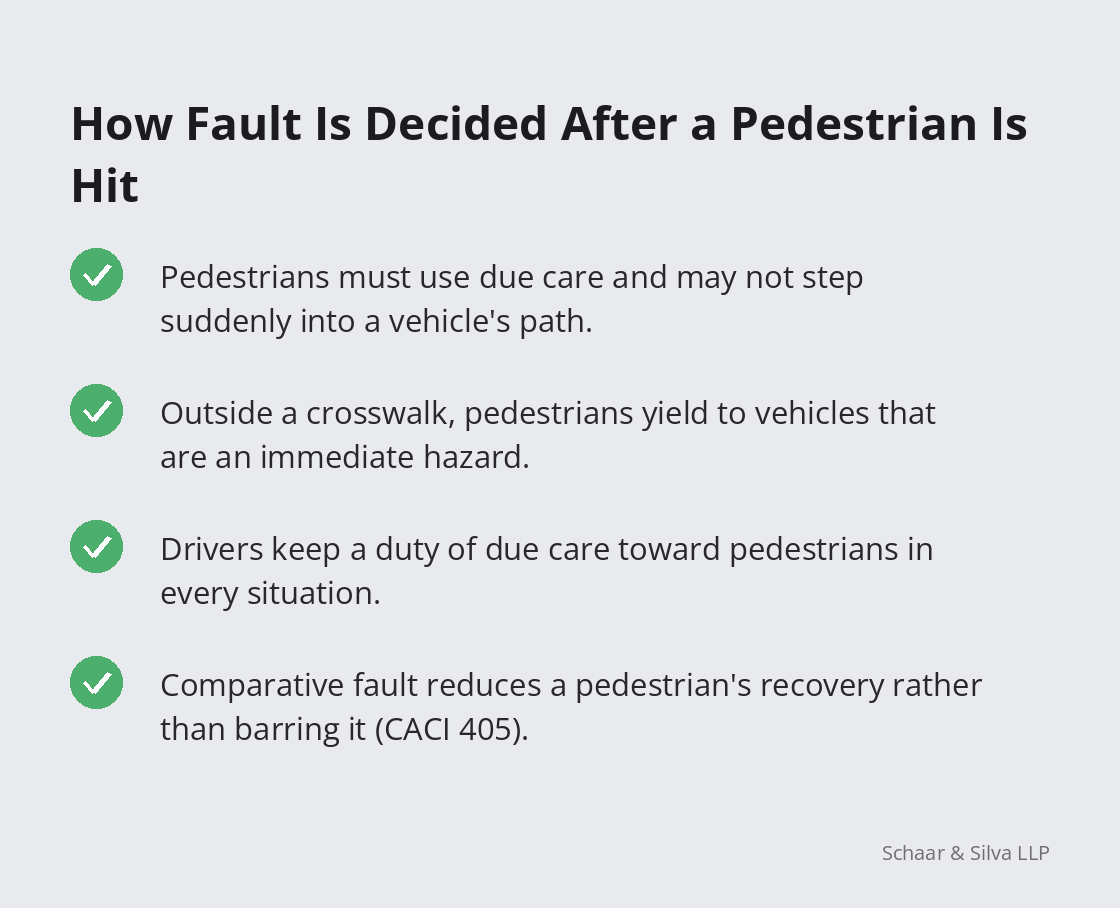
Vehicle Code 21954 provides that a pedestrian on a roadway at any point other than within a marked or unmarked crosswalk shall yield the right-of-way to vehicles so near as to constitute an immediate hazard. Vehicle Code 21955 adds that between adjacent intersections controlled by traffic signals or by police officers, pedestrians shall not cross the roadway except in a crosswalk. Those rules matter, but they are not the end of the analysis. Section 21954 states that it does not relieve the driver of the duty to exercise due care for the safety of any pedestrian on a roadway. Since January 1, 2023, these sections also say that an officer shall not stop a pedestrian for these violations unless a reasonably careful person would realize there is an immediate danger of a collision. Crossing mid-block can affect how fault is shared, but it does not give a driver permission to hit someone.
The Pedestrian’s Own Duty of Care
The law asks pedestrians to be careful too. Under Vehicle Code 21950, no pedestrian may suddenly leave a curb or other place of safety and walk or run into the path of a vehicle so close as to constitute an immediate hazard, and the section does not relieve a pedestrian from the duty of using due care for their own safety. The same statute is equally clear that this pedestrian duty does not relieve a driver from exercising due care for the safety of any pedestrian within a marked or unmarked crosswalk. Both sides carry responsibility, and the facts of each crash decide how that responsibility is divided.
Shared Fault Under California Law
California follows a comparative fault system. Under the Judicial Council’s civil jury instruction on comparative fault, CACI 405, if a jury finds that an injured person was partly responsible, that person’s damages are reduced by the percentage of their own responsibility rather than eliminated. A pedestrian who was partly at fault can still recover from a driver who was also at fault. California also limits how non-economic damages are shared among multiple defendants. Civil Code 1431.2 makes each defendant’s liability for non-economic damages, such as pain, suffering, and emotional distress, several only, in direct proportion to that defendant’s percentage of fault. That rule can matter when more than one driver or a vehicle owner shares responsibility for a crash.
Evidence That Shows What Really Happened
Because fault often turns on seconds and feet, evidence matters more in pedestrian cases than almost anywhere else. Video from storefront cameras, doorbell cameras, buses, and passing vehicles can show the signal phase, the driver’s speed, and where you were standing. Witnesses who were waiting at the same corner can confirm that you had the walk signal. The police report is often the first official record, and our guide on how to obtain and use an Oakland police report explains how to request it and what to look for. Photographs of the intersection, the crosswalk markings, and any obstructions such as parked trucks or overgrown landscaping can also help show why the driver should have seen you.
Mistakes That Can Weaken an Oakland Pedestrian Claim
Pedestrians are often more seriously hurt than anyone else involved in a crash, and the early days after an injury are rarely calm. That is exactly when a few avoidable missteps can make a strong claim harder to prove. Knowing what to watch for helps you protect both your health and your case.
Assuming You Have No Claim Because You Crossed Mid-Block
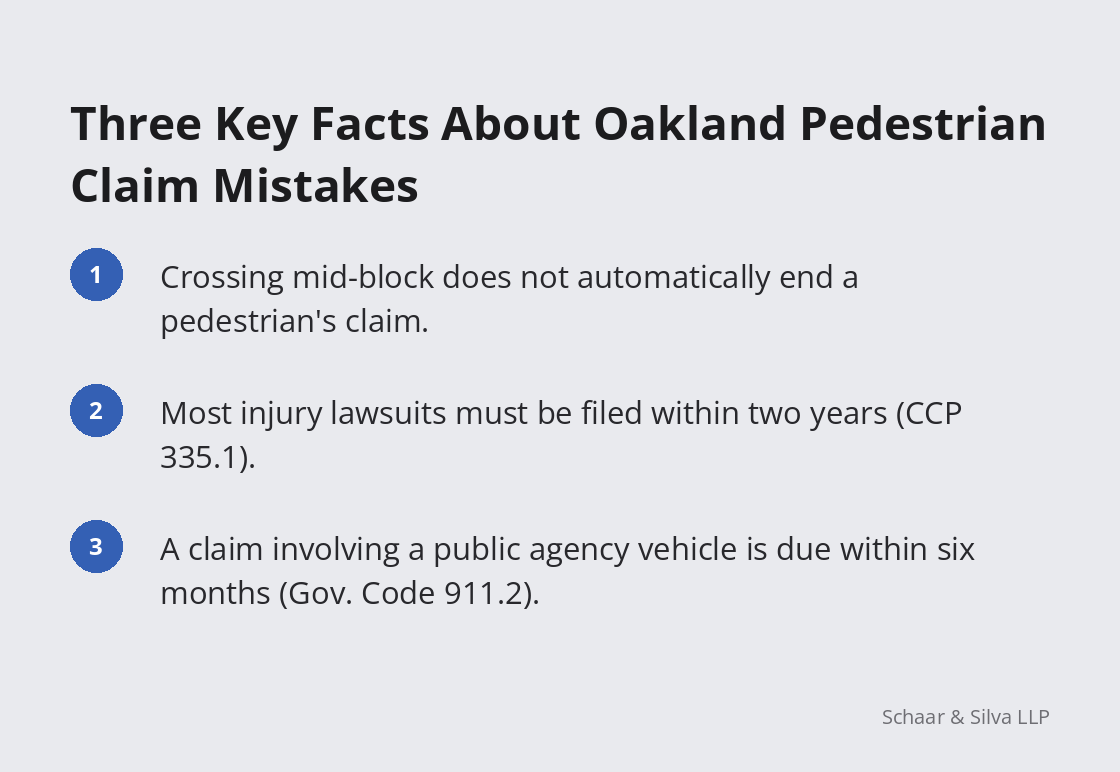
Some injured pedestrians never ask about their rights because they believe that crossing outside a crosswalk means the crash was entirely their fault. As explained above, California law keeps the driver’s duty of due care in place even when a pedestrian is outside a crosswalk, and comparative fault reduces rather than bars recovery. A driver who was speeding, distracted, or not watching the road may still bear a meaningful share of responsibility. It is better to have the facts reviewed than to rule out a claim on an assumption.
Letting a Hit-and-Run Driver Disappear Without a Record
Some drivers who strike a pedestrian do not stop. Vehicle Code 20001 requires the driver of a vehicle involved in an accident resulting in injury to another person to immediately stop at the scene and fulfill the information and assistance requirements of the code. When a driver flees, calling the police promptly and writing down everything you remember about the vehicle, including color, make, partial plate, and direction of travel, gives investigators the best chance to identify them. Depending on the terms of your own auto policy, coverage you already carry may also come into play, so it is worth reviewing your policy early.
Missing the Legal Deadlines
California generally gives injured people two years to file a lawsuit for a personal injury. Code of Civil Procedure 335.1 sets a two-year limit for an action for injury to, or for the death of, an individual caused by the wrongful act or neglect of another. If a public agency vehicle, such as a city truck or a transit bus, was involved, the timeline is much shorter. Government Code 911.2 requires a claim relating to a cause of action for death or for injury to a person to be presented not later than six months after the accrual of the cause of action. Waiting also allows video to be recorded over and witnesses to move on, even when a deadline is still months away.
Final Thoughts
An Oakland pedestrian accident can leave you facing serious injuries and an insurer that wants to focus on what you did instead of what the driver did. California’s crosswalk rules give pedestrians strong protection, and even when a pedestrian shares some of the responsibility, the law keeps the driver’s duty of care in view and reduces rather than eliminates recovery.
Getting medical care, preserving video and witness information, and keeping the filing deadlines in mind are the steps that protect your claim the most. With clear information about your rights, you can focus on healing while the facts of your case are secured.
If you were hit by a vehicle while walking anywhere in Oakland, contact Schaar & Silva LLP to speak with our team. We’ll review what happened, look at who was responsible, and help you take the next step with confidence. We serve Oakland and surrounding areas throughout the East Bay.