

A Santa Cruz County government vehicle accident can feel like any other crash in the moment, but the claim that follows plays by very different rules. If a county truck, a city work vehicle, a public transit bus, or another government-owned vehicle hit you, the deadlines are shorter, the paperwork is specific, and a missed step can close the door on compensation before you realize it was open.
At Schaar & Silva LLP, we help people across Santa Cruz County who have been hurt in car and truck accidents, including collisions with public vehicles. This guide walks you through how these claims actually work under California law, the steps that keep your claim alive, and the mistakes that most often derail them, so you can move forward with confidence.
How Government Vehicle Accident Claims Actually Work in Santa Cruz County
When a private driver causes a crash, you typically deal with that driver’s insurer and, if needed, file a lawsuit within the general time limit for injury cases. When the at-fault driver works for a public entity, California’s Government Claims Act steps in. That set of laws allows injured people to hold public entities responsible, but only if they follow a precise process before going to court.
Public Entities Can Be Held Responsible
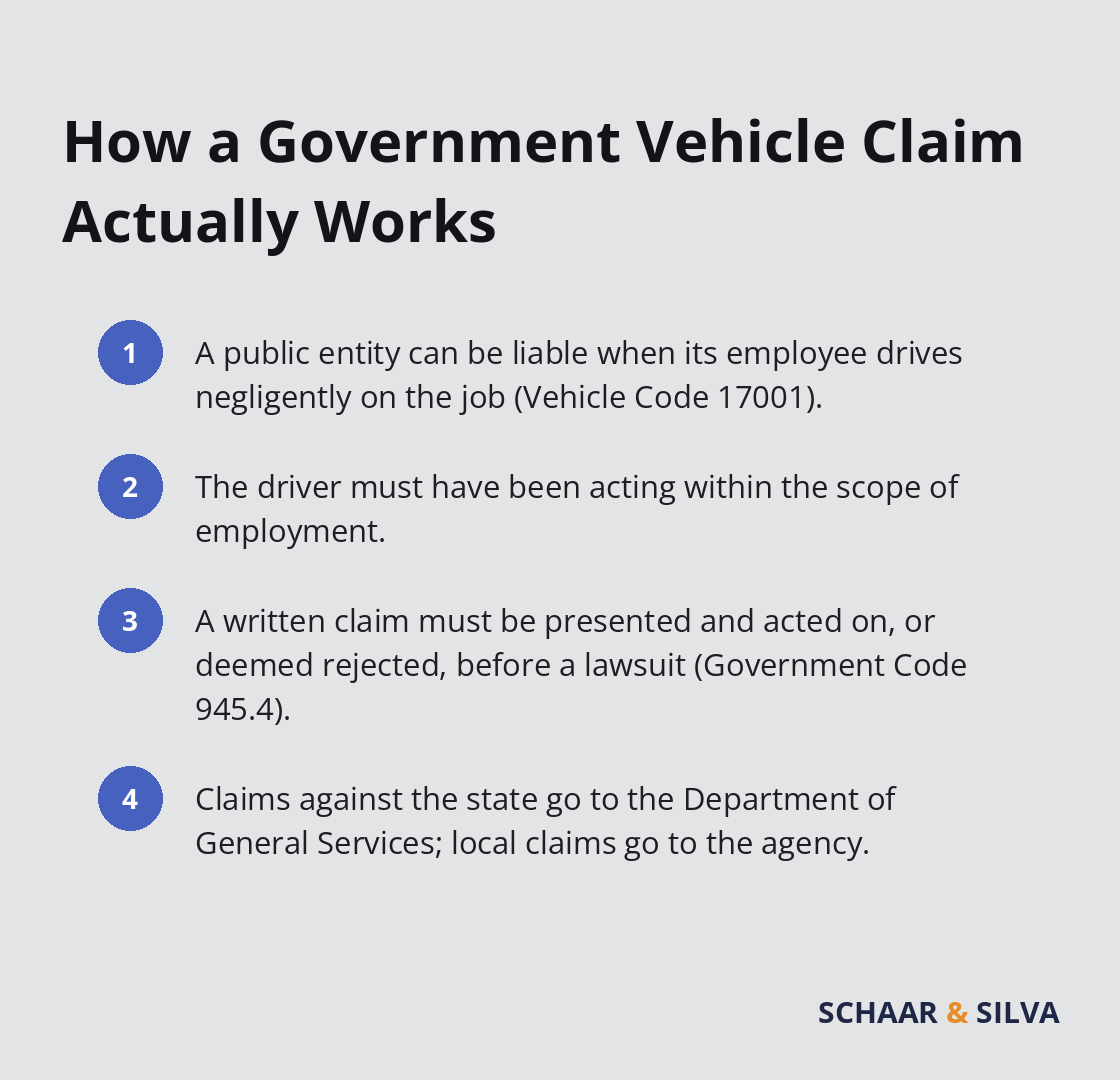
California does not give government agencies a free pass on the road. Vehicle Code 17001 provides that a public entity is liable for death or injury to person or property proximately caused by a negligent or wrongful act or omission in the operation of any motor vehicle by an employee of the public entity acting within the scope of employment. In plain terms, if a county maintenance driver ran a stop sign on the way to a job site, or a city employee rear-ended you while making an official trip, the agency itself can be responsible for the harm.
Why the Scope of Employment Matters
The key phrase in that statute is “acting within the scope of his employment.” A public employee who causes a crash while doing the agency’s work, such as driving a route, responding to a service request, or traveling between job sites, generally falls within this rule. A crash during a purely personal errand in a personal car may not. Establishing what the driver was doing and why they were behind the wheel often becomes one of the first questions in a government vehicle case, and records such as work logs, dispatch notes, and vehicle assignment sheets can help answer it.
The Claim Must Come Before the Lawsuit
The biggest difference from an ordinary car accident case is that you generally cannot sue a public entity right away. Government Code 945.4 provides that no suit for damages may be brought against a public entity on a cause of action that requires a claim until a written claim has been presented to the entity and acted upon by its board, or deemed rejected. The claim is not a formality. It is a legal gateway, and courts take its requirements seriously.
Evidence matters just as much as paperwork. Public vehicles are often equipped with GPS tracking, onboard cameras, or maintenance logs, and agencies keep records about driver assignments and training. Those records may not be kept forever, so identifying them early and asking that they be preserved can make a real difference. At the scene or soon after, photos of the vehicle’s markings, unit number, and license plate, along with the names of witnesses and the responding officer, help confirm which agency is involved. Your own medical records, starting with the first visit after the crash, connect your injuries to the collision and show how they have affected your daily life.
Steps to Protect a Claim Against a Public Agency
Because the process is so structured, the order and timing of each step matters. Thinking of the claim as a series of checkpoints helps keep everything on track, from the first days after the crash through the agency’s response and, if necessary, a lawsuit.
Meeting the Six-Month Claim Deadline
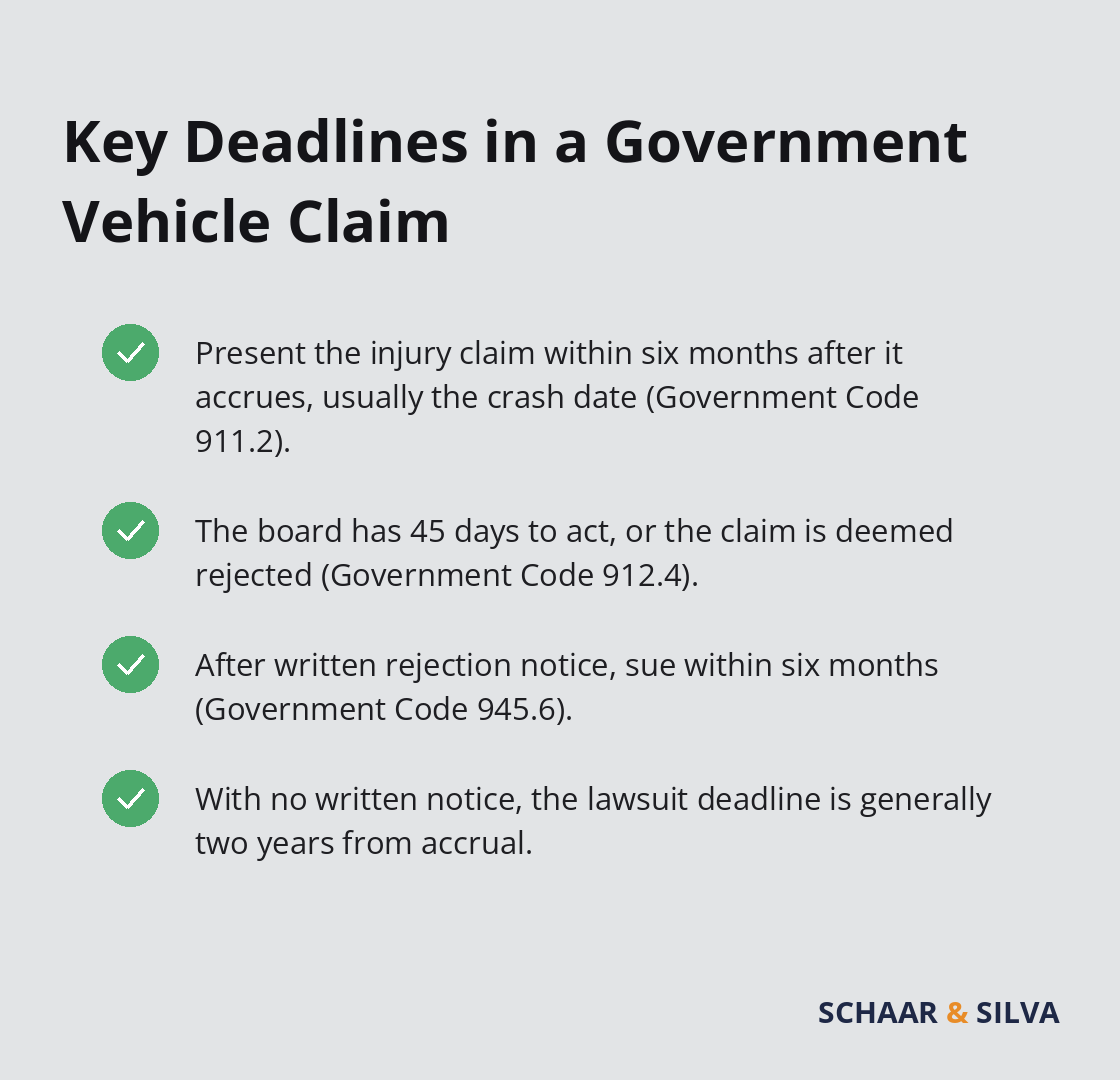
Government Code 911.2 requires a claim relating to a cause of action for death or for injury to a person to be presented not later than six months after the cause of action accrues. For most crash victims, that means the clock starts on the day of the collision. Six months passes quickly when you are attending medical appointments, dealing with vehicle repairs, and trying to get back to work. Starting the claim early also gives you time to confirm exactly which agency owns the vehicle, because a city, the county, a transit district, and a state agency are all separate public entities with separate claim procedures.
Including the Right Information
Government Code 910 spells out what a claim must show. That includes the claimant’s name and post office address, the address where notices should be sent, the date, place, and other circumstances of the occurrence, a general description of the injury, damage, or loss known at the time, and the names of the public employees who caused the injury, if known. Under Government Code 915, a claim to a local public entity can be delivered to its clerk, secretary, or auditor, or mailed to one of them or to its governing body at its principal office. A claim with missing details or sent to the wrong place can create avoidable disputes, so precision at this stage pays off later.
What Happens After the Claim Is Filed
Once the claim is presented, Government Code 912.4 gives the board 45 days to act on it. If the board fails or refuses to act within that period, the claim is deemed rejected on the last day of the period. The claimant and the board can agree in writing to extend the time. From there, Government Code 945.6 sets the lawsuit deadline: if the entity gives written notice of rejection, the suit generally must be filed not later than six months after that notice is personally delivered or mailed; if no written notice is given, the suit generally must be filed within two years from the accrual of the cause of action. These are short windows, and tracking them carefully is essential.
Mistakes That Derail Government Vehicle Claims
Many government vehicle claims fail not because the agency’s driver was blameless, but because the injured person did not know the rules in time. A few recurring mistakes account for most of the trouble, and each one is avoidable with early attention.
Treating It Like an Ordinary Insurance Claim
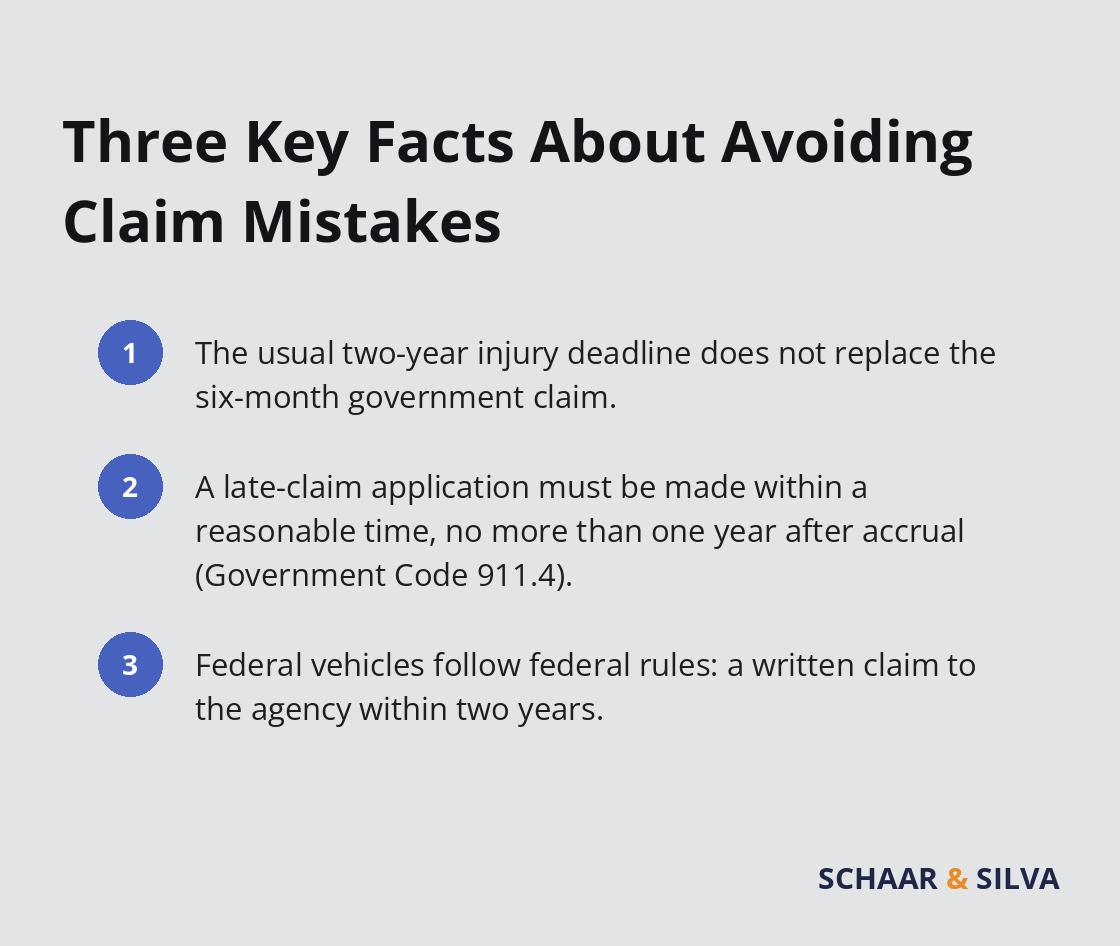
People often assume they have two years to sort things out because that is the general rule for injury lawsuits under Code of Civil Procedure 335.1. With a public entity, that assumption is dangerous. Waiting to see how treatment goes, or trading calls with an adjuster or risk manager, can let the six-month claim window close. Talking with the agency’s representatives does not replace the written claim the law requires.
Missing the Late-Claim Option
If the six-month deadline has already passed, the situation may not be hopeless. Government Code 911.4 allows a written application to the public entity for leave to present a late claim. The application must be presented within a reasonable time not to exceed one year after the accrual of the cause of action, must state the reason for the delay, and must have the proposed claim attached. This is a narrow path with its own requirements, which is why acting as soon as possible is far better than relying on it.
Overlooking Who Owns the Vehicle
Not every official-looking vehicle belongs to a local agency. A truck may be operated by a private contractor working for the county, in which case an ordinary claim against the contractor and its insurer may apply instead. A vehicle may belong to a state department, and under Government Code 915 claims against the state are presented to the Department of General Services rather than to a local clerk. Federal vehicles follow federal law entirely: under 28 U.S.C. 2401(b), a tort claim against the United States must be presented in writing to the appropriate federal agency within two years after the claim accrues. Identifying the correct owner early, through the police report, photos of markings and plates, and witness accounts, keeps the claim aimed at the right target.
Final Thoughts
A crash with a government vehicle in Santa Cruz County raises the same injuries and disruptions as any other collision, but the legal path to compensation is narrower and faster. Public entities can be held responsible when their employees drive negligently, yet the law expects you to present a proper written claim within six months, wait for the agency’s response, and then meet a second set of deadlines before a lawsuit can proceed.
The good news is that these rules are predictable once you know them. Gathering the police report, photos, medical records, and the details of the vehicle and its driver, and getting the claim in early, puts you in a far stronger position than waiting for the agency to make the first move.
If you were hurt in a collision with a county, city, or other public vehicle, contact Schaar & Silva LLP for a case evaluation. We’ll review your situation, help you meet every deadline, and guide you through each step. We serve Santa Cruz County and surrounding areas.