

A Sacramento truck accident lawyer can help you make sense of what happens after a collision with a commercial truck, tractor-trailer, or other large commercial vehicle. These crashes often involve more vehicles, more serious injuries, and more layers of responsibility than an ordinary car wreck, and the first days after the collision shape the strength of any later claim.
At Schaar & Silva LLP, we help people across Sacramento and throughout California navigate personal injury claims after car and truck crashes. This guide explains how liability is actually analyzed in big-rig cases, how a claim is built, and the mistakes that commonly weaken a Sacramento truck accident case. Understanding those pieces early helps you protect your health, preserve evidence, and avoid giving an insurer an incomplete story before your medical picture is clear.
What a Sacramento Truck Accident Case Actually Involves
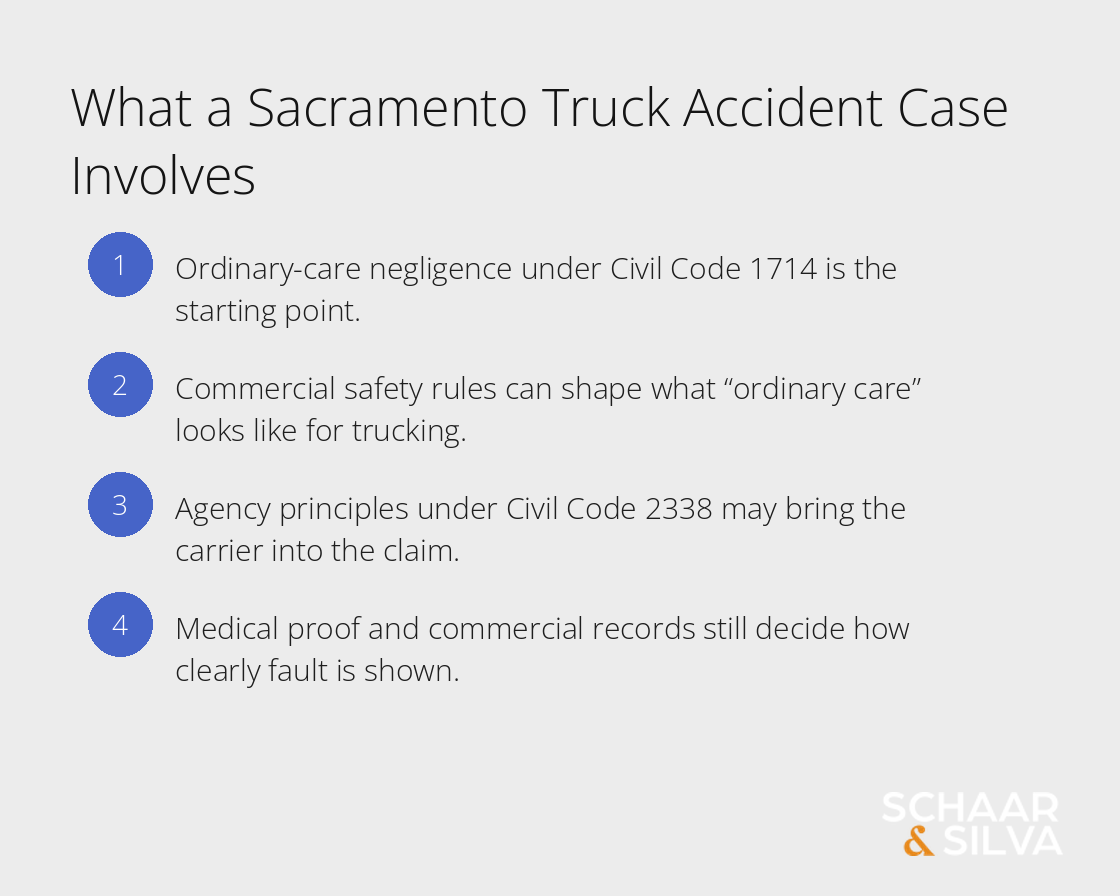
Most personal injury claims in California start from a basic negligence rule. Civil Code section 1714(a) says that everyone is responsible not only for willful acts, but also for an injury caused to another by a want of ordinary care or skill in the management of person or property, except so far as the injured person brought the injury on by willful misconduct or want of ordinary care. In a Sacramento truck crash, that ordinary-care question often expands beyond a single driver. Investigators look at the truck driver, the motor carrier, maintenance practices, cargo loading, hours-of-service compliance, and sometimes other road users.
Commercial trucking also sits under a safety framework that ordinary passenger cases do not. California Vehicle Code section 34501 directs the Department of the California Highway Patrol to adopt rules designed to promote the safe operation of covered commercial vehicles, including rules on hours of service, equipment, inspection, maintenance, recordkeeping, and accident reports. Separately, many interstate and certain other commercial operations are also governed by federal motor carrier safety rules. Those overlapping standards matter because they create concrete expectations for how a commercial driver and carrier are supposed to operate before a crash ever occurs.
Why Commercial Trucks Create Different Liability Questions
A loaded tractor-trailer can weigh many times more than a passenger car. Stopping distances grow, blind spots widen, and the force of impact can turn a routine lane change into a catastrophic injury event. Those physical realities do not change the legal standard by themselves, but they change the evidence you need. Electronic logging data, inspection reports, dispatch records, and maintenance files often become as important as the police report. A Sacramento truck accident lawyer looks for that commercial paper trail early because carriers and insurers move quickly to control it. The same crash that looks straightforward at the roadside can look very different once dispatch notes, prior inspection failures, and driver logs are compared against the official narrative.
Driver Negligence Is Only One Layer
Fatigue, distraction, speeding, unsafe lane changes, and failure to yield still appear in truck cases just as they do in car cases. The difference is that a commercial driver’s conduct may also be measured against company policies and commercial safety rules. If a driver was operating outside permitted hours, driving with known equipment defects, or following dispatch pressure that conflicted with safe operation, those facts can support the negligence analysis under Civil Code section 1714 even when the crash narrative initially looks like a simple lane-change dispute.
Employer and Carrier Responsibility Through Agency Principles
California Civil Code section 2338 provides that a principal is generally responsible to third persons for the negligence of an agent in the transaction of the business of the agency, including wrongful acts committed by the agent as part of that business. In many truck cases, that principle is why the motor carrier, not only the individual driver, can face responsibility when the driver was acting within the scope of the work. Sorting employee drivers from independent-contractor arrangements and identifying every company that controlled the load, the trailer, or the route is part of understanding who may share legal responsibility.
How a Sacramento Truck Accident Claim Is Actually Built
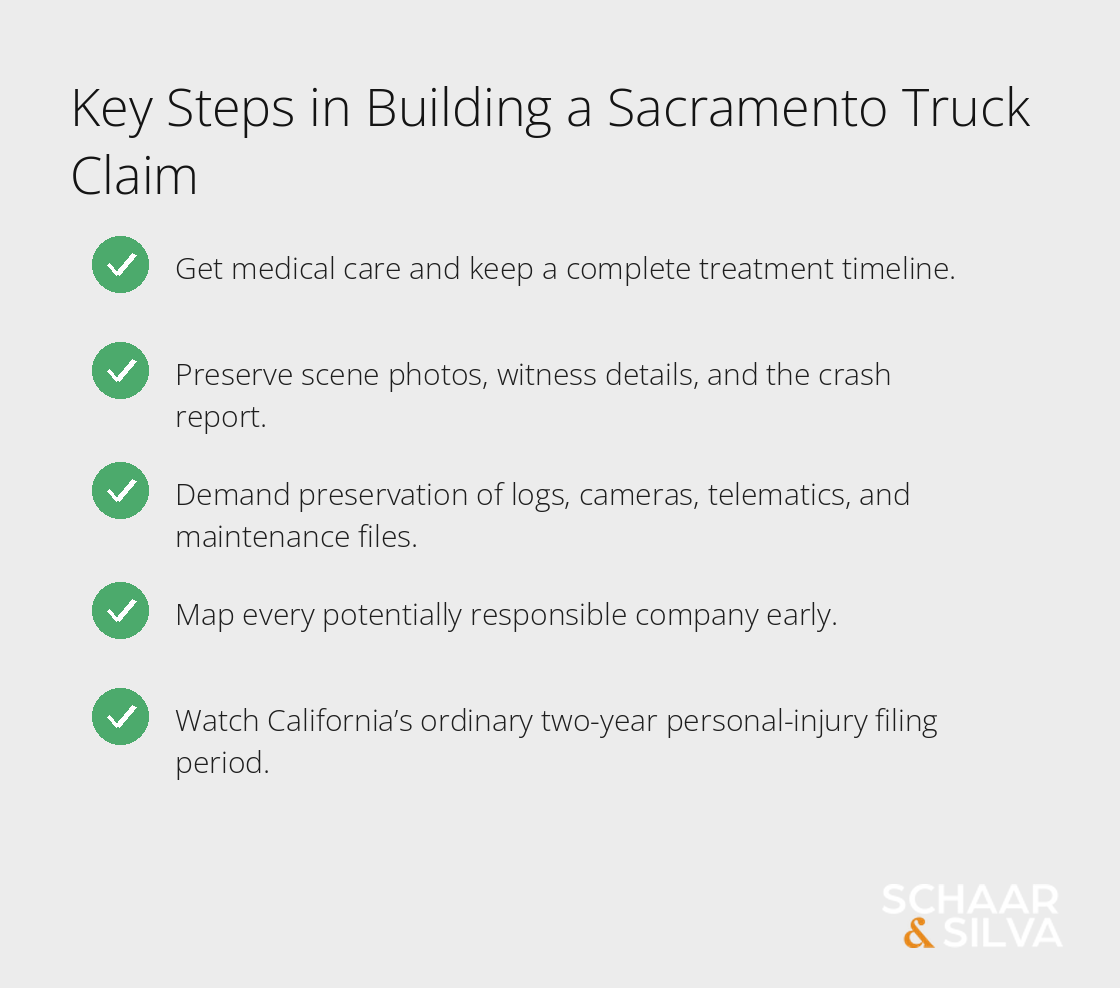
A workable claim is built on medical proof, scene evidence, commercial records, and timing. Sacramento County victims often deal with emergency care first, then insurance notices, then the realization that a trucking company already has investigators in the field. The legal standards above are only the framework. The quality of the record still decides how clearly fault, causation, and damages can be shown.
Medical Care Creates the Injury Timeline
Truck crashes commonly involve fractures, traumatic brain injuries, spinal injuries, internal trauma, and lasting functional limits. Prompt medical evaluation documents what happened and when. Keep discharge papers, imaging reports, therapy notes, work-status slips, and photographs of visible injuries over time. Insurers look for a clear path from the collision to the harm being claimed. Gaps in treatment make that path harder to prove even when liability looks strong on paper.
Preserve the Scene, Vehicles, and Commercial Data
When it is safe to do so, identify witnesses, photograph vehicle positions, skid marks, debris fields, road conditions, and any visible truck markings such as USDOT numbers or company names. Request the crash report and note every responding agency. Just as important, put trucking companies and insurers on notice that electronic logging data, dash-camera footage, telematics, maintenance files, and driver qualification records need to be preserved. Those materials can disappear or be overwritten if nobody asks for them promptly.
Map Every Potentially Responsible Party
A Sacramento truck crash may involve the driver, the motor carrier, a trailer owner, a cargo loader, a maintenance contractor, or another motorist. Civil Code section 2338 helps explain why a principal can answer for an agent’s negligence in the course of the agency’s business, but the facts still have to show who controlled what. Identifying the correct defendants early prevents a claim from focusing only on an underinsured individual driver while overlooking the company that directed the trip. In Sacramento County and surrounding corridors that carry heavy freight traffic, that mapping step often separates a complete claim from a narrowed one.
California’s Filing Deadline Is Easy to Miss While You Recover
Code of Civil Procedure section 335.1 generally requires an action for injury to an individual caused by the wrongful act or neglect of another to be filed within two years. That two-year period is the ordinary personal-injury deadline many truck-crash lawsuits must meet. Settlement talks, medical holds, and slow insurance correspondence do not automatically pause the clock. Early calendar control is part of claim building, not an afterthought for later.
What Commonly Derails Sacramento Truck Accident Claims
Even when negligence principles and commercial safety rules look favorable on paper, practical mistakes still damage otherwise strong cases. The problems usually come from incomplete medical proof, lost commercial evidence, oversimplified fault assumptions, or delay. Sacramento victims who treat the first week as only a medical emergency, and not also as the start of a claim file, often spend months reconstructing facts that were easier to capture right after the crash.
Assuming the Truck Driver Is the Only Defendant Who Matters
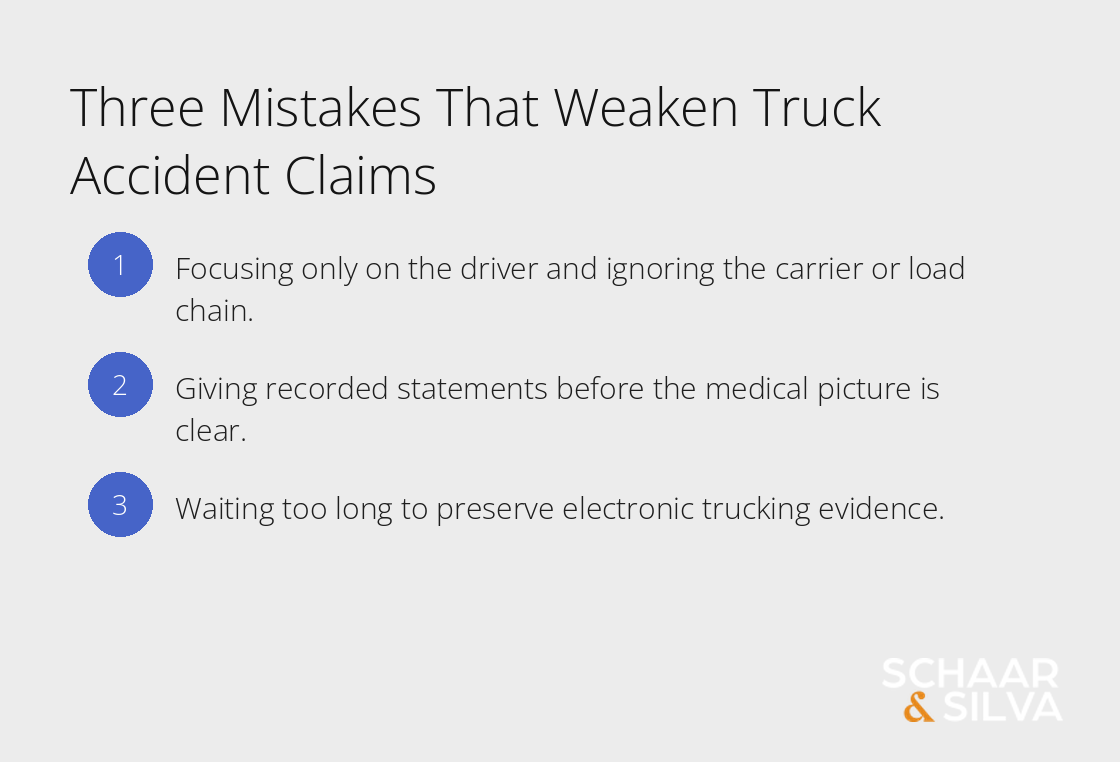
Focusing only on the person behind the wheel can shrink a claim before the full commercial picture is known. Carrier policies, maintenance failures, loading decisions, and dispatch practices may all belong in the analysis. Overlooking those layers can leave you negotiating against incomplete insurance coverage or an incomplete set of responsible parties.
Giving Recorded Statements Before the Medical Picture Is Clear
Truck insurers often request recorded statements early, before imaging is complete and before you understand how injuries will affect work and daily life. Comparative-fault arguments can also appear quickly. Under Civil Code section 1431.2, liability for non-economic damages in personal-injury actions based on comparative fault is several only, and each defendant is liable for non-economic damages in proportion to that defendant’s percentage of fault. Precise wording about speed, lane position, visibility, and your own conduct matters. Speculative answers given while you are still in pain can create inconsistencies that are hard to unwind.
Waiting Too Long to Preserve Trucking Evidence
Electronic logs, camera footage, and telematics are not permanent. If a preservation demand goes out late, key minutes of data may already be gone. Waiting to see whether a minor-looking injury worsens, or hoping the trucking company’s insurer will simply do the right thing, can quietly erase the commercial evidence that separates a truck case from an ordinary car claim. A careful sequence—medical care, evidence preservation, then informed communication—protects the claim better than rushing to close the file.
Final Thoughts
A Sacramento truck accident lawyer helps you connect California’s negligence rules, commercial safety expectations, and practical claim-building steps into one coherent plan. Civil Code section 1714 frames ordinary care, Civil Code section 2338 helps explain when a principal may answer for an agent’s negligence, Vehicle Code section 34501 reflects California’s commercial-vehicle safety regulatory role, and Code of Civil Procedure section 335.1 generally gives injured people two years to file. Medical records, commercial data, and careful handling of insurer contact still decide how clearly that framework can be applied.
If you were hurt in a truck or commercial-vehicle crash in Sacramento or elsewhere in California and need help understanding your options, contact Schaar & Silva LLP to speak with our team. We will review what happened, explain how California personal injury rules may apply to your situation, and help you take a practical next step.