

A car accident can leave you facing medical bills, lost income, and pain that lingers for months. Many people don’t realize their insurance coverage has limits that might not be enough to cover these costs.
Bodily injury limits in California determine the maximum amount your insurance will pay for injuries you cause to others. At Schaar & Silva LLP, we’ve seen how inadequate coverage can devastate families financially when accidents happen.
Understanding California’s Bodily Injury Limits
What Bodily Injury Liability Coverage Means
Bodily injury liability coverage pays for injuries you cause to other people when you’re at fault in an accident. In California, this isn’t optional-it’s required by law. The state mandates minimum coverage of $15,000 per person and $30,000 per accident, according to California’s Department of Insurance. These minimums apply to every driver, yet they’re dangerously low. A single emergency room visit costs $10,000 to $15,000 before imaging, specialist consultations, or surgery.
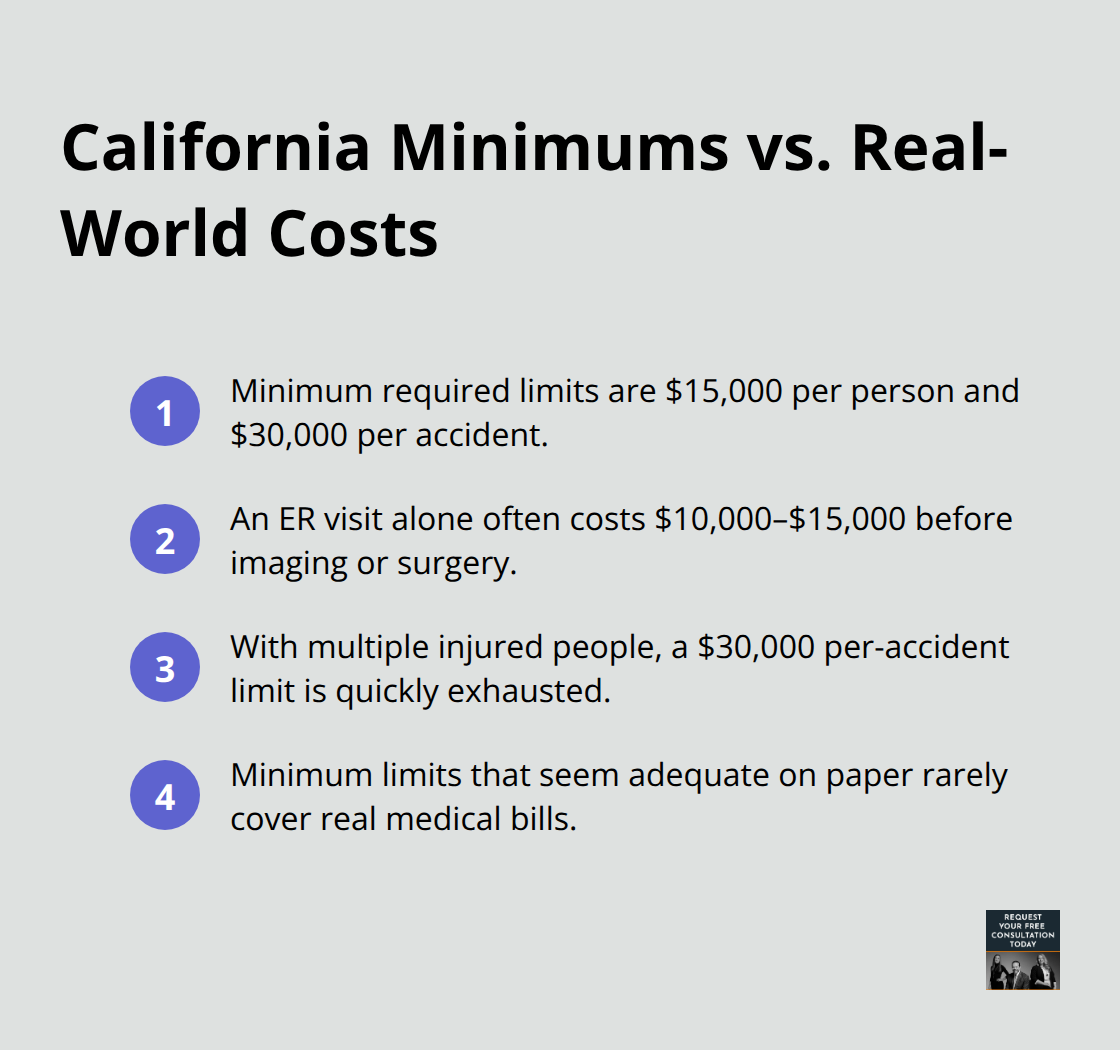
If you cause an accident injuring multiple people, that $30,000 limit disappears fast.
How Your Coverage Limits Work in Practice
When you cause an accident, your insurance company pays medical bills, lost wages, and pain and suffering claims up to your policy limit. Once that limit is reached, you personally become liable for anything beyond it. In Santa Cruz County, where medical costs run high and many residents live paycheck to paycheck, this creates serious financial exposure. A 40-year-old earning $50,000 annually who causes an accident injuring someone could face years of lost wages compensation alone. California courts regularly award $100,000 to $500,000 in personal injury cases involving significant injuries, according to data from the American Association for Justice.
The Real Cost of Minimum Coverage
If your bodily injury limit is only $15,000, you’re responsible for the remaining $85,000 to $485,000. This is why carrying minimum coverage is a financial decision most people later regret. Higher limits, typically $100,000 per person and $300,000 per accident, cost only slightly more in premiums but protect your home, car, and future earnings from creditors pursuing judgment claims. The difference in monthly insurance costs between minimum and adequate coverage often amounts to just $10 to $20, yet that small investment shields you from catastrophic financial exposure. When an accident happens, the gap between what your insurance covers and what courts award can devastate your financial future for years.
What Damages Does Your Coverage Actually Pay For
Bodily injury liability coverage pays for three main categories of losses when you’re at fault in an accident. Understanding what each category covers helps you see why minimum limits create serious problems. Medical expenses represent the most obvious cost, but they’re only part of the picture.
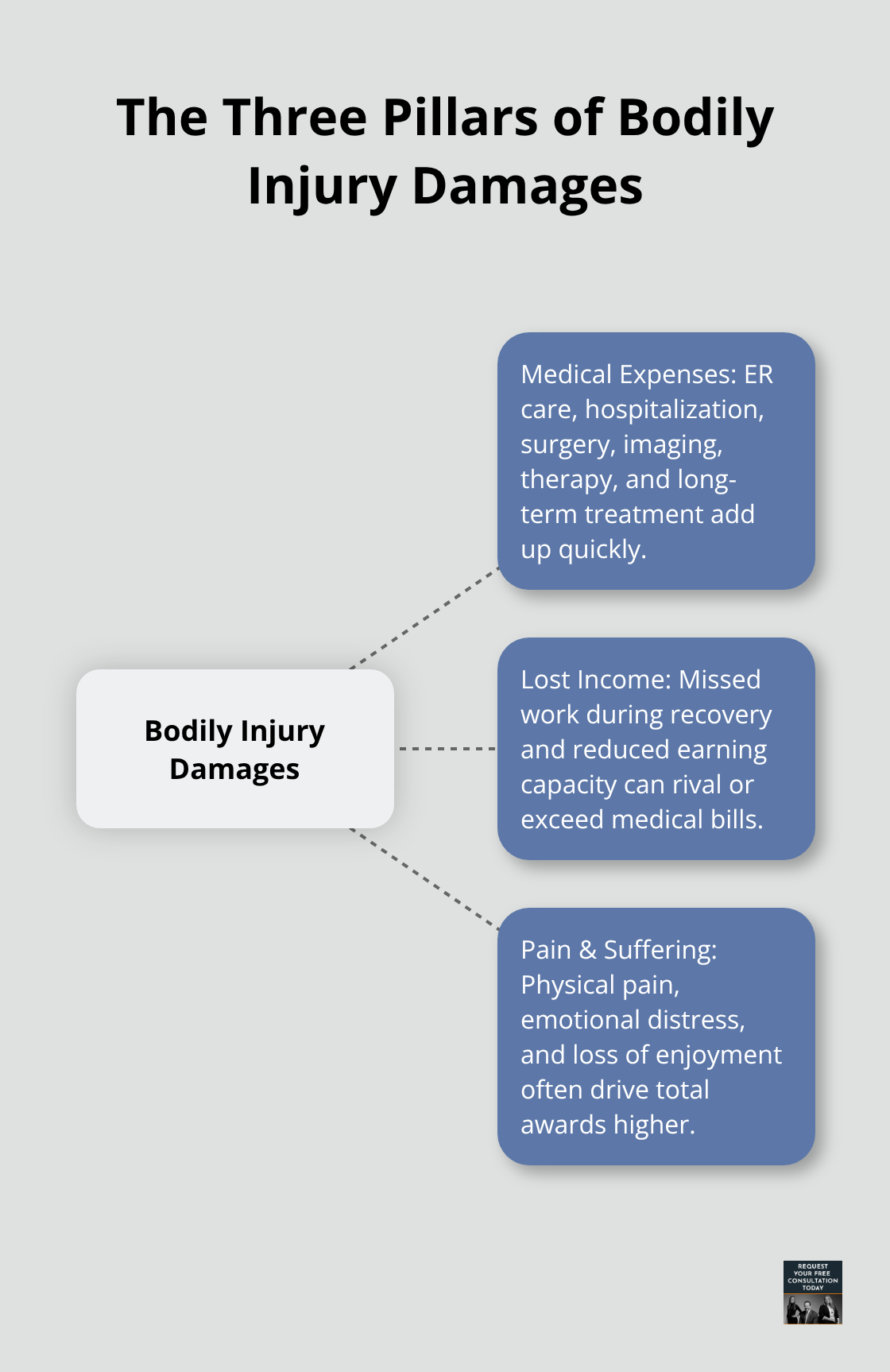
Lost wages and pain and suffering claims often exceed medical bills, which is why so many accident victims end up financially devastated despite having insurance.
Medical Bills Go Far Beyond the Emergency Room
When someone is injured in an accident you cause, your bodily injury coverage pays their medical treatment costs from day one. This includes emergency room visits, hospital stays, surgeries, imaging like MRIs and CT scans, physical therapy, and ongoing specialist care. The average emergency room visit costs between $10,000 and $15,000, according to data from the American Hospital Association. Add surgery and you’re looking at $50,000 to $100,000 quickly. A serious spinal injury requiring surgery and six months of physical therapy easily reaches $150,000. With California’s minimum $15,000 per person limit, you’d personally owe $135,000 to $150,000 just for medical costs. Prescription medications, home health care, and mental health treatment after trauma add thousands more. Insurance companies also pay for future medical care related to the injury, which means ongoing treatment for chronic pain or complications can push total medical claims to $200,000 or higher in serious cases.
Lost Income Claims Mount Quickly After Serious Injuries
A person injured in an accident you caused can claim lost wages from the day of injury through recovery and beyond. If someone earns $60,000 annually and misses three months of work, that’s $15,000 in lost wages alone. More serious injuries mean longer recovery periods. Someone with a broken leg might miss eight weeks; someone with a spinal injury might miss six months or more. A 45-year-old earning $80,000 annually who misses six months of work loses $40,000 in income. These wage losses stack on top of medical bills, not instead of them.
Pain and Suffering Awards Often Dwarf Medical Expenses
California courts award pain and suffering compensation, which is separate from medical bills and lost wages. Pain and suffering covers physical pain, emotional distress, loss of enjoyment of life, and permanent scarring or disfigurement. According to the American Association for Justice, California personal injury cases involving significant injuries typically result in awards between $100,000 and $500,000 total. A case involving permanent nerve damage, chronic pain, or partial disability often exceeds $300,000. With your $15,000 minimum limit, the injured person’s attorney will pursue you personally for the remaining $285,000 to $485,000. Wage garnishment, property liens, and judgment creditors can follow you for years.
Why Higher Limits Protect Your Financial Future
Higher coverage limits of $100,000 per person and $300,000 per accident cost only $10 to $20 more monthly but eliminate this catastrophic exposure. That small premium increase shields your home, car, and future earnings from creditors pursuing judgment claims. The financial protection you gain far outweighs the modest cost difference. When you understand how medical bills, lost wages, and pain and suffering claims combine in real accidents, the inadequacy of minimum coverage becomes impossible to ignore. This is precisely why Santa Cruz County residents face such serious financial risk with state-mandated minimums. The next section examines how underinsured motorist protection works and why it matters when the at-fault driver carries insufficient coverage.
Why Bodily Injury Limits Matter in Santa Cruz County
Financial Reality for Santa Cruz County Residents
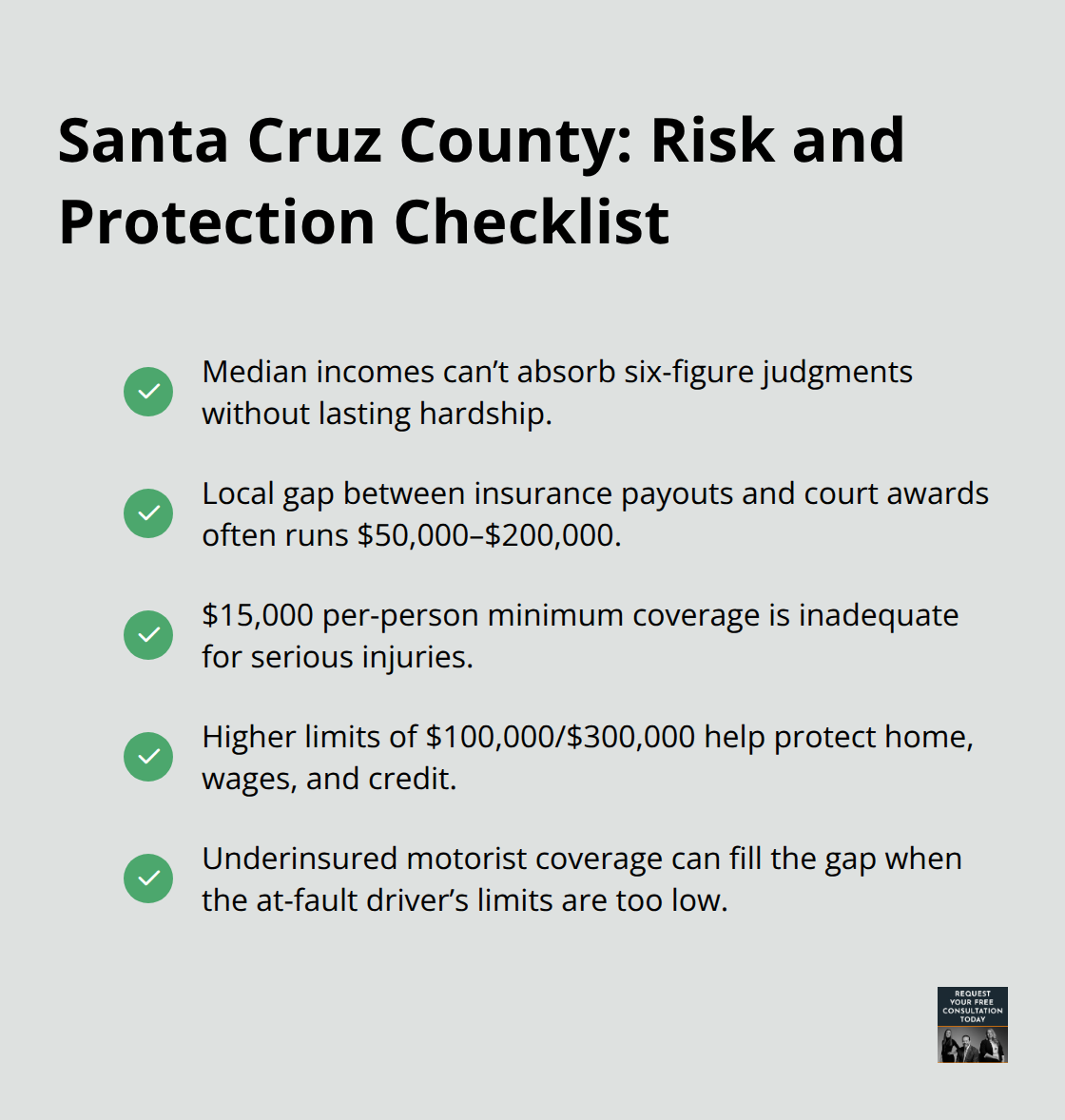
Santa Cruz County residents face a specific financial reality that makes adequate bodily injury coverage a question of survival, not preference. The county’s median household income sits around $85,000 annually, according to U.S. Census data, which means most families lack the reserves to absorb a six-figure judgment. When someone causes an accident here and carries only California’s minimum $15,000 per person limit, they’re essentially gambling with their home and future earnings. A single serious accident triggers wage garnishment for years, property liens that follow you through refinancing attempts, and creditor judgments that destroy your credit score. A moment of inattention on Highway 1 or a misjudged turn in downtown Santa Cruz creates financial consequences that echo through someone’s life for a decade. The gap between what insurance pays and what courts award in Santa Cruz County cases typically ranges from $50,000 to $200,000 for moderate to serious injuries, leaving drivers personally liable for amounts they cannot possibly pay.
How Underinsured Motorist Protection Works
Underinsured motorist protection becomes your only real defense when the person who hits you carries insufficient coverage, but most Santa Cruz County residents don’t understand how this works or whether they actually have it. If you’re injured by a driver with minimum limits and your damages exceed their coverage, your own underinsured motorist protection kicks in to cover the difference, up to your policy limit. However, you must carry underinsured motorist coverage equal to or higher than your bodily injury limits for this to work effectively. Many people skip this coverage to save money, then discover after an accident that they’re stuck pursuing a judgment against someone who owns nothing and earns little.
Long-Term Financial Consequences of Insufficient Coverage
The long-term consequences of insufficient coverage extend far beyond immediate financial pain. Someone with permanent nerve damage from a serious accident faces years of medical treatment, chronic pain management, and lost earning potential. When the at-fault driver’s insurance maxes out at $15,000, that injured person’s medical costs, lost wages, and pain and suffering claims continue accumulating. If you’re the at-fault driver, creditors can garnish your wages indefinitely in California, attach liens to your home, and pursue collection for years. This is why carrying $100,000 per person and $300,000 per accident limits represents basic financial self-defense in Santa Cruz County, not excess caution. The monthly premium difference of $10 to $20 becomes irrelevant when you understand that one accident can cost you $300,000 or more in personal liability.
Final Thoughts
Bodily injury limits in California determine whether one accident destroys your financial future or leaves you protected. The state’s minimum coverage of $15,000 per person and $30,000 per accident exposes you to personal liability that regularly exceeds $100,000 in real cases. Santa Cruz County residents earning modest incomes face wage garnishment, property liens, and judgment creditors pursuing them for years when they carry inadequate coverage.
Increasing your limits to $100,000 per person and $300,000 per accident costs only $10 to $20 monthly but shields your home, car, and future earnings from catastrophic exposure. If you’ve already been in an accident, the financial consequences can feel overwhelming as medical bills arrive, lost wages pile up, and insurance companies offer settlements that fall short of your actual damages. Schaar & Silva LLP helps accident victims in Santa Cruz County navigate the complex process of recovering fair compensation and connecting with the support services you need during recovery.
Contact us today to discuss your situation and understand your options for protecting your financial future.