

A car accident can leave you with a shoulder injury that affects your work, daily life, and finances. The path to a fair shoulder injury settlement requires understanding what damages you can claim and how insurance companies calculate them.
At Schaar & Silva LLP, we help accident victims in Santa Cruz County, Sacramento, and Oakland get the compensation they deserve. This guide walks you through the types of shoulder injuries, how to calculate your damages, and strategies for negotiating with insurers.
What Shoulder Injuries Result From Car Crashes
Car accidents produce specific types of shoulder injuries depending on the force and direction of impact. Rotator cuff tears and strains occur when the tendons around your shoulder socket stretch or rip, often from the sudden jerking motion during a collision. These injuries range from minor inflammation to complete tears that require surgery. According to the American Academy of Orthopaedic Surgeons, rotator cuff tears affect approximately 2 million Americans annually, and car accidents account for a significant portion of acute cases. Shoulder dislocations happen when the ball of your shoulder joint pops out of its socket, which can result from direct impact or when your arm gets wrenched backward during a crash. Subluxations are partial dislocations where the shoulder slides out temporarily before moving back into place, often causing ongoing instability. Fractures to the collarbone, shoulder blade, or upper arm bone frequently result from direct trauma or your body bracing against the steering wheel or dashboard.
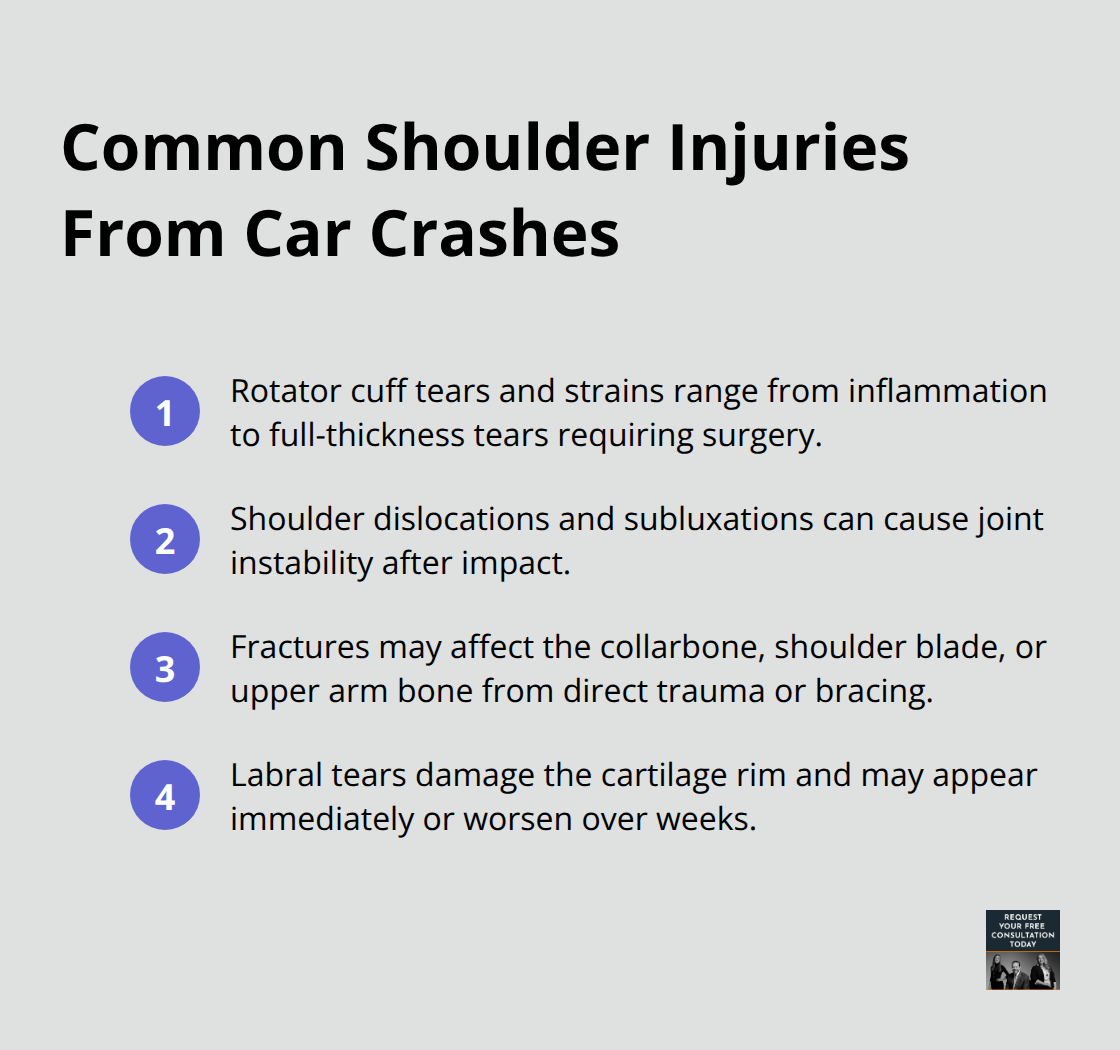
Labral tears involve damage to the cartilage rim surrounding the shoulder socket, which can develop immediately after impact or gradually worsen over weeks following the accident.
Initial Pain Masks Serious Damage
Many people underestimate shoulder injuries because initial pain can be manageable with ice and rest. However, imaging studies like MRI scans often reveal damage that worsens without proper treatment. A tear that seems minor in week one can become severely debilitating by month three if you continue using the shoulder normally. This delayed progression matters significantly for settlement calculations because your medical records must document the full extent of injury, not just what you felt on accident day. Getting imaging done within the first two weeks after your accident creates a clear baseline for your injury claim.
Treatment Costs Add Up Quickly
Physical therapy typically costs between $3,000 and $12,000 for shoulder injuries, depending on severity and duration. Surgical repair for rotator cuff tears ranges from $20,000 to $40,000 when including anesthesia and facility fees. Some injuries require multiple surgeries if initial repairs fail or complications develop. Insurance companies often argue that conservative treatment should work first, which means they’ll push back against surgery costs unless your medical providers document why surgery is medically necessary. Having your orthopedic surgeon clearly state in writing why non-surgical treatment would be inadequate strengthens your settlement position significantly.
Understanding these injury types and their treatment expenses forms the foundation for calculating what your shoulder injury claim is actually worth.
What Your Shoulder Injury Claim Is Actually Worth
Medical Expenses Form Your Claim’s Foundation
Calculating your settlement requires adding up three distinct categories of damages, and most accident victims significantly underestimate at least one of them. Medical expenses form the foundation of your claim, but they extend far beyond the bills you’ve already received. If you had a rotator cuff tear requiring surgery, your immediate costs might total $35,000 for the procedure itself, but that’s only the beginning.
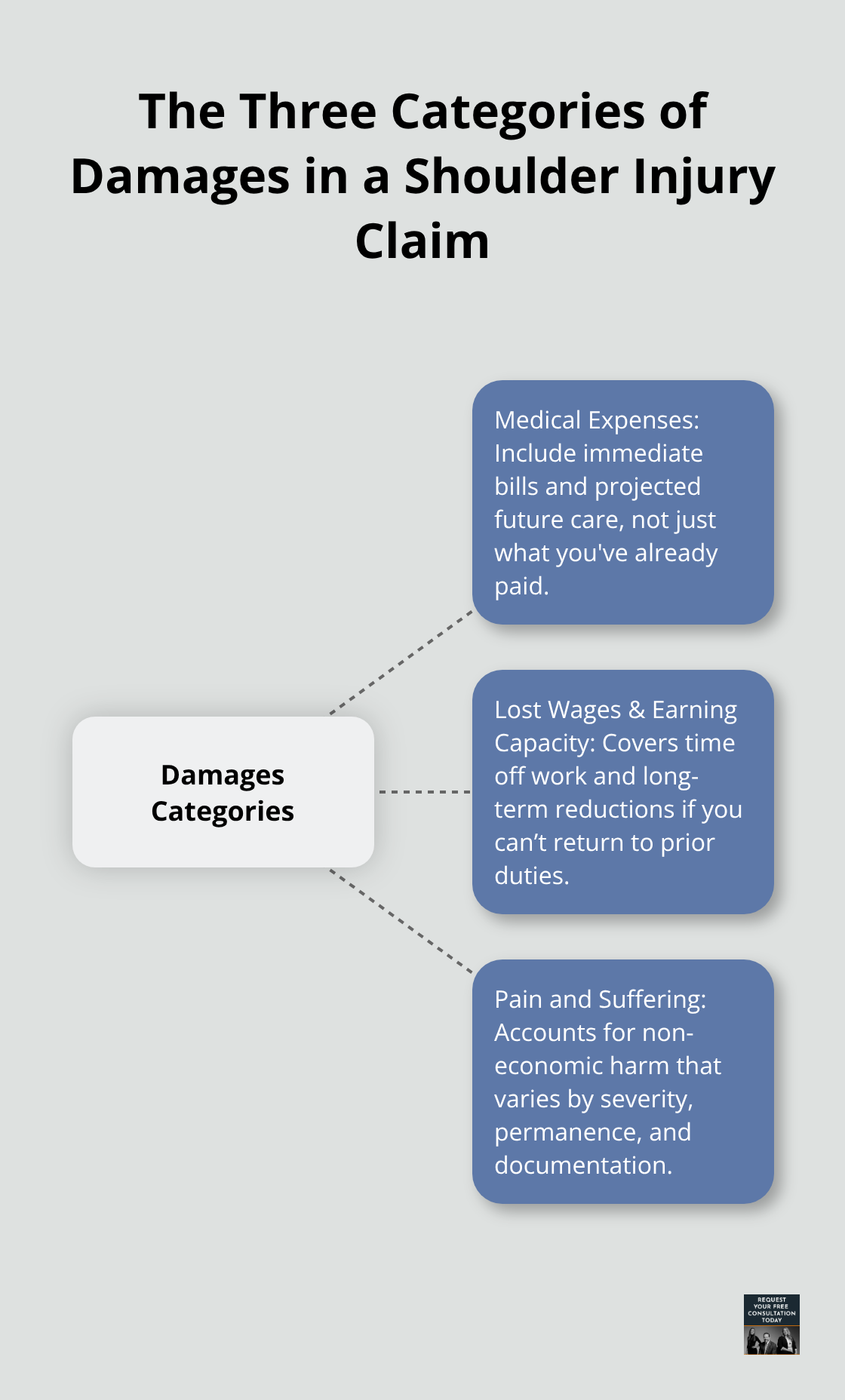
Physical therapy typically continues for six to twelve months post-surgery, adding another $5,000 to $15,000 depending on your location and the facility. Many people need ongoing imaging like MRI scans to monitor healing, which costs $1,500 to $3,000 per scan. If your injury causes chronic shoulder instability, you might need injections or additional procedures down the road, so your settlement must account for these future medical needs.
Insurance companies will argue that you should only receive compensation for treatment you’ve already completed, but this undervalues claims significantly. Your orthopedic surgeon’s prognosis letter stating that you’ll need follow-up care for the next two to five years provides critical documentation that justifies including future treatment costs in your demand.
Lost Wages and Earning Capacity Matter More Than You Think
Lost wages represent the second major component, and your employment situation matters considerably. If you earn $60,000 annually and your shoulder injury kept you out of work for four months, that’s $20,000 in lost income that belongs in your settlement. However, many shoulder injuries don’t prevent you from working entirely-instead, they reduce your earning capacity. If you worked in construction or nursing before the accident and your shoulder damage prevents you from returning to that role, you’ve lost earning potential that extends decades into your career.
A 35-year-old construction worker who can no longer perform that job has potentially lost $500,000 or more in lifetime earnings, and your settlement should reflect this reality. Insurance adjusters will claim you could find different work, but your medical records showing permanent functional limitations contradict this assumption. The gap between your previous income and what you can now earn should be calculated over your remaining work years, not dismissed as speculation.
Pain and Suffering Compensation Varies Significantly
Pain and suffering compensation addresses the non-economic impact of your injury, and settlement amounts vary wildly based on how well you document your experience. The American Bar Association notes that pain and suffering awards typically range from 1.5 to 5 times your total medical expenses, though this varies significantly by jurisdiction and injury severity. California courts in your region tend toward the higher end when injuries are permanent or require multiple surgeries.
If your total medical expenses are $50,000 and your case is strong, you should demand between $75,000 and $250,000 in pain and suffering compensation. This accounts for the months of physical therapy, the lost ability to play sports or hold your children comfortably, and the psychological toll of chronic pain. Insurance companies will offer settlements at the absolute floor of this range, expecting you to accept quickly without understanding your claim’s true value.
How Insurance Adjusters Undervalue Your Claim
Insurance adjusters use formulas that systematically underestimate pain and suffering, particularly in shoulder injury cases. They’ll point to your medical bills and multiply by a low number (often 1.5 times), ignoring the permanent nature of your injury. They’ll argue that your lost wages should only cover the exact time you missed work, not your reduced earning capacity. They’ll question whether your pain is truly as severe as you claim, despite your medical records and imaging studies.
The settlement negotiation process begins once you understand what your claim is actually worth-and that’s where your position strengthens considerably.
Getting Your Medical Records Right From Day One
Document Your Injury Immediately After the Accident
The moment a car accident injures your shoulder, your medical documentation becomes the most valuable asset in your settlement negotiation. Insurance adjusters scrutinize every gap in your treatment timeline and every inconsistency in your medical records, using these gaps to argue your injury isn’t as serious as you claim. If you see a doctor on the day of the accident but then don’t return for three weeks, the adjuster will claim your injury healed or wasn’t severe enough to require immediate follow-up care. This gap doesn’t reflect reality-it reflects your access to healthcare or your assumption that rest would solve the problem-but insurers weaponize these delays regardless.
Start recording everything immediately: photograph any visible bruising or swelling, write down your pain levels on a scale of one to ten each day, and note which activities become impossible or severely limited. If you can’t lift your arm above shoulder height, write that down. If you can’t sleep on your right side, record it. This daily log becomes powerful evidence when you negotiate because it creates a contemporaneous record that insurance adjusters can’t dismiss as exaggeration. Schedule your orthopedic evaluation within two weeks of the accident, even if your pain seems manageable, because imaging studies reveal damage that won’t show up in your pain levels for months.
Request Detailed Medical Reports From Your Providers
Work directly with your orthopedic surgeon and physical therapist to ensure your medical providers understand they’re documenting a legal claim, not just treating your injury. Request that your surgeon include specific language in their reports about your functional limitations, the permanent nature of your injury, and why you’ll need ongoing care. Instead of a generic note stating you have a rotator cuff tear, you need your surgeon to write that your tear involves the supraspinatus and infraspinatus tendons, that it’s a full-thickness tear requiring surgical repair, and that without surgery you face permanent loss of shoulder function and chronic pain.
Ask your physical therapist to record your progress metrics-how many degrees of motion you’ve regained, how much weight you can lift, and whether you’re plateauing in your recovery. Insurance companies often claim that conservative treatment should work perfectly, but your PT’s notes showing limited progress after eight weeks of therapy directly contradict this argument. These detailed reports transform your claim from a general shoulder injury into a specific, documented medical condition with clear treatment requirements.
Respond to Insurance Counteroffers With Medical Evidence
When adjusters make counteroffers that feel insulting, they’re betting you don’t understand your claim’s value or that you’ll accept a lowball number to avoid negotiation stress. They’ll claim your medical expenses are inflated or your pain and suffering doesn’t justify the amount you’re requesting. They’ll argue that you’re not following treatment recommendations or that you’re exaggerating your limitations. These tactics work primarily because accident victims haven’t assembled their medical evidence strategically.
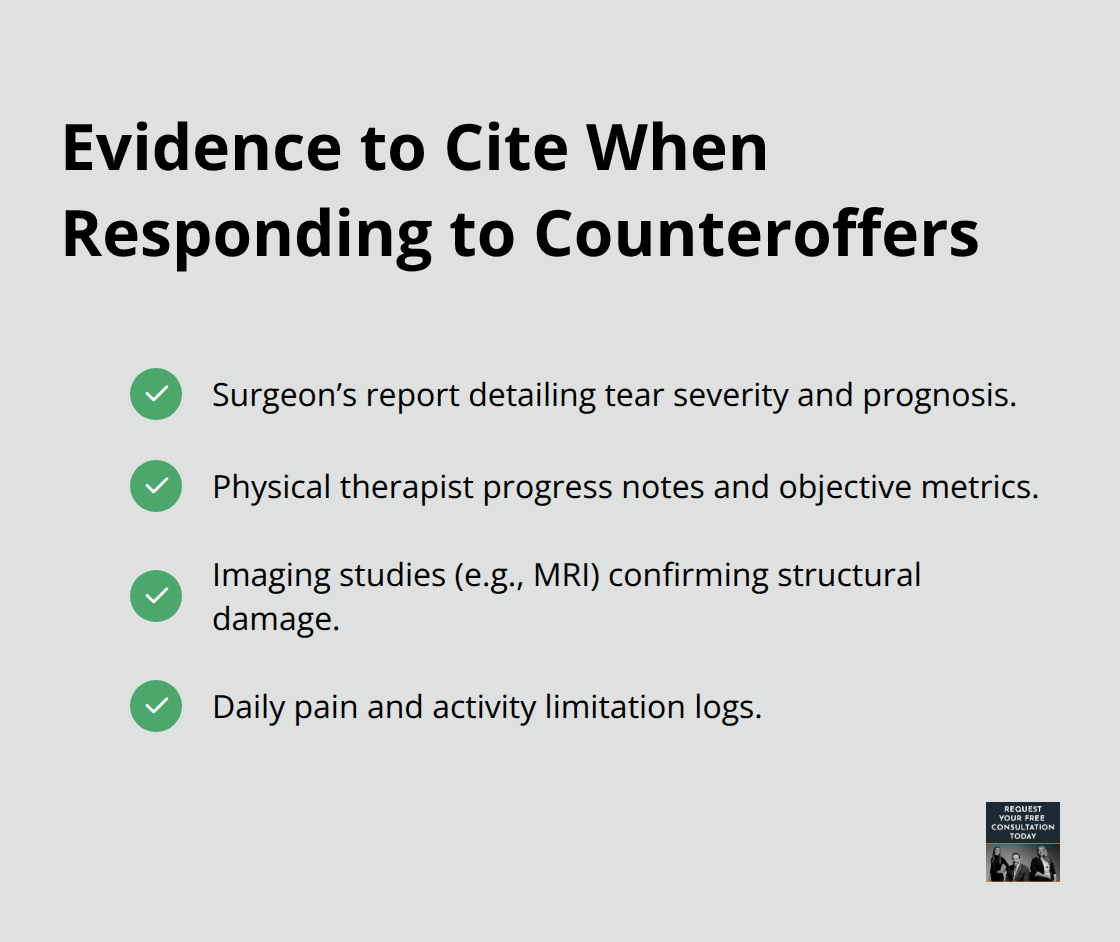
Your response to every counteroffer should reference your specific medical documentation: your surgeon’s report about the tear’s severity, your physical therapist’s progress notes, your imaging studies showing the damage, and your daily pain logs. When an adjuster offers $15,000 for a shoulder injury requiring surgery and six months of therapy, you respond by stating that your medical expenses alone total $45,000 and that your surgeon’s prognosis indicates you’ll need ongoing care for the next three years. You don’t argue emotionally or theoretically-you point to concrete medical evidence that supports your demand.
Understand How Adjusters Exploit Documentation Gaps
Insurance adjusters will scrutinize your medical records for any period where you didn’t receive treatment, using these gaps to minimize your injury’s severity. A two-week gap between your initial doctor visit and your follow-up appointment becomes evidence that your injury wasn’t serious. A month without physical therapy becomes proof that you’ve recovered. These gaps rarely reflect the true nature of your injury-they reflect scheduling difficulties, insurance authorization delays, or your own uncertainty about treatment-but adjusters use them anyway to reduce settlement offers.
Maintain consistent treatment throughout your recovery, even when progress feels slow. If your surgeon recommends physical therapy three times per week, attend those sessions and document your attendance. If your PT suggests you continue home exercises between appointments, record which exercises you complete each day. This continuous documentation creates an unbroken record that contradicts any adjuster’s claim that your injury wasn’t serious enough to require ongoing care. The strength of your settlement position depends directly on how thoroughly you’ve documented your medical journey from accident day through recovery.
Final Thoughts
Your shoulder injury settlement reflects the medical documentation you’ve assembled, the completeness of your damage calculations, and your willingness to stand firm during negotiations. Insurance adjusters count on accident victims accepting their first offer without understanding what their claim is truly worth. A shoulder injury requiring surgery and months of physical therapy generates medical expenses exceeding $40,000, lost wages that may extend across your entire career, and pain and suffering compensation that should reflect the permanent nature of your injury.
We at Schaar & Silva LLP understand that navigating a shoulder injury settlement while managing your recovery feels overwhelming. Our team works with accident victims throughout Santa Cruz County, Sacramento, and Oakland to handle the legal complexities of your claim so you can focus on healing. Contact Schaar & Silva LLP to discuss your shoulder injury settlement options and learn how legal representation strengthens your negotiating position.
Continue your medical treatment consistently, maintain detailed records of your pain and functional limitations, and request comprehensive reports from your healthcare providers that document your injury’s severity and long-term implications. The difference between accepting an adjuster’s lowball offer and receiving fair compensation often comes down to having experienced guidance throughout the process. Your recovery matters more than rushing toward a settlement that undervalues your claim.