

Truck accidents in California often result in serious injuries, mounting medical bills, and complex legal questions. We at Schaar & Silva LLP understand that navigating truck accident litigation guidance requires knowledge of state-specific rules and your rights to compensation.
This guide walks you through California’s liability standards, the damages you can recover, and the critical deadlines that protect your claim.
How California Holds Truck Drivers and Companies Liable
Vicarious Liability and Company Responsibility
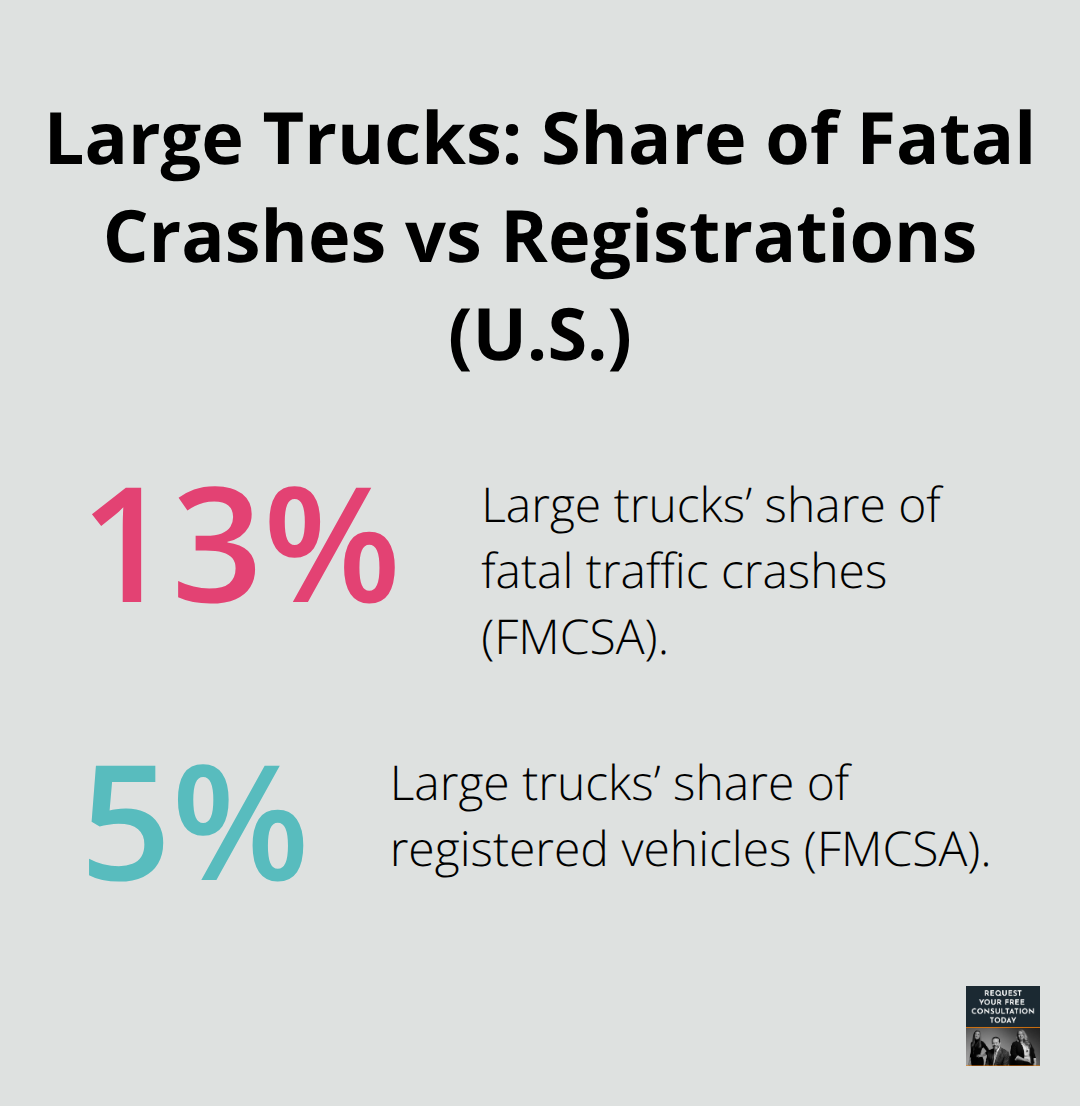
Commercial trucking operations face stricter liability rules than regular drivers in California. Under California law, trucking companies become responsible for accidents caused by their drivers through vicarious liability, which means the company pays for employee negligence regardless of fault. This applies even when the driver followed company policy, making trucking companies highly motivated to enforce safety standards. The Federal Motor Carrier Safety Administration reports that large trucks are involved in approximately 13% of fatal traffic crashes despite representing only 5% of registered vehicles, and Santa Cruz County sees its share of these incidents.
Extended Liability Beyond the Driver
When a truck accident occurs, liability often extends beyond the individual driver to maintenance contractors, dispatchers, and cargo loaders if their actions contributed to the crash. A poorly maintained brake system, improper cargo loading, or a dispatcher’s decision to ignore hours-of-service regulations can all trigger company liability. You must identify all responsible parties to maximize your recovery potential.
Proving Negligence in Truck Accident Cases
Proving negligence requires you to establish four elements: the defendant owed a duty of care, breached that duty, caused the accident, and resulted in damages. The burden falls on you to prove these elements through evidence like accident reports, witness statements, medical records, and testimony about truck maintenance or driver fatigue. Documentation from the accident scene-road conditions, weather, traffic signals, and vehicle positions-strengthens your case significantly.
California’s Comparative Fault System
California’s comparative fault system allows you to recover damages even if you were partially at fault, though your compensation reduces by your percentage of responsibility. If you were 20% at fault and damages total $100,000, you would receive $80,000. Many victims make the mistake of admitting fault or minimizing their injuries to police, which insurers later use against them.
Protecting Your Claim From the Start
Truck accident cases demand careful attention to detail from the moment of impact through settlement or trial. The decisions you make immediately after the crash-what you say to police, how you document the scene, and whether you seek medical treatment-directly affect your legal position. Understanding these liability standards positions you to make informed choices about your next steps.
What Compensation Can You Recover After a Truck Accident
Three Categories of Damages Available to You
Truck accidents generate three distinct categories of damages that California law allows you to recover. Economic damages cover your direct financial losses: medical treatment, hospitalization, surgery, physical therapy, prescription medications, lost wages during recovery, and diminished earning capacity if injuries prevent you from returning to your previous job. The National Safety Council reports that the average cost of a serious truck accident injury exceeds $80,000 in direct medical expenses alone, though Santa Cruz County residents often face additional costs from specialized trauma centers and rehabilitation facilities. Non-economic damages compensate for pain, suffering, emotional distress, loss of enjoyment of life, and permanent disfigurement or disability.
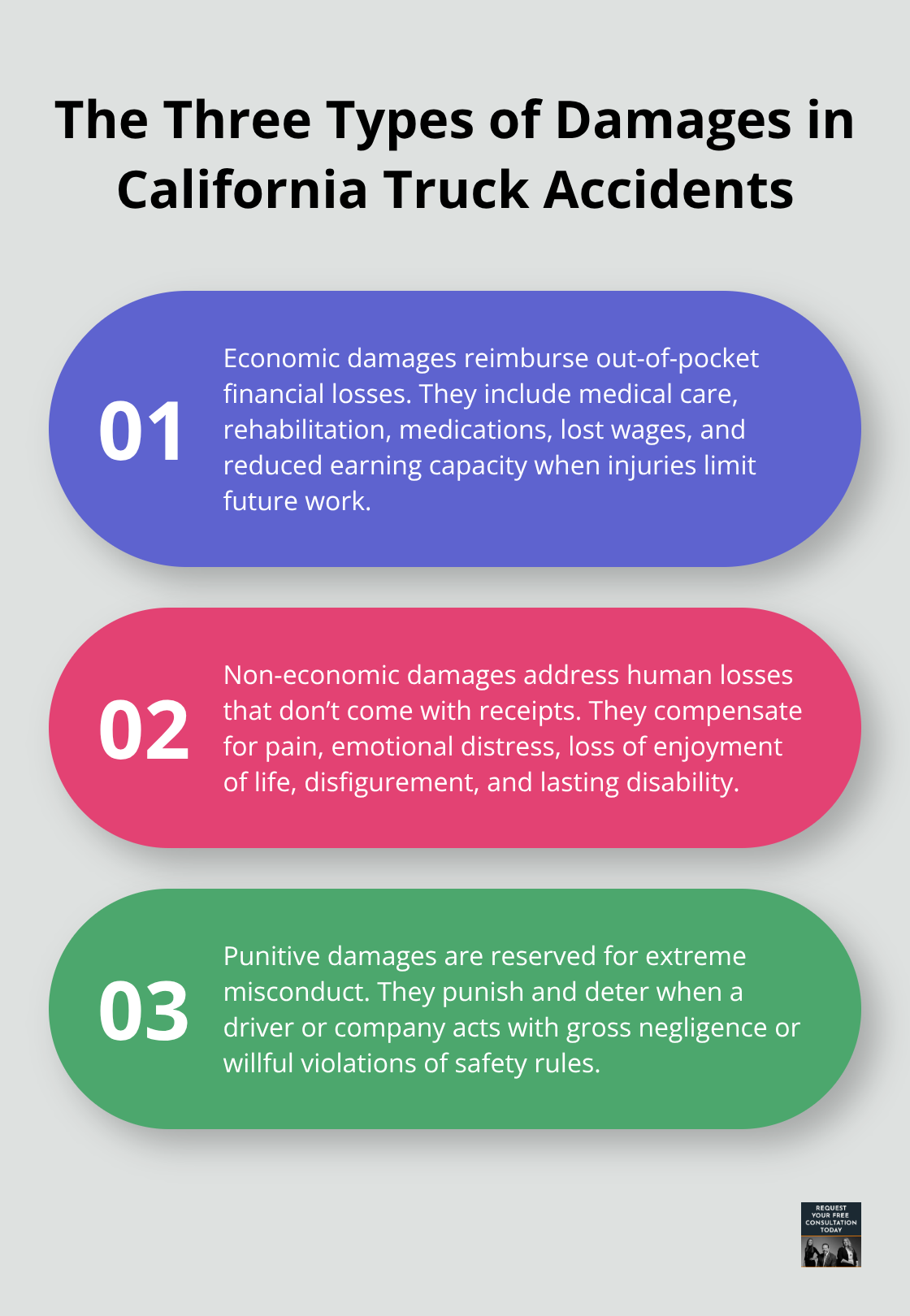
California courts recognize that a broken leg causing chronic pain for years deserves compensation beyond the medical bill, and judges consistently award substantial amounts for permanent injuries. Punitive damages apply only in cases where the truck driver or company acted with gross negligence or intentional misconduct, such as knowingly operating an unsafe vehicle or violating safety regulations repeatedly. These damages punish wrongdoing and deter future violations, and juries in California have awarded punitive damages reaching millions of dollars in cases involving egregious violations.
Document Everything From Day One
Calculating your total recovery requires meticulous documentation from the moment of impact forward. You should preserve all medical records, receipts for treatment and medications, employment verification showing lost wages, and communications with insurers. Insurance adjusters often undervalue non-economic damages by 40 to 60 percent, offering settlements that fail to account for permanent pain or psychological trauma. Photograph your injuries at different healing stages, maintain a journal describing daily pain levels and functional limitations, and gather statements from family members about changes in your quality of life.
Strengthen Your Claim With Evidence of Company Violations
When evaluating your case, we examine whether the trucking company failed to maintain equipment, ignored driver fatigue, or violated federal safety standards, as these factors strengthen claims for both compensatory and punitive damages. A company’s pattern of safety violations (maintenance records, driver complaints, prior accidents) transforms your case from a simple negligence claim into one supporting punitive damages. The difference between accepting an early lowball offer and pursuing full compensation often reaches hundreds of thousands of dollars, making thorough damage documentation your most valuable asset during negotiations or trial. Your next step involves understanding the critical deadlines that protect your right to file a claim and recover these damages.
Critical Deadlines and Filing Requirements in Truck Accident Cases
The Two-Year Statute of Limitations That Controls Your Claim
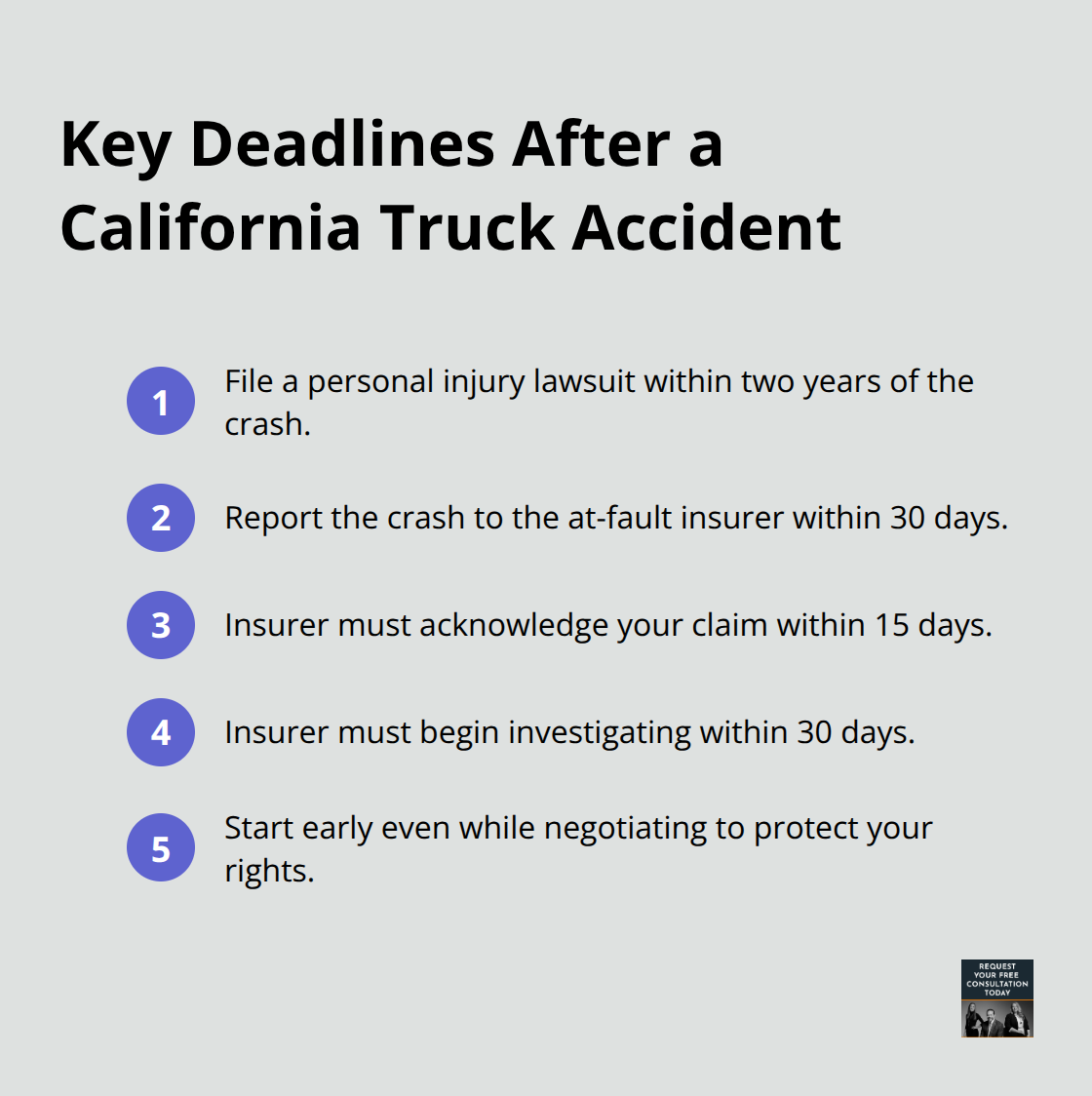
California imposes a two-year statute of limitations for personal injury claims arising from truck accidents, meaning you have exactly two years from the date of the crash to file a lawsuit in court. This deadline applies regardless of whether you’ve settled with insurance or are still negotiating, and missing it permanently bars your right to recover damages through the court system. Many victims believe they have more time because insurance negotiations extend beyond a few months, but the statute of limitations clock ticks from day one of the accident. If your accident occurred on September 15, 2024, your deadline to file is September 15, 2026, with no exceptions for settlement delays or medical complications. The critical mistake we see repeatedly is victims waiting for insurance to resolve their claim before consulting an attorney, only to discover they’ve lost months of that two-year window.
Property damage claims carry a separate three-year statute of limitations, but the personal injury deadline controls your ability to recover for medical expenses, lost wages, and pain and suffering. Starting the legal process early doesn’t mean abandoning settlement negotiations-it means protecting your rights while maintaining flexibility in how your case resolves.
Insurance Claim Procedures and Notification Requirements
You should report the crash to the at-fault driver’s insurance company within 30 days, though notifying them sooner strengthens your position and prevents disputes about claim timeliness. Provide factual information about what happened, injuries sustained, and property damage, but avoid admitting fault or speculating about causes, as insurers use these statements against you later. The insurance company then has 15 days to acknowledge receipt of your claim and 30 days to begin investigating, according to California Department of Insurance regulations. During this period, you must document all medical treatment, preserve evidence like photos and witness contact information, and maintain records of expenses and lost income. Insurance adjusters often undervalue claims by 40 to 60 percent, offering settlements that fail to account for permanent pain or psychological trauma.
Discovery Timelines and Court Filing Deadlines
Discovery timelines in litigation require you to exchange evidence with the defendant’s attorney within 30 days of their initial request, and court filing deadlines vary depending on whether your case settles or proceeds to trial. If litigation becomes necessary, procedural requirements demand strict adherence to court schedules while pursuing maximum compensation for your injuries and losses. The decisions you make during these early phases-what information you share with insurers, how you document your injuries, and when you seek legal counsel-directly affect your final recovery amount.
Final Thoughts
Truck accident litigation guidance in California rests on three fundamental realities: trucking companies face strict liability for driver negligence, you can recover substantial damages across economic and non-economic categories, and a two-year statute of limitations controls your ability to pursue compensation through the courts. The decisions you make immediately after a crash determine your legal position, so report the accident to insurance within 30 days, document all injuries and expenses from day one, and avoid admitting fault or minimizing your injuries to police or adjusters. Preserve evidence like accident scene photos, witness statements, and medical records, as insurance companies routinely undervalue claims by 40 to 60 percent.
Your rights depend on acting within California’s legal timelines, and the two-year statute of limitations for personal injury claims means your deadline is fixed from the accident date forward. Waiting for insurance to resolve your claim before consulting an attorney costs you valuable time and leverage that you cannot recover later. Starting the legal process early protects your rights while maintaining flexibility in settlement negotiations and positions you to maximize your recovery.
We at Schaar & Silva LLP help Santa Cruz County residents navigate truck accident claims from start to finish, connecting you with lien services for medical bill assistance and evaluating property damage claims for fair valuation. Contact Schaar & Silva LLP to discuss your truck accident claim and protect your rights under California law.
