
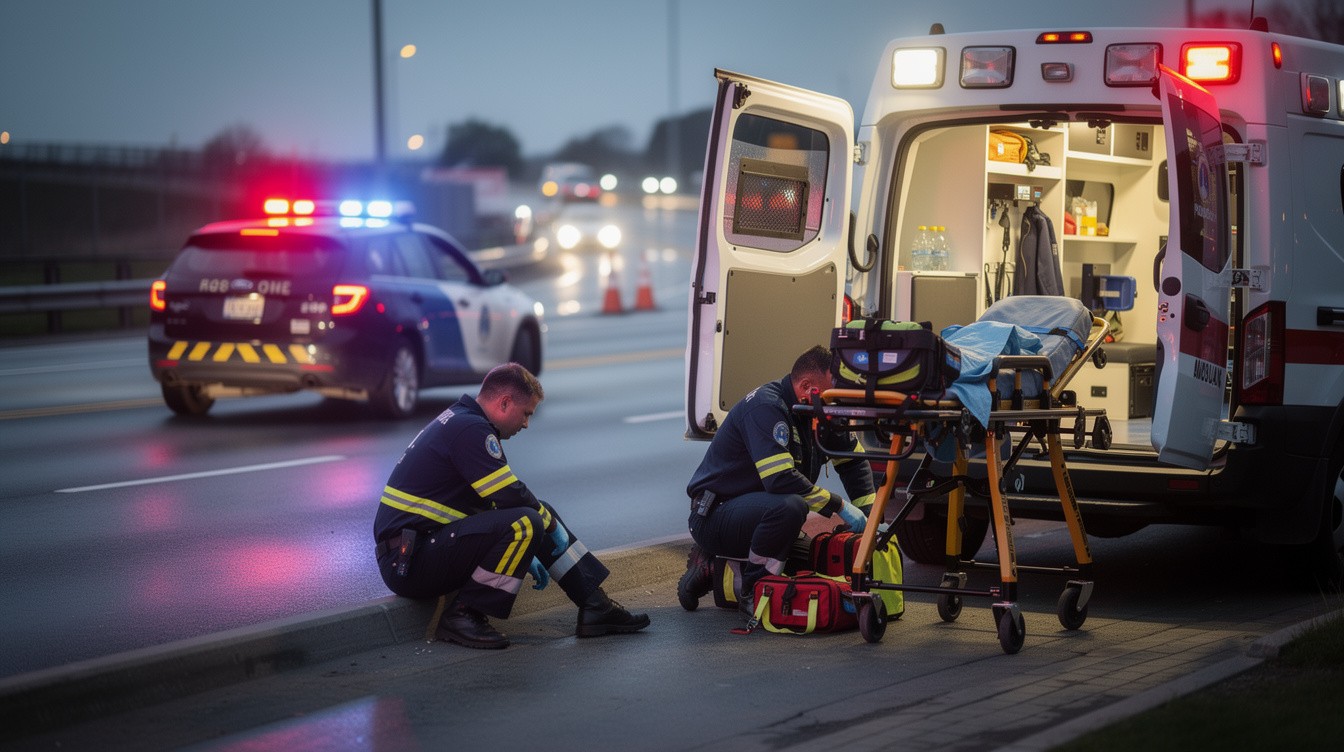
An emergency responder accident creates a unique legal situation that many Santa Cruz County residents don’t fully understand. When a police officer, firefighter, or paramedic causes a crash, the rules that apply are different from standard car accidents.
At Schaar & Silva LLP, we help accident victims navigate these complex cases and understand what protections actually apply to them. Knowing your rights after this type of accident can make a significant difference in your recovery.
What Happens When an Emergency Responder Causes an Accident
How Emergency Vehicles Are Treated Under California Law
California law treats emergency vehicles differently from regular cars, but this difference does not shield government agencies from liability when negligence causes an accident. When a fire truck, ambulance, or police car hits you, the driver and their employer remain responsible if they fail to exercise reasonable care. The California Vehicle Code requires emergency vehicle operators to drive with due regard for public safety, even when responding to calls. This means an emergency responder cannot ignore traffic laws or drive recklessly and escape accountability.
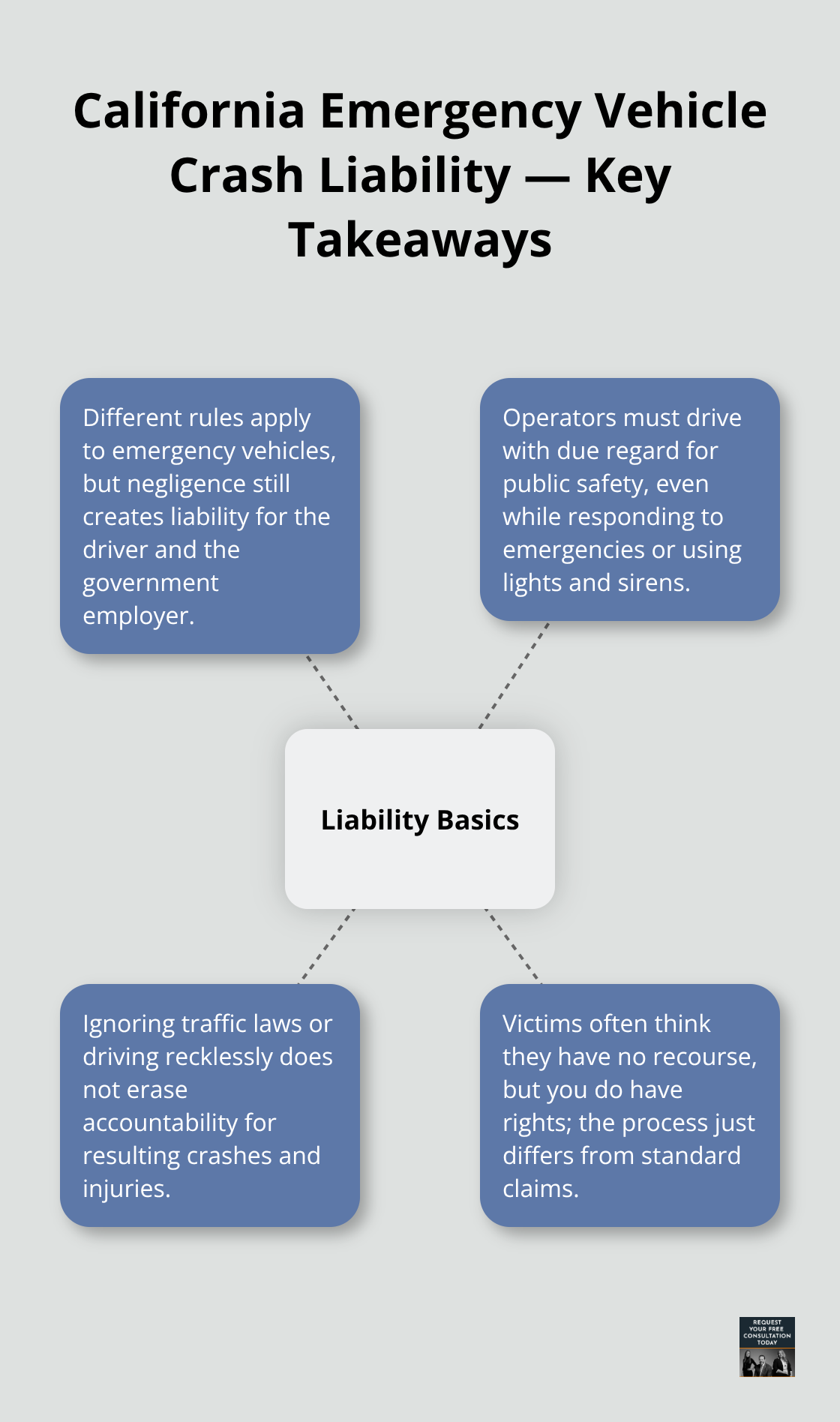
Many Santa Cruz County residents incorrectly assume they have no recourse when hit by an emergency vehicle. The reality is that you do have rights, though the process differs from standard accident claims.
Sovereign Immunity and Government Agency Protections
Government agencies benefit from a legal doctrine called sovereign immunity, which limits when you can sue public entities. However, California significantly restricts this protection through the California Tort Claims Act. This law allows you to file claims against government agencies for injuries caused by employee negligence, including emergency responders.
The procedural requirements demand precision and timing. You must file a government claim within six months of your accident rather than immediately filing a lawsuit. The claim goes to the appropriate government agency-whether that is the city, county, or special district operating the emergency service. California Government Code Section 905 establishes this requirement, and missing the deadline typically bars your entire case.
Your Right to File a Claim Against a Government Entity
Once you submit a government claim, the agency has 45 days to respond before you can proceed to court. If the agency denies your claim or fails to respond within the timeframe, you then have two years to file a lawsuit. This process (which involves multiple steps and strict deadlines) demands careful attention to detail.
The legal team at Schaar & Silva LLP can help you navigate these requirements and meet all critical deadlines. Understanding these procedures protects your ability to recover compensation for your injuries and losses. With proper guidance, you can move forward with confidence toward the next phase of your claim.
Types of Coverage Available After an Emergency Responder Accident
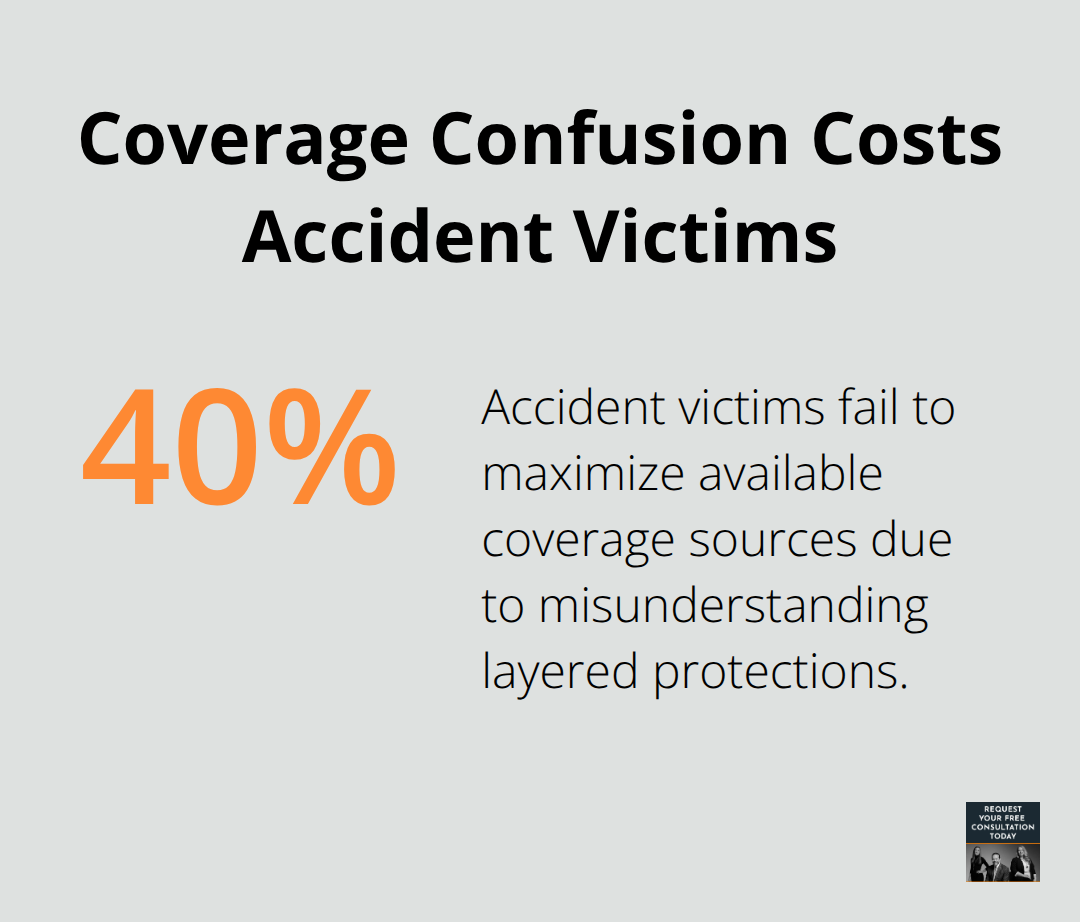
Understanding which insurance policies actually pay for your injuries after an emergency responder accident matters because coverage sources differ significantly from standard collisions. Government agencies that operate emergency vehicles carry liability insurance, but accessing this coverage requires following the government claims process outlined in the previous section. Your own auto insurance also plays a role, though many Santa Cruz County residents don’t realize how their personal policies interact with government liability coverage. The California Department of Insurance reports that approximately 40 percent of accident victims fail to maximize available coverage sources because they don’t understand the layering of protection. This gap in knowledge costs victims thousands in unrecovered damages.
Government Liability Insurance
Government liability insurance covers injuries and damages caused by emergency responders when negligence is proven, but the coverage limits vary by jurisdiction. A city fire department might carry $500,000 in liability coverage per incident, while a county sheriff’s department operates under different thresholds. These limits determine the maximum amount the government agency will pay toward your claim, making it critical to understand what protection actually exists in your specific situation.
Your Own Auto Insurance Coverage
Your auto insurance policy becomes critical because it covers your medical expenses and vehicle damage regardless of fault through your medical payments coverage or personal injury protection (which typically ranges from $1,000 to $25,000 depending on your policy). Contact your insurance agent to confirm your actual coverage limits on your declarations page immediately after an accident. This step takes only minutes but prevents costly mistakes later when you file your claim.
Uninsured or Underinsured Motorist Protection
Uninsured or underinsured motorist protection applies when the government agency’s liability coverage proves insufficient for your damages. California law requires insurers to offer uninsured motorist protection, and choosing the minimum $15,000 limit leaves you exposed if your injuries exceed that amount. This coverage often prevents significant out-of-pocket losses when government liability insurance reaches its ceiling.
The interaction between these three coverage sources determines your total recovery potential. Identifying which policies apply to your specific accident sets the foundation for the next critical step: documenting what happened at the scene and gathering evidence that supports your claim.
Steps to Take Immediately After an Accident With an Emergency Vehicle
Document the Scene and Gather Evidence
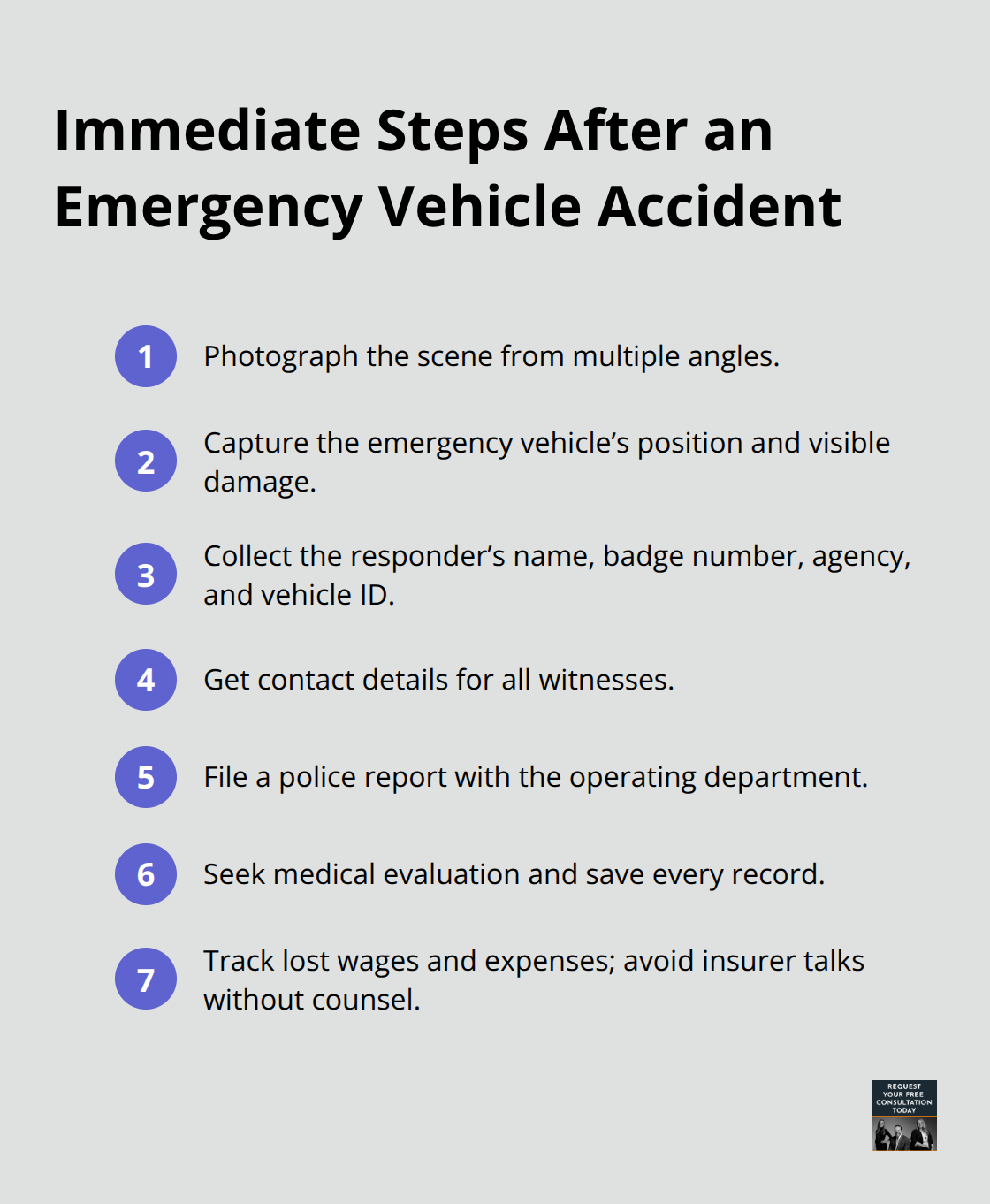
The moments immediately following an accident with an emergency vehicle determine how strong your claim becomes. Your actions in the first hours will either support or undermine your ability to recover compensation, which makes acting decisively critical. Take photos of the accident scene from multiple angles, capturing the emergency vehicle’s position, damage to your car, road conditions, and any visible injuries. The National Highway Traffic Safety Administration emphasizes that scene documentation within 24 hours produces significantly more usable evidence than delayed photography.
Collect the emergency responder’s name, badge number, agency, and vehicle identification number directly from the scene. Request contact information from every witness present, including bystanders and other drivers, because witness statements often prove decisive in government liability claims. Write down the exact time, location, weather conditions, and what happened leading up to the collision while details remain fresh in your memory.
Report the Accident to Police
Contact the police department that operates the emergency service involved in your accident and file a formal accident report immediately. This report creates an official record that strengthens your government claim later. Provide the police with all documentation you collected at the scene, including photos and witness contact information. The official report establishes a timeline and independent account of what occurred.
Seek Medical Attention and Keep Records
Seek medical evaluation even if you feel fine, since many accident injuries develop over hours or days and an early medical record establishes the injury timeline. Keep every medical receipt, prescription, imaging report, and treatment note in a dedicated folder because these documents directly support your compensation request. Request your complete medical records from each provider you visit, and maintain a detailed log of your symptoms, pain levels, and how the accident affects your daily activities.
Document Your Financial Losses
Document any missed work days and lost wages by obtaining written confirmation from your employer, as this information translates directly into recoverable damages. Track all expenses related to your accident recovery, including transportation costs to medical appointments and medication expenses. This financial documentation strengthens your claim when you calculate total damages.
Protect Your Legal Position
Do not communicate with the government agency’s insurance company without guidance from an attorney, since anything you say can limit your recovery. An attorney can review all communications before you respond to insurance inquiries. If you need assistance navigating this process, the legal team at Schaar & Silva LLP can guide you through documentation and help you avoid costly mistakes that reduce your claim’s value.
Final Thoughts
An emergency responder accident leaves you facing unfamiliar legal territory, but understanding your rights transforms confusion into actionable steps. You now know that government agencies cannot hide behind immunity when their employees cause crashes through negligence, and you have concrete pathways to recover compensation through government claims and insurance coverage. The six-month deadline for filing a government claim, the documentation you gather at the scene, and the medical records you maintain all directly impact your ability to receive fair payment for your injuries and losses.
Legal representation matters significantly in these cases because the procedures differ fundamentally from standard auto accidents. Missing a single deadline or communicating incorrectly with an insurance company can eliminate your entire claim, which is why having someone guide you through the process protects your interests. The team at Schaar & Silva LLP understands the specific challenges Santa Cruz County residents face after an emergency responder accident and can help you navigate government claims procedures, maximize your available coverage, and avoid the mistakes that cost victims thousands in unrecovered damages.
Contact Schaar & Silva LLP to discuss your situation with someone who understands these cases. We help you evaluate your claim, meet all procedural deadlines, and connect you with the resources you need to recover physically and financially from your accident.
