
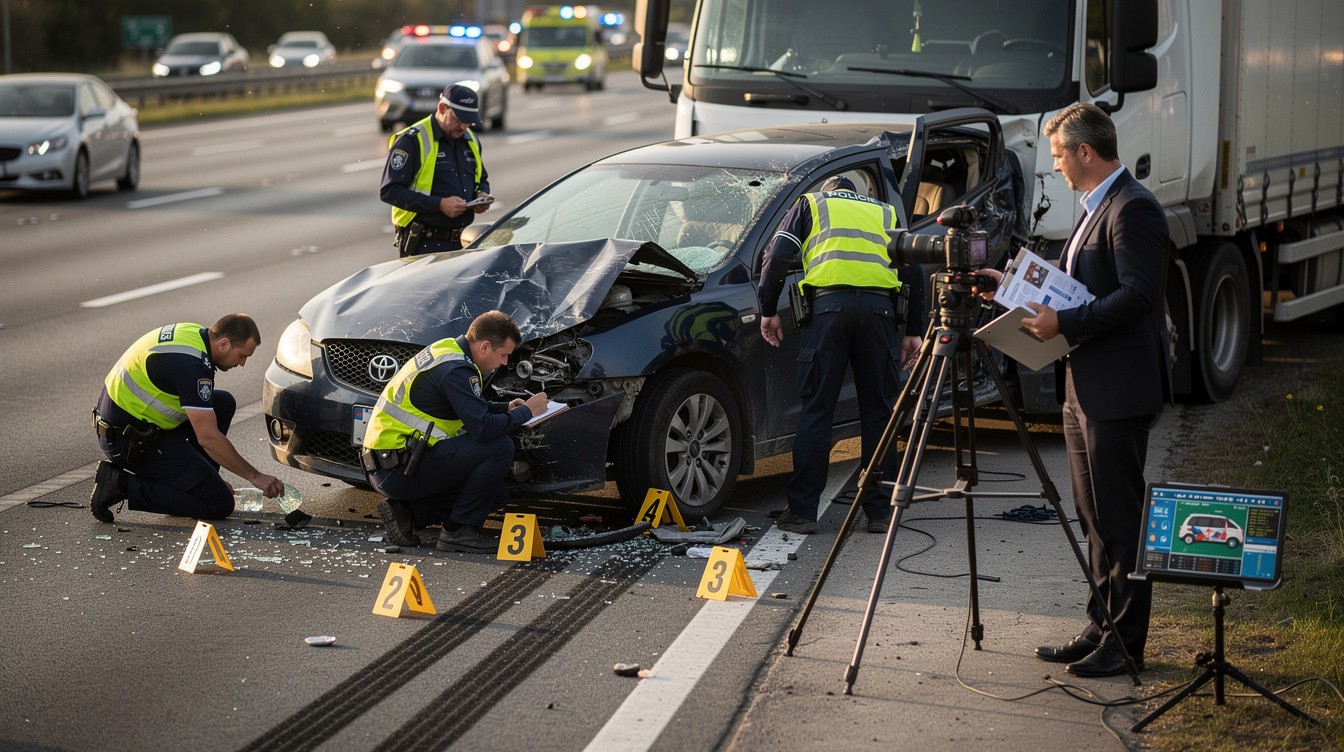
Truck crashes involve multiple parties, complex regulations, and competing claims of fault. Determining who bears responsibility requires careful analysis of driver actions, vehicle conditions, and external circumstances.
At Schaar & Silva LLP, we help accident victims understand how liability works in these complicated cases. California’s comparative negligence rules mean fault can be shared among several defendants, which directly affects the compensation you receive.
What Causes Truck Accidents to Happen
Driver Error and Fatigue
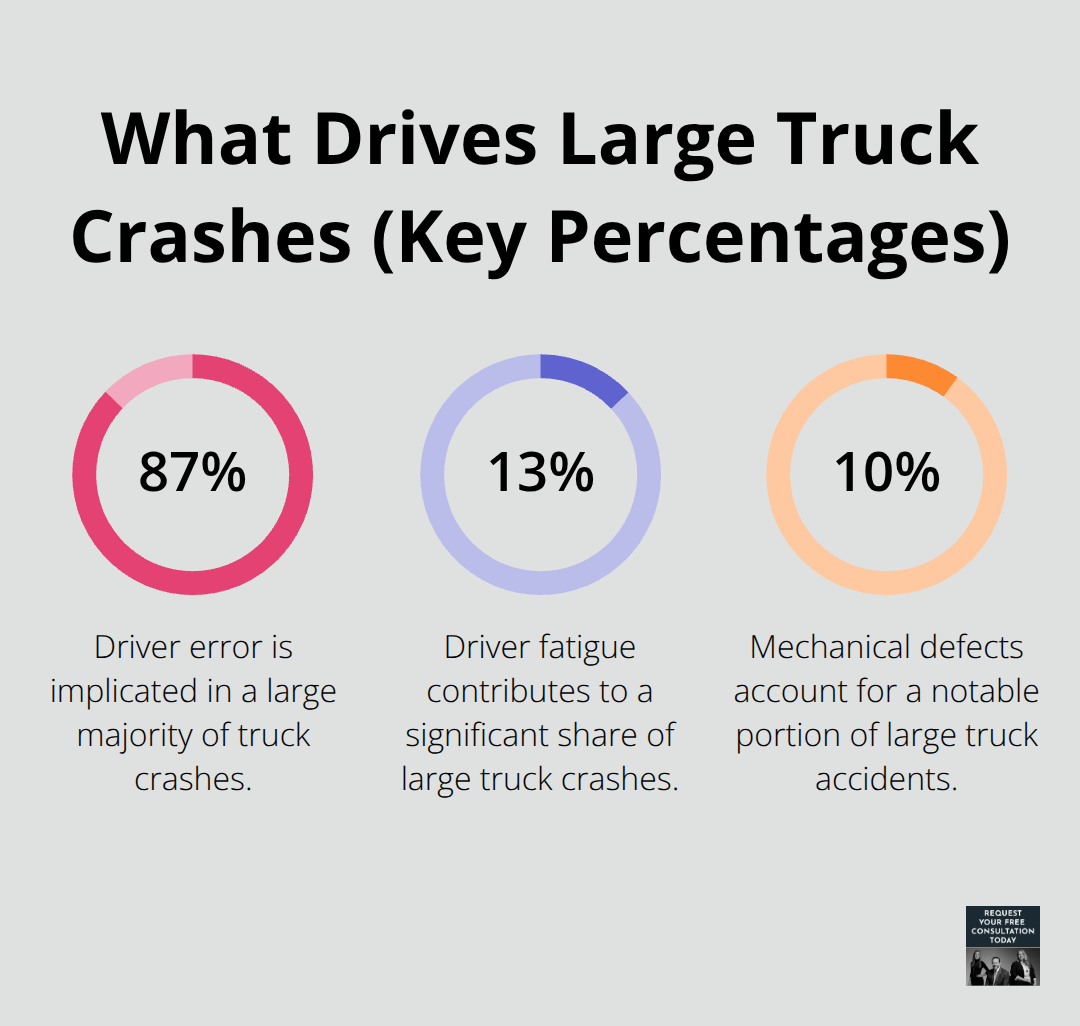
Driver error accounts for approximately 87% of truck crashes, according to the Federal Motor Carrier Safety Administration. Fatigued driving represents one of the most dangerous forms of operator negligence, with the American Transportation Research Institute finding that driver fatigue contributes to roughly 13% of large truck crashes. Hours-of-service violations directly enable fatigue-related accidents, yet enforcement remains inconsistent across California.
Speeding, improper lane changes, and failure to maintain safe following distance appear repeatedly in accident reports. When a truck driver violates California Vehicle Code sections governing commercial vehicle operation, this creates a strong foundation for establishing liability. Distracted driving behind the wheel of an 80,000-pound vehicle produces catastrophic outcomes, and phone records often reveal texting or app usage at the moment of impact.
Mechanical Defects and Maintenance Failures
Brake failure, tire blowouts, and steering problems do not occur randomly. Trucking companies must maintain detailed service records, and when they fail to do so, courts view this as evidence of negligence. The National Highway Traffic Safety Administration reports that approximately 10% of large truck accidents stem from mechanical defects.
Worn brake components, improperly loaded cargo, and defective coupling systems create predictable hazards. Third-party maintenance contractors sometimes bear responsibility when they perform substandard repairs or inspections. Thorough investigation of maintenance records, inspection logs, and repair histories often reveals critical evidence that shifts liability toward the trucking company or equipment manufacturer.
Environmental and Road Conditions
Poor road conditions, weather, and visibility factors occasionally contribute to accidents, though they rarely eliminate driver or company responsibility entirely. Environmental factors become relevant only when they combine with other negligent conduct. A truck operator must adjust speed and following distance to match conditions, and failure to do so constitutes negligence regardless of weather or road surface.
These multiple sources of liability mean that establishing fault requires examining driver conduct, vehicle maintenance, and external circumstances together. The next section explains how California law handles situations where multiple parties share responsibility for a crash.
How Fault Splits Among Multiple Parties
California’s Pure Comparative Negligence System
California’s pure comparative negligence system fundamentally changes how truck accident compensation works. Unlike states that bar recovery if you bear any responsibility, California allows you to recover damages even if you are 99% at fault, though your award reduces by your percentage of responsibility. This means a truck driver, trucking company, maintenance contractor, and even a vehicle manufacturer can all share liability in a single crash, with each party’s percentage of fault determined through evidence and testimony.
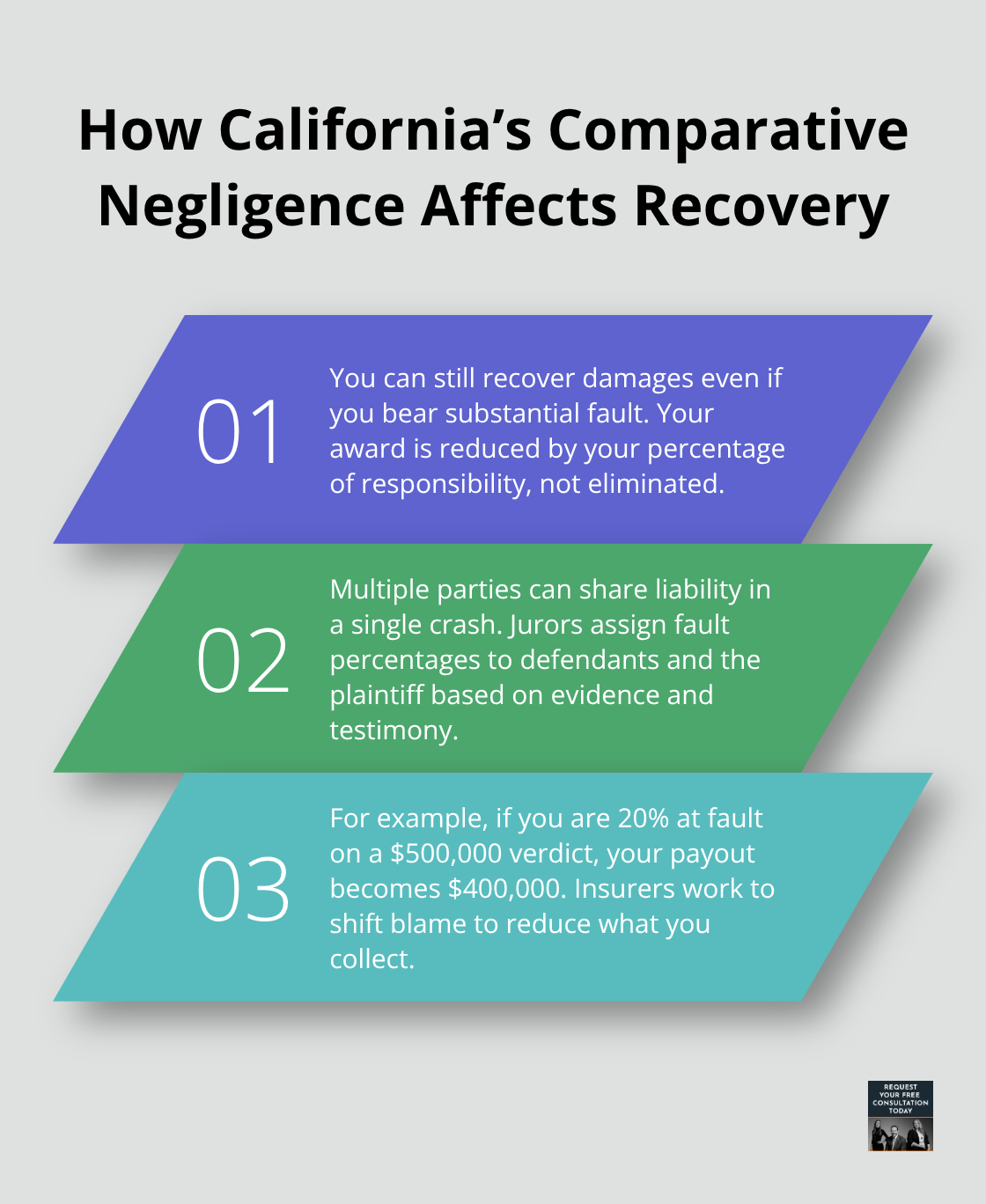
The California Civil Jury Instructions explicitly state that jurors must assign fault percentages to every defendant and the plaintiff, which directly determines your final payout. If you are found 20% responsible and a jury awards $500,000 in damages, you receive $400,000. This distinction matters enormously in truck cases because multiple defendants often exist, and aggressive insurance companies will push hard to shift blame toward you.
How Evidence Determines Fault Percentages
Establishing fault percentages requires detailed evidence that investigators and attorneys must uncover systematically. Truck companies frequently argue that road conditions or weather caused the accident, or that you contributed through your driving decisions, specifically to reduce their liability percentage. Electronic control module data from the truck’s onboard computer often shows speed, braking patterns, and lane position at the moment of impact, and this data frequently contradicts the trucking company’s account of events. When multiple defendants exist, you need separate discovery from each party because their interests conflict. The trucking company will blame the driver, the driver will blame the company for inadequate training or vehicle maintenance, and the maintenance contractor will blame both.
Managing Multiple Insurance Policies and Coverage Limits
Insurance policy limits create practical complications that affect your recovery significantly. A truck driver might carry $1 million in liability coverage, the trucking company $5 million, and a third-party maintenance contractor $2 million, meaning settlement negotiations must account for each policy’s limitations. Coordinating among multiple insurance carriers requires understanding how each policy applies to the accident and which defendant’s coverage pays first. These policy interactions determine whether you recover your full damages or face shortfalls when one defendant lacks sufficient coverage. The next section addresses the specific challenges that arise when you attempt to collect evidence and preserve critical information in these complex cases.
What Makes Truck Cases So Difficult to Resolve
Truck accident investigations require navigation through federal and state regulations that most personal injury cases never encounter. The Federal Motor Carrier Safety Administration enforces Hours of Service rules, vehicle maintenance standards, and driver qualification requirements that create layers of potential liability. When a truck driver violates these regulations, it establishes negligence, but proving which regulation was violated and how it caused your injuries requires understanding complex compliance frameworks. California Vehicle Code sections 34500 through 34507 impose additional commercial vehicle standards that trucking companies routinely ignore. Insurance companies exploit this regulatory complexity by arguing that technical compliance details obscure responsibility, when in reality these regulations exist precisely because violations cause serious injuries and deaths. These regulations are not bureaucratic obstacles but rather safety requirements designed to protect people like you.
Evidence Disappears Rapidly in Truck Accidents
Evidence in truck cases vanishes faster than in standard car accidents, and this creates urgent practical problems. Trucking companies have legal obligations to preserve electronic control module data, maintenance records, and dispatch logs, yet many destroy this evidence within weeks or claim it was lost. The Federal Motor Carrier Safety Administration requires retention of certain records for six months minimum, but electronic data often gets overwritten on a shorter cycle. Dashcam footage from the truck, if it exists, must be requested immediately because companies frequently delete it. Cell phone records showing driver distraction require subpoena within a narrow timeframe before carriers purge them. Witness statements deteriorate in reliability as time passes, and truck stop security footage typically records over itself every 30 days. Insurance adjusters deliberately delay investigations to allow this evidence to vanish, so speed matters enormously.
Multiple Insurance Policies Complicate Recovery
Insurance coverage in truck crashes involves layers that create both opportunities and obstacles. A single accident might trigger coverage under the truck driver’s personal policy, the trucking company’s commercial liability policy, the company’s cargo liability coverage, and potentially the vehicle manufacturer’s product liability insurance. Each policy has different limits, different exclusions, and different defense attorneys working against your interests. Some policies contain provisions that shift liability entirely to another defendant’s carrier, creating disputes that delay your recovery for months. Underinsured and uninsured motorist coverage from your own policy sometimes provides recovery when truck company coverage proves insufficient, but this requires filing your own claim against your insurer.
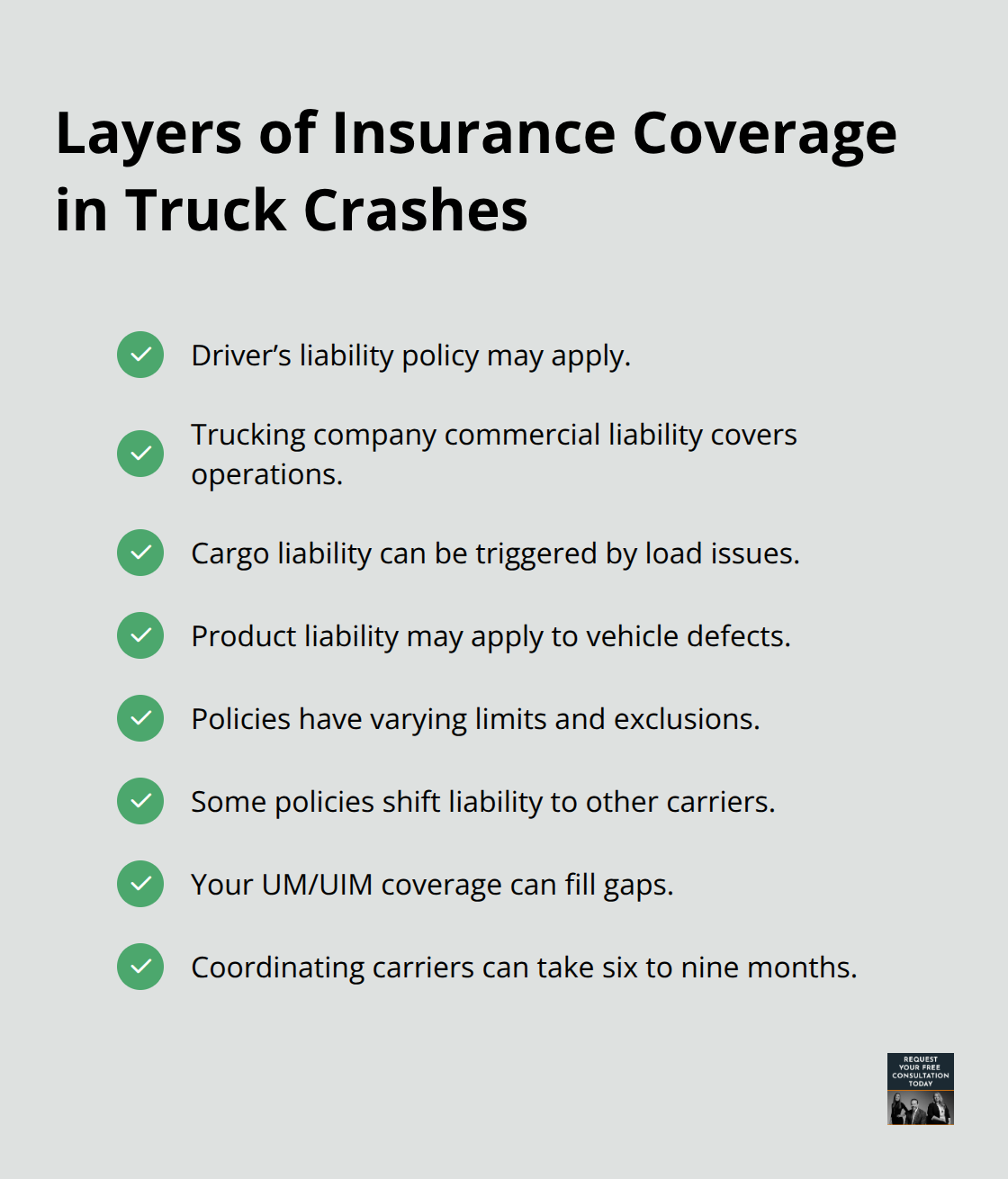
The coordination process means settlement negotiations cannot proceed until all carriers acknowledge their potential exposure, and this coordination frequently takes six to nine months. Each carrier protects its own financial interests rather than yours, which is why you need representation that focuses solely on your recovery.
Final Thoughts
Truck crash liability overview cases demand simultaneous attention to driver conduct, vehicle maintenance, regulatory compliance, and insurance coverage. Establishing fault requires examining electronic control module data, maintenance records, dispatch logs, and witness statements before evidence vanishes. California’s pure comparative negligence system allows you to recover damages even if you share partial responsibility, though your award reduces by your percentage of fault.
Handling these cases without legal representation puts you at a significant disadvantage against trucking companies that employ experienced defense attorneys and insurance adjusters trained to minimize liability. These professionals understand federal motor carrier regulations and use regulatory complexity as a shield against accountability, while they coordinate among multiple insurance policies to protect their financial interests rather than yours. They know which evidence to request preservation of and which evidence to allow to disappear.
We at Schaar & Silva LLP help accident victims in Santa Cruz County navigate these complexities by investigating truck accidents thoroughly, preserving evidence before it vanishes, and holding trucking companies accountable for safety violations. We coordinate with multiple insurance carriers and fight for fair compensation that reflects your actual damages. Contact Schaar & Silva LLP to discuss your case and begin preserving evidence immediately.