

A back injury from a car crash can transform your life in seconds. The pain, medical bills, and lost income pile up fast, leaving you uncertain about what comes next.
We at Schaar & Silva LLP help accident victims in Santa Cruz County, Sacramento, and Oakland navigate recovery and fight for fair compensation. This guide walks you through treatment options, damage calculations, and the legal steps that protect your rights.
What Back Injuries Look Like After a Car Crash
How Impact Forces Damage Your Spine
Car crashes cause back injuries through sudden deceleration and violent twisting motions that overwhelm the spine’s natural stability. Muscle strains represent the most common outcome, occurring when impact forces stretch soft tissues beyond their limit. Herniated discs happen when the gel-like center of a spinal disc ruptures through the outer layer, pressing on nerves and causing radiating pain down the legs. Spinal fractures, while less frequent, indicate severe trauma and require immediate immobilization.
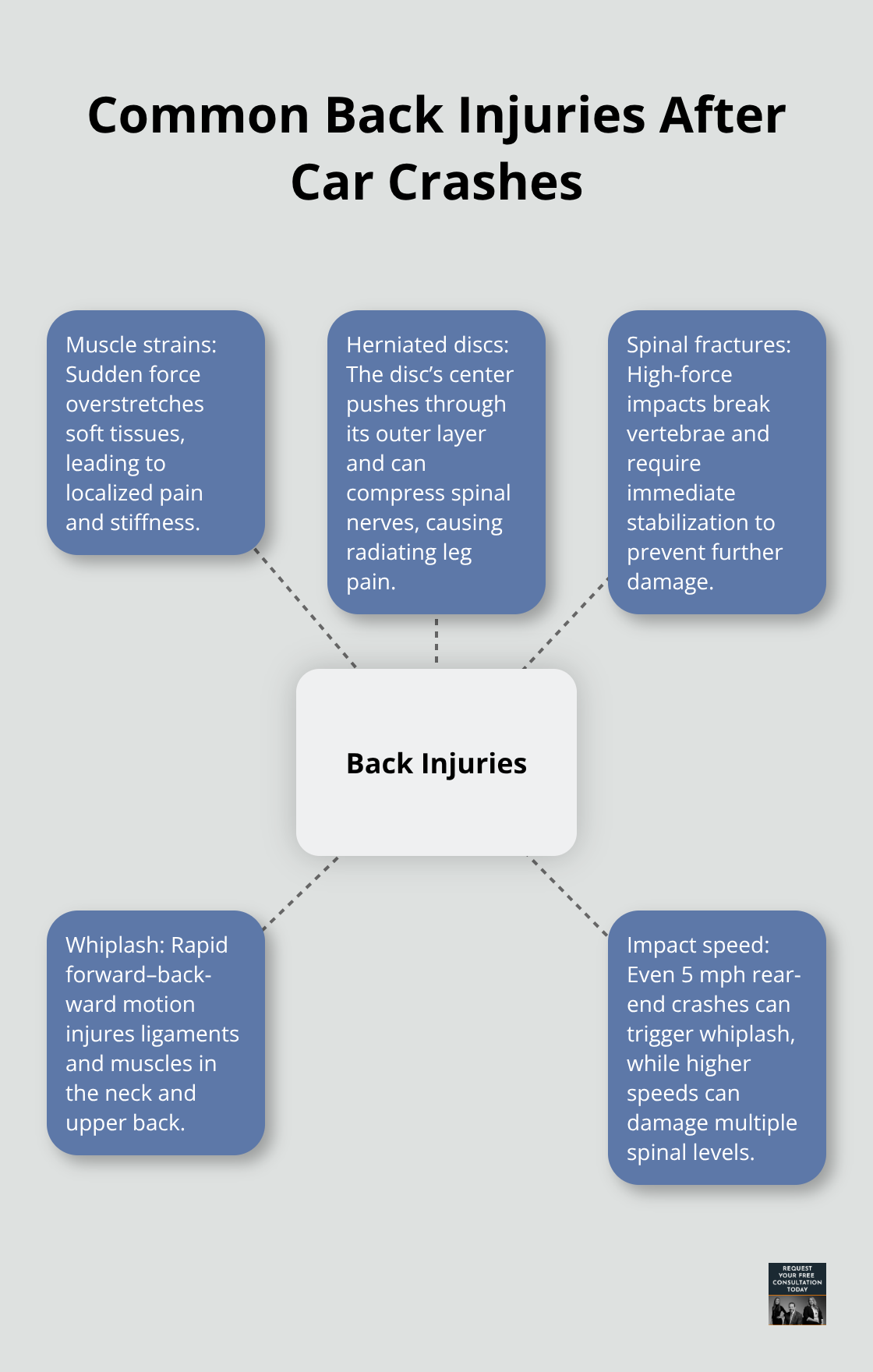
Whiplash injuries affect the neck and upper back when your head snaps forward and backward rapidly, damaging ligaments and muscles. A rear-end collision at just 5 mph can trigger whiplash, while high-speed impacts create more extensive damage across multiple spinal levels.
Recognizing Immediate vs. Delayed Symptoms
Your symptoms after a crash may feel minor initially but worsen over days or weeks as inflammation develops. Immediate pain at the injury site, stiffness, or reduced movement often appear within hours. Long-term complications emerge later: nerve damage causes numbness, tingling, or weakness in your legs; chronic pain persists for months or years; reduced mobility limits your ability to work and perform daily activities. Adrenaline masks pain immediately after the crash, which is why seeking medical evaluation within 48 hours matters significantly. Diagnostic imaging like MRI or CT scans creates the medical documentation insurers require to validate your claim.
Settlement Values Reflect Injury Severity
The difference between your initial symptoms and final diagnosis determines your compensation significantly. Soft tissue injuries average $10,000 to $50,000, while herniated discs without surgery range from $50,000 to $100,000. Cases requiring surgery climb to $100,000 to $150,000 or higher. Spinal cord injuries settle for $500,000 and above due to permanent disability and lifelong care needs. These figures show why thorough medical documentation and proper diagnosis establish the foundation for fair compensation. Understanding your injury category helps you anticipate what recovery and legal claims may involve moving forward.
Getting the Right Medical Care After Your Back Injury
Seeking immediate medical attention after a car crash is non-negotiable, regardless of whether you feel pain. Adrenaline suppresses pain signals for hours or even days, which means a seemingly minor impact can mask serious spinal damage. Head to an emergency room or urgent care within 24 hours of your accident, even if symptoms feel manageable. The physician will perform a physical examination, assess your range of motion, and order diagnostic imaging. MRI scans cost between $1,000 and $3,000 but provide detailed images of soft tissue damage, herniated discs, and nerve compression. CT scans run $500 to $2,000 and excel at detecting fractures. X-rays cost $100 to $300 and serve as the initial screening tool. This medical documentation becomes your foundation for insurance claims and compensation calculations. Without it, insurers have no obligation to acknowledge your injury or pay damages.
Conservative Treatment Works for Most Cases
Most back injuries from car crashes resolve with physical therapy, anti-inflammatory medications, and activity modification within three to six months. Physical therapists design exercises that rebuild strength and flexibility without aggravating the injury. You’ll attend sessions two to three times weekly, typically for eight to twelve weeks. Heat therapy, ice application, and epidural steroid injections reduce inflammation and pain, allowing you to participate in rehabilitation. Chiropractors offer spinal manipulation, though results vary-some patients report relief while others see minimal improvement. If you choose chiropractic care, coordinate with your primary physician to avoid conflicting treatments. Conservative approaches cost significantly less than surgery and carry fewer risks, which is why doctors recommend them first. Track your progress through treatment with detailed notes about pain levels, mobility improvements, and missed work days, as this documentation strengthens your compensation claim.
Surgery Becomes Necessary for Severe Cases
Herniated discs causing persistent nerve damage, spinal fractures, or conditions limiting your ability to function warrant surgical intervention. Microdiscectomy, the most common procedure, removes the damaged disc material pressing on nerves and costs $15,000 to $50,000 depending on complexity and location. Spinal fusion surgery, which joins two or more vertebrae together, runs $50,000 to $150,000 and involves longer recovery periods of three to six months before returning to normal activities. Recovery from surgery demands strict adherence to post-operative protocols: no heavy lifting for six to twelve weeks, limited bending or twisting, and gradual return to work as cleared by your surgeon. Surgical cases typically settle for substantially higher amounts than conservative treatment cases because they demonstrate severe injury and extended disability. Document every surgical expense, follow-up appointment, and rehabilitation session meticulously, as these records directly influence your final settlement value.
Building Your Medical Record for Compensation
Every medical visit, test result, and treatment note creates evidence that insurers use to calculate your settlement. Maintain a file with imaging reports, physician notes, physical therapy progress reports, and surgical records if applicable. Photograph visible injuries and keep a pain journal that tracks daily symptoms, medication use, and activity limitations. This detailed record (combined with police reports and accident scene photos) establishes the link between the crash and your injury. When you file a claim, insurers scrutinize medical records to determine what they’ll pay. Gaps in treatment or missing documentation give them reasons to deny or reduce your settlement. The stronger your medical evidence, the higher your compensation typically becomes. Once your medical treatment stabilizes and you understand the full scope of your injury, the next step involves calculating what your case is actually worth and navigating the claims process.
What Your Back Injury Case Is Actually Worth
Building Your Damage Calculation
Your settlement rests on concrete numbers tied directly to your injury, treatment, and lost income. Medical expenses form the foundation: every MRI, CT scan, physical therapy session, and surgical procedure gets tallied with actual receipts. If your herniated disc required microdiscectomy costing $30,000, that $30,000 enters your damage calculation immediately. Lost wages are equally straightforward-multiply your hourly rate or salary by the exact days you missed work or couldn’t perform your job duties. A construction worker earning $25 per hour who missed eight weeks of work due to post-surgery restrictions claims $4,000 in lost wages alone.
Quantifying Pain and Suffering
Pain and suffering damages reflect the emotional burden: anxiety about permanent disability, depression from chronic pain, or PTSD from the crash itself. These non-economic damages typically range from one to five times your medical expenses, depending on injury severity and state law. An Uber driver with a herniated disc facing permanent back problems and unable to return to driving might justify pain and suffering damages of $150,000 when medical costs total $75,000. Reduced earning capacity applies when your injury prevents you from returning to your previous profession-a nurse with spinal fusion who can no longer work twelve-hour shifts may recover compensation for decades of reduced income.
Documenting Everything for Maximum Value
The key is documenting everything: medical invoices, pay stubs, employment letters confirming missed work, and detailed records of how the injury disrupted your daily life. This documentation transforms abstract claims into measurable losses that insurers must acknowledge and address.
Negotiating With Insurance Companies
Insurers calculate settlements conservatively, offering 30 to 50 percent less than your case’s actual value in initial proposals. When you submit a claim, the insurance adjuster reviews your medical records, police report, and liability evidence to determine their opening offer. Most back injury cases resolve within 12 to 18 months, though complex cases involving surgery or permanent disability extend longer. You hold significant leverage: insurers know that taking your case to trial costs them money in legal fees and court expenses, making settlement attractive. Many accident victims accept the first settlement offer without realizing they’ve left substantial compensation on the table-a mistake that costs them tens of thousands of dollars.
Protecting Your Rights With Legal Representation
Statutes of limitations in California create urgency: you have two years from the accident date to file a personal injury claim, and waiting beyond that deadline forfeits your right to compensation entirely. Having legal representation from the start protects your claim because we at Schaar & Silva LLP ensure all evidence is preserved, deadlines are met, and your medical documentation supports maximum damages rather than the minimal amount an insurer might initially offer. Our years of experience in personal injury law mean we understand exactly what insurers will accept and where they’ll push back.
Final Thoughts
A back injury from a car crash demands immediate action on two fronts: medical recovery and legal protection. You have two years from the accident date to file a personal injury claim in California, and missing that deadline eliminates your right to compensation permanently. Within the first 48 hours, seek medical evaluation even if pain feels minimal, since adrenaline masks serious spinal damage.
Your settlement value depends entirely on what you can prove through medical records, diagnostic imaging, treatment progress, and documentation of missed work days. Soft tissue injuries settle for $10,000 to $50,000, while herniated discs requiring surgery reach $100,000 to $150,000 or higher, and spinal cord injuries command $500,000 and above due to permanent disability. Many accident victims accept initial settlement offers without realizing they’ve left tens of thousands of dollars on the table.
We at Schaar & Silva LLP help accident victims in Santa Cruz County, Sacramento, and Oakland navigate back injury car crash claims from start to finish. Our team connects you with lien services that manage medical expenses, evaluates property damage claims fairly, and understands exactly what insurers will accept during negotiations. Contact us for a free case evaluation with no upfront costs or legal fees-you pay nothing unless we win your case.
