
California comparative negligence rules can significantly reduce your compensation after an auto accident, even if you weren’t entirely at fault. Understanding how fault is calculated and how it affects your claim is essential for protecting your rights.
We at Schaar & Silva LLP help accident victims navigate these complex rules and fight back against unfair fault assessments. This guide breaks down how comparative negligence works and what you need to do to strengthen your case.
How Fault Gets Calculated After Your Accident
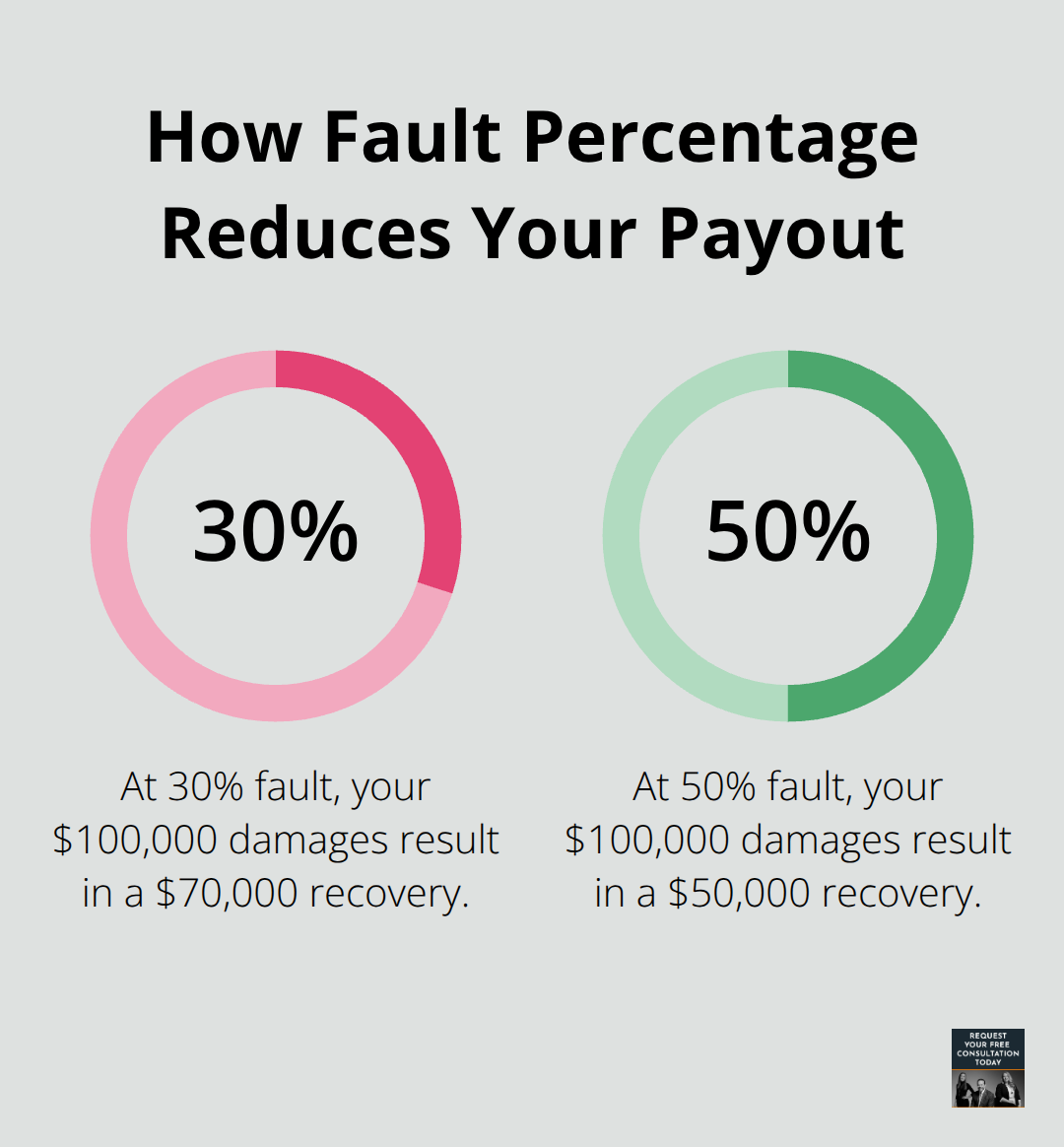
California’s pure comparative negligence rule means you can recover damages even if you caused part of the accident. Unlike states that bar recovery if you’re more than 50% at fault, California allows any level of fault to reduce your payout proportionally. If total damages equal $100,000 and you’re 30% at fault, you receive $70,000. If you’re 50% at fault, you get $50,000.
This framework, established under California Civil Code Section 3333.3, shifts the entire burden of proof onto insurance adjusters and defendants to prove your fault percentage. The problem is that insurance companies actively work to assign you as much fault as possible at the accident scene, knowing that even small increases in your fault percentage mean thousands of dollars in their favor. A shift from 20% to 30% fault on a $500,000 claim costs you $50,000 in recovery.
What Evidence Controls Your Fault Percentage
Police reports, dashcam footage, vehicle damage patterns, electronic data from your car, witness statements, and traffic law violations all factor into fault determination. Police reports carry significant weight but contain errors regularly; reviewing yours within 48 hours and correcting inaccuracies can shift fault allocation meaningfully. Dashcam footage and electronic data recorders provide objective evidence that counters subjective blame-shifting from the other driver or their insurer.
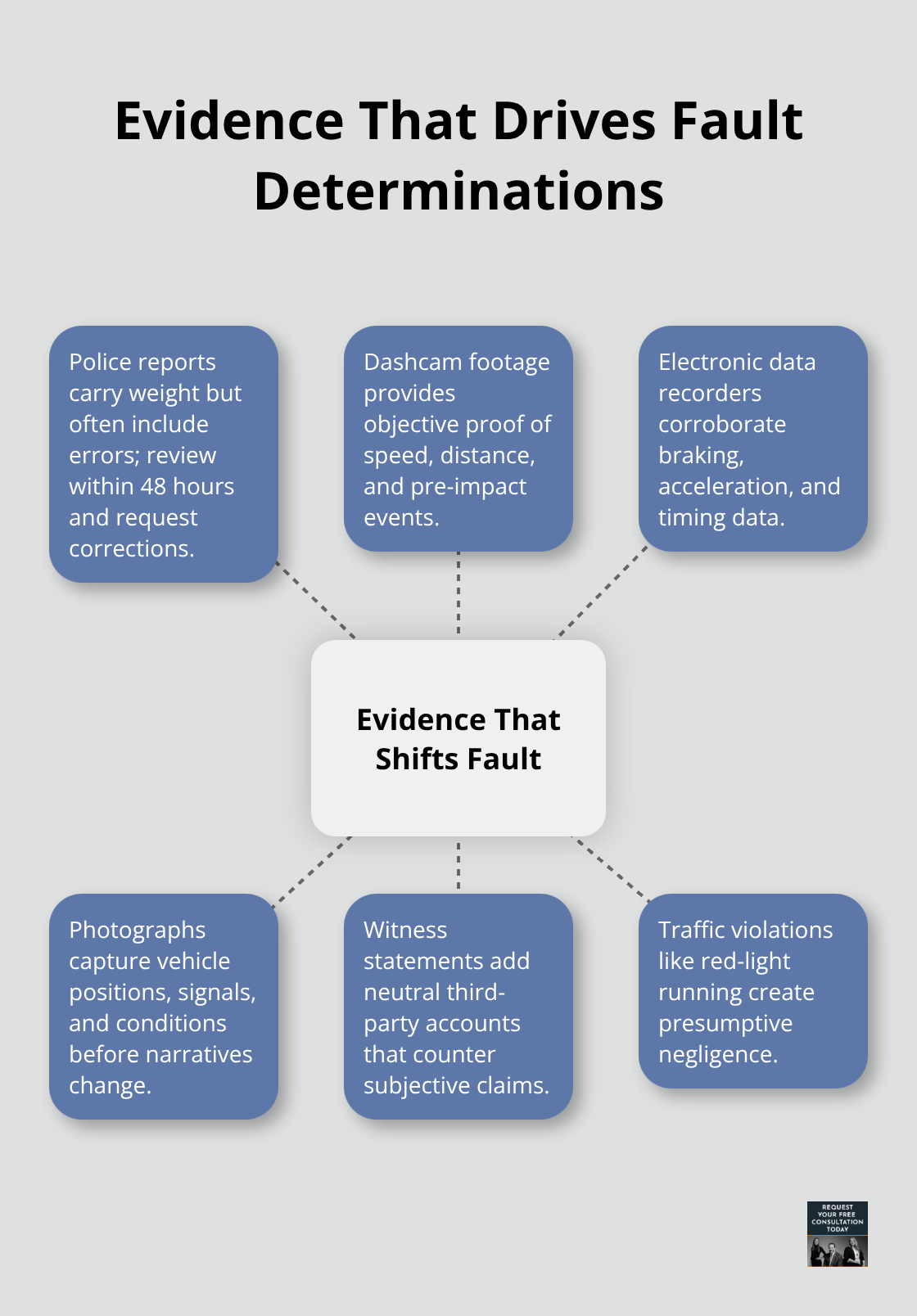
Photographs taken at the scene showing vehicle positions, road conditions, and traffic signals document the accident’s circumstances before adjusters reinterpret them. Witness statements matter tremendously because third parties have no financial stake in the outcome, unlike the at-fault driver. Traffic violations create presumptive negligence; if the other driver ran a red light or violated hours-of-service rules (critical in truck accidents), that establishes fault more directly than accident reconstruction alone.
How Adjusters Manipulate Fault Assessments
Adjusters understand that most accident victims don’t know California’s comparative negligence framework and accept fault assessments without challenge. They count on you admitting fault at the scene, apologizing, or making statements that sound like acceptance of responsibility. These admissions become ammunition in settlement negotiations. Insurance companies also know that many victims lack dashcam footage or electronic evidence, making it their word against yours. When evidence is absent, adjusters win by default. The strategy is simple: assign maximum fault to you, offer a low settlement based on reduced damages, and hope you accept before consulting legal counsel.
Building Your Defense Against Inflated Fault Claims
Strong evidence collected quickly shifts the negotiating position entirely in your favor. Gather evidence immediately at the scene-take multiple-angle photos, note road conditions, collect witness contact information, and identify nearby cameras with addresses for footage recovery. Obtain the police report within 48 hours and review it for inaccuracies that could shift fault. In truck accidents, preserve electronic data through formal preservation letters to protect ELD records and maintenance logs. Do not admit fault or apologize at the scene; stick to factual descriptions of what happened and observed movements. Back up dashcam footage to cloud storage immediately to prevent loss or tampering.
The evidence you collect in the first 48 hours determines whether you fight from a position of strength or weakness in settlement negotiations.
Rear-End, Left Turn, and Multi-Vehicle Accidents Under California’s Rules
Rear-End Collisions: Why Fault Isn’t Always Clear-Cut
Rear-end collisions appear straightforward on paper, but California’s comparative negligence rules often complicate what seems obvious. The driver who hits from behind is not automatically 100% at fault. If you were struck from behind and your brake lights were inoperative, or if you stopped suddenly without signaling, you could share liability. Insurance adjusters exploit this aggressively. They argue you braked without cause, that your vehicle had mechanical defects, or that you failed to maintain proper following distance in reverse. The reality is that rear-end cases hinge on evidence: dashcam footage showing the other driver’s speed and distance, your vehicle’s brake light condition at impact, and witness accounts of what happened before contact. A dashcam recording that captures the other vehicle approaching at highway speed with minimal braking distance puts you in a strong negotiating position. Without it, adjusters will claim you created the hazard.
Left Turn Accidents: Shared Fault More Common Than You Think
Left turn accidents split fault more evenly than most people expect. If you turned left across oncoming traffic and were hit, California law does not automatically assign you majority fault. The oncoming driver’s speed, visibility conditions, and whether they had time to avoid you all matter. Many left turn cases result in 50-50 or 60-40 splits. Adjusters often claim that turning drivers bear inherent fault, but that ignores whether the other driver was speeding, distracted, or running a red light. Photographs showing sight lines, road geometry, and traffic signal timing become critical. These details shift the entire fault calculation in your favor.
Multi-Vehicle Accidents: Complexity Multiplies Liability
Multi-vehicle accidents introduce exponential complexity because fault must be distributed among three or more parties. A five-car pileup on Highway 17 might assign 10% fault to the first driver who braked suddenly, 35% to the second driver who failed to maintain safe distance, 40% to the third driver who was texting, and 15% to the fourth driver who swerved without signaling. Each party’s recovery shrinks based on their individual percentage. Gathering evidence becomes harder because you compete for witness statements and scene documentation with multiple other victims. Preserve electronic data immediately: obtain dashcam footage from nearby vehicles if possible, request traffic camera footage from the California Department of Transportation, and photograph vehicle positions before they move. Insurance companies attempt to assign you disproportionate fault in multi-vehicle scenarios because liability appears murky. Strong documentation counters this strategy decisively and protects your recovery when multiple parties share responsibility for the crash.
Protecting Your Claim Under Comparative Negligence
Act Fast to Control the Narrative
The first 48 hours after an accident determine whether you negotiate from strength or weakness. Adjusters arrive at accident scenes with one goal: assign maximum fault to you and minimize their company’s payout. You counter this by collecting evidence before the narrative hardens. Photograph vehicle positions, road conditions, traffic signals, and debris patterns from multiple angles. Obtain dashcam footage immediately and back it to cloud storage to prevent loss or tampering.
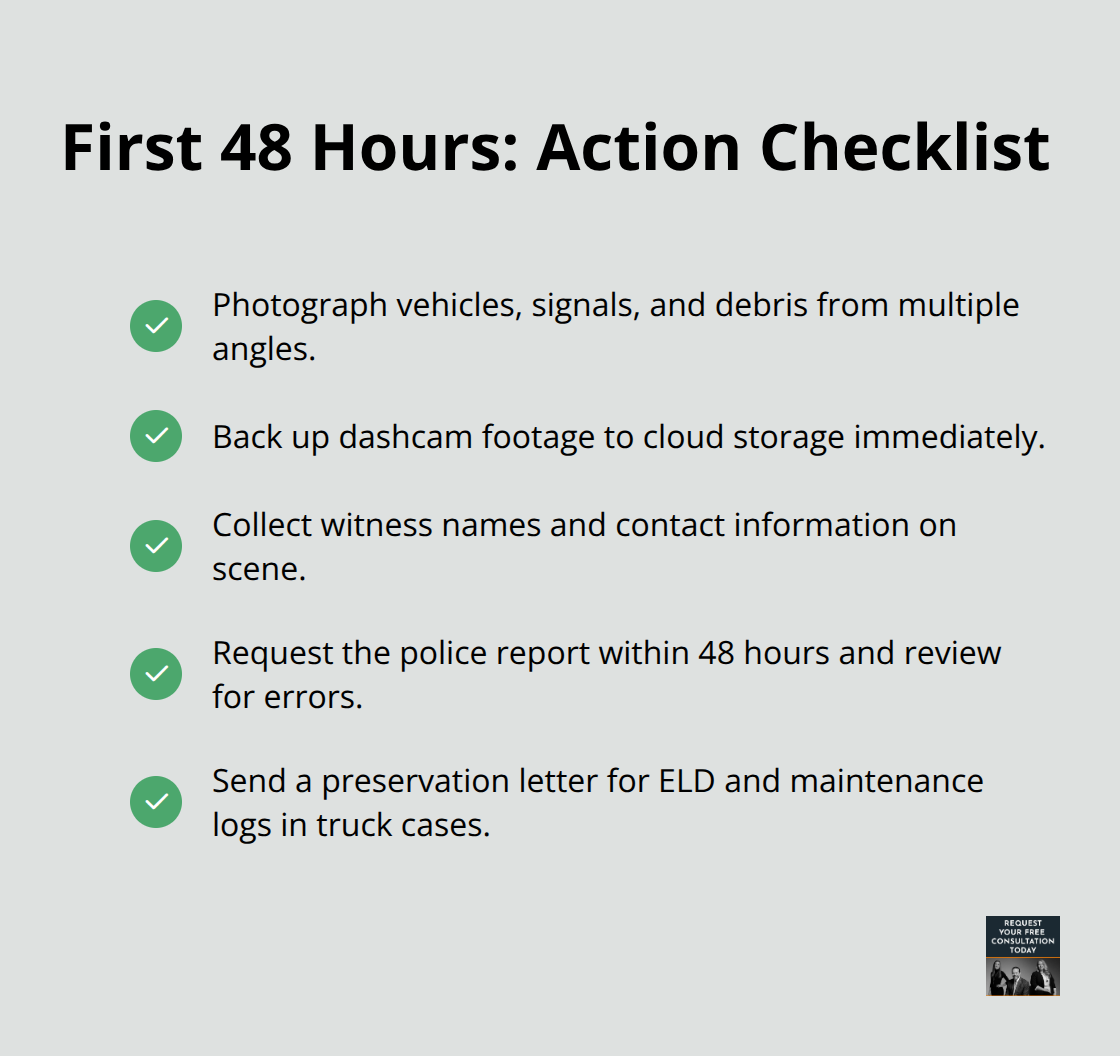
Collect witness contact information while people remain at the scene; their statements carry weight because they have no financial stake in the outcome. Request the police report within 48 hours and review it for errors that could inflate your fault percentage. For truck accidents, send a formal preservation letter to the carrier to protect electronic logging device records and maintenance logs.
Control What You Say at the Scene
Do not admit fault or apologize at the scene. Stick to factual descriptions of what you observed and what happened. Insurance adjusters weaponize admissions and statements that sound like acceptance of responsibility during settlement negotiations. Even saying you’re sorry can be twisted into an admission. When the adjuster calls to discuss the claim, provide only basic facts and decline to discuss fault percentage without legal counsel present. Your words at the scene become permanent ammunition in their settlement strategy.
Challenge Adjusters on Their Fault Calculations
Working with adjusters requires understanding their tactics and holding firm on evidence rather than accepting their initial fault assessment. Adjusters craft fault narratives at the scene and in their preliminary reports, knowing most accident victims lack confidence challenging their conclusions. If an adjuster assigns you 40% fault without presenting evidence, request the specific factors supporting that percentage in writing. Ask them to explain how dashcam footage, witness statements, or vehicle damage patterns support their assessment. Many adjusters cannot articulate their reasoning when pressed because it relies on assumptions rather than objective evidence.
Small fault shifts create substantial payment differences: moving from 25% to 35% fault on a $200,000 claim costs you $20,000 in recovery. Counter their arguments with your evidence. A dashcam recording showing the other vehicle approaching at excessive speed with minimal braking distance shifts negotiating leverage entirely in your favor. Police reports showing the other driver violated traffic laws create presumptive negligence that strengthens your position.
Get Professional Support for Your Case
When you work with an attorney, they identify where adjusters overreach on fault allocation and present evidence that contradicts their narratives. Legal representation also handles medical bill assistance and property damage claims so you focus on recovery while the legal complexities receive proper attention. Building your case against comparative negligence arguments requires systematic documentation and refusal to accept inflated fault percentages without challenge.
Final Thoughts
California comparative negligence rules create a path to recovery even when you share fault for an accident, but only if you act strategically from the moment of impact. The framework under California Civil Code Section 3333.3 protects your right to compensation, yet insurance adjusters count on your uncertainty to assign inflated fault percentages that reduce your payout. Every percentage point matters financially-moving from 25% to 35% fault on a $200,000 claim costs you $20,000 in recovery, which is why challenging their initial assessments with solid evidence determines your outcome.
The evidence you gather in the first 48 hours shapes your entire negotiation position. Dashcam footage, police reports, witness statements, and photographs of vehicle positions and road conditions provide objective proof that counters subjective blame-shifting from adjusters. Without this documentation, adjusters operate from a position of strength, but with it, you shift leverage entirely in your favor.
When you work with an attorney at Schaar & Silva LLP, they identify where adjusters overreach on fault allocation and present evidence that contradicts their narratives. We handle medical bill assistance and property damage claims so you focus on recovery while the legal complexities receive proper attention. Contact us for a free case review to understand your fault share and potential recovery.
