

After a car accident, medical bills pile up fast. Many people don’t realize that medical providers can place liens on their settlement to get paid directly, which protects your right to treatment while you recover.
At Schaar & Silva LLP, we help clients navigate auto accident lien services so they understand how these agreements work and what they mean for their claim. This guide breaks down everything you need to know about medical liens and how professional help can protect your recovery.
Understanding Medical Liens and How They Work
What Medical Liens Are
A medical lien is a legal claim that a healthcare provider places on your personal injury settlement to recover the cost of treatment related to your accident. When you’re injured in a car accident and lack sufficient insurance coverage, hospitals and medical providers agree to treat you immediately without payment, but they secure a lien against your future settlement as collateral. This arrangement protects providers who face real financial risk: they deliver care upfront while waiting months or years for payment through your settlement. The lien doesn’t require you to pay out of pocket during your recovery, which matters since accident victims often face gaps in coverage.
Two Main Types of Liens in California
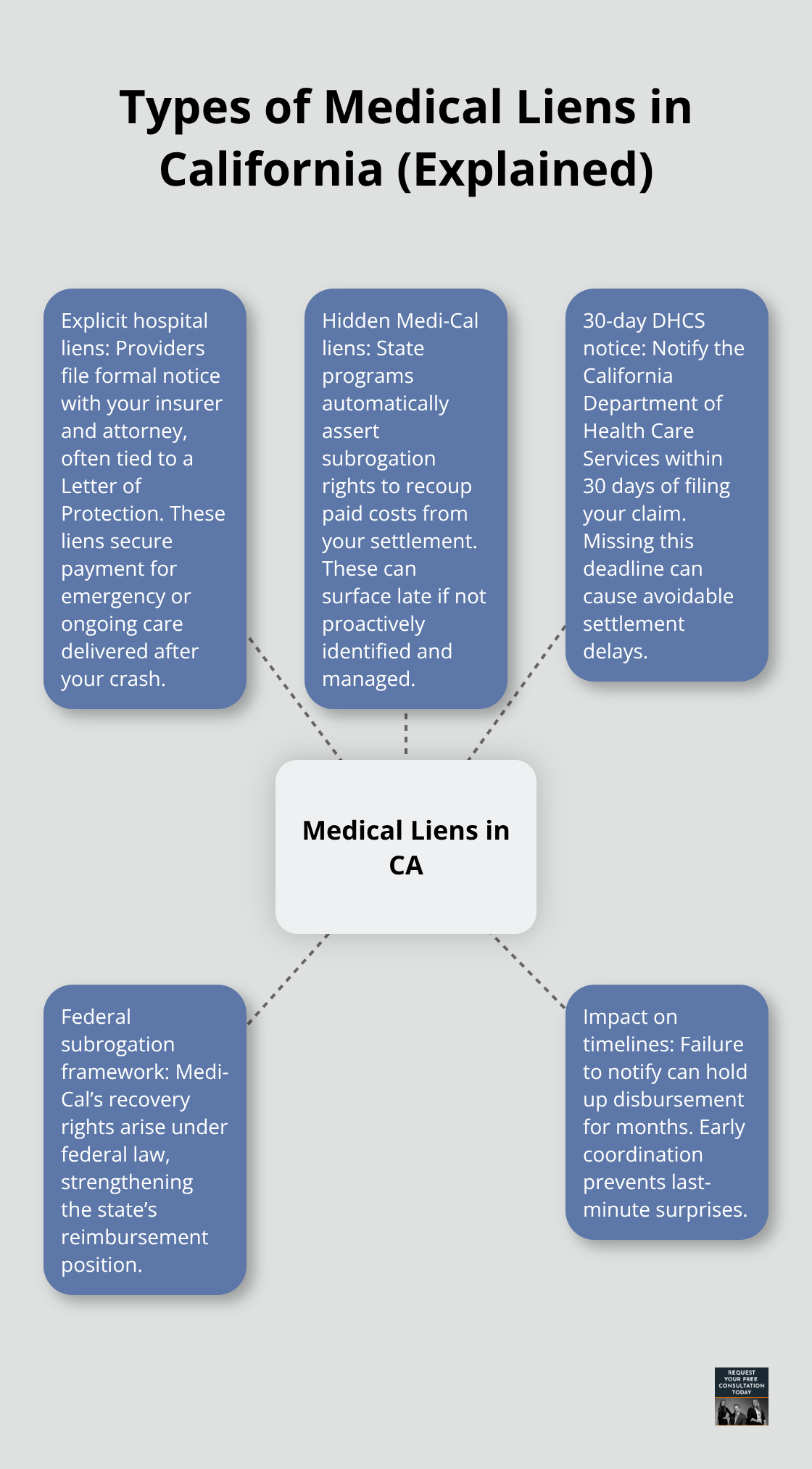
California law recognizes two main types of liens. Explicit liens come from hospitals that provide emergency or ongoing care and file formal notice with your insurance company and attorney, documented through what’s called a Letter of Protection. Hidden liens emerge from government programs like Medi-Cal, which covers over 13 million Californians and automatically holds subrogation rights to recover its paid medical costs from your settlement under federal law. Medi-Cal specifically requires notification to the California Department of Health Care Services within 30 days of filing your claim, and failure to notify can delay settlement for months while the state establishes its lien position.
How Lien Services Manage Your Medical Debt
Professional lien services handle the heavy lifting of managing these agreements so you aren’t caught off guard at settlement. When your case resolves, lien companies coordinate with providers to obtain their final bills, verify that charges connect to your accident injuries, and identify opportunities to reduce amounts owed. California law limits certain liens under Civil Code Section 3040, capping hospital lien recovery at the lesser of total medical costs, one-third of your settlement if you have an attorney, or one-half without one. A skilled attorney negotiates these reductions aggressively because every dollar paid to a lien is a dollar you don’t receive.
Negotiating Liens Protects Your Net Recovery
Consider this scenario: your settlement reaches $60,000 and medical liens total $18,000. Negotiating that amount down to $12,000 puts an additional $6,000 in your pocket. The coordination between your attorney, lien managers, and healthcare providers determines whether your net recovery reflects fair compensation or gets consumed by medical debt. Understanding your rights under California law positions you to challenge inflated charges and protect what you’ve earned through your settlement. The next section explains how medical liens directly impact your ability to access ongoing treatment and preserve your financial recovery.
Why Medical Liens Matter for Your Recovery
Immediate Access to Treatment Without Financial Barriers
Without medical liens, accident victims face an impossible choice: delay treatment until their settlement arrives or pay thousands out of pocket while their case moves through the legal system. Medical liens eliminate this trap by allowing hospitals and providers to treat you immediately without requiring upfront payment. This matters because treatment delays after accidents directly worsen outcomes. A study from the Journal of Trauma found that patients who received immediate orthopedic care after accidents had significantly better long-term mobility compared to those who delayed treatment due to financial constraints. When you’re injured in Santa Cruz County, Sacramento, or Oakland, waiting weeks or months for settlement funds while your injuries worsen isn’t an option-liens ensure you get care when you need it most.
How California Law Protects Your Settlement
The real power of liens emerges when your case settles. California law caps how much providers can recover through liens under Civil Code Section 3040, which limits hospital lien recovery to the lesser of your total medical costs, one-third of your settlement with an attorney, or one-half without one. This legal protection prevents providers from consuming your entire recovery. If your settlement reaches $50,000 and medical providers bill $20,000, California law typically limits their recovery to roughly $16,667 (one-third of your settlement), leaving you $33,333 before attorney fees and costs. However, this protection only works if someone actively manages the liens on your behalf.
Managing Medi-Cal Liens and State Timelines
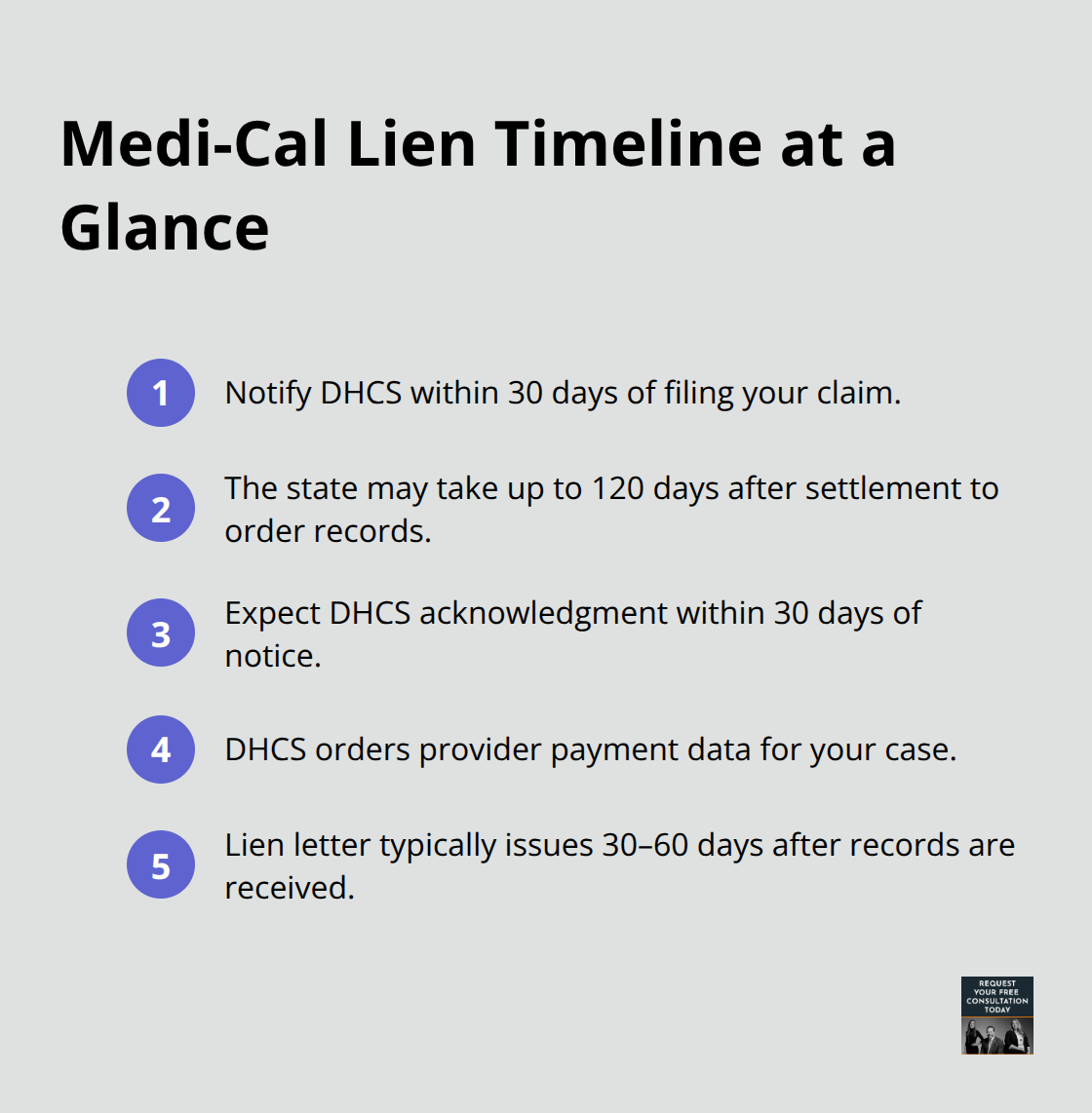
Medi-Cal liens present additional complexity-Medi-Cal covers over 13 million Californians, and the state automatically holds subrogation rights to recover its paid costs. Medi-Cal requires notification within 30 days of filing your claim, and the state can take up to 120 days from your settlement date before ordering payment records to establish its final lien amount. Without proper coordination, Medi-Cal liens can delay your settlement disbursement for months while the state reviews records. The state’s process involves multiple steps: DHCS acknowledges your notification within 30 days, orders payment data from your healthcare providers, and then reviews that data to create a lien letter (typically 30–60 days after receiving records).
Each delay compounds, which is why proactive notification and tracking matter significantly for your timeline.
Negotiating Reductions to Maximize Your Net Recovery
Consider this scenario: your settlement reaches $60,000 and medical liens total $18,000. Negotiating that amount down to $12,000 puts an additional $6,000 in your pocket. The coordination between your attorney, lien managers, and healthcare providers determines whether your net recovery reflects fair compensation or gets consumed by medical debt. Understanding your rights under California law positions you to challenge inflated charges and protect what you’ve earned through your settlement. At Schaar & Silva LLP, we direct clients to medical lien services that facilitate the payment of bills until your case resolves, ensuring you understand how liens affect your final recovery. The next section explains how professional help navigates these complex agreements and protects your rights throughout the process.
How Professional Help Protects Your Lien Rights
Navigating medical liens alone puts you at a serious disadvantage. Most accident victims don’t understand California’s lien reduction rules, which means they accept inflated bills that could have been negotiated down substantially. When you work with lien services alongside your personal injury attorney, you gain access to professionals who know provider billing practices, understand state timelines, and can identify which charges actually connect to your accident injuries.
Why Lien Negotiation Matters for Your Settlement
A skilled lien negotiator reviews every medical bill line-by-line, challenges inflated charges, and uses California’s legal caps to push back on providers. If a hospital bills $15,000 for accident-related care but California law limits their recovery to one-third of your settlement, that lien negotiator leverages that cap during settlement discussions. Without this negotiation, you’d pay the full amount. The coordination between your attorney and lien services matters because your attorney handles the overall settlement strategy while lien professionals focus specifically on reducing medical debt.
Your Critical Obligations During the Lien Process
Your obligations during this process are straightforward but essential. You must notify the California Department of Health Care Services within 30 days if you’re receiving Medi-Cal benefits (which covers over 13 million Californians). This notification requires your injury date, Medi-Cal ID, and details about the liable party’s insurance. Failing to notify DHCS within this window delays your settlement significantly because the state won’t process its lien until it receives formal notice.
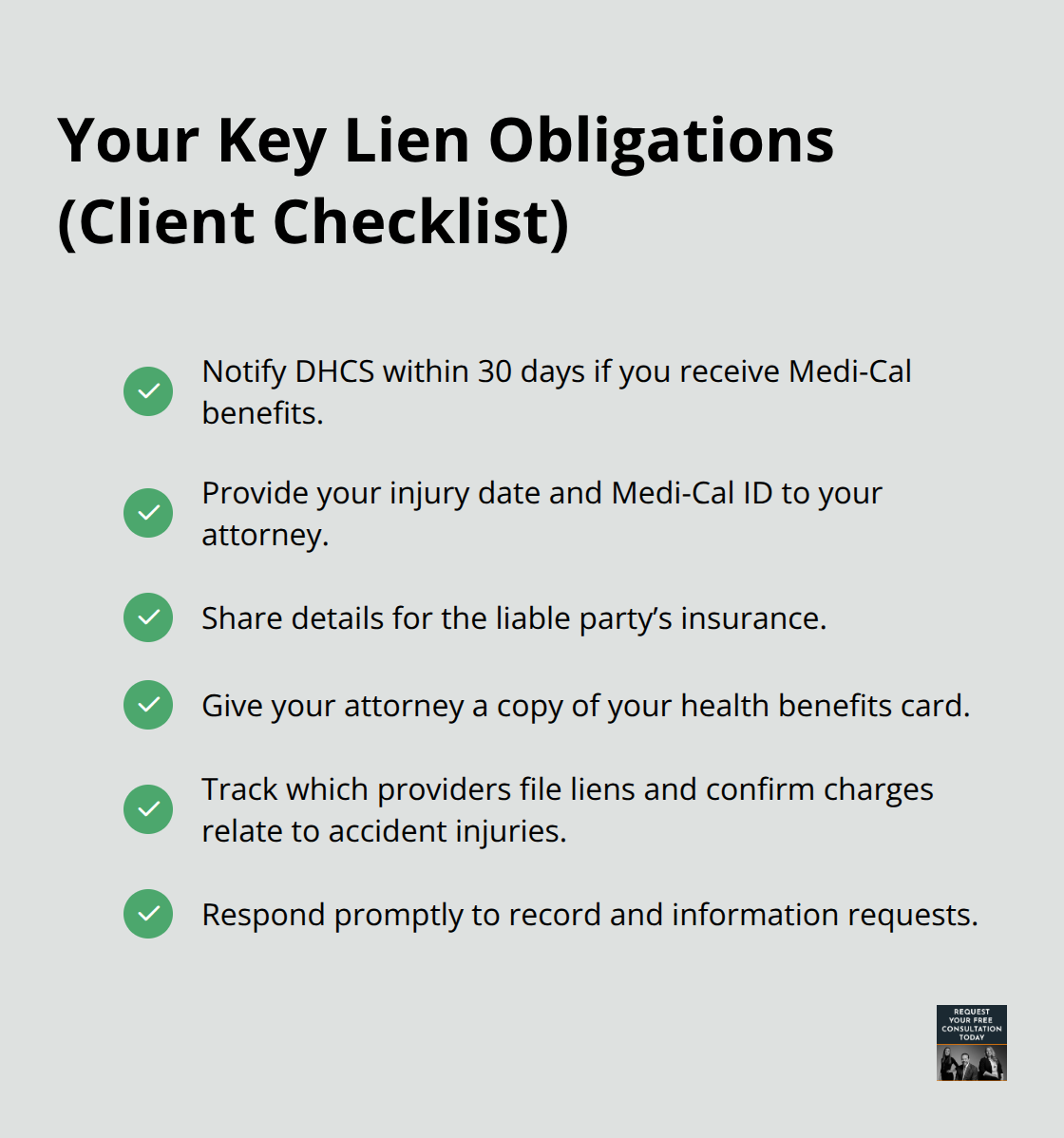
You also need to gather your health benefits card and provide copies to your attorney so they can identify all potential lien sources, including your own auto insurance, government programs, and hospital providers. As treatment progresses, your lien services team tracks which providers file liens and verifies that each charge relates directly to accident injuries rather than pre-existing conditions.
How Settlement and Lien Reduction Work
When your case settles, lien services obtain final billing records from providers, confirm the amounts owed, and present reduction proposals based on California Civil Code Section 3040. Your role involves responding promptly to requests for medical records or insurance information and authorizing your attorney to negotiate on your behalf. The entire process typically takes 30 to 60 days once settlement funds are available, but this timeline depends on how quickly providers respond to billing record requests and how aggressively your attorney negotiates reductions.
At Schaar & Silva LLP, we direct clients to medical lien services that facilitate payment of bills until your case resolves, ensuring you understand how liens affect your final recovery.
Final Thoughts
Medical liens protect your access to treatment after an auto accident while preserving your right to fair compensation. California law caps how much providers can recover through liens, but those protections only work if someone actively negotiates on your behalf. Without professional management, you risk accepting inflated bills that consume thousands from your settlement.
We at Schaar & Silva LLP understand that auto accident lien services require coordination across multiple parties: your attorney, healthcare providers, lien managers, and government agencies like the California Department of Health Care Services. Our role is to direct you toward lien services that handle this complexity while we manage your overall case strategy. We help you understand your obligations, such as notifying DHCS within 30 days if you receive Medi-Cal benefits, and we verify that every medical charge actually connects to your accident injuries rather than pre-existing conditions.
If you’ve been injured in a car accident in Santa Cruz County, Sacramento, or Oakland, contact Schaar & Silva LLP to discuss your accident claim and how we manage medical liens on your behalf. We’ll explain your rights under California law and show you exactly how professional lien management protects your recovery. Early coordination prevents delays and positions you to maximize your net recovery.
