
Santa Cruz beach area accidents present legal complexities that most people don’t anticipate. Crowded parking lots, coastal roads, and shifting sand create hazard layers that complicate liability and evidence gathering.
At Schaar & Silva LLP, we’ve handled dozens of these cases and seen how jurisdiction rules, multiple parties, and insurance disputes can derail fair compensation. This guide walks you through what happens after an accident and how to protect your rights.
What Makes Beach Area Accidents in Santa Cruz Uniquely Difficult
Environmental Hazards That Complicate Liability
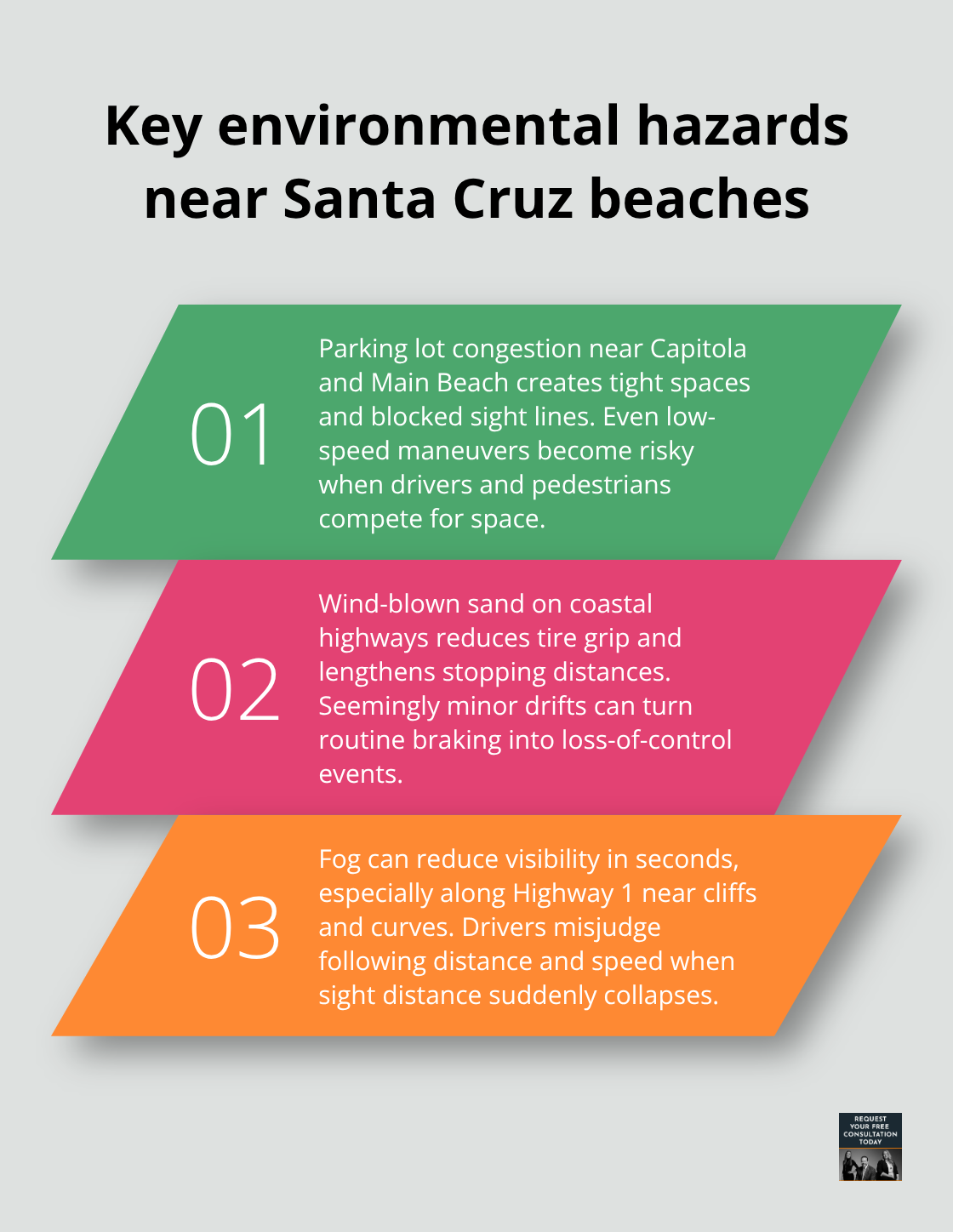
Santa Cruz’s beach environment creates accident conditions you won’t find on typical inland roads. Crowded parking lots near popular beaches like Capitola and Main Beach funnel thousands of vehicles into tight spaces during peak season, reducing visibility and increasing collision risk. Sand drifts onto coastal highways, reducing tire grip and making sudden stops harder. Fog rolls in without warning, especially near cliffs and curves on Highway 1, cutting visibility to under 50 feet in seconds.
These unique environmental factors compound liability questions because fault becomes harder to establish when weather and terrain play obvious roles. California follows comparative negligence rules, meaning even if you’re partially at fault, you can still recover damages. However, proving the other driver’s percentage of fault requires solid evidence of conditions at the time of impact, which many accident victims fail to document properly.
Documenting Environmental Conditions at the Scene
The moment after an accident, photograph the road surface, weather conditions, visibility markers, and any sand or debris. These details matter far more than most accident victims realize because insurance adjusters will scrutinize environmental factors to reduce payouts. Take photos from multiple angles to show how fog, sand, or poor road conditions affected visibility. Capture time stamps on your photos-they establish exactly when conditions existed. Weather reports from that day and hour can corroborate your scene documentation and strengthen your claim against insurers who downplay environmental impact.
Jurisdiction Complications in Coastal Areas
Jurisdiction complications add another layer of difficulty in beach areas. Accidents near Santa Cruz beaches may fall under county jurisdiction, state highway authority, or even federal lands depending on location. A collision in a parking lot at a state beach park involves different liability rules than one on a public county road or private property. Multiple parties often share responsibility (the municipality for poor road maintenance, the property owner for unsafe parking design, the other driver for negligence, and sometimes equipment manufacturers if a vehicle defect contributed).
When multiple parties are involved, insurance claims become fragmented across different policies and coverage limits. Insurance companies representing different parties will fight over who pays what, and victims often get caught in the middle. Document everything at the scene including street names, mile markers, parking lot owners, and any visible signage about jurisdiction or liability. This information helps determine which parties bear responsibility and which insurance policies apply to your claim.
Where Beach Accidents Happen Most in Santa Cruz
Parking Lot Collisions and Liability Disputes
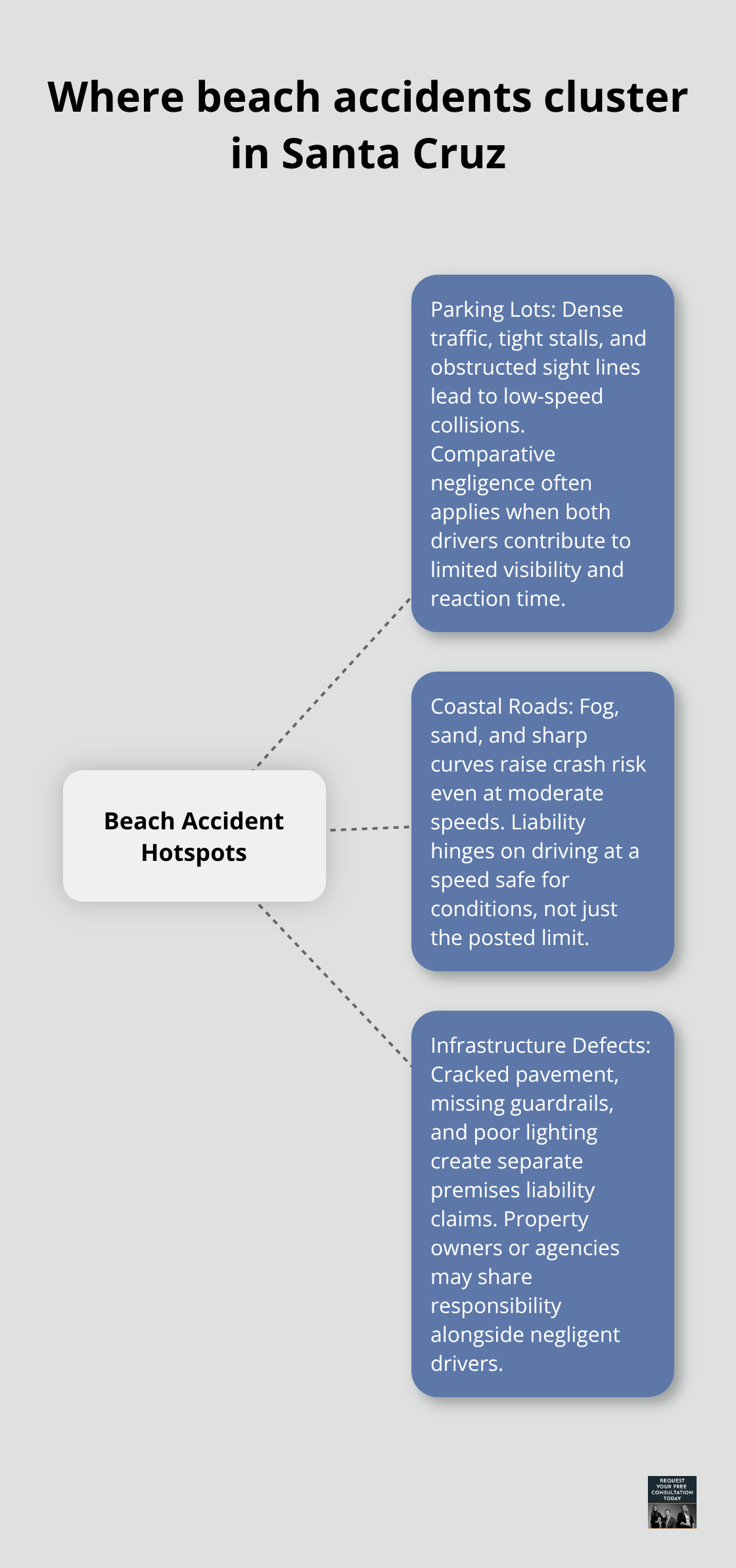
Parking lot collisions dominate Santa Cruz beach accident statistics, yet most victims underestimate their legal complexity. Peak season brings 40,000 to 50,000 daily visitors to popular beaches like Capitola and Main Beach, funneling vehicles into undersized lots where sight lines disappear behind parked cars and pedestrians dart between spaces. These collisions rarely involve high speeds, which makes them deceptively simple to insurers but legally tricky for victims. California’s comparative negligence rule means a driver backing out of a space shares fault with a driver who fails to honk or slow down, yet insurance companies weaponize this shared blame to reduce payouts. You must document the exact location within the lot, the direction each vehicle faced, pedestrian traffic patterns, and any missing or damaged sight-line markers like mirrors or painted lines.
Coastal Road Accidents and Speed-Related Liability
Coastal road accidents present a different hazard profile altogether. Highway 1 near Santa Cruz experiences fog that reduces visibility to 30–50 feet, sand accumulation that reduces braking effectiveness, and sharp curves that amplify speed-related collisions. CalTrans data shows coastal highways account for roughly 15–20% of Santa Cruz County’s serious injury crashes despite lower traffic volume than inland routes. Speed becomes a critical liability factor on these roads because drivers traveling 40 mph in heavy fog violate California Vehicle Code 21658, which requires speeds safe for conditions regardless of posted limits. You should photograph the fog density, road surface conditions, and any debris at the accident moment to establish what conditions actually existed when the collision occurred.
Infrastructure Defects and Property Owner Liability
Unsafe beach infrastructure injuries-cracked pavement in parking areas, missing guardrails on cliff-side lots, or broken lighting that creates hazard zones-create property liability claims distinct from vehicle collisions. These claims require identifying the property owner or municipality responsible for maintenance. A parking lot managed by a state parks agency carries different liability standards than privately owned beach access. You must inspect the infrastructure carefully before leaving the scene and photograph defects alongside your vehicle damage. When infrastructure failures contribute to accidents, property owners face separate liability exposure that can increase your total recovery beyond what the at-fault driver’s insurance covers.
What to Do Immediately After a Beach Accident
Move to Safety and Call for Help
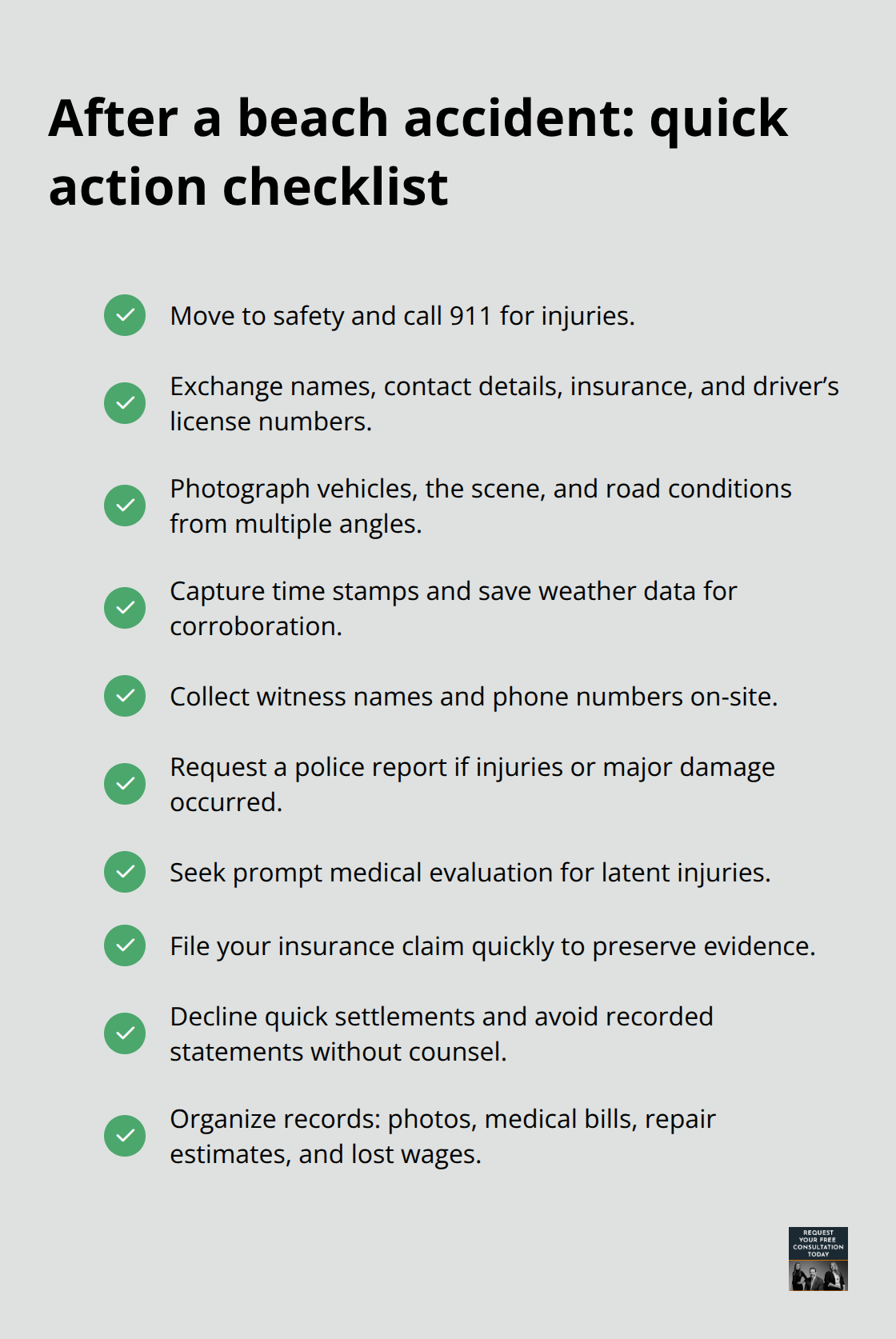
The first 30 minutes after a beach accident determine whether your claim succeeds or fails. Call 911 for injuries and move to safety if possible. California law requires you to remain at the scene and exchange information with the other driver-names, contact details, insurance information, and driver’s license numbers. Staying present protects you legally and allows you to control the narrative before memories fade or witnesses leave.
Photograph Everything at the Scene
Take photos of vehicle damage, the accident scene, road conditions, and traffic signs immediately. Time stamps on photos prove conditions at the exact moment of impact, which insurers scrutinize carefully. In parking lots, photograph the sight lines from both vehicles’ positions and any missing mirrors or painted markers that should have prevented the collision. For coastal road accidents, capture the visibility conditions, road surface quality, and any debris. Environmental documentation (fog density, sand accumulation, or water on pavement) strengthens your claim because California’s comparative negligence system requires solid evidence to prove the other driver’s percentage of fault.
Collect Witness Information and Avoid Admissions
Collect witness statements while people remain present because unbiased recollections carry significant weight with insurers. Do not admit fault at the scene-statements like “I’m sorry” can be used against you later in comparative negligence disputes. If injuries or significant property damage occurred, obtain a police report with objective documentation. Even if you feel fine, seek medical attention within a day or two because some injuries have delayed symptoms that affect claims later.
File Claims Promptly and Reject Quick Settlements
File your insurance claim promptly because delays hurt your claim and make evidence harder to locate. Do not accept quick settlement offers because they typically fall far below total damages and may waive rights to future compensation. Avoid giving recorded statements to insurers without legal guidance. Document everything thoroughly: photographs of scenes, witness contacts, medical treatments, expenses, and time off work.
For beach accidents involving infrastructure defects or multiple parties, understanding your legal options becomes essential, and professional guidance helps protect your interests against insurance company pressure.
Final Thoughts
Santa Cruz beach area accidents demand legal expertise that goes beyond standard car accident knowledge. Jurisdiction rules shift depending on whether your collision occurred in a state park lot, county road, or private property, and each location triggers different liability standards and insurance coverage limits. Insurance companies exploit these jurisdictional gaps to minimize payouts, which is why professional representation protects your interests when complexity increases.
Environmental factors like fog and sand create legitimate liability questions, yet insurers weaponize these conditions to argue comparative negligence and reduce your compensation. Multiple parties often share responsibility in beach accidents, fragmenting claims across different policies and coverage limits. Medical bills from beach accident injuries accumulate fast, especially when delayed symptoms emerge weeks later, and insurance adjusters routinely undervalue property damage claims that account for repair costs and rental expenses during recovery.
We at Schaar & Silva LLP understand how coastal accidents differ from inland collisions and help you navigate the financial and legal pressures that follow. Contact us to review your case-we serve Santa Cruz County and work on contingency, meaning you pay nothing upfront and only pay if we recover compensation for you.
