

A DUI bodily injury crash brings serious legal consequences that can reshape your life. California treats these charges far more severely than standard DUI offenses, with penalties ranging from jail time to substantial fines and license revocation.
We at Schaar & Silva LLP understand the urgency of your situation. This guide walks you through what happens after an arrest, how to build a strong defense, and what resources exist in Santa Cruz County to help you move forward.
What Makes DUI with Bodily Injury Different from a Standard DUI
The Legal Distinction Under California Law
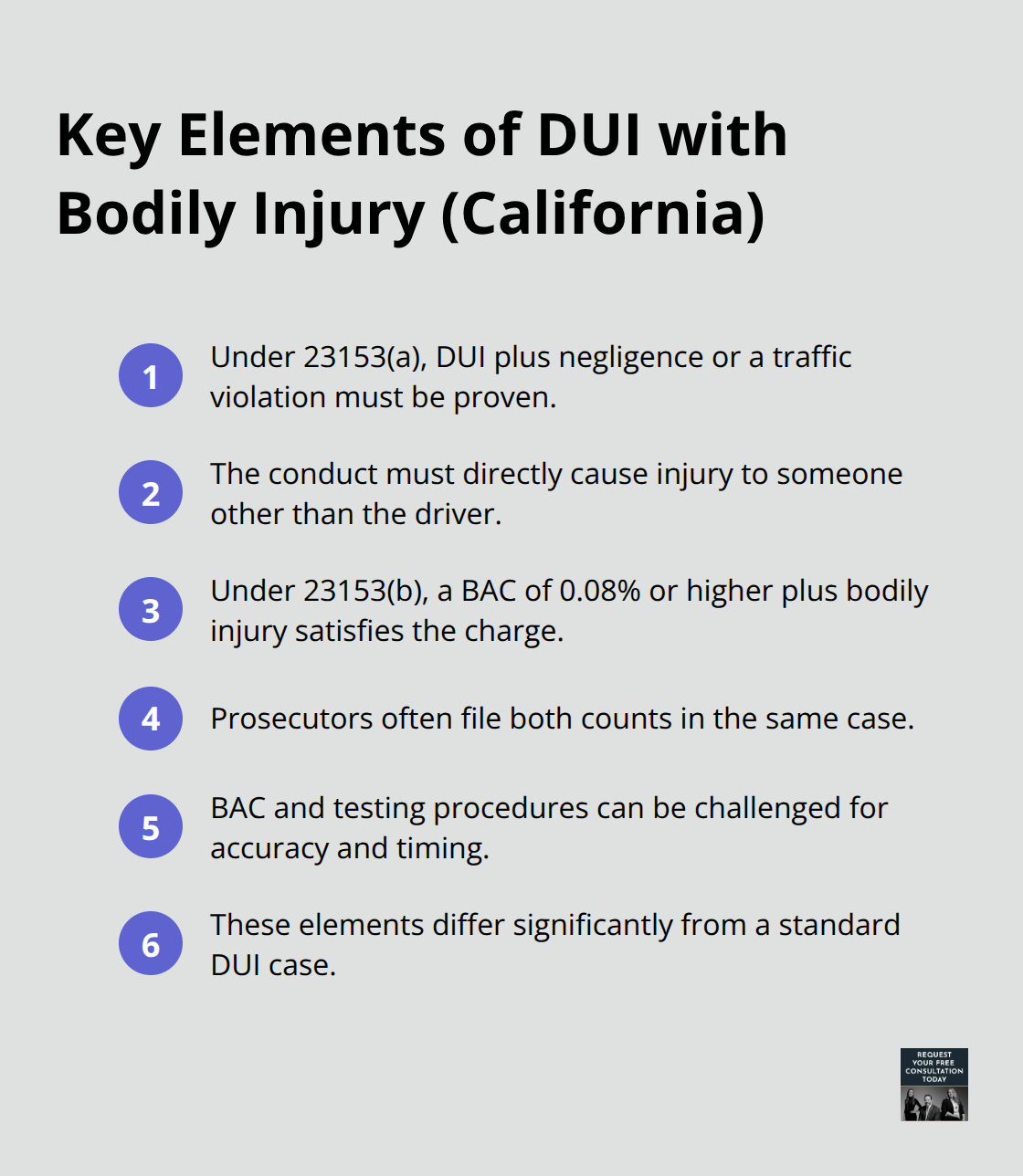
California Vehicle Code Section 23153 creates a fundamentally different offense when your DUI results in injury to another person. A standard DUI under Vehicle Code 23152 focuses solely on impaired driving, but 23153 adds a critical element: bodily injury to someone other than the driver. This distinction transforms the legal landscape entirely.
Prosecutors commonly charge two separate counts together. Count 23153(a) requires proof that you drove under the influence, acted negligently or violated a traffic law, and that this conduct directly caused injury. Count 23153(b) focuses on BAC evidence, requiring only that your blood alcohol concentration was 0.08% or higher at the time of driving and that you caused bodily injury, without needing to prove particularly reckless driving.
How the Three-Hour Rule Affects Your Case
The three-hour window matters significantly here. If your BAC was 0.08% or higher within three hours of driving, California law presumes it was at least that high while you were behind the wheel. This presumption shifts the burden substantially in the prosecution’s favor, but it is not absolute. An experienced attorney can challenge whether your BAC at the time of driving actually matched your BAC at the test.
Rising BAC presents a legitimate defense: if your BAC climbed after you stopped driving due to alcohol still absorbing into your bloodstream, you may have been under the limit while operating the vehicle. Mouth alcohol from mouthwash, cough syrup, or other sources can inflate breath test results by up to 0.02%, potentially dropping you below the 0.08% threshold. Chemical test accuracy depends entirely on proper administration, calibration, and maintenance. Breathalyzers require calibration every six months; if your arresting officer’s equipment was overdue for calibration, that test result becomes vulnerable to suppression.
Penalties That Escalate Dramatically
Unlike a standard DUI where jail time might be limited to 48 hours to six months for a first offense, bodily injury charges escalate dramatically. Misdemeanor penalties include up to one year in county jail, fines up to $5,000, license suspension, and mandatory DUI education programs. If prosecutors charge it as a felony, you face up to four years in state prison, license revocation, restitution to victims, and potential Habitual Traffic Offender designation.
Great bodily injury enhancements add consecutive prison sentences of three to six years, with an additional year for each additional injured person. The injury threshold is not high; any injury beyond minor bruising typically qualifies. Your BAC level at arrest becomes central to your case strategy.
Building Defenses Based on BAC Evidence
If your BAC registered below 0.05% at the time of testing, prosecutors must rely on non-BAC evidence like field sobriety tests, officer observations, and witness statements to prove impairment under 23153(a). This creates a viable defense pathway. If your BAC was between 0.05% and 0.08%, you still face charges under 23153(a) but have stronger arguments against 23153(b).
Blood tests demand proper chain-of-custody documentation, correct collection procedures, and expert laboratory analysis. If the blood sample was contaminated, stored improperly, or tested incorrectly, the results lose reliability. These technical defenses require immediate action.
The DMV Hearing as a Separate Battle
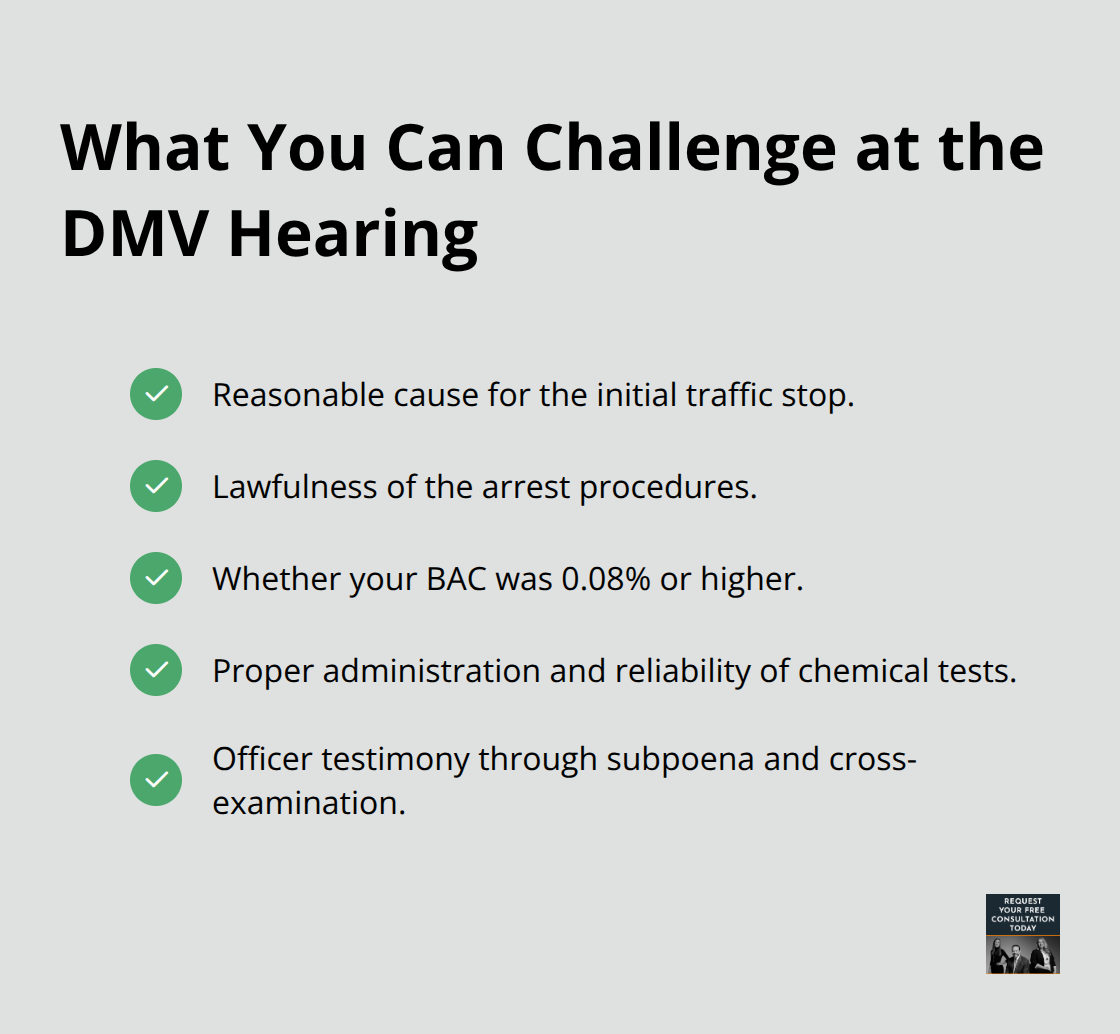
The moment you are arrested, you have ten days to request a DMV administrative hearing separate from your criminal case. This hearing determines license suspension and operates under different rules than criminal court. At the DMV hearing, the burden is lower, and you can challenge whether there was reasonable cause for the stop, lawful arrest, BAC evidence, and whether a chemical test was properly administered. A favorable DMV outcome does not guarantee criminal acquittal, but it strengthens your overall position and potentially prevents immediate license loss while your criminal case proceeds. Understanding these immediate consequences sets the stage for the next critical phase: what happens in the days and weeks following your arrest.
Immediate Consequences After a DUI Bodily Injury Arrest
The Ten-Day DMV Deadline That Changes Everything
The arrest itself triggers two completely separate legal processes running simultaneously, and you must act decisively in both or face catastrophic consequences. The moment police arrest you for DUI bodily injury, California’s DMV administrative process begins automatically. You have exactly ten days from your arrest date to request a DMV hearing, and missing this deadline means your license suspension takes effect automatically with no chance to contest it. This is not a suggestion or recommendation-it is a hard deadline that costs you your driving privileges if ignored.
What Happens at the DMV Hearing
At the DMV hearing, the hearing officer examines whether the arresting officer had reasonable cause to stop your vehicle, whether probable cause existed for arrest, and whether your BAC was 0.08% or higher. The burden of proof at this hearing is lower than criminal court, which actually works in your favor when challenging evidence. You can subpoena the arresting officer or CHP officer to testify, and you can cross-examine them about how they administered field sobriety tests or whether they followed proper procedures for breath testing. A DMV hearing victory does not erase criminal charges, but it preserves your license while the criminal case proceeds, and it provides critical evidence you can use in court later.
Bail, Release Conditions, and Your First Court Appearance
Bail or release conditions determine whether you stay in custody or go home. For DUI bodily injury charges, bail amounts typically range from $5,000 to $25,000 depending on your prior record, the severity of injuries, and your ties to Santa Cruz County. If you cannot afford bail, request a bail reduction hearing immediately; judges sometimes lower amounts when presented with employment records, family ties, and community involvement. Your first court appearance occurs within 72 hours of arrest, where the judge informs you of charges and sets bail. Subsequent appearances follow a predictable pattern: arraignment within 30 days, preliminary hearing to determine if probable cause exists, and then either plea negotiations or trial preparation. Each court date requires your presence unless your attorney obtains specific permission otherwise. Missing even one court appearance results in a bench warrant for your arrest.
How a DUI Bodily Injury Conviction Reshapes Your Life
A DUI bodily injury conviction creates a permanent criminal record that affects employment, housing, professional licensing, and immigration status. California employers conducting background checks will see this conviction permanently unless you pursue record dismissal under Penal Code Section 1203.4, which requires you to complete probation successfully and demonstrate rehabilitation. Some professions-nursing, teaching, law, security-automatically face license suspension or revocation with a DUI conviction. If you hold a commercial driver’s license, a DUI conviction means permanent disqualification from commercial driving.
The conviction also affects your ability to rent housing, as many landlords deny applications from applicants with recent DUI convictions. Immigration consequences are severe if you are not a U.S. citizen; a DUI bodily injury conviction can trigger deportation proceedings. Your insurance rates increase dramatically (typically 100 to 300 percent above pre-conviction rates for three to five years), and some insurers cancel policies entirely upon learning of a bodily injury DUI conviction.
Building Your Defense While Time Remains
The consequences extend beyond legal penalties into every aspect of your daily life, which is why fighting charges aggressively from the moment of arrest matters enormously. The evidence gathering phase happens immediately after arrest-police reports, witness statements, surveillance footage, and chemical test documentation all become available through discovery. Your attorney can challenge the accuracy of breath or blood tests, examine whether proper procedures were followed during your arrest, and identify weaknesses in the prosecution’s case. Understanding car accidents resulting in death and their causes helps contextualize how bodily injury charges develop and why your defense strategy must address the specific circumstances of your accident.
How to Gather Evidence That Strengthens Your Defense
The hours immediately following your arrest determine whether your defense succeeds or fails. Police reports, witness statements, surveillance footage, and chemical test documentation all become available through discovery, but you must act fast to preserve evidence that police may not have collected.
Securing Independent Testing and Chemical Evidence
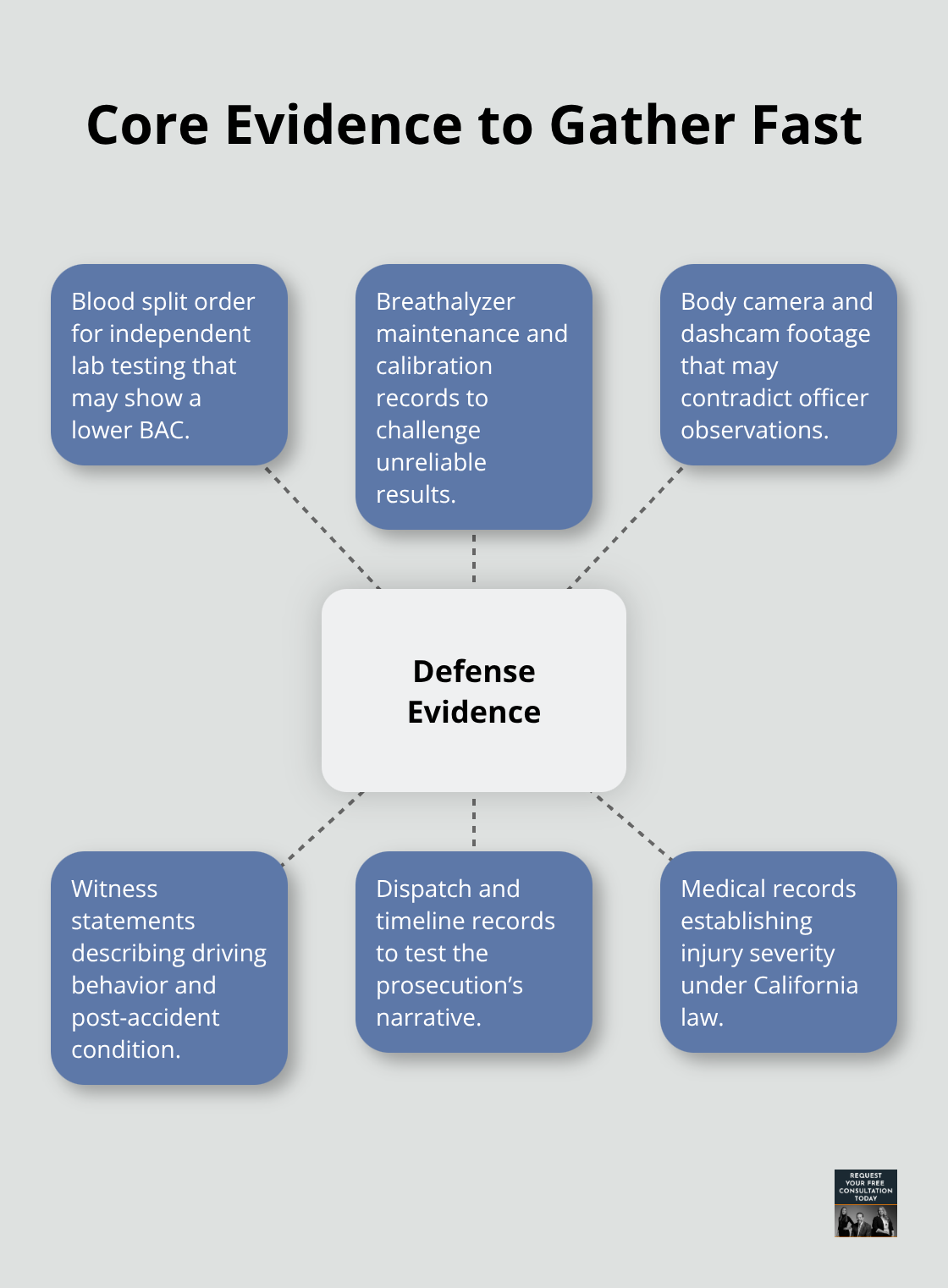
Request a blood split order within days of your arrest. This action allows an independent laboratory to test a portion of your blood sample, potentially revealing a lower BAC than the prosecution’s results. The state lab may show 0.09%, but an independent test might show 0.07%, which fundamentally changes your case. Courts in Santa Cruz County grant these orders routinely when requested promptly.
Obtain the arrest report, toxicology results, and dispatch records immediately through your attorney. Dispatch records reveal exactly when officers received the call, what they observed, and whether their timeline matches the prosecution’s theory. Obtain maintenance records for the breathalyzer used during your arrest; if calibration was overdue or equipment showed problems, the test result becomes unreliable.
Video Evidence and Witness Statements
Field sobriety test videos matter enormously. If the officer administered the tests improperly or your performance was actually acceptable, that footage becomes your strongest defense tool. Request all body camera and dashcam footage from the arresting agency. Many agencies in Santa Cruz County now use these cameras, and the footage often contradicts officer testimony about how you performed on sobriety tests or how you behaved during the stop.
Witness statements carry substantial weight, particularly independent witnesses who observed your driving before the accident or your condition immediately after. Identify anyone who saw you at the scene, spoke with you, or observed your vehicle’s movement leading up to the crash. Weather conditions, road hazards, vehicle defects, and the other driver’s conduct all become relevant when building your defense.
Medical Records and BAC Defense Strategies
Medical records documenting the injuries sustained establish whether bodily injury actually occurred under California’s definition; minor bruising may not qualify as bodily injury requiring felony charges. Your attorney can challenge the prosecution’s interpretation of the three-hour rule through evidence of when you actually consumed alcohol or proof that your BAC rose after you stopped driving. Mouth alcohol from mouthwash or cough syrup can inflate breath tests significantly; if you used these products before testing, that becomes a viable defense point.
Negotiation and Trial Considerations
When negotiating with prosecutors, present this evidence early and often. Prosecutors review cases constantly and make charging decisions based on evidence strength. If you can demonstrate weak BAC evidence, procedural violations during your arrest, or questions about actual bodily injury, prosecutors sometimes reduce charges from felony to misdemeanor or even to wet reckless under Vehicle Code 23103, which carries substantially lighter penalties.
Going to trial makes sense only when the evidence genuinely favors acquittal. Juries in Santa Cruz County take bodily injury seriously, and conviction rates remain high for these charges. Your attorney evaluates whether trial or negotiation better serves your interests based on the specific evidence in your case, not on general assumptions about jury behavior.
Final Thoughts
A DUI bodily injury crash punishment reshapes your life far beyond the courtroom. Employers conducting background checks will see this conviction permanently unless you complete probation and petition for record dismissal under Penal Code Section 1203.4. Professional licenses in nursing, teaching, and security face automatic suspension or revocation, while commercial driver’s licenses become permanently disqualified. Insurance rates spike 100 to 300 percent above pre-conviction levels for three to five years, and many insurers cancel policies outright.
Immigration consequences prove particularly severe if you are not a U.S. citizen, as a bodily injury DUI conviction can trigger deportation proceedings that separate you from family and community. Housing becomes difficult when landlords deny applications based on recent DUI convictions, and restitution payments to injured parties compound the financial burden alongside court fines and mandatory DUI education programs. Yet your situation is not hopeless-the evidence you gather immediately following arrest determines whether your defense succeeds.
Blood split orders, maintenance records for breathalyzers, body camera footage, and witness statements all provide pathways to challenge the prosecution’s case. Prosecutors in Santa Cruz County sometimes reduce charges from felony to misdemeanor when presented with strong evidence of procedural violations or weak BAC proof. Contact Schaar & Silva LLP for a free consultation to understand your options and take decisive action immediately after arrest.
